Transitioning from Tween to Teen in 1966

The summer before my eighth grade year, I started hanging out with nerdy high school sophomores who, rather than drinking and fornicating, behaved like tweens, tweens who could drive at night but who also did dumb stuff like chunking lit cherry bombs out of windows of moving vehicles with fireworks galore on board. I didn’t lie to my mother – my father was a distant figure, not involved with my comings and goings – I’d tell Mama I’d be riding around town with Ricky and Dave, and she’d say okay but be home by ten. I can’t remember my precise curfew, probably ten. In high school it was 11:30.

I have no memory of what we talked about on those hours-long drives, but I do remember cherry bombs exploding underwater when we’d stop at a bridge, and I remember the circuit we’d take, heading out Trolley Road to Dorchester, taking a left, then another left that took us to Ladson, skirting a subdivision called Tranquil Acres where my crush, blandly pretty, super-intelligent Laura Alexander lived with her Air Force Lt. Colonel of a father, her mother, and whatever siblings she may have had. 

We’d head back along that stretch of Hwy 78 towards Twin Oaks, or sometimes take Lincolnville Road back to our subdivision. This looping drive introduced me to a strange, incongruous world of manufactured houses with meticulously tended gardens and churches, churches, churches, tiny concrete block churches, every half-mile on both sides of the road, with exotic names rife with schism, like the Second Church of God Consecrated in Holy Blood of the Nazarene.[1]

My high school friend Ricky was the product of what some called in those days “a broken home,” and he rarely saw his father, an airline pilot who showered him with gifts whenever they did get together. His mother worked, so we could hang out at his house and listen over and over and over again to The Animals Greatest Hits, which ended up being a revelation to me, hearing Eric Burdon sing “House of the Rising Sun” in a voice that sounded as if he himself could have been  born in Summerville, singing in baritone with a hint of Gullah about things much deeper than you found in the Monkees’ catchy love songs.
Ricky had two sisters, one off at college and another maybe a junior or senior, a year or two older. Her name was Penelope, and one afternoon, she jumped out of a closet in her institutional white bra and panties screaming “boo!” If this were a graphic novel instead of po-dunk memoir, I’d have my auburn hair porcupining like I’d received an electric shock. She howling, laughing, sprinted to her room, butt jiggling, and slammed the door. It was weird, but cool, yet it never happened again. She spent a lot of time in her room alone. She was a brunette, very good looking, but not all that popular.

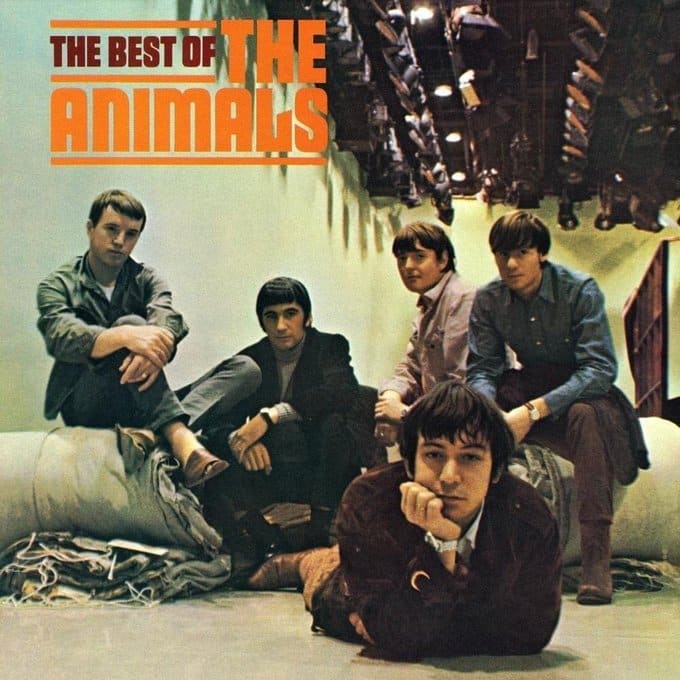
The older sister, on the other hand, a coed at the University of South Carolina, had been a Summerville High School superstar, the homecoming queen, maybe.[2] I met her once with her boyfriend at Ricky’s, the boyfriend Hollywood good-looking and the son of the woman who four years later would be my English teacher, the model for Mrs. Barrineau in Today, Oh Boy. I knew about this star couple because my aunt Virginia, only 6 years older than I-and-I[3], was in their graduating class. I felt as if I were hanging with celebrities, and they shocked me by striding up to Ricky’s mama’s bar and pouring themselves some kind of whiskey over ice. Ricky showed my future teacher’s son of Best of the Animals‘ album cover, and he said that “House of the Rising Sun” was the only song he liked, and I thought to myself what about “We Got to Get Out of This Place,” what about “It’s My Life,” what about “Please Don’t Let Me Misunderstood?” 

It was a memorable summer. 


[1] Or something like that.

[2] None of my yearbooks have survived my bopping from place to place, so I can’t confirm. 

[3] This affectation, using the Rasta hyphenated pronouns, does come in handy here where I can avoid the conversational, grammatically incorrect “me” yet sound hip.

You can purchase Today, Oh Boy HERE.

Bo Diddley Revisited

Bo Diddley Revisited

I’ve been making good use of my time, watching YouTube videos of interviews with Eric Burdon, former front man for the Animals.[1] In the mid-Sixties, the Animals ranked as my favorite band because the timbre of Burdon’s singing voice sounded as if he could have been from my native ground, the Lowcountry of South Carolina (as opposed to Eric’s Newcastle-upon-Tyne). In fact, it was the Animals, and to lesser extent the Rolling Stones, who introduced me the blues, to Muddy Waters, Howlin Wolf, John Lee Hooker, and a host of others.

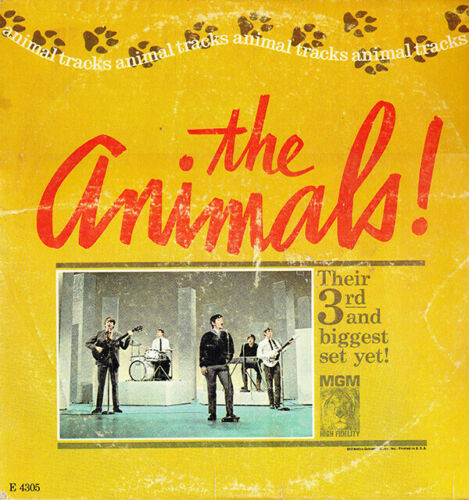
Decades ago, at his record store on Society Street (we’re talking Charleston, South Carolina), Gary Erwin, AKA Shrimp City Slim, told me that the Animals also had turned him onto R&B and the blues. He referenced their album Animal Tracks as his gateway into the land of shotgun shacks, cotton fields, black snakes, two-timing, big-legged women, and prison farms. 

Here’s the tracklist for Animal Tracks.

A1We Gotta Get Out Of This Place3:17
A2Take It Easy Baby2:51
A3Bring It On Home To Me2:40
A4The Story Of Bo Diddley5:42
B1Don’t Let Me Be Misunderstood2:26
B2I Can’t Believe It3:35
B3Club A-Go-Go2:19
B4Roberta2:04
B5Bury My Body2:52
B6For Miss Caulker3:55

Although “We Gotta Get Out of This Place” and “Don’t’ Let Me Be Misunderstood” are the big hits from the album, my two favorite tracks are the magnificent cover of Sam Cooke’s “Bring It on Home to Me” and “The Story of Bo Diddley,” a sort of pop song bio of one of the pioneers of rock-n-roll, which ends with a comic encounter when Bo, his sister the Duchess, and Jerome Greene meet the Animals at the Club A-Go-Go in Newcastle. 

Listen and read along:

Now lets hear the story of Bo Diddley
And the Rock n Roll scene in general

Bo Diddley was born Ellis McDaniels
In a place called McCoom, Missississipi about 1926
He moved to Chicago about 1938
Where his name was eventually changed to Bo Diddley.


He practiced the guitar everyday and sometimes into the night
Till his papa’s hair began to turn white
His Pa said “Son, listen hear, I know
You can stay but that guitar has just gotta go.”


So he pulled his hat down over his eyes
Headed out for them Western Skies
I think Bob Dylan said that, he hit New York City.


He began to play at the Apollo in Harlem,
Good scene there, everybody raving.
One day, one night, came a Cadillac with four head lights
Came a man with a big, long, fat, cigar said,
“C’mere son, I’m gonna make you a star”
Bo Diddley said, “Uh.whats in it for me?”
Man said, “Shut your mouth son,
Play the guitar and you just wait and see.”


Well, that boy made it, he made it real big
And so did the rest of the rock n roll scene along with him
And a white guy named Johnny Otis took Bo Diddleys rhythm
He changed it into hand-jive and it went like this
In a little old country town one day
A little old country band began to play
Add two guirtars and a beat up saxophone
When the drummer said, boy, those cats begin to roam

Oh baby oh we oh oh
Ooh la la that rock and roll
Ya hear me oh we oh oh
Ooh la la that rock and roll

Then in the U.S. music scene there was big changes made.
Due to circumstances beyond our control such as payola,
The rock n roll scene died after two years of solid rock
And you got discs like, ah…
Take good care of my baby
Please don’t ever make her blue and so forth.


About, ah, one year later in a place called Liverpool in England
Four young guys with mop haircuts began to sing stuff like, ah…
It’s been a hard days night and I’ve been working like a dog and so on.

In a place called Richmond in Surrey, whay down in the deep south

They got guys with long hair down their back singing
I wanna be your lover baby I wanna be your man yeah and all that jazz.


Now we’ve doing this number, Bo Diddley, for quite some time now
Bo Diddley visited this country last year
We were playing at the Club A Gogo in Newcastle, our home town.

The doors opened one night and to our surprise
Walked in the man himself, Bo Diddley
Along with him was Jerome Green, his maraca man,
And the Duchess, his gorgeous sister.
And a we were doing this number


Along with them came the Rolling Stones, the Mersey Beats,
They’re all standing around diggin’ it
And I overheard Bo Diddley talkin’
He turned around to Jermone Green
And he said, “Hey, Jerome? What do you think these guys
Doin’ our.our material?”


Jerome said, “Uh, where’s the bar, man? Please show me to the bar…”


He turned around the Duchess
And he said, “Hey Duchess… what do you think of these young guys
Doin’ our material?”


She said, “I don’t know. I only came across here
To see the changin’ of the guards and all that jazz.”


Well, Bo Diddley looked up and said to me,
With half closed eyes and a smile,
He said “Man, ” took off his glasses,
He said, “Man, that sure is the biggest load of rubbish
I ever heard in my life…”


Hey Bo Diddley
Oh Bo Diddley
Yeah Bo Diddley
Oh Bo Diddley
Yeah Bo Diddley

from lest to right, Bo Diddley, the Duchess, and jerome Green
Bo, the Duchess, and Jerome Green

By the way, this is my second homage to Bo. I also wrote about him in April of 2021 and my father-in-law’s Bo Diddley obsession. If so inclined, you can access that HERE, and it features videos of Bo performing on the Ed Sullivan Show and a snippet from the movie Fritz the Cat

By the way, the white fellow in the collage up above is my father-in-law Lee Tigner in his younger days.

[bongo fade out]


[1] What prompted this foray into nostalgia was my recent poem, which you can access HERE, “The St James Infirmary iPhone Blues.”

St. James Infirmary iPhone Blues

I first heard “St. James Infirmary Blues” covered by Eric Burdon and the Animals, and the song really moved me, the horror of it, having to encounter the corpse of your lover “stretched out on a long white table/ So cold, so stiff/ She was dead.” Throughout the years, the song really stuck with me.[1]

The other night, Caroline and I were at the Lowfife Bar on Folly, and somehow the topic of public domain tunes came up. I mentioned that Dylan had borrowed the melody of “St. James Infirmary Blues” for his masterpiece “Blind Willie McTell.” In fact, I sang two verses of the Burdon cover right there at the bar.

Well, the very next day, an ad showed up on my Facebook feed for this book, which I’m eager to read.

Anyway, we can probably chalk up the ad’s appearance to coincidence, but, man, could it be some bot was listening to us via our phone?

Then last night at the Soapbox open mic at Chico a banjo player covered the song. WTF?

So, this morning, during one of my undelightful stints of insomnia, I composed this piece of doggerel in my head, which I consider a more productive use of my time in the wee hours than contemplating politics, my health, the past, or the future.

(BTW, occasionally, a reader accuses me of cultural appropriation one of these paeans to Black culture, but my conscience is clear on that score.)

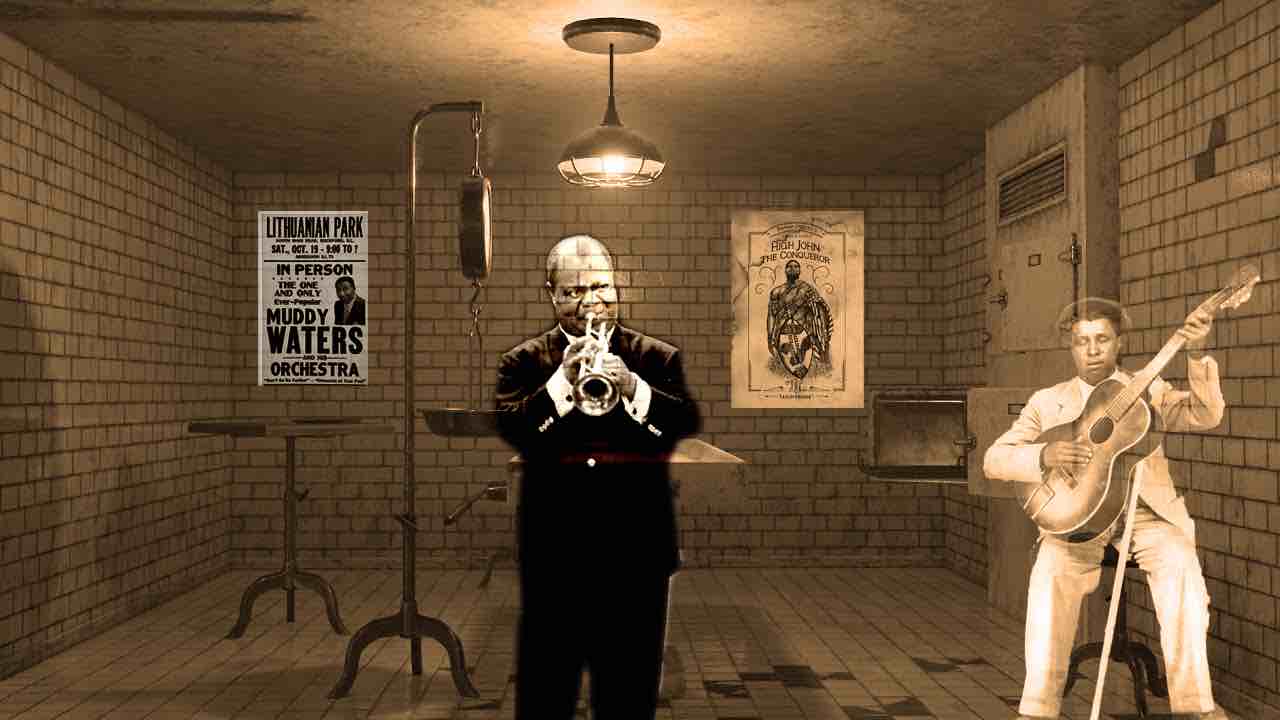
St James Infirmary iPhone Blues

Tapping a cane,
Mr. Andre Beaujolais,
with some hoodoo magic
in his front pants pocket
bopped down St. Charles
on his way to see
Miss Hattie Dupree,
the one-time lover
of McKinley Morganfield,
better known as Muddy Waters,
King of the Chicago Blues.

Those who got bad mojo
go see Miss Hattie Dupree
for the inside dope
in the hope of counteracting
shenanigans ¬– hexes,
curses, wet nurses,
vexations, permutations,
marital relations.
genetic mutations,
Haitian sensations,
and genital truncations.

Mr. Andre Beaujolais
was on his way
to deliver a batch
of John the Conkeroo juice
to help some dude
whose private
conversations had
been swiped by
advertisers, enterprisers,
franchisers, monopolizers,
and merchandizers.

He’d been telling his gal
about Blind Willie McTell,
how the Dylan song
by the same name
was sung to the same tune
as St James Infirmary Blues.
Their moment of intimacy
the next day mysteriously
appeared in an ad
for a book being peddled
on the dude’s Facebook page.

“I Went Down to the
St, James Infirmary:
Investigations in the shadowy
world of early jazz-blues
in the company
of Bling Willie McTell, Louis Armstrong . . .
where did this dang song
come from anyway?
“That title don’t trip off the tongue,”
Mr. Beaujolais said when
he heard the dude explain.

“Hand me your phone,” Andre say,
then took off its cover,
whupped out the Conkeroo juice,
poured it over the device,
mumbled some discrete mumbo jumbo.
“Ta da! problem solved!”
“Wait a minute, “the dude hollered.
My phone’s quit working!”
“No shit,” Mr. Andre replied.
“That’ll be fifty dollars.
I’ll accept ten fives.”


[1] In fact, I asked Gary Erwin to play it at Judy Birdsong’s memorial service, which he graciously did. BTW, Gary is an underappreciated Charleston treasure.