Eraserhead Revisited

From Painter to Filmmaker

The death of the brilliant film director David Lynch has spurred my wife Caroline and me to revisit his oeuvre.[1]

We started with the Jon Nguyen’s 2016 Lynch documentary The Art of Life, the culmination of four-year’s worth of conversations, twenty in all, recorded at Lynch’s home in LA. I had not been aware that Lynch was a painter, a highly skilled and prolific one at that. 
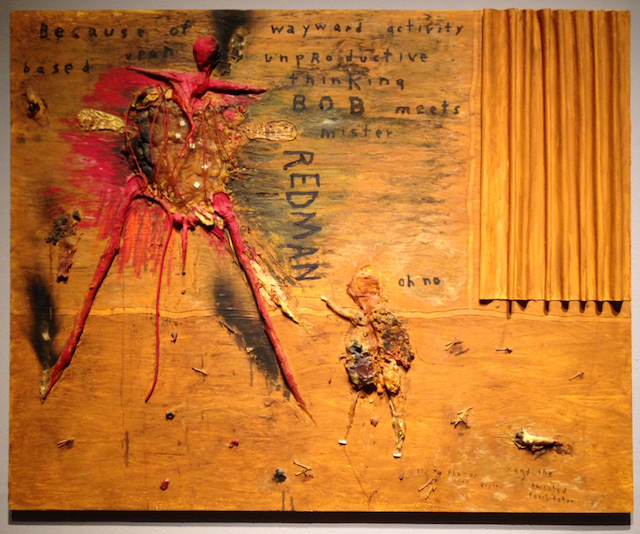
Throughout the documentary, we listen to Lynch narrate his life story while watching him in the act of creating paintings and sculptures. Interspersed are 8mm home movies of him and his family from the ’50s and ’60s. If you love Lynch, you’ll love this film, enjoy its leisurely pace and artful presentation.

What struck me most was Lynch’s revelation that “moving pictures” could be “moving paintings.”

So post epiphany off Lynch went to the American Film Institute where he resided in stables owned by the institute, and there he made his first feature film Eraserhead, transforming the narrow halls and small rooms of the stables into movie sets. 

By the way, I first saw Eraserhead in 1989 as a refugee from Hurricane Hugo, a dozen years after its original release, the again in the mid-’90s, and for the third time last night with Caroline.[2]

Dr. Caligari’s Great-Great Grandchild

In the fall of 1973 or 4, at the University of South Carolina, I had the great fortune to enroll in a multi-departmental course on German Expressionism, the prominent artistic movement of the Wiemer Republic. This class really broadened my intellectual horizons. We read Hesse, Kafka, and Bertolt Brecht; analyzed the paintings of Ernst Ludwig Kirchner, Karl Schmidt-Rottluff, and Emil Nolde; listened to the music of Schoenberg and Alban Berg; and watched each week in the student union’s theater an expressionistic Wiemer film. We began with the Cabinet of Dr. Caligari and ended with Fritz Lang’s Metropolis. Murnau’s original Nosferatu was also among the films we saw and analyzed. It was, by far, the most interesting and rewarding course I’ve ever taken. 

Obviously, Caligari heavily influenced Eraserhead in its set designs, dark themes, and murky black-and-white lighting. Also, Eraserhead is essentially a silent movie with only four minutes of dialogue in its 89-minute running time. The protagonist Henry, played by Jack Nance, waddles Chaplin-like throughout the film in what amounts to a Kafka nightmare. Though Eraserhead’s billed as a surrealistic horror movie, both Caroline and I found it to be hilariously funny. I can’t remember the last time I saw a film that produced so many out-loud laughs.

On the other hand, one significant way in which Eraserhead doesn’t resemble a silent movie is in its soundtrack. Unlike a silent movie whose soundtrack is more or less pasted on afterward, the soundtrack of Eraserhead consists of irritating sounds arising from the action, sounds like rain hissing, a radiator hissing, the mewling and crying of that abomination of a baby whose arrival marks the turning point of the plot. Caroline aptly described these background noises as “a plaid of sounds,” which provides a sort of underlying mechanical, menacing buzzing. 

Caroline also suggested that the central theme lay in Lynch’s hatred of fatherhood, though I saw it more as a strangely puritanical parable about the dangers of premarital sex. Ends up Caroline was correct. Lynch’s daughter Jennifer was born with severally clubbed feet and had to undergo several corrective surgeries as an infant, and she considers her birth defects as the major inspiration for the infant of the film.

At any rate, we had a fun night and look forward to checking out Lynch’s next film The Elephant Man, which, although more mainstream, shares with Eraserhead a very malformed human being at the center of the action.


[1] Why do I feel guilty using “oeuvre” when EB White would applaud its economical aptness? Perhaps because American anti-intellectualism lurks in the shadowy shotgun shack of my subconscious mocking me like the bully it is? 

[2] Caroline, who minored in art history and has a master’s in psychoanalytical criticism, is the perfect companion and provides a wealth of cogent observations that would have escaped me otherwise.

The Trump Campaign: A Tragical Farce or Farcical Tragedy?

Mr Trump

“Life is a comedy to those who think and a tragedy for those who feel.” – Horace Walpole

When taken to extremes, melodramas and farces turn topsy-turvy and elicit the opposite effect of their original intent – overdone melodramas provoke laughter instead of tears; overdone farces can provoke palatable discomfort and sometimes fear.

For example, check out the trailer for the overly melodramatic movie Reefer Madness. Although it conforms to Laurence Perrine’s description of melodrama as attempting “to arouse feelings of fear and pity,” it does so through “cruder means” by employing “oversimplified plots” and “flat characterization.” In other words, everything is overdone, suspension of disbelief shattered, so the audience ends up laughing instead of trembling.

Farces are by definition exaggerated comedy, and given the inherent cruelty in comedy, it’s not surprising that when taken to the extreme, farces can create discomfort.   Take, David Lynch’s 1977 movie Eraserhead, for example. Here’s an excerpt from Dennis Lim’s David Lynch: A Man from Another Place in which he describes a few scenes from the movie:

The first section of the movie with extended dialogue is also when most audiences realize they are watching a comedy of sorts. Lynch turns a staple of sitcom humor — the meet-the-parents dinner – into an ominous minefield of absurdist non sequiters, a deadpan farce [my emphasis] of misbehaving bodies. On the couch next to Henry [the protagonist], Mary [Henry’s consort] suffers an epileptic fit, which Mrs. X assuages by grabbing her daughter’s jaw and brushing her hair. Meanwhile, a litter of puppies nurse hungrily on their mother. Mr. X rants about the woes of being a plumber (“People think pipes grow in their homes!”), standing before an enormous duct that could have sprung from the ground. In the kitchen, Mrs. X tosses the salad with the help of catatonic Grandma X’s lifeless limbs. When Henry cuts into the squab-like creature that Mr. X has roasted for dinner, viscous blood spills from its cavity and its thighs wag up and down, sending Mrs. X into a drooling erotic trance. Then comes the bombshell, “there’s a baby,” at which point Henry gets a nosebleed.

Here’s a clip from the dinner in which someone has spliced in brief scenes of Robert De Niro, which, obviously, weren’t in the original. I don’t think they’re too distracting, though.

Compare the tone of that scene to this description of the English granddaddy of all farces, the puppet show Punch and Judy, The quote comes from a paper written by Ian Horswill of Northwestern University entitled “Punch and Judy AI Playset: A Generative Farce Manifesto Or: The Tragical Comedy or Comical Tragedy of Predicate Calculus.”

In Collier’s historical script (Collier and Cruikshank 2006), Mr. Punch successively beats to death his friend’s dog, his own baby, his own wife, his horse, the doctor who tries to treat him after he’s injured by the horse, a policeman (beaten but not killed), and the Devil himself. When his wife confronts him over the murder of his own child, Mr. Punch, who wants to have sex with her, replies that she’ll soon have another one.

Thus, extreme farce shares with tragedy irrationality and darkness but lacks any positive cathartic effects.

I think most would agree that Donald Trump’s campaign has denigrated into a farce.   I’ll spare you an encyclopedic rehash of voluminous blunders that have characterized the campaign and merely offer that yesterday morning Emily Nussbaum wondered on Twitter what outrage Trump might come up during the day.  She posited his assaulting a baby or biting a bat’s head off.  After the incident in Virginia when Trump had a baby removed from his rally, Nussbaum tweeted this:

Perhaps I’m getting soft in my old age, but I’m starting to feel pity for Trump – pathos in the old Greek sense of the term.  Sure, he’s a terrible human being with skin as thin as Zig Zag Ultra Thin Cigarette Rolling Papers, but imagine the insecurities he must harbor. Imagine being such a hemophiliac of rage, every little nick resulting in arterial spurting; imagine being your own worst enemy. Imagine how unhappy he must be. Think Michael Henchard of The Mayor of Casterbridge or Dostoyevsky’s Underground Man – but without the self-awareness.

Let’s hope for his own sake – and for our own — that he loses the election.