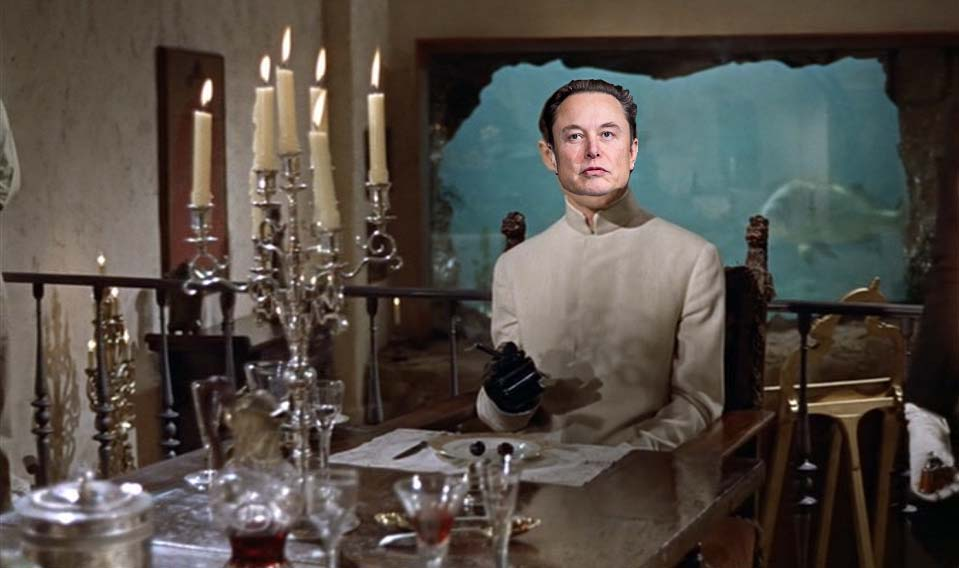
Elon Musk as Bond Villain

Oscar Wilde’s counterintuitive observation that “life imitates art” certainly seems a valid observation when you consider that Elon Musk obviously modeled his persona on the Bond Villains he identified with as a child watching 007 movies in his South African enclave.

I asked ChatGPT to create a Venn diagram comparing characteristics of Dr. No, Auric Goldfinger, Ernst Blofeld, and Elon Musk, but rather than creating the visual representation I asked for he/she/it/they came up with this:

“Creating a Venn diagram comparing characteristics of Dr. No, Goldfinger, Blofeld, and Elon Musk could be interesting! Here’s how we might categorize some of their traits”:

Dr. No

  • Monologuing: Dr. No is known for his villainous speeches and arrogance.
  • Desire for Global Power: His main goal is to dominate the world.
  • Tech Savvy: Uses technology for his villainous deeds, such as a secret base and advanced machinery.

Goldfinger

  • Love of Wealth: Obsessed with gold and wealth accumulation.
  • Manipulative: Skilled in manipulating people and situations for personal gain.
  • Planning for Destruction: Plans to increase his wealth by threatening global economics.

Blofeld

  • Mastermind: A schemer and manipulator who plans complex, worldwide operations.
  • Philanthropic Facade: Often hides his true intentions behind a charitable or business façade.
  • Desire for Control: Wants to control global events to advance his personal agenda.

Elon Musk (Common Traits)

  • Innovative: Known for pushing technological advancements (SpaceX, Tesla).
  • Wealth: A billionaire who accumulates wealth through various ventures.
  • Ambitious: Has ambitious goals such as colonizing Mars and transforming energy production.
  • Public Persona: Often in the media spotlight and makes bold statements.[2]

Note how ChatGPT avoided portraying any of Musk’s traits as negative, much less as villainous.

Allow me to rectify that failure:

Elon Musk (Common Traits)

  • Monologuing: an asshole known for his villainous speeches and arrogance.
  • Desire for Global Power: a megalomaniac who desires to dominate the world.
  • Tech Savvy: an innovator who builds rocket ships, electric cars, etc.
  • Wealth: a billionaire obsessed with wealth accumulation
  • Mastermind: a schemer and manipulator who plans complex, worldwide operations.
  • Desire for Control: a self-obsessed piece of shit who wants to control global events to advance his personal agenda.

Oh, yeah, what about the autism, the lack of social grace and human empathy, not to mention operating outside the bounds of law?  The stilted speech patterns all four share?

On this assignment, I’d give ChatGPT a big fat D if he/she/it/they were my student and myself a C- on this blog post, which has forsaken hard work for expediency. 

That said, it’s kind of scary that a Bond villain now has access to my social security number.


[1] The name Elon Musk sounds like Ian Fleming himself came up with it.

[2] Not how ChatGPT doesn’t bother with parallel construction. The catalogue he/she/it/they came up with is about as elegant as a Tesla truck.


A Working Class Assassin Is Something to Be

I’ve been reading Ariel and Will Durant’s short collection of essays entitled Lessons of History, a remarkable condensation of 5,000 years of various civilizations’ modi operandi. The Durants organize their treatise according to twelve categories: History and the Earth, Biology and History, Race and History, Character and History, Morals and History, Economics and History, Socialism and History, Government and History, History and War, Growth and Decay, ending with the question: Is Progress Real?

Some of this seems dated, especially the chapter on race; however, I found the chapters on Economics and Socialism to be especially eye-opening. I’d really never considered the distribution of wealth in pre-industrial cultures, but as it turns out, the battle between oligarchs and peasants, the haves and have-nots, is as old as the pyramids, stretching from ancient Greece to China.

Here’s the last paragraph of their essay “Economics and History”:

We conclude that the concentration of wealth is natural and inevitable, and is periodically alleviated by violent or peaceful partial redistribution. In this view all economic history is the slow heartbeat of the social organism, a vast systole and diastole of concentrating wealth and compulsive recirculation.

In the United States, a country that doesn’t provide affordable healthcare for many of its citizens, the top 1% of households (or penthouseholds) control 30%, or about a third, of the country’s wealth. Counterintuitively, the working class overwhelmingly opted to elect billionaire Donald Trump who has joined forces with Elon Musk to continue the redistribution of wealth upward, threatening to cut social security and replace the ACA with something or another. There would seem to be no agitation among what used to be called the proletariat about the inequities of current wealth distribution. These voters eschewed Kamala Harris’s plans for free in-home care for the elderly and voted for even more tax cuts for the super wealthy.

But bam! (excuse the bad taste in diction) the murder of United Healthcare CEO Brian Thompson has generated a tsunami of vitriol from citizens who actually approve of the murder.[1]  Often when a murderer somehow slips through the Orwellian ubiquity of surveillance cameras, on-line sleuths attempt to aid authorities in apprehending the assailant. However, according to the New York Times, “in a macabre turn, some people seem to be more interested in rooting for the gunman and thwarting the police’s efforts,” and “civilian efforts to find Mr. Thompson’s killer have appeared muted.” 

In fact, a look alike contest based on surveillance photos of the murderer was held in Lower Manhattan yesterday, and the winner (see below) said he celebrated the killer’s action.

The words “deny, defend, depose,” which were etched on the bullet casings and are presumed to refer to insurance companies’ tactics in withholding benefits, have become a sort of rallying cry. According to the Times, a jacket similar to the one worn by the killer “is flying off the shelf.”

More from the Times: “Alex Goldenberg, a senior adviser at the Network Contagion Research Institute, which tracks online threats, said the internet rhetoric had left experts ‘pretty disturbed’ by the glorification of the murder of Brian Thompson and the ‘lionization of the shooter.’

““It’s being framed as some opening blow in a broader class war, which is very concerning as it heightens the threat environment for similar actors to engage in similar acts of violence,’ Mr. Goldenberg said.”

No doubt the murderer’s James-Bond-like ability to slip through the sieves of our contemporary spying-on-each-other network of cameras and microphones has something to do with his lionization.

Perhaps as I type this he is undergoing plastic surgery in some underground bunker.


[1] Presumedly even opponents of capital punishment are applauding the killing of this father of two.