Pee Wee’s Here, Pee Wee’s There, Pee Wee’s Everywhere, Pee Wee’s Dead, But Be Aware

Probably my favorite and most oft-repeated personal anecdote is my half-hour ride to Folly Beach chauffeured by none other than that legendary folk hero and serial killing cut-up Donald “Pee Wee Gaskins,” nee Donald Parrot, AKA Junior Parrot.[1]

In fact, the Kirkus review of my memoir Long Ago Last Summer highlights the Pee Wee incident:

One of the standout pieces involves the author hitchhiking to Folly Beach as a teenager—he and his brother survived an encounter with someone who was likely the serial killer Donald “Pee Wee” Gaskins. Even though the hitchhiking story is only four pages long, it fits a lot of frightening intrigue into a short space; the reader not only learns who Gaskins was, but gets to see the monster in action, doing things like casually burning a boy with a cigarette. [2]

Of course, during that harrowing hitch-hiking experience, Pee Wee didn’t formally introduce himself or the beer-swilling, cigarette smoking ten-year-olds accompanying him, but twenty years later when I read his autobiography Final Truth, I put two-and-two together when he mentioned that he’d take nephews on beach excursions to Folly.

By the way, the memoir also boasts an original poem entitled “Pee Wee Gaskins Stopping at a Lake House on a Summer Evening.”  Because of its macabre content and abject vulgarity, I dare not post it here in its entirety, but I will share its first stanza:

Whose corpse this is I ought to know

Cause I’m the one what killed it so.

I hope no one comes by here

To watch me in the lake it throw.

So you can imagine how delighted I was last week to receive unsolicited through the mail a pre-publication copy of Dick Harpootlian’s upcoming book Dig Me a Grave: The Inside Story of the Serial Killer Who Seduced the South.

I’ve not quite finished it, but when I do, I’ll post a review here. For now, I’ll just say it’s a real page turner written in noirish prose as Harpootlian, who prosecuted Pee Wee, weaves the narrative of Pee Wee’s life with his own.  Exposure to cold blooded killers transforms Harpootlian from an underground newspaper publisher[3] into a prosecutor of murderers and from an anti-capital punishment advocate into a diehard (forgive the pun) proponent.

And as luck would have it, just last night I was privileged to hear my pal David Boatwright and his band Minimum Wage perform David’s song “Pee Wee Gaskins” at art reception at Redux Contemporary Art Center where Buff Ross is showing some of David’s murals that have lost their original homes in Charleston’s real estate shuffles.

The murals are so great.  My favorite is a street scene in which Fredick Douglas is operating a Trolly Car that runs from White Point to the Neck.

Cool ass art is displayed throughout the building, which is located at 1054 King Street.

It’s not every day you see an ad for a James Brown inflatable sex machine sex toy.

Anyway, here’s a snippet of Minimum Wage performing “Pee Wee”Gaskins.”  The iPhone video doesn’t do it justice.


[1] He’s also the namesake of an Indonesian punk rock band. 

[2] It’s floundering at number 1,125,593 on the Amazon Best Sellers list, so why don’t you do a senior citizen on a fixed income a favor and order yourself one.

[3] The Osceola, which I read as an undergrad at USC

My Take on Summerville 1970, an Adaptation of My Novel Today, Oh Boy

poster designed by Gil Shuler

Given that my novel Today, Oh Boy inspired David Boatwright’s and Paul Brown’s short film Summerville 1970, I won’t pretend that my critical assessment of their movie possesses the clear-eyed detachment that disinterest fosters.  

On the other hand, the number of authors who hated film adaptations of their work is legion.  For example, Gore Vidal considered the adaptation of his novel Myra Breckenridge “not just a bad movie [but also] an awful joke” and Donn Pearce, the author of the novel Cool Hand Luke, hated its screen adaptation. “They did a lousy job,” he said, “and I disliked it intensely.”  Other unhappy authors include Ken Kesey, Stephen King, and PL Travers.  Like I say, a lot of authors have hated films based on their works. 

Therefore, my admiration of the project was by no means guaranteed.

That said, I loved Summerville 1970.  

photo credit Joan Perry

Shortly after David Lynch’s death, Caroline and I watched a documentary about Lynch’s transition from painting to movie making.  In the documentary, he described a revelation he experienced at film school: it suddenly occurred to him that he could make “moving paintings” rather than merely “moving pictures.”  

In other words, Lynch attempted to render each scene of his movies so visually interesting that each still could be frozen and stand alone as a painting.  

Like Lynch, Boatwright is also a painter, and like Lynch, studied at the American Film Institute in LA. Summerville 1970 is a “painterly film,” rich in color and artistic in layout.

For example, check out this photograph Caroline took of my cameo appearance during the premiere Friday night.

When Caroline showed the shot to me, she said, “It looks like a painting.”  

“Wow, yeah, that looks like it could have been painted by Hopper,” I said.

 “Or [Thomas Hart] Benton,” she replied, which indeed is more accurate.

One of the most vexing problems a short story writer and short film creator faces is having to constrict action within a confined space and time. David does a terrific job of compressing the events of poolroom chapter of the novel into a fluid narrative that doesn’t have one second of down time.  The movie has, as all good stories must, a beginning, a middle, and end. Crisply edited, the plot unfolds efficiently with a disquieting subtle sense of foreboding.  Of course, any work of fiction requires conflict, and in addition to the central physical conflict of rednecks attacking a hippie, we have other conflicts as well: a developing high school crush, the vet’s anguish, and the lost basset hounds’ wandering.[1]

To simplify matters, David took four of my characters – Rusty Boykin and Ollie Wyborn, the co-protagonists, and Jill Birdsong and Sandy Welch, the female leads – and fused them into two characters, i.e., into a single male and a single female.   In the film, the character Rusty is actually more Ollie than Rusty. For example, in Summerville 1970, Rusty, like Ollie, hails from Minnesota and knows karate.  On the other hand, like the Rusty of the novel, cinematic Rusty has embraced the counterculture of the late ’60s and early ’70s.  In the novel, Ollie is a conformist who wants to attend the Air Force Academy. Because the film is limited to fifteen minutes, these changes make a lot of sense. 

The Jill Birdsong character of the movie closely resembles Jill of the novel, only she’s less straightlaced and less shy, though the character does maintain a quiet shyness, nevertheless.

Olivia Brooks, the actress who portrays her, is superb, as is Thomas Williams, who plays Rusty.

Not only do the main characters shine, but the minor characters do as well. Patrick Basquill’s Bobby Ray Bossheen exudes mindless menace, and his two redneck cohorts, the twin brothers Andre and Remy Levesque, come off as authentically belligerent, not-too-bright country boys. In addition, David Mandell is a stabilizing force as the compassionate bartender who attempts to maintain peace. Jill’s wisecracking friend Nanci played by Sara Rudeseal is spot-on as well. 

My favorite character of all is David Boatwright’s invention, a Viet Nam vet who tells a horrific war story to the bartender and later breaks up the fight outside the tackle shop. The actor, Logan Marshall Green, makes the vet’s PTSD seem all too real as he draws heavily on his cigarette with shaking hands, knocking back whiskey after whiskey as he shares his horrible memory of a situation that brings to mind My Lai.

In addition, the costumes, sound, and editing are all superb.  It’s truly a pleasure to watch, and I hope you get a chance to see it.

BTW, here’s a LINK to a review of Today, Oh Boy that provides a link to its Amazon and Barnes and Noble pages. .  Rumor has it that it might be screened again at the Terrace for the general public.  Fingers crossed. 

[1] I got the idea of writing Today, Oh Boy after listening an audio book of Joyce’s Ulysses.  The basset’s actual name is Hambone Odysseus Macy, but the kids who find him on the side of the road dub him Mr. Peabody.  He is the Ulysses character in the novel who wanders all over Summerville to finally making his way home safely to his family.

Yesterday, Oh Boy

Yesterday, Oh Boy

When my friend David Boatwright, who produced the cover of Today, Oh Boy, approached me about adapting the poolroom chapter from the novel into a fifteen-minute film, I jumped at the chance.  David whipped out a script, which I approved, then later made some significant changes. 

Near the end of the novel, which is set in 1970, Rusty Boykin, an ADD-riddled hippie-wanna-be from Summerville, South Carolina, and Ollie Wyborn, a straightlaced, straight-A transplant from St. Paul, Minnesota, join forces in thwarting an attack from a pair of rednecks whose favorite pastime is, to use the Lowcountry lingo of the day, “cutting ass,” i.e., beating up people they don’t cotton to.  

David’s major change in the second draft of the script was fusing Rusty and Ollie into one character, which I again approved, given I had complete confidence in his intelligence and talent, and because as a practical matter, there’s virtually no room for character development in a fifteen-minute movie.  Another significant change, which added gravitas to the film, David created a new character, a Viet Nam vet who relates a harrowing account of wartime mayhem to the bartender, played my former student, David Mandell. 

So anyway, David Boatwright and his producer Paul Brown raised the needed money and assembled a crew of costume designers, cinematographers, assistant directors, sound people, make-up artists, art directors, property managers, actors, a stunt coordinator, a basset hound, etc. and shot the film in four days. 

The exterior shots, which included fisticuffs and car chase, were filmed on bucolic Wadmalaw Island and the interior shots at the defunct West Ashley restaurant Bearcat, which has been transformed into a ’70s era bait and tackle shop/bar complete with pinball machines and a functioning jukebox on loan from my friend Thom Piragnoli.

I asked David if I could have a cameo, and he said, of course, so yesterday I spent twelve amazing hours on the set being part of an incredibly complicated matrix of moving parts. 

When I arrived at seven, an actor was seated having his hair tended to. One of the make-up women said she would do my hair next, and I explained, “But I have no hair,” removing my hat, and she said, “Great!,” meaning, I take it, less work for her.  After I introduced myself, another woman said, “Oh, these young actors can’t wait to meet you. They’re walking around with the book.” 

Indeed, they were incredibly appreciative. Each one sincerely thanked me for writing the novel.  Two actors, twins brothers playing rednecks, asked me why their characters were so angry. When the actor Logan, who played the Viet Nam vet, thanked me for, in his words, “creating all of this,” I told him that, in fact, David had created his character and dialogue. He said yes, but I had created the world around him. To my mind, his performance and speech are the climax of the film. 

I abstractly knew that it would be cool to see characters I had created “come to life,” but had underestimated how gratifying it ended up being.  It was especially moving to see Jill Birdsong, modeled on the high school version of my late wife Judy Birdsong, performing her role, and I especially enjoyed the actor Patrick Basquill, who brought the bully Bobbey Ray Bosheen to life. The creepiness he brought to the role reminded me of William Dafoe’s portrayal of Bobby Peru in David Lynch’s Wild at Heart.

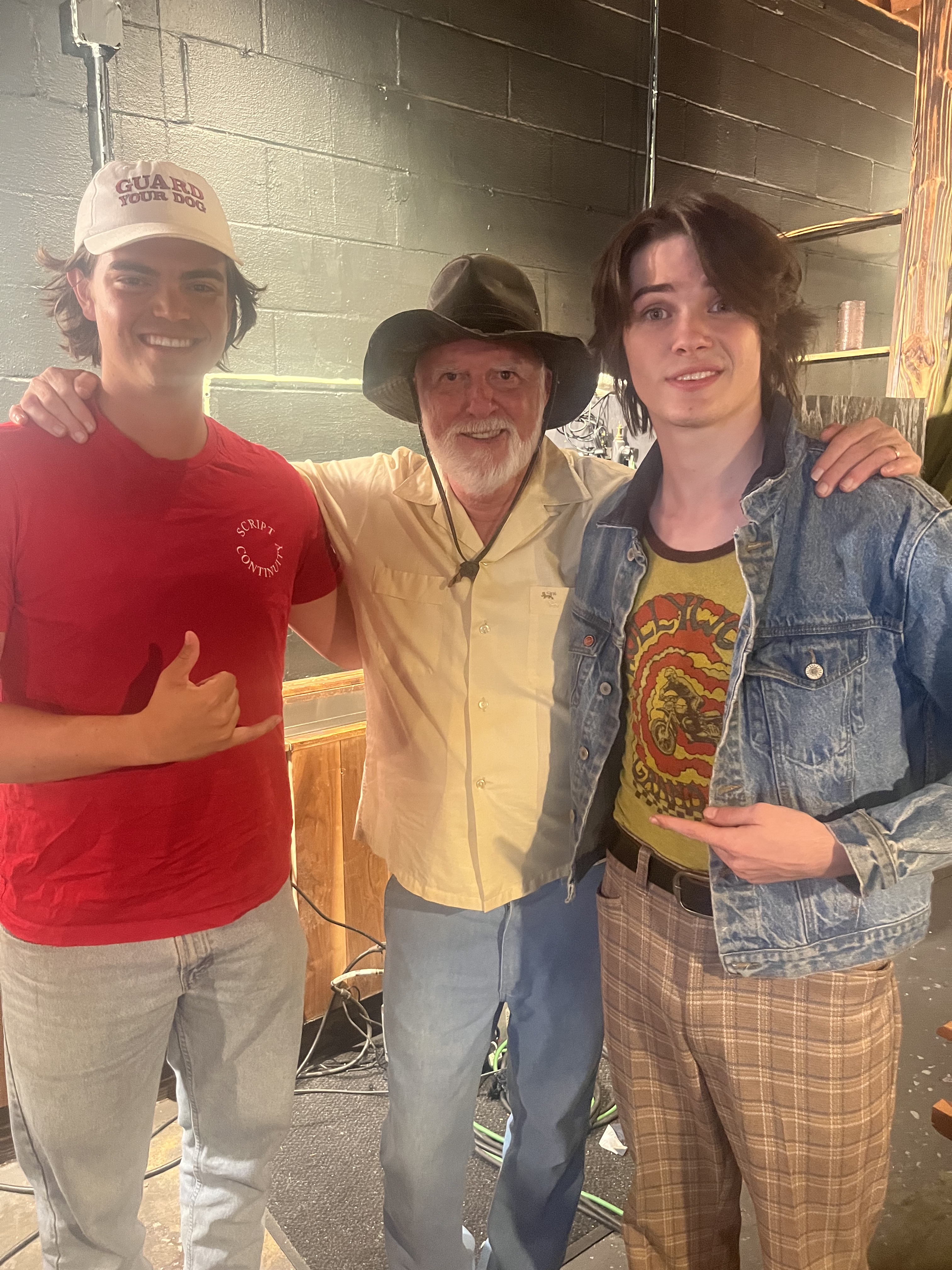
Also, it was really weird to hear the name “Rusty,” my childhood nickname, called out throughout the day. Sometimes, I thought they were referring to me. And Thomas, the actor who plays Rusty, looks a lot like I did in high school, except he has blue eyes, high cheek bones, brown hair, and isn’t riddled with freckles and acne. 

In other words, he’s skinny.

from left to right, Thomas Beck, Rusty Moore, and “Rusty Boykin”

It was such a wonderful day, the best ever in my life as a writer, and I can’t wait to see the finished product, entitled Summerville 1970, which will make the festival circuit and premiere sometime in the fall at the Terrace Theater on James Island.

Before I end this way too egotistical account, I want to acknowledge my wife Caroline Tigner Moore, without whom the manuscript of Today, Oh Boy would have been found in a drawer after my demise, rather than becoming a published novel. 

Caroline has encouraged me throughout but also has bravely said, “Un-uh, that doesn’t work, why don’t you do this instead.” She’s tactfully guided me through the interviews and the whole befuddling process of my post-teaching career, including offering encouragement in my avocation of creating “fake paintings.” 

After my beloved Judy Birdsong died, I imagined the lonely life of a wounded epicurean, but Caroline has enriched my life in ways I could not have imagined, especially in establishing a loving family that includes my wunderkind stepdaughter Brooks, who is as kind as she is brilliant, and a trio of pets, KitKat, the demi-mutt, and our blue-eyed ragdoll cats, Juno and Jasmine.

Love to them and to you!

PS. Here’s a link to the Kirkus review of Today, Oh Boy that includes an interview and links to purchase it via Amazon and Barnes and Noble, or better yet, get it from your local independent book store, which in Charleston is Buxton Books.

AI Has Its Place But It Ain’t Above My Mantle

The other day on Facebook, every septuagenarian’s favorite social media platform, I posted this confession:

“I’ve just come to the terrible realization that I’m a professional dilettante!”

I meant the quip, of course, to be humorous given the oxymoronic pairing of professional, denoting lucrative compensation for someone who can claim to be an expert, and dilettante, which describes a poser, an amateur who dabbles in the arts.[1]

A few kind responders begged to differ, claiming that I was the real deal, which I appreciate, but don’t buy, especially when it comes to what I have come to call my “fake paintings,” which are essentially photocollages filtered to look like paintings and printed on canvases. Not that they’re not eye-catching in a good way. My friend the painter and filmmaker David Boatwright ­ — the antithesis of a dilletante — finds them amusing.[2] So even though I call them “fake,” I do think they qualify as “art,” but it’s amateur art. When in a groove, I can crank one out in a couple of hours.[3] David, on the other hand, toils over his canvases and murals for months, not ceasing until every last miniscule detail is right.

Which brings me to the central subject of these ramblings — AI generated illustrations. 

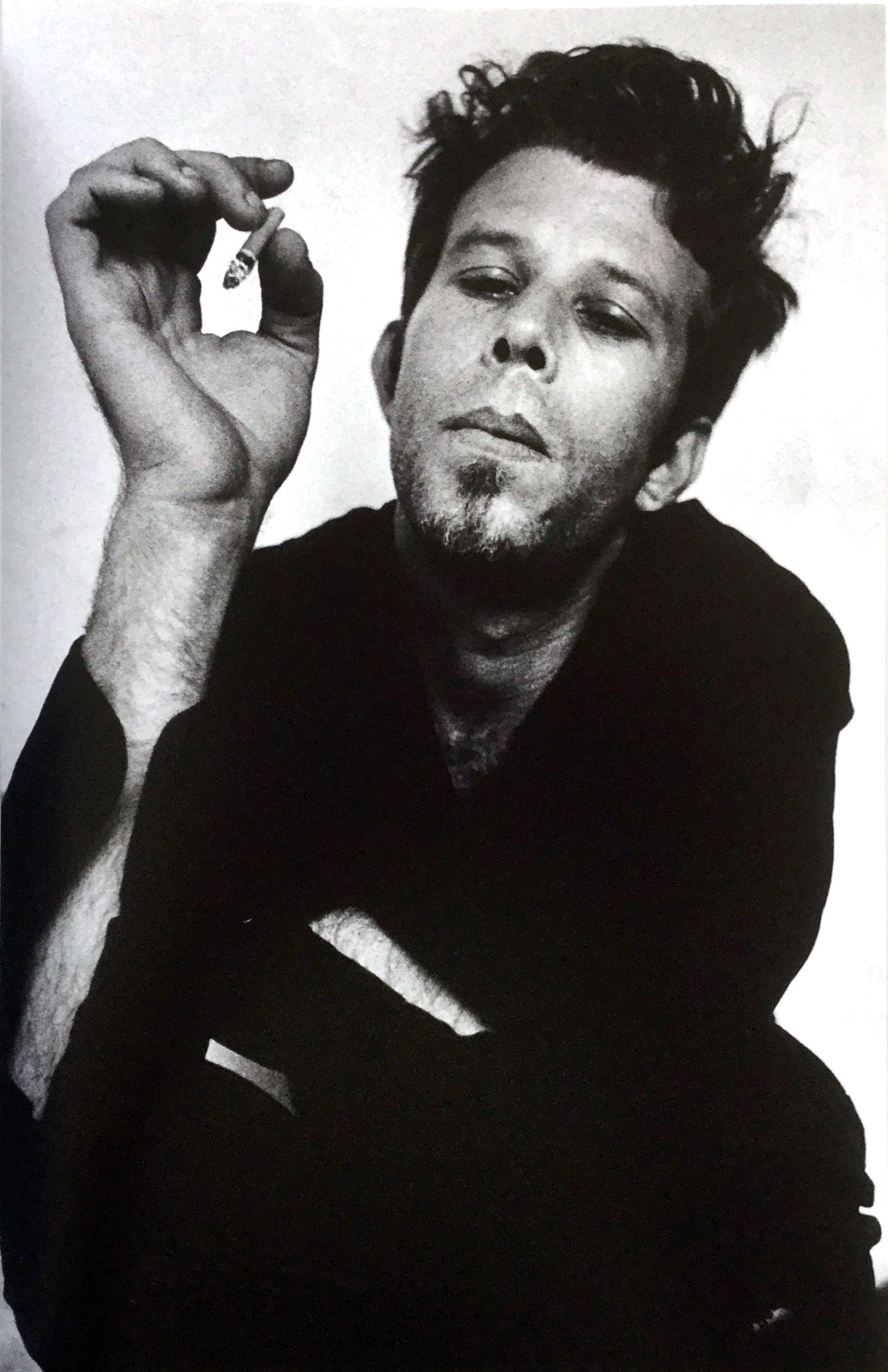
A while back a Facebook friend lamented that AI-generated “art” was going to put people like me out of business, but I begged to differ. “AI hasn’t listened to Tom Waits while smoking Thai sticks,” I responded. It can’t, by its very essence, be original. It ain’t got soul. 

Last night my wife Caroline and I were looking at my two latest canvases, and I said, “There’s no way AI could come up with either one of these.”

“Let’s do a little experiment and see what AI comes up with,” she said. 

So we did, prompting the software to create something similar. 

Before we begin the comparison, I’ll explain briefly how I go about making a fake painting. 

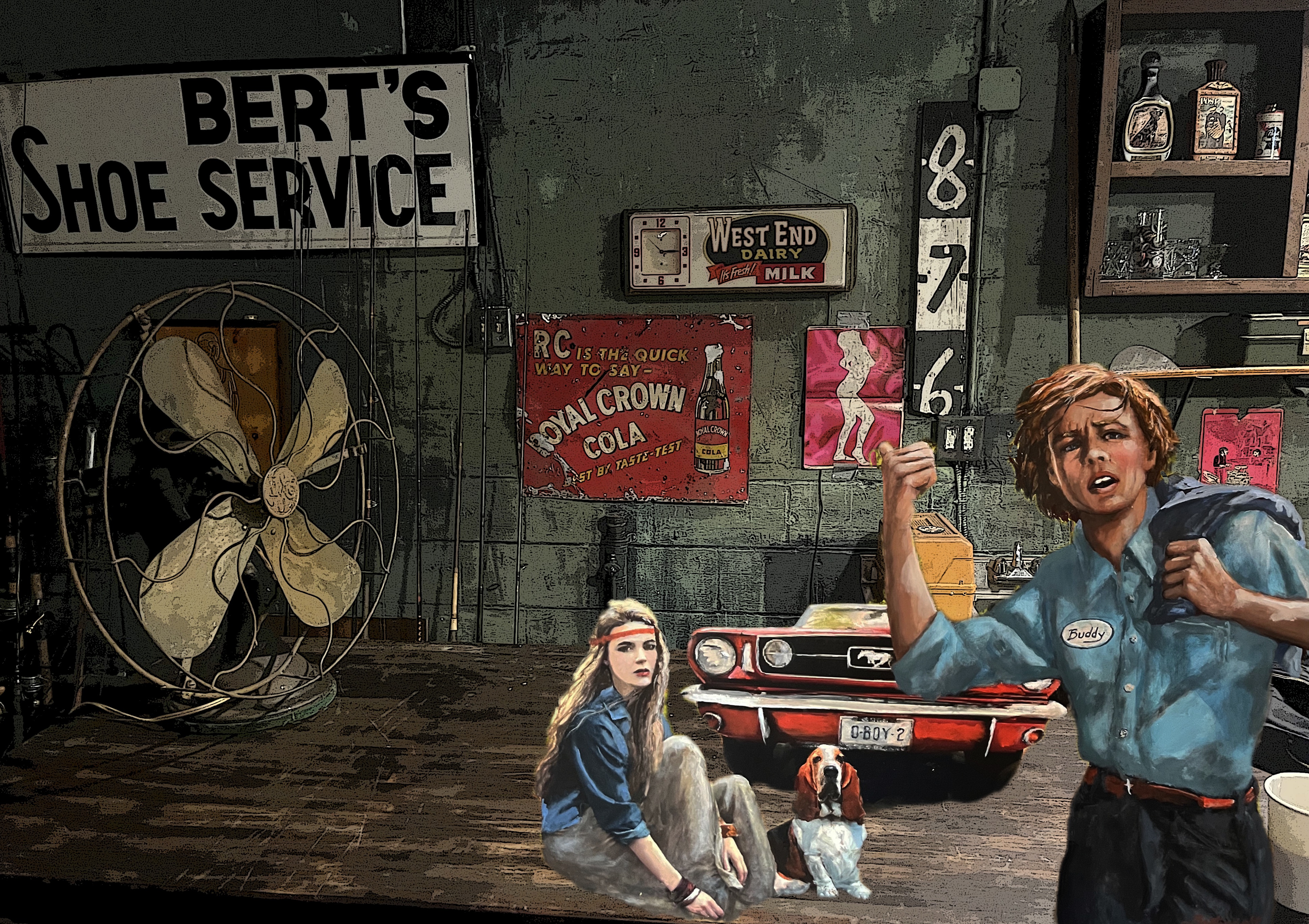
I start with a high resolution photograph. In my latest (see below) TGIF Chico Feo, I took a photo of the bar area when I was the only customer in the establishment. 

I upload the photograph to Photoshop and add an artistic filter, in this case, the “Dry Brush” filter.

Almost always, I have no preconceived notions about what I’m looking to create. In this case, I googled “pulp cover paperbacks bar scenes” and scored the couple kissing from a novel entitled Divorce. Of course, the man wasn’t leaning over a bar to kiss his lover, but I determined I might be able to cut the couple out and paste them into the photo, and, damn, it worked. Next, I found the woman sitting to the couple’s left and did likewise, and once again, I was successful.

I thought it might be amusing to have an organ grinder in the foreground, but I couldn’t find any illustrations that suited; however, I did find the begging monkey with the cup and tried him in various locations until I hit upon placing him on the bar, interrupting the passionate kiss. 

I decided to place a large figure in the foreground and went Screaming-Jay-Hawkins hunting. I experimented with various Hawkins iterations, but the vibe wasn’t right, and then the proverbial cartoon light bulb went off above my fedora. Louis Armstrong, Satchmo!

And boom![4]

So here are my TGIF Chico Feo and AI’s response to the prompt “create a picture of Louis Armstrong playing at a beach bar.”

See what I mean.

One more example. 

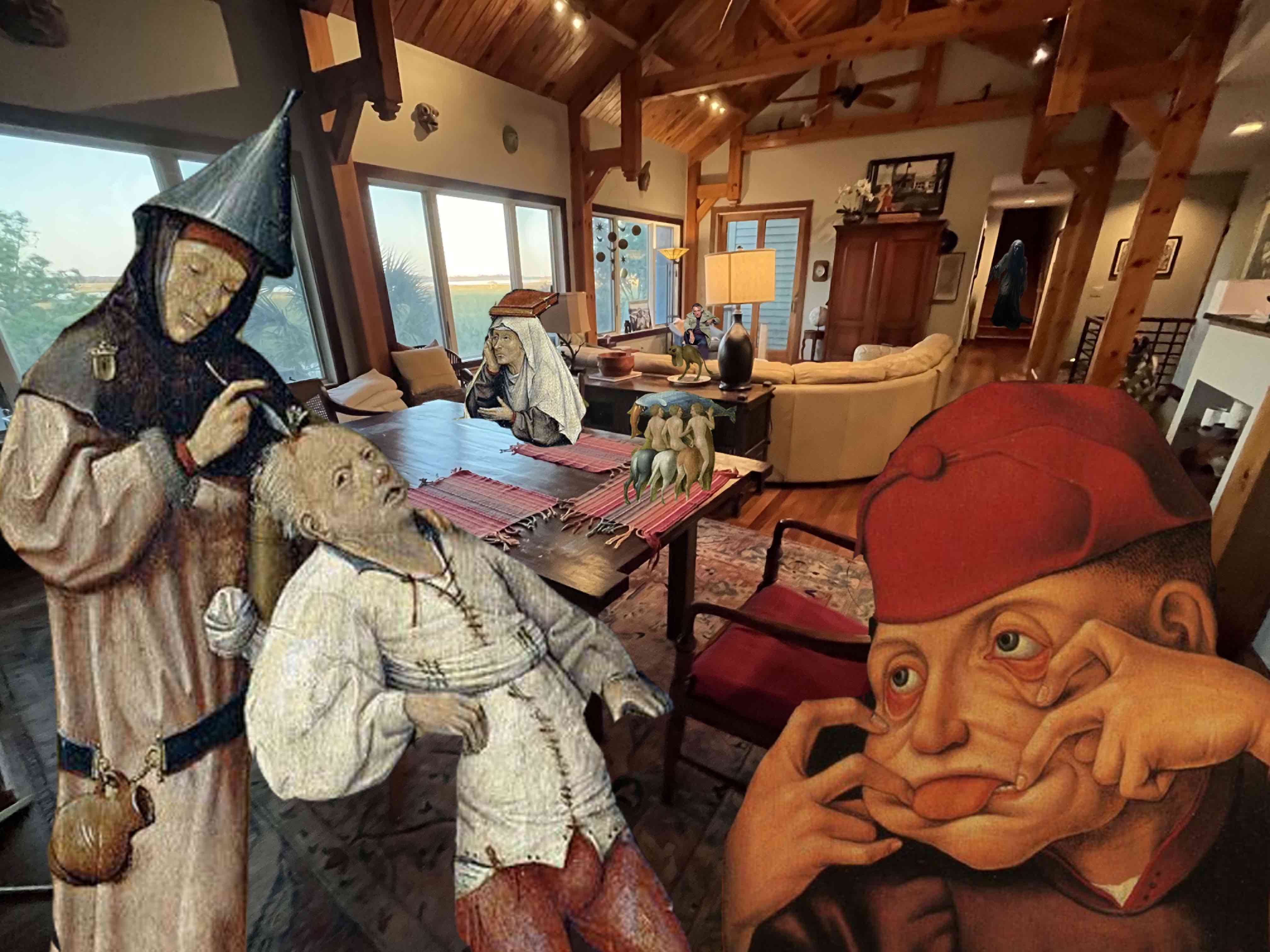
Two of my favorite artists are Bruegel the Elder and Hironimus Bosch. 

I took a photo of our living room, which struck me as sort of Flemish-looking so I peopled it with Bosch figures, being in a mocking post-election funk. 

Here’s the final product.

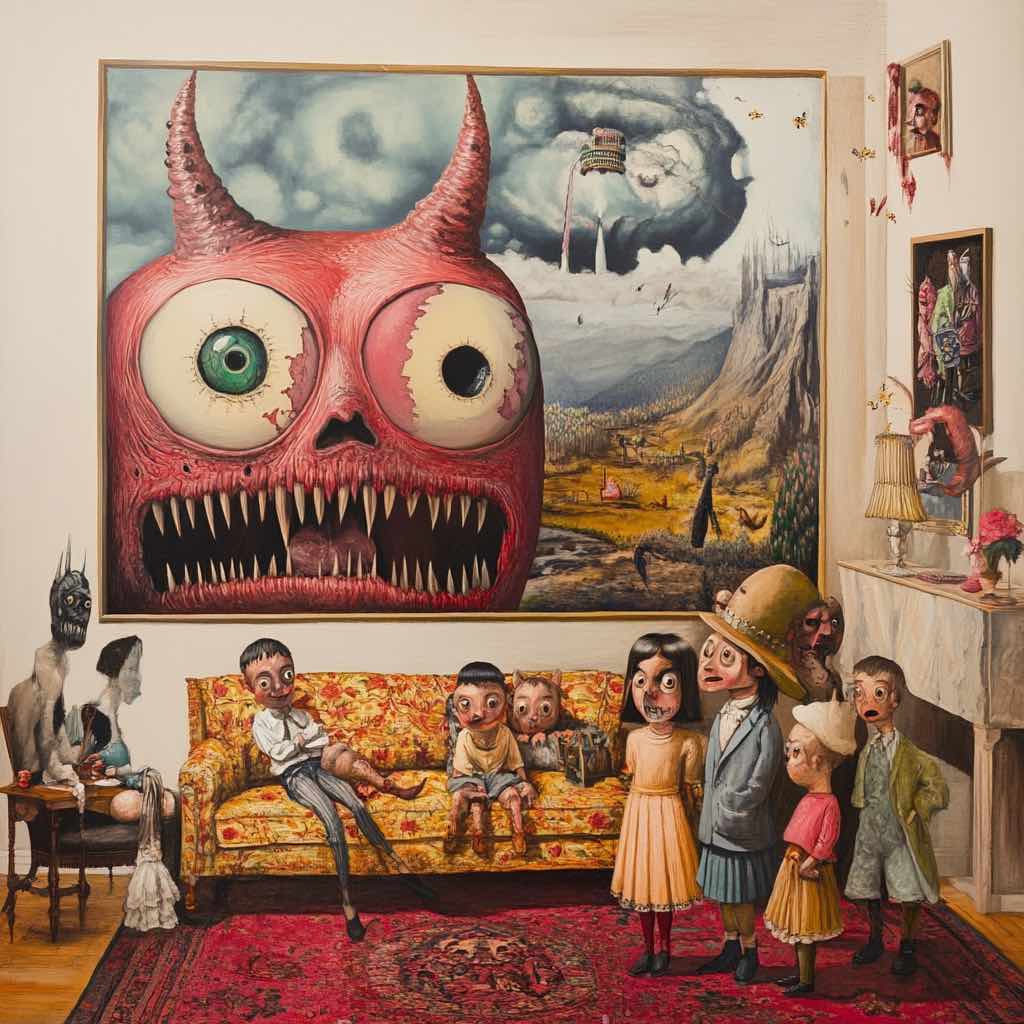
And here’s what AI came up with when prompted “Boschian style weird people and one Boschian monster in a regular modern beach house living room.”

Of course, AI is likely to put some illustrators out of business. In fact, because Caroline subscribes to AI software, I might ask her to provide me images to illustrate some of my blog posts. However, for book covers, I always prefer scruffy over slick. 

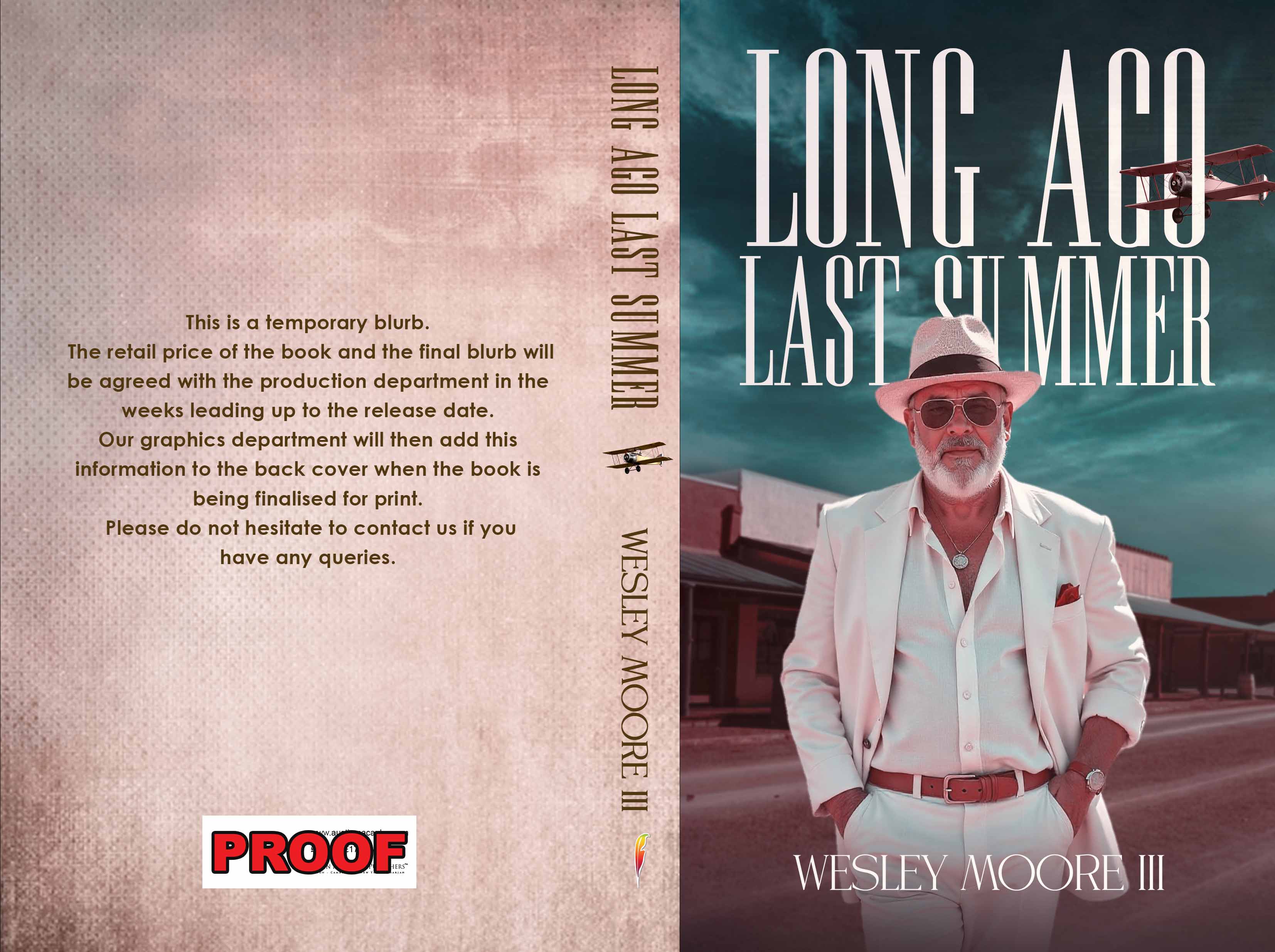
Which cover would you guess Caroline and I chose?


[1] The awkwardly phrased sentence this footnote references is proof in and of itself of my dilettantism. A professional, a true wordsmith, would devote time to express these ideas in a more cogent fashion, spending perhaps an hour or so insuring that every word was in its proper place and that the clauses melded in pleasant fluidity. but [cue Bob Dylan]. “[That] ain’t me, babe. 

[2] BTW, David has written a screenplay for a 15-minute film based on the poolroom chapter of my novel Today, Oh Boy and is just 50K short of having the funds to start production, so if you happen to be wealthy and want to be an art patron and contribute to making a really cool indie film, contact me, and I’ll forward your info to David. 

[3] I have had a one-man show at Studio Open and have sold a couple of dozen, two of which went for $500, so there’s that.

[4] I also Hitchcock like, try to make a cameo appearance in the “paintings.” In this case, it’s the cover photo of my next book Long Ago Last Summer. Can you find it?

The Hawkes and Flannery O’Connor

Thursday night, our friend David Boatwright met Caroline and me at the Terrace Theater to check out the Ethan Hawke Flannery O’Connor biopic Wildcat.[1]  It’s gotten mixed reviews—hovers around 5 on the Rotten Tomato ten point scale— but I wonder if to fully appreciate the film you need to be familiar with O’Connor’s work. Throughout the action, Hawke and fellow screenwriter Shelby Gaines intersperse fiction from O’Connor’s canon into the story of her adulthood, but if you’re unfamiliar with her stories — e.g., “Parker’s Back” or “Revelation”— you very well may find the film quilt-like, a series of narratives stitched together that don’t create a comprehensive or unified overview. Brandon Yu, who reviewed the movie for New York Times, complains, “Half-sketched and sometimes hard to follow, the stories glimpsed here ultimately fail to produce a fully legible or consistently engaging arc of what must be a roiling inner world.” However, if you’ve read the stories, this is not the case. You see how they came to be via her daily interactions with others and understand how the stories embody her Catholic vision.

I don’t think the Hawkes (Ethan’s daughter Maya plays O’Connor and his wife Rachel is credited as a producer) necessarily set out to produce a fully integrated masterpiece like Citizen Kane but rather made the movie as an homage to Flannery, an artist of the highest caliber who simultaneously can make you laugh out loud and feel pathos. Maya Hawke discovered O’Connor in high school, used O’Connor’s Prayer Journal for her audition monologue at Julliard, and essentially became obsessed with the writer. 

I can empathize. I’ve learned a lot from Flannery O’Connor about writing fiction. Not only that, but her stories are so fun to teach, are so well crafted with each element of the plot — name selection, physical description, characterization, symbolism, and tone—linked to a common central theme: in a Catholic universe underserving people can be granted grace, even in the seemingly godforsaken Southern Gothic world of rural Georgia. 

Take the story “A Good Man Is Hard to Find,” for example, which dramatizes a family vacation where a mother, father, two bratty children, an infant, and a grandmother are murdered by an escaped convict called the Misfit. Yet I’d classify the story as a comedy, both in the literary sense and also in the Medieval sense of “The Divine Comedy” where a soul moves from darkness to light. The grandmother in the story is a self-centered pain-in-the-ass who essentially causes the wreck that allows the Misfit to murder the family and steal their car. However, at the very end of the story, grace descends upon the old woman when she sees how miserable the Misfit is and tries to comfort him:

[The Misfit’s] voice seemed about to crack and the grandmother’s head cleared for an instant. She saw the man’s face twisted close to her own as if he were going to cry and she murmured, “Why you’re one of my babies. You’re one of my own children!” She reached out and touched him on the shoulder. The Misfit sprang back as if a snake had bitten him and shot her three times through the chest. Then he put his gun down on the ground and took off his glasses and began to clean them. 

Hiram and Bobby Lee returned from the woods and stood over the ditch, looking down at the grandmother who half sat and half lay in a puddle of blood with her legs crossed under her like a child’s and her face smiling up at the cloudless sky. 

illustration by Jeffrey Smith

Note that her “legs are crossed,” an obvious Christian symbol, “under her like a child,” which suggests innocence regained, and that she is “smiling up at a cloudless sky.” In O’Connor’s Catholic universe, this amounts to a happy ending for the Grandmother’s death comes at a moment of redemption. This message is no doubt alien to most contemporary US citizens; however, as the movie makes abundantly clear, she wasn’t writing for the materialistic middle class. 

“Either one is serious about salvation or one is not,” O’Connor writes in Mystery and Manners. “And it is well to realize that the maximum amount of seriousness admits the maximum amount of comedy. Only if we are secure in our beliefs can we see the comical side of the universe.”

For me a movie is a successful if I think about it a lot after seeing it. In the wee hours this morning, as I wandered the barren moors of my insomnia, I thought about how the subdued colors of the film in general and threadbare genteel shabbiness of her home in specific underscore the profound melancholy of Flannery O’Connor’s life. She had studied at the famed Iowa Writer’s Workshop, hung out with Robert Lowell and Katherine Anne Porter, but after developing lupus was exiled from a literacy life in the North to a suffocatingly provincial existence on a farm in Milledgeville, Georgia, There she worked in pain and physical decline until her death at 39, all the while being totally unappreciated by her homefolk who found her fiction to be inaccessible and life-negating.

My only gripe is that the Hawkes’ depiction of O’Connor lacks the dry humor that she demonstrated in her letters. Maya Hawkes’ acting is superb, but she portrays O’Connor as sort of a rigid, humorless young woman on the spectrum whereas in reality O’Connor was fun to be with. I once had dinner with the late Ashley Brown, a professor at the University of South Carolina, who was close friends with Flannery and who appears often in her collected letters. I asked him if she were as severe a Catholic as the stories suggested, and he said, “Oh, no, not at all. She was delightful, very witty, fun to be with.” Then he whipped out photo albums featuring pictures he had taken of her with her peacocks. She was often beaming in those photos.

Nevertheless, by external standards, her life was bleak, and the film’s underscoring of that fact has made me appreciate her achievement even more. To see her alchemizing on screen the characters from her daily life into the immortals of her stories is very satisfying indeed. I also appreciate the way she didn’t outline her stories but had them unspool spontaneously from her subconscious, which is the way I also write fiction.

I’ll leave you with this delightful seduction scene from “Good Country People” where in a hayloft Manly Pointer, a door-to-door Bible salesman, demands that one-legged hot-to-trot nihilist Hulga Joy Hopewell say the words “I love you” to satisfy a mechanical formula he insists must be followed as a prerequisite for sex:

The boy’s look was irritated but dogged. “I don’t care,” he said. “I don’t care a thing about what all you done. I just want to know if you love me or don’tcher?” and he caught her to him and wildly planted her face with kisses until she said, “Yes, yes.”

“Okay then,” he said, letting her go. “Prove it.”

She smiled, looking dreamily out on the shifty landscape. She had seduced him without even making up her mind to try. “How?” she asked, feeling that he should be delayed a little.

He leaned over and put his lips to her ear. “Show me where your wooden leg joins on,” he whispered.

I often say that my novel Today, Oh Boy has the most unerotic sex scene in all of American literature, but now, rereading the above, I take it back.


[1] Although better known in Charleston a muralist and a painter, David is also a filmmaker, and sitting next to a filmmaker made me pay closer attention to technique, which is a good thing. 

America, Good Luck by David Boatwright