Folly Beach, East Coast Macondo

chico feo in the morning 1.0

Chico Feo in the Morning, original art by Wesley Moore

A decade ago, sick of the blood-sucking capitalists at the MLA changing their research paper guidelines every other year, I decided to create my own how-to guide, something I could run off and hand out to students but also update whenever some OCD sufferer at the Modern Language Association decided that placing periods after abbreviations was so last century.

I decided that rather than writing a dry, clinical exposition, I would make this how-to-guide a narrative featuring two fictional Porter-Gaud students, Bennington Rhodes and Robert “Flip” Burger. Bennington, a good student but not particularly interested in literature, goes about the process systematically whereas poor Flip waits to the night before due dates, which, as the omniscient narrator points out, is not the way to go. Not only could I provide students with a handy guide, but I could also mock their fads and peccadilloes.

Here’s a snippet to show you what I’m talking about, the protagonist Bennington going through the process of selecting a novel for his research paper project:

macondoEven though White Noise looks interesting, Bennington is going ahead to see about Chronicle of a Death Foretold while he’s at it. He types in “garcia marquez literary criticism bibliography,” and presto, right away the number one hit is applicable: “Garcia Marquez – Criticism.” Once again this site yields a plethora of potential sources including one of those handy Harold Bloom anthologies. Although he’s leaning toward White Noise, a painting on the Garcia Marquez site catches his eye. It’s called “Macondo” and features a Latina sleeping with her hair in her hands next to two oranges that are about to be scaled by a trio of ants on a dish next to her bed.

To save time, Bennington logs onto the Porter-Gaud Library page and discovers to his delight, that not only does the library own White Noise and Chronicle of a Death Foretold, but also that both books are available. He punches the call letters into his cell phone and heads to the library before the bell rings. As he passes the back entrance to the S&T building, he sees his friends playing hackysack. One of these, Robert Burger (aka Flip) is going to wait until the last minute and choose on a whim Henry James’s The Ambassadors because he’s heard of Henry James and thinks being an ambassador would be a great job because you have diplomatic immunity and can park anywhere you like. Not until it’s too late he discovers his error as he attempts to read the fourth sentence of that novel:

“The principle I have just mentioned as operating had been, with the most newly disembarked of the two men, wholly instinctive–the fruit of a sharp sense that, delightful as it would be to find himself looking, after so much separation, into his comrade’s face, his business would be a trifle bungled should he simply arrange or this countenance to present itself to the nearing steamer as the first “note,” of Europe. “(9)

Not only is the novel virtually unreadable, the criticism might as well be rendered in Sanskrit for all of the sense it makes to Flip. Even Pink Monkey and Spark Notes summaries are way over his head. If only he had taken his sage teacher’s advice and devoted the time to select a book more to his liking!

Gabo and Clinton

Gabo and Clinton

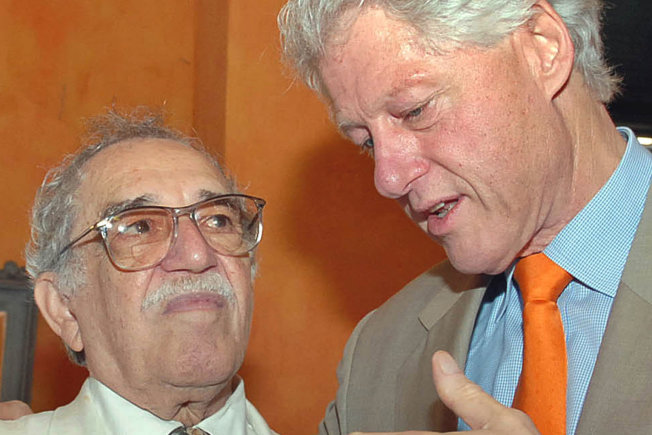
As part of the process, I decided to have Bennington compose a high school research essay on Chronicle, which, of course, meant I actually had to do a bit of research.  I discovered a fascinating piece from Salon by Gabriel Garcia-Marquez about his first meeting Bill Clinton at a dinner party at William Styron’s on Cape Cod that also featured Carlos Fuentes.

When [Carlos and I] talked about Latin America in general, we realized that
[Clinton] was much more interested than we had supposed, although he
lacked some essential background. When the conversation seemed to
stiffen a bit, we asked him what his favorite movie was, and he
answered “High Noon,” by Fred Zinneman, whom he had recently
honored in London. When we asked him what he was reading, he
 sighed and mentioned a book on the economic wars of the future,
author and title unknown to me.

“Better to read ‘Don Quixote,’” I said to him. “Everything’s
in there.” Now, the ‘Quixote’ is a book that is not read nearly
as much as is claimed, although very few will admit to not having
read it. With two or three quotes, Clinton showed that he knew it
very well indeed. Responding, he asked us what our favorite books
were. Styron said his was Huckleberry Finn.

I would have said Oedipus Rex, which has been my bed table
book for the last 20 years, but I named The Count of Monte
Cristo,”mainly for reasons of technique, which I had some
trouble explaining.

Clinton said his was the Meditations of Marcus Aurelius, and Carlos Fuentes stuck loyally to Absalom, Absalom,
Faulkner’s stellar novel, no question, although others would
choose  Light in August purely personal reasons. Clinton,
in homage to Faulkner, got to his feet and, pacing around the
table, recited from memory Benji’s monologue, the most thrilling
passage, and perhaps the most hermetic, from  The Sound and the
Fury.

Faulkner got us to talking about the affinities between
Caribbean writers and the cluster of great Southern novelists in
the United States. It made much more sense to us to think of the
Caribbean not as a geographical region surrounded by its sea but
as a much wider historical and cultural belt stretching from the
north of Brazil to the Mississippi Basin.

Mark Twain, William Faulkner, John Steinbeck and so many
others would then be just as Caribbean as Jorge Amado and Derek
Walcott. Clinton, born and raised in Arkansas, a Southern state,
applauded the notion and professed himself happy to be a
Caribbean.

* * *

As I was sipping on an “All -Day IPA” at Chico Feo in those amiable days before the pandemic, a polite young couple plopped down next to me at the bar. The male was unusually clean cut for the clientele, with short well-kempt hair and sporting some subdued ink on his right arm. His lovely companion spoke with a slight accent, so I asked her where she hailed from.

“Colombia.”

“Ah ha,” I said, “the homeland of the great Gabo – Gabriel Garcia-Marquez!”

“He is dead, you know,” she said with a rueful smile.

So we shot the mierda about the great man’s canon, of which she was very familiar, and that wonderful little magical village Macondo, Gabo’s Yoknapatawpha County, and I mentioned that even though Ronald Reagan wouldn’t give Gabo a visa to visit the US , he and Bill Clinton ended up being drinking buddies. I mentioned Gabo’s comment about Southerners and Caribbean folk sharing folkways and attitudes.

Given that probably most people associate Colombia with drug cartels, I suspect it was nice for her to hear praise for her homeland, and suddenly it occurred to me that Gabo was right, that the eastside of Folly was Mercondo-like. I have Folly friends with a parrot who tortures their dogs by mimicking both the owners’ accents, asking the dogs if they’d like to go for a walk, and then the parrot does a dead-on sound effect of a screen door creaking open. Magical realism right here in the Lowcountry.

“Especially this place,” she said, talking about Chico Feo. It reminds me of home.”

No roof, beers sold out of coolers, the aroma of curried goat wafting from the kitchen inside, free music, day and night . . .

Oh me oh my oh, Chico Feo.

I shook hands with them both and waved good-bye

My Colombia sister

My Colombia sister


The Screaming Js Address Same Sex Marriage at Our Lady of the Chico Feo

Proponents of traditional marriage have suffered legal setback after setback in the last couple of years as the populace has undergone a sea change in its opinion of whether or not people of the same sex should enjoy the emotional and legal benefits of marriage.

As a high school English teacher, I’ve witnessed this shift towards tolerance toward homosexuality firsthand. As recently as the early 90’s, gay students (and even non-athletic males) suffered taunts — some muttered, others clearly voiced — about their presumed orientation.   The word “gay” was often used as a pejorative term, as in that song or that shirt is “so gay.” However, nowadays, I never hear “gay” used pejoratively, and even more positively, gay students are treated with respect (at least in the halls and classrooms). This spring, I assigned an essay that prompted students to find an op-ed piece with which they disagreed, to analyze its reasoning, and to rebut its arguments. Out of 37 students, three students (two boys and a girl) chose to defend same sex marriage.

Not surprisingly, opponents are up in arms. The National Organization for Marriage is planning a march on Washington next week to show the nation they have not given up what they consider a holy war. Of course, many of these folks base their arguments on Judeo-Christian scripture, which they claim corresponds with natural law.

Take it away Bishop Morlino of Madison, WI:

Marriage is, and can only ever be, a unique relationship solely between one man and one woman, regardless of the decision of a judge or any vote. This is not based on any private sectarian viewpoint, but on the natural moral law that is universally binding on all peoples, at all times, and inscribed into our human nature, as man and woman from the beginning of creation. It behooves us to safeguard the sacred ecology of all nature, especially of our human.

Huh? Not based on “any private sectarian viewpoint” but “on natural moral law?” Obviously, the Most Reverend slept through his anthropology classes and skipped those OT passages written in the heyday of polygamy. Furthermore, his argument ignores evolution with the idea of “natural law inscribed into our human nature.” All in all, it’s preposterous.

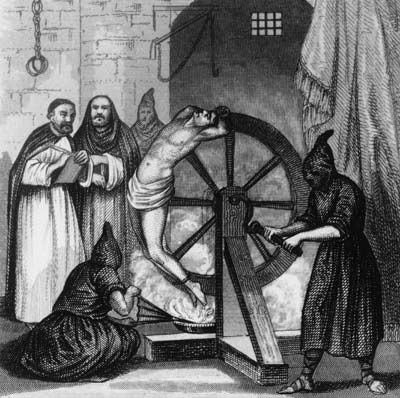
Then, there are the whiners. Here is Doug Mainwaring playing the persecution card. (I would like to point out to him that if he thinks what he describes is persecution, he ought to read a history of the Inquisition). He writes

No tactic of the powers opposing Judeo-Christian mores has proven more effective than political correctness. Why? Non-adherents are threatened with social isolation and anaclitic depression. Thus, the peer pressure that dominates middle schools, high schools, and college campuses retains all its horrifying power [ my emphasis] to intimidate American adults, causing multitudes to suppress free inquiry.


A sufferer of the4 "horrifying power" of political correctness

The horror of politically correct torture


Good old fashioned torture from the Inquisition

Good old fashioned torture from the Inquisition


At any rate, in Late Empire America hedonism trumps unscientific dogma any day of the week. I’ll give the Screaming Js on the final word on the subject. They preached this sermon last Sunday night at Our Lady of the Chico Feo.


Chico Feo, TS Eliot, Joseph Conrad, Lost Souls, & I-and-I

For whatever perverse reason, I prefer dives to tony bars and restaurants. The same goes for neighborhoods. You couldn’t pay me to live on Kiawah or Daniel Island. The manicured bicycle paths, the antiseptic standards of what is allowed architecturally, the non-diversity of income and outlook, and the bland, vowel-less intonations of their residents and tourists would produce in me fogbanks of despair.

Nor would I want to live in an upstate mill village where all the small clapboard houses have the same floor plan and everyone twangs vocally the verbal equivalent of out-of-tune banjo strings.

No, what I like is diversity, the mixed neighborhoods of the Upper Peninsula and the non-gated barrier islands. So I’m very happy here on Folly where a million dollar house might stand next to quaint cottage or a ramshackle two-story paint-peeling survivor of Hurricane Hugo, happy to live in a community where trick-or-treating is forbidden because the poorly lighted streets have no sidewalks and vehicular traffic can be, well, unsteady.

Like the various options in housing on Folly, the island also offers a variety of drinking and eating establishments, and since the closing of the Brew Pub on Center Street, my favorite hangout is Chico Feo, an outdoor Caribbean “restaurant” whose limited menu consists of curried goat, Dominican beans, or shark or pork tacos. In the unlikely case you’re an old-time Charlestonian, think Captain Harry’s without walls or a roof. Like Captain Harry’s, beers are sold out of coolers and the seats are not very comfortable.

Click the arrow in the frame above for a panoramic pan of Chico Feo

Counting the left turn onto Second Street, Chico Feo lies a mere six blocks from my house, so I ride my bike there, weaving my way through the clogged cars of day trippers to enjoy a brew or two beneath the overarching trees – and maybe, just, maybe, to knock off six or so essays.

Yesterday, however, I left my stack of essays at home [‘”Argue that Conrad’s Heart of Darkness can be read as the debunking of stereotypes found in Rudyard Kipling’s ‘The White Man’s Burden”‘] and carried with me instead Hugh Kenner’s 1964 book TS Eliot: The Invisible Poet, my journal, and a trusty pen.

Chico Feo attracts locals – a homeless man named Greg, surfers in their late twenties and beyond, musicians, C of C alums/dropouts who never left (damn them), and Folly residents like me – and, yes, many of us are indeed “ugly boys” in keeping with the English translation of the bar’s Spanish name.

After the bartender Charlie provided me with my Bell’s IPA, I found an empty table with a view of Second Street where I could watch locomotive skateboarders with backpacks glide past the mural of Bert the Pirate that graces his iconic market, or I could cast my critical eyes on the never ending parade of pedestrians headed either to or from the beach.

images-2

Yesterday, inside the friendly confines – and Chico Feo is incredibly friendly – the bar was occupied with an eclectic group of imbibers: a limping, bearded 50-something sporting a straw cowboy hat, a slender long haired surfer dude, and a group of already-over-the-hill 20-somethings with expanding hips and incipient beer bellies.

On the large picnic table a tableaux of young, middle class hedonists bowed down looking at their cell phones in the attitude of prayer. The temperature was perfect, and the onshore breeze provided a bit of respite from the gnats.

So I opened Kenner’s book and began a chapter devoted to the philosopher Francis Herbert Bradley’s influence on Eliot’s thought and came upon this passage:

My external sensations are no less private to myself than are my thoughts and feelings. In either case my experience falls within my own circle, a circle closed on the outside, and, with all its elements alike, every sphere is opaque to the others which surround it [. . .] In brief, regarded as an existence which appears in a soul, the whole world for each is peculiar and private to that soul.

I looked up from that passage and caught sight of one of the most grotesque human beings I’ve ever encountered.

Where to begin?

The words “obese” and “corpulent” don’t begin to do justice to this shambling Rabelaisian, Falstaffian 400-pound 25-year-old. All he wore was a pair of board shorts that clung precariously an inch or two below the broad expanse of the Brobdingnagian belly that sagged and quivered with every painful, bare-footed step he took on sun-blistered feet and legs. I’ll forego a description of his breasts – let it suffice to say they drooped the way you might imagine Mae West’s drooping in her Myra Breckinridge era. I could see from where I was sitting that he was stoned or tripping or worse.

I returned to Kenner ‘s take on TS when I heard, “Hey, man, how’s it going?”

My deafness has gotten so bad that I didn’t even notice that the giant had pulled up at my table.

I looked up, and there he was sitting, his blue eyes as vacant as a Detroit warehouse, glazed, abnormal.

He commenced a monologue of his surreal misadventures of the previous 24 hours, which I’ll summarize as briefly as possible.

Someone had offered him an LSD-laced drink because they wanted to kill him because he had come here from Kentucky to make and sell art, i.e., sun hats made out of palmetto fronds. They had drugged him, and he had passed out on the beach. He was supposed right now to be with some “sweet honey” from Summerville [I’m ashamed to admit I tried to imagine what contortions must take place to achieve heterosexual intercourse with this man], but now he’s lost her forever, and he remembers the night before gaining consciousness in a restroom downtown washing his hands and screaming, “The water is scalding my hands!”

I patiently listened as I sipped my beer, nodded my head sympathetically, muttered an occasional, “wow-that-sucks.” Finally, when the beer was done, I bid him good-bye and wished him better luck.

Alienation – the great theme of 20th century literature – “every sphere is opaque to the others which surround it” – or as Marlow puts it in Heart of Darkness, “No it is impossible; it is impossible to convey the life-sensation in any given epoch of one’s existence – that which makes the truth, its meaning – its subtle and penetrating essence. It is impossible. We live, as we dream – alone.”

Or as Eliot himself puts it in “The Waste Land” :

I have heard the key

Turn in the door once and turn once only

We think of the key, each in his prison

Thinking of the key, each confirms a prison . .

The image that stays with me is that of those friends around the picnic table together but apart, prayerfully bowing their heads as they stared into their cell phones – an image of our times.


Follow on Twitter @ragwatercat