Emma Bovary Meets the Hardy Boys

Obviously, I’m a huge fan of the novel as a literary genre. Just the other day, I was explaining to someone at Chico Feo how literary novels can be treasure troves of vicarious experience because they feature lifelike characters who behave like real people.  These novels aren’t didactic, but by co-experiencing Emma Bovary’s tragic vanity, you might glean that fabricating a persona through conspicuous consumption is not the way to go. 

In other words, rather than discovering through personal experience that purchasing a vintage Rolls Royce Silver Shadow will likely destroy your credit and leave you destitute, you can witness rabid Emma’s spending sprees, yet not personally suffer the consequences of her foolhardiness.

Of course, part of Emma’s problem is that she mistook the romance novels she misread as real life, the way I misperceived the Long Ranger as real life when as a five year old in Biloxi, Mississippi, I leapt from the top of my chest of drawers onto a rocking horse that catapulted me face first on a wooden floor, a hard lesson (literally) in appreciating the difference between illusion and reality. If I had read about a fool boy doing that in a book, I never would have tried it myself.

As Laurence Perrine states in his wonderful textbook Literature, Sound, Structure, and Sense, “inexperienced readers” [of commercial fiction] want their stories to be mainly pleasant. Evil, danger, and misery may appear in them, but not in such a way that they need be taken really seriously or are felt to be oppressive or permanent.”  A steady diet of happy endings could inculcate in an unsophisticated reader (or movie goer) the misperception that things always work out.  

In other words, evil, danger, and misery need to be taken very seriously.[1]

Of course, the puritans, those “vice crusaders farting through silk,” who have taken over the schoolboards in our budding authoritarian state are aware of the potential for fiction to alter attitudes.  For example, reading a novel that portrays a gay teenager as a decent, sincere person doing her best to navigate the perilous journey of adolescence might suggest to a homophobic sixteen-year-old that gay people are worthy of respect and empathy. 

The vice crusaders certainly don’t want that.

Just for the hell of it, after rereading Jo Humphrey’s brilliant but under-appreciated novel Fireman’s Fair –set in the disorienting wreckage of post Hurricane Hugo Charleston – I switched to escapist fiction, and for the first time since I read it out loud to my sons, ripped through the Hardy Boys series’ first title The Tower Treasure.

Whereas Jo’s book featured an array of well-rounded characters, The Tower Treasure trots out a series of underdeveloped static, one-dimensional mouthpieces: the indulgent dad, ace detective Fenton Hardy, his wife, a homemaker who doesn’t merit a first name because all she does is make sandwiches, and the boys themselves, Joe and Frank, and their various “chums” and female friends.

(A sidenote to budding fiction writers: avoid elaborate dialogue tags like “‘You’re elected,’ the others chorused.'”[2])

Truth be told, I actually enjoyed The Tower Treasure, which, despite its flaws, boasts a fast-moving plot that creates temporary suspense, but I never feared that the one of the two helmetless boy detectives would crash his motorcycle and end up a paraplegic.

And, of course, the novel also offers sociological insights into the attitudes of White people in the early 20th century and how those attitudes changed as the series progressed through the decades, e.g., Mrs. Hardy’s earning a first name –– Laura –– and eventually working outside the home as research librarian.

Someone (but not me) should do a scholarly paper on how the Hardy Boys novels reflect the social mores of their times and how those changing mores are reflected in changes in the novels’ depiction of the white enclave of Bayport, a city in New York in some novels and New Jersey in others.

After all, the ways things are going here in the dumb-downed US, the Hardy Boys may replace Animal Farm as required reading.


[1] Just last week a cook a Chico Feo, Jorge, who had a valid visa and a green card, was apprehended by ICE as he played by the rules by visiting his immigration office. ICE handcuffed him and swept him away to god knows where.  I don’t foresee a series of hairbreadth escapes in his future but, rather, disorienting displacement, maltreatment, in sum, a horrible existence. A novel dramatizing his sad journey could offer insights into the human condition; however, although an action novel depicting his escaping might be fun to read, it would literally be escapism, a means to avoid our everyday humdrum. 

[2] That the six “youths” in the scene all “chorus” the exact phrase “you’re elected” is distracting and Hindenburgs my suspension of disbelief.

Deaf Heaven, Bootless Cries, Sha La La La La Live for Today

Like the recurring characters in Cheers, I show up most afternoons at what the quaint call “a local watering hole.”  Chico Feo, my bar of choice, is one part Cannery Row, one part Key West tourist mecca, one part – as far as the cooks and bartenders go – extended family.  

I enjoy watching people interact, hearing the latest gossip, and, if the opportunity arises, engaging tourists with meaningful conversations. After all, I suspect my obituary will mention that among other things I was a fiction writer, and as I often inform total strangers, I’m constantly gathering “data” about this and that, which I might use in creating a character. It’s a way to justify my personal questions about their lives.  To me, constructing characters that readers care about is the most gratifying aspect of fiction-writing.

Unfortunately, today I happened to sit next to a borderline asshole. He was in his late 20s sporting muscles, tattoos, and the ubiquitous baseball cap worn backyards.  On the plus side, he might end up in one of my stories and receive the karmic comeuppance he deserves. 

Solle, perhaps the most effective bartender I’ve encountered in a drinking career that spans over a half a century, asked me how my book promo TV interview went, and the aforementioned borderline asshole said, “I saw it!”

I informed the borderline asshole that his having seen it was impossible in the current space/time continuum because the interview hadn’t aired yet.  Then he said, “I saw you at the studio.”  It occurred to me that he might be a camera person, so I asked him if he worked for FOX 24, and he said, laughing, “No, I’m just fucking with you.”

I was not amused.

He and his friend started talking about how great it must be to live on Folly, and I agreed it was, that I was very fortunate.  They live in West Ashley, and I said that was a convenient place to live because it’s near everything – the airport, downtown Charleston, Folly itself.

A few minutes later, the borderline asshole asked me what the book was about, so I clicked off some sound bites from the interview.  “It’s a memoir,” I said, “but it’s as much about the South as it is about me – antebellum plantations, shotgun shacks, Pentecostal churches, juke joints.  It’s a collection of short stories, essays, and poems, each of which can stand alone and be enjoyed separately, but if you read it cover to cover you get a history of the South from segregation through the civil rights movement and the cultural revolution of the 60s.”

“Wow, you must be a racist,” he said.

“What!!!??? Why do you say that?”

“If you’re not a racist, then why aren’t you?”

“Why not, because I grew up with Black people. I like most of them I’ve met.”

“I’m a racist,” he said.

No doubt I was scowling, because he immediately said, “Ha, ha, I’m not really a racist. I’m just fucking with you.”

Dark clouds were scudding overhead, so I decided it was time to walk home, which takes me past a melancholy memorial marking the spot where someone named Phillip died in a traffic accident.  For some reason – maybe because before I left the bartender Katarina clasped her hands in mock prayer asking the skies not to rain – my inner poetic jukebox cued a line from one of Shakespeare’s sonnets: “And trouble deaf heaven with my bootless cries” and then a line from A Midsummer’s Night’s Dream followed: “Chanting faint hymns to a cold fruitless moon.” And finally, a line from a Grass Roots song that I don’t even like: “Sha la la la la la live for today.”

I took a right on Erie, and as coincidence would have it, I encountered an interracial couple pushing a baby stroller. They were taking up the entire right hand lane, so I suggested they walk on the left so they could see the traffic coming.  The red-haired woman and her husband smiled. She said, “Thanks, but we’re staying right here” and disappeared into the yard of a rental.

So much for my mansplaining.

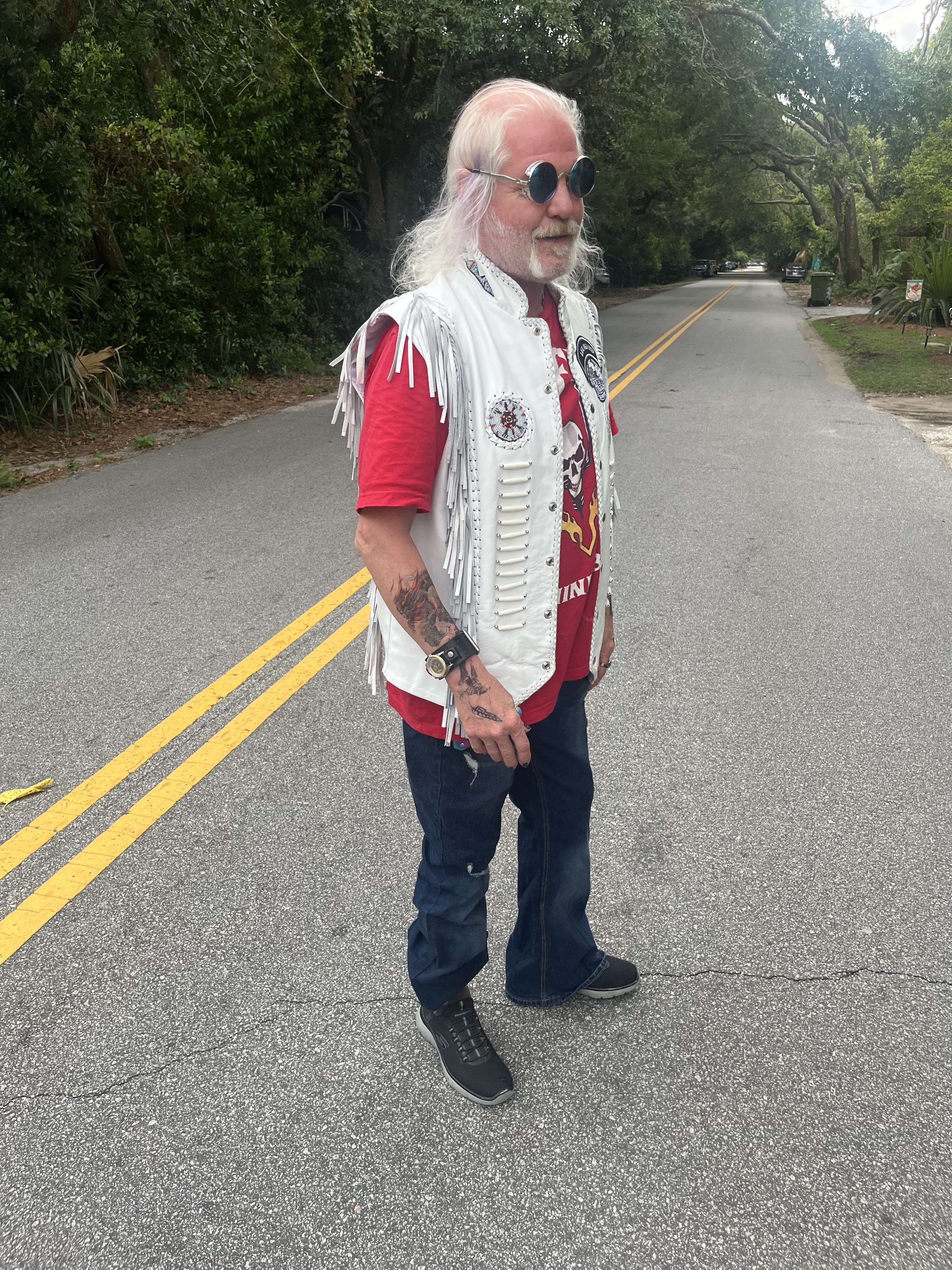
I decided to cross over to Hudson using a tree embowered beach access path and spotted through the tree tunnel a couple weaving past on skateboards.  Once I hit 5th Street, I bumped into my neighbor Lance.  I asked him about his outfit, a white fringed patch-bedecked vest over a red tee shirt emblazoned with a skull, and he explained the various patches and emblems.

As I said good-bye, he said, “I love you, man,” which was a nice way to end my excursion.  

Fa la la la la, live for today.

In a Retro-Futuristic Tawdry Sort of Way

You know how some literates, English majors and their ilk, just for the sake of argument joust about whether we’re living in Huxley’s Brave New World or Orwell’s 1984?  

Well, this afternoon Chico Feo is giving off some heavy Huxley vibes. Workers off-the-clock loll in full self-expression, tattoos mapping their life histories in hieroglyphic fashion. A 21st Century version of a Pre-Raphaelite model, wan with auburn ringlets, sits across the bar from me hitting on her vape every now and then, vacant eyed but sort of beautiful in a retro-futuristic tawdry sort of way. I think she is what Aldous had in mind. Across the street at Berts you can buy blunts stuffed with Delta 8 and toke on them in public.

Oh, brave new world, indeed.

Meanwhile, a few billionaires (like the Fords) command a ridiculously disproportionate portion of global wealth, but few of them cotton to giving up not even a sliver of it, especially through taxation. These powerful people – the opposite of folk – possess the means to “dope [us] with religion and sex and [the internet”], to update John Lennon’s “Working Class Hero.”  TGIF is the rallying cry of drudges content to go with the status quo. It’s so ingrained that even though I’m retired, I still look forward to Fridays.

Huxley prophesized pleasure, drugs, sex, and swing music, which morphed into rock-n-roll, disco, hip-hop, and all the jazz. All of it literally at my fingertips as I key “In-A-Gadda-Da-Vida” into Spotify.

But that’s in the USA.

Iran, Russia are North Korea are bigtime Orwellian. Not many dropping Soma In Pyongyang. skinny dipping in Tehran, or thumbing their noses at Big Brother in St. Petersburg.

But let’s face it, the US is also Orwellian, but in more subtle ways. It’s not so much Big Brother is spying on us, but that we’re spying on ourselves, paying AT&T, Verizon, and Apple to track our every move, tallying the number steps we’re taking as surveillance cameras video us from storefronts. Computer-equipped automobiles clock our speed as we bounce down dirt roads up to no good. Alex Murdaugh can attest to that.

The good news – and it’s very good news – is that we have freedom of speech. I can burn a Chinese made American flag and not be dragged off to a Gulag while wearing a vulgar tee shirt mocking the President, the Pope, and/or the Dalai Lama. I might get punched in the face or shot by a fellow citizen, but the government will not be coming after me.

So cheers!

A Little Madness in the Spring

A Little Madness in the Spring

I recently ran across a balding fellow, probably in his early forties, wearing a grey too-snug tee-shirt that read “Every Day Is a Good Day.” Of course, I get the subtext: life is miraculous on the cosmic impersonal plane – the nighttime sky, as Hamlet put it, a “brave o’erhanging firmament, [a] majestical roof fretted with golden fire,” not to mention down below “the beauty of the world, the paragon of animals.” We should be thankful for the chain of events that gave rise to a consciousness that allows us to appreciate and contemplate these wonders around us. The subtext of the subtext is that this wonderfulness is the handiwork of a benevolent deity. Every day is a good day because it’s a colorful shard in the ever-shifting kaleidoscope of a creator god’s abracadabra. 

But, as we all know, a day’s goodness or badness depends on an individual’s experience during that 24-hour period. For example, at Chico Feo I just heard a horrific account of a traffic fatality that happened on Folly Beach last night. A car crammed with six drunks doing 65 in a 25-zone barreled into a golf cart driven, as the story was told to me, by a woman who had just gotten married that very day on the island.[1]

So, I might suggest, that the tee shirt’s message be edited: “For me, every day is a good day” instead.

And print this on the back.

A little Madness in the Spring
Is wholesome even for the King,
But God be with the Clown —
Who ponders this tremendous scene —
This whole Experiment of Green —
As if it were his own!

                                    Emily Dickinson


[1] The fellow who related the story said she was in her bridal gown.

St James Infirmary iPhone Blues: A Reading

Here’s a video of my reading my original poem “St. James Infirmary iPhone Blues” on February 6 2023.

St James Infirmary iPhone Blues

Tapping a cane,
Mr. Andre Beaujolais,
with some hoodoo magic
in his front pants pocket
bopped down St. Charles
on his way to see
Miss Hattie Dupree,
the one-time lover
of McKinley Morganfield,
better known as Muddy Waters,
King of the Chicago Blues.

Those who got bad mojo
go see Miss Hattie Dupree
for the inside dope
in the hope of counteracting
shenanigans ¬– hexes,
curses, drywet nurses,
vexations, permutations,
marital relations.
genetic mutations,
Haitian sensations,
and genital truncations.

Mr. Andre Beaujolais
was on his way
to deliver a batch
of John the Conkeroo juice
to help some dude
whose private
conversations had
been swiped by
advertisers, enterprisers,
franchisers, monopolizers,
and merchandizers.

He’d been telling his gal
about Blind Willie McTell,
how the Dylan song
by the same name
was sung to the same tune
as St James Infirmary Blues.
Their moment of intimacy
the next day mysteriously
appeared in an ad
for a book being peddled
on the dude’s Facebook page.

“I Went Down to the
St, James Infirmary:
Investigations in the shadowy
world of early jazz-blues
in the company
of Blind Willie McTell, Louie Armstrong . . .
where did this dang song
come from anyway?
“That title don’t trip off the tongue,”
Mr. Beaujolais said when
he heard the dude explain.

“Hand me your phone,” Andre said,
then took off its cover,
whupped out the Conkeroo juice,
poured it all over the device,
mumbled some mumbo jumbo.
“Ta da! problem solved!”
“Wait a minute, “the dude complained.
My phone’s not working!”
“No shit,” Mr. Andre replied.
“That’ll be fifty dollars.
I’ll accept ten fives.”

Sports Tribalism, Ear Worms, and Falling Acorns

One of my many irritating habits is repetitively singing/reciting snatches from old songs or jingles or poems that have risen from the playlist of my inner jukebox and loop through my consciousness like irritating commercials that repeat time and again during a television broadcast.

After yesterday’s unexpected Gamecock triumph over the 14-point-favorite Clemson Tigers, a line from Warren Zevon’s “When Johnny Strikes Up the Band” took up repetitive residence in my mind. 

“They’ll be rocking in the projects.”

I sang that line out loud at two or three junctures during my six-block trek to Chico Feo, and it is what came out of my mouth as I mounted a bar stool and received my first All Day IPA from Casey. He gave me a quizzical smile. I explained I was happy because the Gamecocks had finally beaten the Tigers after eight long years so I had a song in my heart.

Sitting to my right were twenty-eight-year-old identical twin Kelsey McCormick, a Chico regular, and a young man I’d never met. We started talking sports, and I confessed that although I intellectually understood the atavistic absurdity of team sports tribalism that I whooped and hollered when the Cocks recovered that late fourth quarter Clemson fumble.

“They’ll be rocking in the projects.”

The young man, whose name is Zac, asked me if I was watching any of the World Cup. I said I was paying secondhand attention to the outcomes and was pulling for Germany because my sons had gone to school there, one in Berlin and the other in Bamberg. I mentioned that Ned is currently living in Nuremberg.

Ned (second from right) on an ad for a bar in Bamberg

Kelsey asked me to guess where Zac was from based on his accent. “Three guesses,” she said.

I guessed Minnesota, California, and Goose Creek, South Carolina.

Zac smiled and said, “Pretty Close. I’m from Montana and lived in Seattle and also Phoenix and for a short time in Sweden.”

I asked him what he did for a living, and as it ends up, he had just retired from professional soccer as a goalie.

So, I had been oldmansplaining the tribal nature of sports fans to a professional athlete, a somewhat famous one as far as American soccer goes.

Zac Lubin

He asked me about my line of work, and I said that I had a novel coming out but had taught English for thirty-four years before my retirement. Kelsey mentioned that she had heard me read poetry at the Singer/Songwriter Soapbox and enjoyed my stuff but was less enamored of the some of the other poets she had witnessed. I mentioned two superb poets, Chuck Sullivan and Jason Chambers, but admitted one or two of the other poets read prose chopped up in lines that lacked the compression that makes a poem a poem.  I mockingly intoned:

As I walk around the grounds of the asylum,

the brown leaves like a carpet in a boarding house,

I think of father’s irritating habit of smacking his lips

while smoking unfiltered Chesterfields.

Kelsey got it. “The more condensed the more powerful.”

“Like splitting an atom as opposed to sorting socks.”

Then I leaned over and asked if they wanted to hear my favorite lines of poetry. I mean, what could they say?

O chestnut tree, great rooted blossomer,

Are you the leaf, the blossom or the bole?

O body swayed to music, O brightening glance,

How can we know the dancer from the dance?

And right at that moment, an acorn fell from the sky and bonked Zac right on the head.

Zac asked about the possible meanings of the acorn hitting him at that moment. and I explained that in a piece of short fiction, you could have acorns fall periodically and serve as symbols that support the theme and provide unity. In a comedy, it could be funny, the acorn hitting him on the head, like a cartoon Sir-Isaac-Newton epiphany, that he was in love or something.

“An acorn’s a seed, right?”

“Right, Zac! The acorn seed sperm hits the ovum of your head. It’s a very good omen for your relationship’s growing.”

“On the other hand,” I went on, “in a sad story the acorns could represent failure, dropping off the trees, rolling across the bar, down across the cooler, onto the ground to be crushed by the bartenders’ feet as they concoct Samurai slings and pull drafts.”

Kelsey asked what advice I’d give a 28-eight-year-old and a 33-year-old.

“Find someone to love, be kind to them, marry them, have children, and be happy around the children.”

We sat there quietly for a while.

“Hey, Wesley,” Kelsey said. “You haven’t asked what advice a 28-year-old would give a 70-year-old.”

I smiled. “What’s your advice?”

“You get to decide how old or young you get to be. It’s up to you. I mean, mentally how old you want to be.”

I said that teaching keeps you young, and I was appreciative of that.

We finished our drinks and said our goodbyes, Zac was headed up to Montana Monday, and Kelsey would be at the Soap Box. He plans on moving down here and starting a soccer-related business.

Kelsey wanted to know if Zac fit in at Chico Feo. “Desitively,” I said. “He’ll be rocking in the projects.”

Pernell McDaniel at Chico Feo

photo credit George Fox

One of the premier artists at Chico-Feo’s Singer/Songwriter open mic Mondays, Pernell McDaniel performs a wide range of originals. Whether he is singing about his beloved grandfather, star-crossed interracial couples, or the abundant goods available at Bert’s Market, his melodies and lyrics seamlessly meld into well-crafted crowd pleasers.

Here he is performing “The Ballad of Chris and Willy” on 19 September 2022.

The lyrics appear beneath the video.

Enjoy!

THE BALLAD OF CHRIS AND WILLY

On the other side of the tracks
On the shady side of town
Two young bucks worked a corner spot
Sharing their love around
Pimpin’ riffs and rhymes
And layin’ down beats and tracks

Chris and Willy made their way
Climbin’ each others backs
Scrapin’ and scratchin’ A
nd tryin’ to get ahead
Where street cred and the dollar bill
Was all the pride they had

And then the big time struck
Like a lightning bolt
And they got swept away in the fray
Not knowin’ that their crooked paths
Would cross again one day

Chorus

Yeah, Chris and Willy had a lifelong feud
Kinda like they never had Nothin’ much better to do.
But, Chris and Willy Never had a real fight
Until a bald headed woman Came between ’em At the Oscar’s one night

Willy married a time or two
And wound up with a chick named Jada.
She was a swinger with alopecia.
She was low hanging fruit for a hater.

Chris got rich on SNL
And later on the silver screen.
His money was green.
But, he was an A-list star
‘Cause his jokes were all so mean.
Then one night at the Oscar’s Willy had a nomination.
And Chris was MC-ing center stage
And tryin’ to be an aggravation.
In a single lapse of judgement
Chris joked about Jada’s scalp.
And Willy stormed the stage
And slapped the taste Out of Chris’s mouth!
Tears filled Willy’s eyes
As he reached his front row seat
While Chris was tryin’ to keep his cool
And checkin’ for loose teeth.
Jada scanned the crowd
Then beamed at Willy in adoration.
But Willy couldn’t let it go
Without one last indignation.
In a voice that thundered Like the cannon fire
When Sherman raped the South He said
“Don’t let my wife’s name Come outa your fuckin’ mouth!”

Yeah, Chris and Willy had a lifelong feud
Kinda like they never had Nothin’ much better to do.
But, Chris and Willy Never had a real fight
Until a bald headed woman Came between ’em At the Oscar’s one night

Screen-Faced Nation

Megan Posey

George Fox’s Monday Night extravaganza known as the Singer/Songwriter Soapbox provides local musicians and poets a venue to showcase their original works, and many of them are damned good, like Jason Chambers, Chuck Sullivan, among a host of others.

Last night Megan Posey recited – not read – recited “Screen-Faced Nation,” a performance you can check out in the video below. This twenty-something has some serious chops. Check her out.

Note: the incompetent videographer [embarrassed throat clearing] didn’t start shooting until the fifth line, but you can read the entire poem below the video.

Screen-Faced Nation

by Megan Posey

I’m reporting to you live from Addictionville, USA

Found in the collective mind of humankind

Where substances and behaviors disguised as property investors

Develop land on top of your bulldozed dopamine receptors

Uppers, downers, booze, gambling, sex, shopping and food

Are just some of the towns long established moguls of real estate

The city was historically inhabited by massive huddles of the tired and poor

And though many transients were lured in by the pleasure and escapism that dangled as bait

It was an exit on the interstate that you would probably just ignore

But that is clearly that is no longer the case

We’ve become a needle-armed, powder-nosed, screen-faced nation.

Pundits are puzzled over what led to the gentrification

But I’d like to shift your attention back to 2010

When we had just demolished OxyContin

And nicotine was undergoing renovation

The cigarette was outdated but we hadn’t yet created

A plan to market vaping to the younger generation.

So there was some land available in town

And a growing family looking to settle down

That’s when Social media began to break ground

And construct their now all-encompassing compound

But look beyond the flimsy facade of connection

And you’ll see an opium den filled to the brim with junkies

Fiending for their next self-esteem injection

This just in

Property crime in the area has now reached an all-time high

Your focus, motivation, and creativity are being jacked in broad daylight

But the truth is you hand them over without so much as a fight

See, you were so scared of getting left behind

That you closed your eyes and got in line with the blind

Until one day you woke up with your head pounding on a cold, hard floor

You tried to escape, but what did you find?

The foyer had turned to a labyrinth of corridors

And there was just no easy way out anymore

Even if you could manage to free your mind

These days you still gotta have at least one foot in the door

It’s sad to watch people waste their whole lives in this podunk town

They’re like stillborns in the underbelly who never started to crown

A real individual could have been born and that’s a hefty cost

But so long as you search outside of yourself for the way

It does not matter what turn you take, you will always end up lost

In the unnavigable wasteland of Addictionville, USA

Ain’t Got You

A aged man is but a paltry thing, a tattered coat upon a stick, so what shall I do with this absurdity, O Heart, O Troubled heart, decrepit age that has been tied to me as to a dog’s tail? What am I gonna do? Make a fool out of myself, that’s what. Here’s exhibit A. The Old Scarecrow Boogie.

Ain’t Got You

I’m sixty-five, got cataracts,
Hump-forming on my back,
A candidate for a heart attack,
But I ain’t got you . . .

Got nurses to the left of me,
Nurses to the right of me,
Nurses all around me,
But I ain’t got you.

Got a wheelchair, a walk-in tub,
Teeth ground down into little nubs,
Got a membership to the Rotary Club
And you lookin’ good in your hot pink scrubs!

Got a closet full of robes,
And no matter where I go
Got hair in my nose.
But I ain’t got you.

But I ain’t got you.
No, I ain’t got you.