 I’ve just sailed through the uncorrected proofs of long-title-lover Elijah Wald’s latest, Dylan Goes Electric: Newport, Seeger, Dylan, and the Night that Split the Sixties. The book is slated for publication on 15 July 2015, almost fifty years to the day after Dylan shocked the Newport Folk Festival by going electric, and I encourage anyone interested in popular music to check it out.
Wald’s previous books include Robert Johnson and the Invention of the Blues and How the Beatles Destroyed Rock ’n’ Roll: An Alternative History of Popular Music. A musician himself, Wald possesses that rare ability to weave meticulous research into engaging narratives propelled by conversational but polished prose. It’s as if someone with an advanced degree in history and musicology who witnessed the events first hand is talking to you.
Wald begins his chronicle in 1949 with the story of Pete Seeger, yet another one of Harvard’s incredibly successful dropouts. We follow Seeger through the ‘40s and ‘50s as he becomes both an archivist of traditional music and a creator of original “folk songs” like “The Hammer Song (If I Had a Hammer)” and “Where Have All the Flowers Gone.” The folk scene of the 50s and early 60s was no love fest, or as Wald puts it, “[The] tendencies and cliques of the American folk scene [. . .] were endlessly tangled, but Seeger served as a guide for virtually everyone, whether they considered themselves traditionalists, revivalists, agitators, or potential pop stars.” Nevertheless, even Seeger himself received criticism from the most rigid of folk purists for associating himself with the Weavers whose polished performances weren’t authentic enough for their tastes.
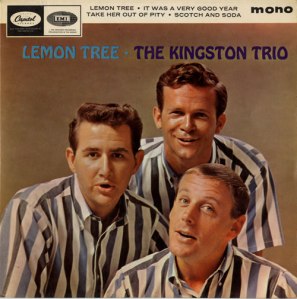 This static between the rawness of down-home renditions by performers like Doc Watson and the dulcet harmonies of groups like the Kingston Trio (arrayed in matching outfits) crackles throughout those decades, and Wald does an excellent job of providing a historical context, especially in his depiction of the Red Scare. Wald concludes the first chapter with Seeger’s sentencing in 1961 for contempt of Congress when he refuses to name names of associates with connections to the Communist Party.
The next few chapters detail the familiar but time-obscured transformation of Hibbing-bred Bobby Zimmerman into that self-created icon we call Bob Dylan (whose fanciful verbal autobiography had him hoboing his way across the continent). Wald provides some clarification for those early days, noting that unlike many adolescents who were ignorant of rock ’n’ roll’s R&B roots, Bobby Zimmerman through late night radio broadcasts, especially Frank “Gatemouth” Page’s No Name Jive, discovered the likes of Muddy Waters and Howlin’ Wolf. Wald notes, “Dylan was getting the music direct from its southern source and valued it in part because it was secret knowledge.” Again, we see tension between the authenticity of artists like John Lee Hooker and the co-opting of roots music by white performers like Elvis and Buddy Holly. That Dylan was enamored of R&B before he became a folk singer is well-known but worth repeating, given his eventual embrace of rock ’n’ roll.
In the chapters chronicling Dylan’s hero-worship of Woody Guthrie, his move to New York, his ascent, and eventual coronation as once and future king, we see the continuation of the motif of contention among the folk music community, and at the Newport Folk Festivals of the early-to-mid 60s, these rifts widen into chasms. Wald does a masterful job of relating the events of the festivals, cataloging in detail the eclectic mix of performers that range from obscure yodelers, rock icons like Chuck Berry, blues masters like Lightening Hopkins and John Hurt, Bluegrass legends Bill Monroe and Ralph Stanley, folk interpreters including the Weavers, Joan Baez, and Judy Collins. How fortunate those aficionados who could attend the workshops, scheduled but informal get-togethers where a group of performers swapped songs and provided instruction. Dig this, at the ’64 festival:
“[R]elatively small contingents gathered to hear successive guitar and banjo workshops that included Muddy Waters, Robert Pete Williams, the Hawaiian guitarist Nolan Mahoe, and [Doc] Watson, and then Mike Seeger again with Ralph Stanley, Frank Profit, and Elizabeth Cotton. Meanwhile, over two-thousand people were watching Mike’s half-brother Pete host a topical songs workshop, and although it began with older artists from Ireland, Cuba, and the United States, most of the audience was there for the who’s who of Broadside writers Len Chandler, Phil Ochs, Tom Paxton, Malvina Reynolds, Hedy West, and Dylan.
Among the diverse crowds, we again see animosity of roots music devotees towards college-aged pop fans, and with the British Invasion of the Beatles, Stones, and Animals, folk music had in fact begun its decline in popularity. Of course, the culmination of the schism occurred on Sunday night, 25 July 1965, when Dylan, as Wald title puts it, goes electric.
Wald’s meticulous detailing of previous festivals makes it crystal clear that Newport was no stranger to amplified music. At the ’65 festival, “[t]here were more amplifiers in evidence [. . .], and they were recognized as a sign of change, but few people considered them as a sign of sacrilege.” The Paul Butterfield blues Band played an electric (and by all reports electrifying) set Saturday as an illustration of the amplified Chicago Blues made famous by Muddy Waters. This performance was part of a sonic history of the folk music presented as a lecture by Alan Lomax, and indicative of the animus inherent in the various authenticity camps, Lomax, a stickler for authenticity, and Alan Grossman, a developer of musical acts (and Dylan’s manager), broke into a a clownish bout of fisticuffs over Grossman’s objections to what he considered Lomax’s disrespectful intro of the Butterfield Band. Wald’s depiction of this incident – a sort of kaleidoscopic presentation from various, sometimes conflicting, witnesses’ perspectives – is alone worth the price of purchase. Here’s a snippet:
Lomax tried to push Grossman aside, or maybe it was Grossman who pushed Lomax. Either way, in seconds the portly prophet of tradition and the portly purveyor of mammon — “two big bears,” in Maria Muldaur’s description — were throwing inept punches and rolling in the dust.
 Of course, all of the various in-fighting that Wald writes about leads up to Dylan’s performance that Sunday night. Because of the not so simple existential fact that except for edited film, all we have to go on is a jumble of individual perspectives from various people sitting in different locations with different attitudes towards Dylan and with memories perhaps corrupted by the passage of time. Wald provides us with a sort of cubist painting, sharing with us a host of individual takes, including a present-tense rendering of the film. He suggests that Dylan’s decision to go electric was impulsive. Perhaps it was a reaction to Lomax’s less than glowing introduction of the Butterfield Band whose guitarist Mike Bloomfield had worked on Highway 61 Revisited and its electric hit “Like a Rolling Stone.”
The make-up of the band also suggests a hasty decision. It consisted of a hodgepodge of musicians, some of whom were unfamiliar with the tunes. The drummer Sam Lay had heard “Like a Rolling Stone” on the radio but didn’t know who Bob Dylan was. Almost all agree the volume was ear-splitting, especially Bloomfield’s guitar, and the performance uneven (a charitable assessment) with much time wasted on stage tuning up, struggling with the tempo, getting started. According to Wald, the bassist Jerome Arnold played essentially one note throughout much of the performance. Dylan, who had grown accustomed to being idolized, heard perhaps his first boos since high school, though the boos were mixed with cheers. The proportions of boos to cheers (60/40? 50/50? 40/60?) seemed to depend on where you were sitting.
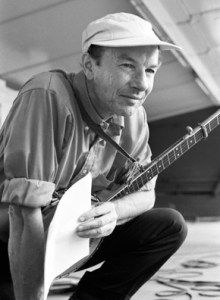
Pete Seeger
Most upset by the debacle of Dylan’s performance was Pete Seeger who is reported by some to have sought shelter in his car or by others to have run around screaming to turn down the sound, and Wald forever puts to rest the apocryphal story of an ax-wielding Seeger eager to sever the cables.
Wald manages to place the reader in the visceral world of that concert, no mean trick, and wisely avoids ever attempting to psychoanalyze Dylan, who as we all know by now is a restless soul who changes the tunes of his classics when the mood suits him. As an extra added treat, Wald slips into his prose without quotation marks phrases from Dylan’s lyrics, as in the following from the last chapter’s first sentence, “For many people the story of Newport 1965 is simple: Bob Dylan was being born, and anyone who didn’t welcome the change was busy dying.” I think we can all agree — or at least almost all of us can agree — Dylan’s genius could never be constrained within the confines of folk. I don’t know about you, but I prefer Highway 61 to Freewheeling.
Note: As I said, I read the uncorrected proofs so the book is bound to be even better than my version. It’s heavily noted, has a bibliography, and although my copy lacked an index, one will appear in the final edition. As far as errors, I only ran across a couple of typos, except for the phrase, which I hope someone catches — “the nameless protagonist of Albert Camus’s Stranger.” The protagonist’s name is Meursault.
 In my boyhood, before adolescence, I began each day by retrieving the newspaper from what we called the front porch, though, in truth, it was more like an elevated stoop, a 6 x 6 concrete slab. If there were a big story, like the suicide of Marilyn Monroe, I’d read it right there, or if there were an untelevised sporting event I cared about, I’d rip open the sports section to discover the outcome. That was the case on 25 February 1964 when Cassius Clay, as he was called in those days, upset Sonny Liston for the Heavyweight Championship of the World. It was the outcome I had fervently hoped for, and it had happened, despite 7 to 1 odds. I remember sitting on the steps of the stoop, reading the account that included the accusation that Liston had thrown some type of blinding powder in Clay’s eyes.




 You Do Hoodoo