Wesley’s Weave: Dark Musings on Election Eve

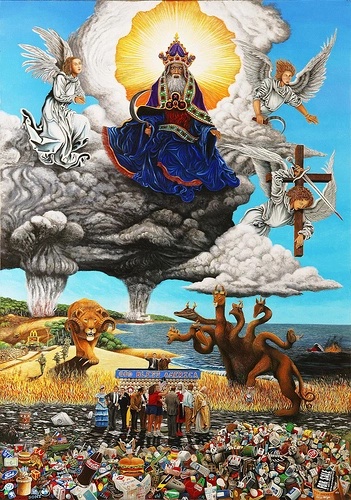
Apocalypse by Adrian Kenyon

Donald Trump has dubbed his rambling speeches “the weave,” claiming that if you connect the dots of his zigzags, a unified picture appears. So I thought I’d give it a try myself.

Here goes.

The other night, after suffering through a self-righteous, ill-informed screed from a Facebook follower, I found myself listening to Bob Dylan’s masterful protest song “Hurricane,” a cinematic narrative recounting the arrest and trial of Rubin Hurricane Carter, a boxer wrongly convicted of a triple homicide in 1966 in Patterson, New Jersey.

Meanwhile, far away in another part of town
Rubin Carter and a couple of friends are drivin’ around
Number one contender for the middleweight crown
Had no idea what kinda shit was about to go down

When a cop pulled him over to the side of the road
Just like the time before and the time before that
In Paterson that’s just the way things go
If you’re black you might as well not show up on the street
‘Less you want to draw the heat

Near the end of the song Dylan sings,

How can the life of such a man
Be in the palm of some fool’s hand?
To see him obviously framed
Couldn’t help but make me feel ashamed to live in a land

Where justice is a game

Now all the criminals in their coats and their ties
Are free to drink martinis and watch the sun rise
While Rubin sits like Buddha in a ten-foot cell
An innocent man in a living hell

As I was listening, the long gone idealism of the 60s came to mind. Dylan himself — and Joan Baez –performed at the March on Washington, sharing the stage with Martin Luther King. They heard firsthand the “I Have a Dream Speech.”  They’re both still alive sixty-one years later.

In 1963, the American people considered communism the greatest threat to the nation’s sovereignty, and the Soviet Union was our greatest enemy whose spy agency the KGB eventually became the employer and training ground for Vladimir Putin, whom Donald Trump so idolizes, along with Kim Jong Un, the North Korean dictator. 

According to Trump, outside forces like Russia and North Korea aren’t the greatest threat to American sovereignty; no, it’s “the enemy within,” American citizens, news organizations, and celebrities tarred with the paradoxical disapprobation “woke.”  It’s Joe McCarthy redux, and McCarthy’s corrupt lawyer Roy Cohn was Donald Trump’s mentor.

Trump and his followers bring to mind WB Yeats’s lines from “The Second Coming”:

The best lack all conviction, while the worst

Are full of passionate intensity.

Fueled by the fifth deadly sin wrath, these resentful white supremist faux Christian cultists seem to prefer a dictatorship of oligarchs to the teachings of their would-be Savoir who famously preached

Blessed are the meek, for they shall inherit the earth.

Blessed are the merciful, for they shall obtain mercy.

Meanwhile,  

The blood-dimmed tide is loosed, and everywhere

The ceremony of innocence is drowned.

Connect these dots and what do you get?

[a] rough beast, its hour come round at last,

Slouch[ing] towards Bethlehem to be born.

The Age of Miracles Rambling Redux Blues

Years ago I saw Barbara Walters interview Jack Nicholson on one of her specials. The British actor Hugh Grant had just been busted for solicitation, so Barbara asked Jack why someone as goodlooking and famous and rich as Hugh Grant would require the services of prostitutes.

Jack donned his patented devilish grin and said, “Peculiarities. Peculiarities.”

Which brings us to Louis CK.

I first caught Louis on the Letterman Show back in the days of VCRs when I prerecorded Dave for civilized midmorning viewing. If I remember correctly, Louis didn’t do standup that night but walked over and took a seat next to Dave. Louis started riffing on the entitlement of whiny airline passengers who carp about minor inconveniences while soaring o’er the plains of Nebraska where wagon trains once rambled through “Injun” territory in months-long treks. 

“You’re sitting in a seat in the air, for Christsakes!”

[c.f. Cormac McCarthy’s Blood Meridian.]

Earlier this evening, perched on a barstool at Chico Feo, I almost texted my wife Caroline, who is in New York City, to complain that my boredom was approaching John Berryman red alert levels:

Dream Song 14

Life, friends, is boring. We must not say so.
After all, the sky flashes, the great sea yearns,
we ourselves flash and yearn,
and moreover my mother told me as a boy
(repeatedly) ‘Ever to confess you’re bored
means you have no

Inner Resources.’ I conclude now I have no
inner resources, because I am heavy bored.
Peoples bore me,
literature bores me, especially great literature,
Henry bores me, with his plights & gripes
as bad as achilles,

Who loves people and valiant art, which bores me.
And the tranquil hills, and gin, look like a drag
and somehow a dog
has taken itself and its tail considerably away
into mountains or sea or sky, leaving
behind: me, wag.

John Berryman

But I didn’t want to darkcloud any fun Caroline was having, and anyway, I got into a conversation with a travelling nurse named Elise who is doing preop duty for a couple of months at Roper Hospital where my late wife Judy Birdsong stayed every other two weeks getting 96 hours of continuous chemo during the first stint of her cancer. Yet, the thing is, I don’t have a negative feeling about Roper. I told Elise how I had come to appreciate the nurses there. They were absolutely wonderful. They knew/know life from a perspective of pain. They are brothers and sisters of mercy. 

I asked her what she was reading. She said she didn’t enjoy reading, had never enjoyed reading, that she would rather “watch things,” so of course I told her I was novelist, which elicited headshaking and a rueful chuckle. 

We continued to make small talk. I asked her superficial questions about her life, thinking I might create a character like her for a minor role in some future fiction, maybe a confidant. I appreciated her forthrightness.[1]

On my walk home, Bob Dylan’s “Just Like Tom Thumbs Blues” got stuck in my head, so I started singing it, walking along singing, checking out the afternoon’s fading, shimmering, almost nervous sunlight. When I-and-I am afflicted by these songs looping in my head, the only cure is to listen to the song as a form of exorcism.

Like Louis CK’s disgruntled flier, I had forgotten that I live in an age of miracles. Now I am sitting in front of my computer listening to Bob sing “Tom Thumb’s Blues” and reading the lyrics against the static background of the iconic Highway 61 Revisited album cover that – look – I’ve conjured from a Cloud and presented below.

But now I realize that for fifty years I have misheard the lyrics. For example, the first line isn’t “When you’re down in Wallace”; it’s “When you’re down in Juarez,” which makes a lot more since given that “Sweet Melinda speaks good English” and “the authorities just sit around and boasts.” In other words, the song is about being down and out in Mexico. I also mistook “Rue Morgue Avenue” for “Remark Avenue,” which I sort of like better. My favorite line from the song is “Well, I started off on burgundy but soon hit the harder stuff,” which I always thought was “hardest,” which definitely would be better, going from burgundy to heroin, instead of going from burgundy to Jim Beam. 

Anyway, I’ve exiled my boredom to an ice floe in Antarctica. “It’s all good,” as the young people say after you’ve bumped into them and apologized.


[1] “Forthrightfulness” ought to be a word. 

St James Infirmary iPhone Blues: A Reading

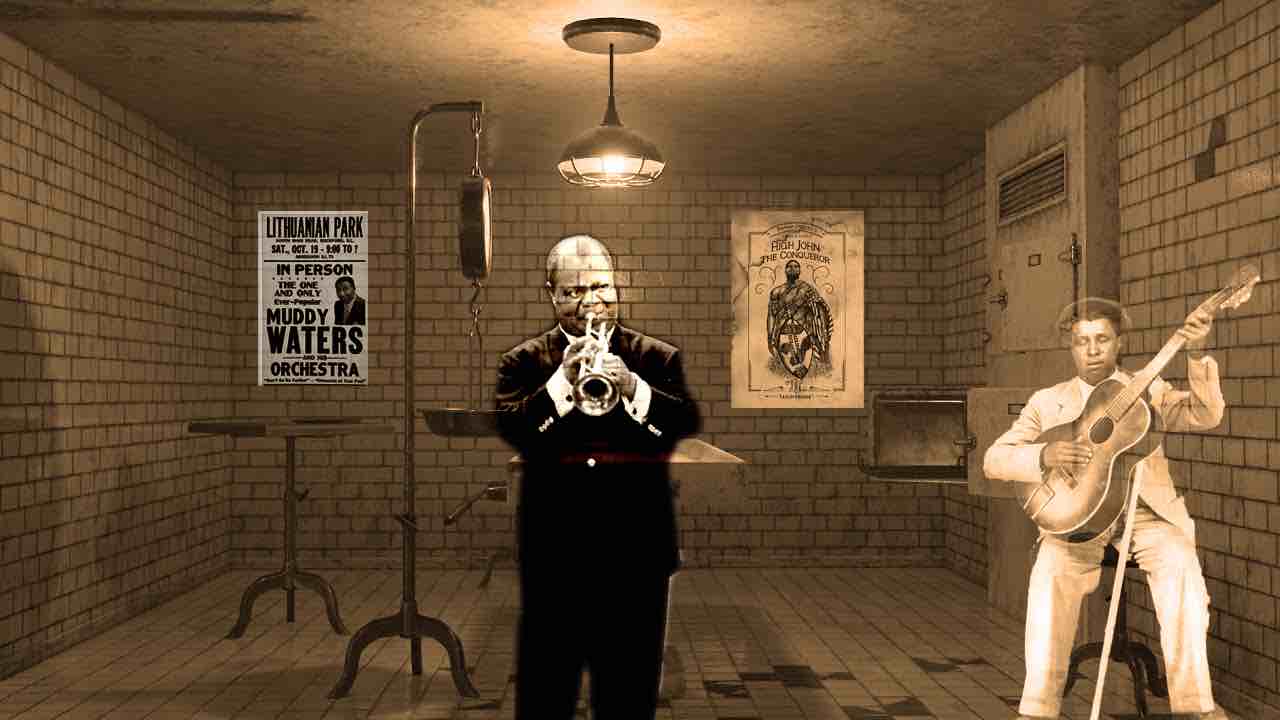
Here’s a video of my reading my original poem “St. James Infirmary iPhone Blues” on February 6 2023.

St James Infirmary iPhone Blues

Tapping a cane,
Mr. Andre Beaujolais,
with some hoodoo magic
in his front pants pocket
bopped down St. Charles
on his way to see
Miss Hattie Dupree,
the one-time lover
of McKinley Morganfield,
better known as Muddy Waters,
King of the Chicago Blues.

Those who got bad mojo
go see Miss Hattie Dupree
for the inside dope
in the hope of counteracting
shenanigans ¬– hexes,
curses, drywet nurses,
vexations, permutations,
marital relations.
genetic mutations,
Haitian sensations,
and genital truncations.

Mr. Andre Beaujolais
was on his way
to deliver a batch
of John the Conkeroo juice
to help some dude
whose private
conversations had
been swiped by
advertisers, enterprisers,
franchisers, monopolizers,
and merchandizers.

He’d been telling his gal
about Blind Willie McTell,
how the Dylan song
by the same name
was sung to the same tune
as St James Infirmary Blues.
Their moment of intimacy
the next day mysteriously
appeared in an ad
for a book being peddled
on the dude’s Facebook page.

“I Went Down to the
St, James Infirmary:
Investigations in the shadowy
world of early jazz-blues
in the company
of Blind Willie McTell, Louie Armstrong . . .
where did this dang song
come from anyway?
“That title don’t trip off the tongue,”
Mr. Beaujolais said when
he heard the dude explain.

“Hand me your phone,” Andre said,
then took off its cover,
whupped out the Conkeroo juice,
poured it all over the device,
mumbled some mumbo jumbo.
“Ta da! problem solved!”
“Wait a minute, “the dude complained.
My phone’s not working!”
“No shit,” Mr. Andre replied.
“That’ll be fifty dollars.
I’ll accept ten fives.”

St. James Infirmary iPhone Blues

I first heard “St. James Infirmary Blues” covered by Eric Burdon and the Animals, and the song really moved me, the horror of it, having to encounter the corpse of your lover “stretched out on a long white table/ So cold, so stiff/ She was dead.” Throughout the years, the song really stuck with me.[1]

The other night, Caroline and I were at the Lowfife Bar on Folly, and somehow the topic of public domain tunes came up. I mentioned that Dylan had borrowed the melody of “St. James Infirmary Blues” for his masterpiece “Blind Willie McTell.” In fact, I sang two verses of the Burdon cover right there at the bar.

Well, the very next day, an ad showed up on my Facebook feed for this book, which I’m eager to read.

Anyway, we can probably chalk up the ad’s appearance to coincidence, but, man, could it be some bot was listening to us via our phone?

Then last night at the Soapbox open mic at Chico a banjo player covered the song. WTF?

So, this morning, during one of my undelightful stints of insomnia, I composed this piece of doggerel in my head, which I consider a more productive use of my time in the wee hours than contemplating politics, my health, the past, or the future.

(BTW, occasionally, a reader accuses me of cultural appropriation one of these paeans to Black culture, but my conscience is clear on that score.)

St James Infirmary iPhone Blues

Tapping a cane,
Mr. Andre Beaujolais,
with some hoodoo magic
in his front pants pocket
bopped down St. Charles
on his way to see
Miss Hattie Dupree,
the one-time lover
of McKinley Morganfield,
better known as Muddy Waters,
King of the Chicago Blues.

Those who got bad mojo
go see Miss Hattie Dupree
for the inside dope
in the hope of counteracting
shenanigans ¬– hexes,
curses, wet nurses,
vexations, permutations,
marital relations.
genetic mutations,
Haitian sensations,
and genital truncations.

Mr. Andre Beaujolais
was on his way
to deliver a batch
of John the Conkeroo juice
to help some dude
whose private
conversations had
been swiped by
advertisers, enterprisers,
franchisers, monopolizers,
and merchandizers.

He’d been telling his gal
about Blind Willie McTell,
how the Dylan song
by the same name
was sung to the same tune
as St James Infirmary Blues.
Their moment of intimacy
the next day mysteriously
appeared in an ad
for a book being peddled
on the dude’s Facebook page.

“I Went Down to the
St, James Infirmary:
Investigations in the shadowy
world of early jazz-blues
in the company
of Bling Willie McTell, Louis Armstrong . . .
where did this dang song
come from anyway?
“That title don’t trip off the tongue,”
Mr. Beaujolais said when
he heard the dude explain.

“Hand me your phone,” Andre say,
then took off its cover,
whupped out the Conkeroo juice,
poured it over the device,
mumbled some discrete mumbo jumbo.
“Ta da! problem solved!”
“Wait a minute, “the dude hollered.
My phone’s quit working!”
“No shit,” Mr. Andre replied.
“That’ll be fifty dollars.
I’ll accept ten fives.”


[1] In fact, I asked Gary Erwin to play it at Judy Birdsong’s memorial service, which he graciously did. BTW, Gary is an underappreciated Charleston treasure.

The Eclectic Musings of Bob Dylan

image courtesy of The Telegraph

I consider Bob Dylan’s Theme Time Radio Hour one of the musical highlights of the early 21st Century. Each week from May 2006 to April 2009, for an hour Dylan aired a sort of parody of an AM radio show, except that the songs weren’t the latest hits from the Hot 100 but an eclectic, carefully curated set of tunes based on particular themes, like drinking, divorce, summer, etc.

Here are the songs from Episode 14, The Devil, compliments of Wikipedia.

  1. “Me and the Devil Blues” – Robert Johnson (1936)
  2. “Satan is Real” – The Louvin Brothers (1958)
  3. “Friend of the Devil” – Grateful Dead (1970)
  4. Devil In Disguise – Elvis Presley (1963)
  5. The Devil Ain’t Lazy – Bob Wills and His Texas Playboys (193 ?)
  6. Christine’s Tune (The Devil in Disguise) – The Flying Burrito Brothers (1969)
  7. Suzanne Beware of the Devil – Dandy Livingston (1972)
  8. Devil In His Heart – The Donays (1962)
  9. Must Have been the Devil – Otis Spann (1954)
  10. Devil’s Hot Rod – Johnny Tyler (1955)
  11. Devil Got My Woman – Skip James (1931)
  12. Between The Devil And The Deep Blue Sea – Count Basie & His Orchestra with Helen Humes (1939)
  13. Devil With A Blue Dress On – Shorty Long (1964)
  14. Devil’s Haircut – Beck (1996)
  15. “Race With the Devil” – Gene Vincent (1956)
  16. “Way Down In The Hole” – Tom Waits (1987)
  17. “Go Devil Go” – Sister Lille Mae Littlejohn (1948)

In between songs Dylan plays the part of an avuncular DJ, telling jokes, taking calls from fictitious listeners and actual celebrities, and most interesting to me, providing oral liner notes on the history of the musicians and songs. Suffice to say that his knowledge of popular music is encyclopedic, as indeed the wide-ranging selection of musicians and genres of Episode 14 suggests.

Dylan brings the same spirit and encyclopedic knowledge to his just published tome The Philosophy of Modern Song. The book, a compilation of observations of 66 songs, runs 339 pages and is richly illustrated with photographs, movie posters, magazine covers, vintage advertisements, postcards, and paintings. Even non-Dylan fans might enjoy flipping through and checking out the illustrations.

Dylan doesn’t really analyze the songs, but instead paraphrases them in riffs often rendered in second person. For example, here’s his take on “Money Honey,”  a Jesse Stone song made famous by Elvis:

“This money thing is driving you up the wall, it’s got you dragged out and spooked, it’s a constant concern. The landlord’s at your door, and he’s ringing the bell.  Lots of space between the rings, and you’re hoping he’ll go away, like there’s nobody home.  You stare through the blinds, but he’s got a keen eye and sees you. The old scrooge has come for the rent money for the 10th time, and he wants it on the double, no more hanky-panky.”

This jaunty, somewhat down-home prose is reminiscent of his DJ persona’s voice (and might be the way he actually speaks for all I know).

And again, as in Theme Tme Radio, Dylan sometimes provides background by the way of bio.

After paraphrasing Eddie Arnold’s “You Don’t Know Me,” Dylan provides some history:

“Eddie Arnold grew up on a farm, but he also worked in the mortuary field. He was managed by Colonel Tom Parker, who eventually dubbed him “the mortician plowboy” — not even Solomon Burke could call himself that.”

At other times, he philosophizes. Here’s the tail end of his treatment of Pete Townsend’s “My Generation”:

“Today it’s commonplace to stream a movie directly to your phone. So when you’re watching Gloria Swanson as faded movie star Norma Desmond proclaim from the palm of your hand, ‘I am big, it’s the pictures that got small,’ it contains layers of irony that writer/director Billy Wilder could never have imagined [. . .]

“Every generation gets to pick and choose what they want from the generations that came before them with the same arrogance and ego driven self-importance that previous generations had when they picked the bones of the ones before them.”

My approach is to listen to the songs via YouTube and read the lyrics, then read Dylan’s take. It’s a lot of fun, and I’m learning a helluva lot and discovering songs I’ve never heard of. Of course, you  can jump around, say from Bobby Darin’s “Beyond the Sea” on page 85 to Warren Zevon’s “Dirty Life and Times” on page 191, but I prefer to go in order, one revelation at a time.

“The Best Bad Dylan I Ever Saw”

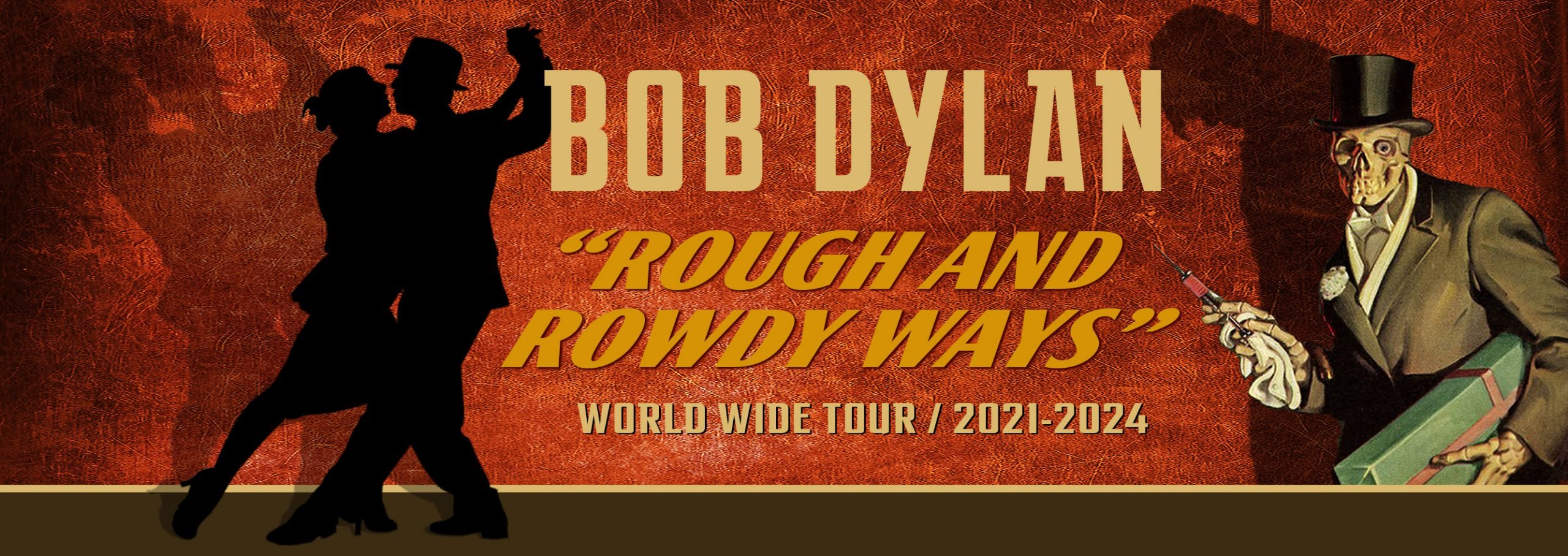
In a not so shocking development, Bob Dylan’s coming to Charleston, South Carolina, in his Never Ending Tour.[1]

The cat’s indefatigable: March 16, Austin, March 18 Shreveport, March 19 New Orleans, March 21 Montgomery, March 23 Nashville, March 24 Atlanta, March 26 Savannah, March 27 Charleston . . . [2]

And the beat goes on, as they say.

I just checked the last set list from December of 2021, and if you’re planning to attend a show, I strongly suggest purchasing the album Rough and Rowdy Ways because a majority of the songs performed (at least in December of 2021) come from the album, his first album of original songs since 2012.

Here’s the first paragraph of Jon Parleles’ review in the Times:

Latter-day Bob Dylan is for die-hards. His voice is tattered and scratchy, not always bothering to trace a melody. His lyrics can be cryptic or throwaway when they’re not downright bleak. His music is adamantly old-fashioned, and he’s not aiming to ingratiate himself with anyone.

And the last:

And in “Black Rider,” a string-band ballad that tiptoes along, pausing each time Dylan takes a breath, he addresses a mysterious figure — Death, perhaps — with alternating sympathy and aggression. “Don’t turn on the charm,” he warns. “I’ll take a sword and hack off your arm.” For all he has seen and sung, on “Rough and Rowdy Ways” Dylan refuses to settle down, or to be anything like an elder statesman. He sees death looming, but he’s still in the fray.

I should add, perhaps, that his shows are for die-hards as well. Sometimes, because he has changed the melodies and his voice is indistinct, you might not recognize a song, even an iconic one like “Blowing in the Wind,” until it’s almost done.

Obviously, I’m one of the die-hards, and I’ve seen some fantastic concerts, one in Columbia, SC, in 1988, one at the North Charleston Coliseum in which he played a killer electric guitar, and my favorite, at the Orange Peel, a bar in Asheville, during the 2004 election campaign.

I’ve also seen some less than stellar shows, the worst outside at the Joe with Willie Nelson as the opening act.

But I’ve never seen one quite as bad as my pal, fellow die-harder, Jeremy Jones described to me last night at Low Life, one of Folly’s coolest spots. Anyway, I’ll let Jeremy tell it.

“The best bad Dylan I ever say was at the Saegner Theater in New Orleans. He was as drunk as a skunk. The band went into the Hendrix version of “All Along the Watch Tower,” and he stumbled to the mike and started singing “Like a Rolling Stone,” and the band was like, what the? I mean it was absolutely fantastic.”

This occurred in the Aughts, so I suspect we’ll not witness something so conjunctificated, but if we do, I’ll be smack dab in the middle of Row A in the orchestra, if Dylan and I are still among the quick, that is.

illegal photo by my son Ned Moore

[1] It began 2 June 1988 and has featured 3,066 shows and counting. Of course, one day it will end, when ol’ Bob succumbs to something or another. Certainly, Keith Richards will be named one of the pallbearers.

[2] No wonder is voice is raspy.

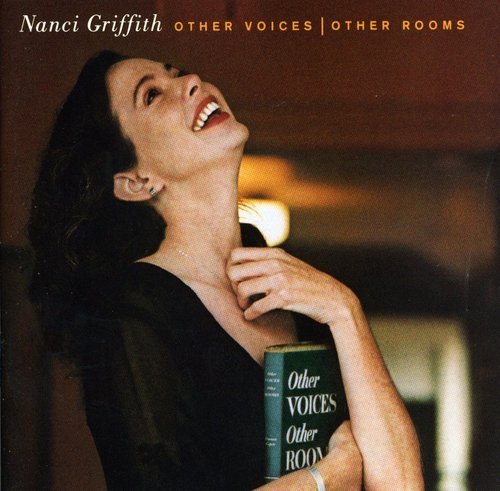
The Late Nanci Griffith’s “Other Voices, Other Rooms”

The very best Christmas present I ever received from an in-law is Nanci Griffith’s masterpiece Other Voices, Other Rooms, a collection of covers from songwriters who influenced Griffith’s own music making. My sister-in-law Linda Birdsong gave it to me in 1994, saying she thought I’d enjoy it. Understatement of the century Clinton years.

I ended up purchasing ten or so more CDs to check out the work of some of the featured songwriters, which include Kate Wolf, Vince Bell, Townes Van Zandt, Frank Christian, Bob Dylan, John Prine, Ralph McTell, Tom Paxton, Woody Guthrie, Janis Ian, Gordon Lightfoot, Jerry Jeff Walker, and Malvina Reynolds and Harry Belafonte, just to name fourteen.

The magic begins with a cover of Kate Wolf’s “Across the Great Divide,” an incredibly beautiful composition that embodies concretely the passage of time in both terrestrial and temporal images.

Here are the first three verses, but I encourage to go to YouTube (who won’t allow me to embed a link) and check out a live version:

I’ve been walkin’ in my sleep
Countin’ troubles ‘stead of countin’ sheep
Where the years went I can’t say
I just turned around and they’ve gone away

I’ve been siftin’ through the layers
Of dusty books and faded papers
They tell a story I used to know
And it was one that happened so long ago

Although they’re all excellent, the next song that blows me away is the third cut, Townes Van Zandt’s “Tecumseh Valley,” a duet Nanci performs with the great Arlo Guthrie. 

Other personnel featured on the album include Dylan himself, who plays harmonica on “Boots of Spanish Leather” and Guy Clark on the Woody Guthrie’s “Do-Re-Mi.” Also, Emmylou Harris and Iris Dement are sprinkled about, and the final cut “Wimoweh” features Odetta, the Indigo Girls, John Prine, James Hooker, Holly and Barry Tashian, John Gorka, Dave Mallet, Jim Rooney, and Nanci’s father Marlin Griffith.

Demonstrating just how much of life is fraught with loss and longing, the overall mood is melancholic with “From Clare to Here” (featuring Peter Cummin), Jerry Jeff’s “Morning Song for Sally,” Michael Burton’s “Night Rider’s Lament,” and “Speed of the Sound of Loneliness” (featuring John Prine who wrote the song).

Of course, Nanci produced an admirable body of work herself, and she’s certainly going to be missed. From everything I’ve read about her, she was a lovely person, generous, intelligent, somewhat scholarly.

Sad, sad, sad.

Sam Cooke, Shreveport, and “A Change Is Gonna Come”

Sam Cooke’s plaintive, moving civil rights ballad “A Change Is Gonna Come” was born in 1963 of discrimination after he and his wife were turned away from a segregated Holiday Inn at Shreveport, Louisiana. Incensed when the desk clerk lied and claimed no vacancies, Sam made a scene in the lobby, vociferously protesting, and while driving off, he and his entourage honked horns and lobbed insults like Molotovs as their taillights disappeared into the night. 

When Sam and company arrived at the Black hotel downtown, the police were waiting. However, the arrests created abysmal p.r. north of the Mason-Dixon line after the NY Times and UPI caught wind and publicized the discriminatory arrest of an affable fellow (at least he sounded affable on his records) who only wanted a place to sleep after twisting the night away. In 2019, Shreveport’s mayor apologized to the Cooke family and awarded Sam a key to the city – a mere fifty-six years after Cooke’s death at thirty-three. Nothing like a posthumous award to salve the wounds of a no-longer-sentient being.

According to Peter Guralnick’s biography Dream Boogie: The Triumph of Sam Cooke, Dylan’s “Blowin’ in the Wind” also spurred Sam to compose “A Change Is Gonna Come.” Sam, the story goes, felt chagrined that a White fellow had written such a moving civil rights song. In fact, Sam admired “Blowin’ in the Wind” so much that he included it in his live performances not long after its release. 

Of course, the songs are much different. In “Blowin’ in the Wind,” Dylan asks in third person a series of questions that ponder “how long” it’s going to take to end discrimination. “A Change Is Gonna Come,” on the other hand, is deeply personal, written in first person, and cites incidents of hurtful slights and expresses existential despair. However, despite the dirge-like tone of the song, the narrator feels certain that eventually “a change is gonna come” and justice will prevail, so the overall effect is hopeful rather than depressing.

Well, despite the election of Obama and the proliferation of people of color in national advertising, we’re not quite there yet, and it seems that many in the South have recently become emboldened to unfurl and wave their inner Stars-and-Bars, not to mention Republican-led state legislatures’ ongoing successful attempts to make voting more difficult for African Americans. 

In fact, to me, 2021 feels an awful lot like 1961, though at least now, Sam would have no trouble checking into a Holiday Inn – though he might turn up his nose at one – and Confederate statues are coming down as opposed to being erected. 


Post-Election Electrification

Post-Election Electrification

For Stacey Abrams

There’s a chain gang on the highway
I can hear them rebels yell
And I know no one can sing the blues
Like Blind Willie McTell

Bob Dylan, “Blind Willie McTell”

Back in my wilder days of manic
Boppa-bop-a-bebop – PAR-DEE,
I’ll admit I got arrested a couple of times,

blinded by them PO-lice lights
swirling and stuttering blue
in the nightscape like a UFO landing.

I’ve survived slope driving in suburban Atlanta,
not looking both ways before crossing streets,
trafficking in whatever to make ends meet,

have tossed and turned a couple of nights in jail,
which amounted ultimately to next to nothing,
except for experience to cross reference and relate.


I once told my late wife’s oncologist,
“Doc, I guess you’ve never spent a night in the clink.”

His blank stare a tacit no-he-hadn’t.

“But that’s what it’s like in the middle of the night,
when you’re waiting for the biopsy
to drop the next day.”

Experience to cross reference and relate.


Nowadays the Boppa-bop-a-Bebop – PAR-DEE,
rarely sparks in my nervous system circuitry –
except it actually did yesterday –
when James Brown’s Georgia,
when Otis’s Redding’s Georgia,
when Little Richard’s Georgia,
when Ray Charles’s Georgia,
when Ma Rainey’s Georgia turned a very light shade of blue.

Blind Willie McTell himself
Had limped past the President.

So I stepped outside on the deck,
took in a deep breath,
opened my mouth,
and scat-bellowed at the top of my lungs into the wild blue yonder:

Geetchie geetchie yappa yappa – woo!

On the Utility of Memorizing Poetry

illustration by David Rowe from "Financial Review" website

illustration by David Rowe from “Financial Review” website

Each year, our English Department requires all students to memorize a poem of at least fourteen lines and recite it in front of their classes.

Students choose the poems they recite, so the first step in the process is for them to read poems in search of a ditty or two that strike their fancy. Obviously, it forces them to read poetry.  Of course, every year a student asks if he can recite song lyrics instead, and I say no.

I explain that very few song lyrics can stand alone on the naked page without musical accompaniment. I recite these lyrics from Dylan’s “To Ramona (which, of course, I’ve memorized):

From fixtures and forces and friends

Your sorrow does stem

That hype you and type you

Making you feel

That you gotta be exactly like them

I’d forever talk to you

But soon my words

Would turn into a meaningless ring

For deep in my heart

I know there is no help I can bring

Everything passes

Everything changes

Just do what you think you should do

And someday maybe

Who knows, baby

I’ll come and be cryin’ to you.

And then I recite these lines from Yeats, which, again I know “by heart.”

Now all the truth is out,

Be secret and take defeat

From any brazen throat,

For how can you compete,

Being honor bred, with one

Who were it proved he lies

Were neither shamed in his own

Nor in his neighbors’ eyes;

Bred to a harder thing

Than Triumph, turn away

And like a laughing string

Whereon mad fingers play

Amid a place of stone,

Be secret and exult,

Because of all things known

That is most difficult.

The difference is palpbable.


Of course, the question of why memorize comes up. What’s the purpose? You’ll just forget it anyway, etc. I explain that in times of despair that poetry can provide solace by articulating powerfully the human condition, which has remained essentially the same over the course of centuries.

Ben Jonson’s dead son is my brother-in-law’s dead son.

My sin was too much hope of thee, loved boy.

Seven years thou wert lent to me, and I thee pay,

Exacted by thy fate, on the just day.

Oh, could I lose all father now!

I tell them that possessing a storehouse of poetry in the record collection of their minds can also come in handy at cocktail parities. Why rely on your own feeble wit when you can conjure TS Eliot?

On November the 9th, one of my colleagues asked me what I thought, and I said,

“I think we are in rats’ alley

Where the dead men lost their bones.”

If he’d asked me how I felt, I would have said, “like ragwater, bitters, and blue ruin.”

Anyway, this year, I’ve decided to memorize a poem myself, and I have chosen Wallace Stevens’ “The Emperor of Ice Cream.”

Call the roller of big cigars,

The muscular one, and bid him whip

In kitchen cups concupiscent curds.

Let the wenches dawdle in such dress

As they are used to wear, and let the boys

Bring flowers in last month’s newspapers.

Let be be finale of seem.

The only emperor is the emperor of ice-cream.


Take from the dresser of deal,

Lacking the three glass knobs, that sheet

On which she embroidered fantails once

And spread it so as to cover her face.

If her horny feet protrude, they come

To show how cold she is, and dumb.

Let the lamp affix its beam.

The only emperor is the emperor of ice-cream.

What in the hell does that mean? Here’s one cool, jazzy take from Kenneth Lincoln:

So a wench is dead, stretched out cold at the ice cream party. The dresser deal “knobs” transpose to “horny” bunions, glass to skin calluses. No empty jar lies here, rounding the wild, but a woman’s body in its cool opaque skin, thickened from walking the earth. Her “horny feet” index a prosaic, if bewitching reality, bunioned and “dumb” as the “slovenly wilderness”: feet are the earthen root, nonetheless, the vulgate “base” of a poetic meter iambically shamanic. She embroidered “fantails” on her bedsheet, her tail-end art. Those curlicues may rover her face, if they cannot mask her feet, which grounded her in reality, finally in death. So, for a fourth and final call, “Let the lamp” of nature “affix its beam,” the sun its sundown flame, as the seeing eye celebrates an inner light in mortal darkness, a comeback optics of imagining sunrise reborn at sunset.

[snip]

With rhyming comic finality (come/dumb/beam/cream), the refrain rides on a boisterous iambic pentameter, “The only emperor is the emperor of ice-cream.” The fourteen syllables curdle in a spondee (as with the twelve-syllable, shaggy last line of “The Snow Man”). There’s a youthful break in the pace, a jump-rope skip completing the Falstaffian form. From bunioned foot to embroidered fantail, earthly base to fanciful end, this elegy resists loss by making art of what seems to be, seeing what is, delightfully. It is an act of the imagination at a wake; the final test, to return to childhood joy in “cream” made of “ice” (Carolina “aspic nipples” sweetened). A concupiscent summer is whipped up from winter’s absence, the snow man’s “nothing” curdled by sweet belief.

So, fast-forward to that future cocktail party where some jackass is plastering lipstick on some political or theological or philosophical pig.

Simply say, “Let be be the finale of seem/The only emperor is the emperor of ice cream.”

Chances are his rejoinder won’t be in “boisterous iambic pentameter.”

emperor-illustration