A Renewed Awareness of the Wonderous 

A Renewed Awareness of the Wonderous 

“Its only boundary was the horizon, the sill of the sky, separating what the eye could see from what the mind might imagine.”
                                                                        ― Barry Lopez, Horizon

At the moment, thanks to my pal Bill Thompson, I’m reading Horizon, Buddha-like Barry Lopez’s fascinating memoir, a meditation on nature, human cultures, capitalism’s role in the secularization of society, language’s function in altering the world we perceive, the poisoning of the planet, among a host of other fascinating topics. 

Lopez is difficult to characterize. For example, he was an explorer, having travelled to over 80 countries. His National Book Award winning work Arctic Dreams details five years he spent in the Canadian Arctic as a biologist.  Lopez possessed, among many other virtues, a profound patience that allowed him the peace of mind to observe over hours, days, and weeks phenomena like light changing in the passage of time from dawn to dusk over the surface of the Pacific Ocean. Though married twice, he seems monkish in his seeking solitude, and indeed, after his Catholic education, he flirted with the idea of becoming a Trappist monk. Instead, he became a novelist, a painter, a landscape photographer, and philosopher. These hours of observation and solitude engender philosophical observation:

During certain periods of uninterrupted vigilance at the edge of the sea, I’ve also had the sense that there is some other way to understand the ethical erosion that engenders our disaffections with modern life—the tendency of ruling bodies, for example, to be lenient with entrenched corruption; the embrace of extrajudicial murder as a legitimate tool of state; the entitlement attitudes of those in power; the compulsion of religious fanatics to urge other humans to embrace the fanatics’ heaven. The pervasiveness of these ethical breaches encourages despair and engenders a kind of social entropy; and their widespread occurrence suggests that these problems are intractable.

Lopez is particularly interested in how commercial enterprises like logging transform forests from diverse ecosystems to tree farms. Clearcutting disrupts the natural order as invasive species displace native plants and animals, so rather than the terrain boasting a variety of different trees, the denuded landscape is replanted with one type of commercially profitable tree, e.g. Douglas firs or loblolly pines. A clearcut,” he writes, “is not the outward sign of a healthy economy but of an indifference to life.”

In a similar light, he laments Colonialism’s obliteration of native people’s cultures, the loss of native languages, and drives home the point that advanced technology does not make a culture superior to a less technically advanced culture, especially if the happiness of a culture’s people is a gauge of success:

The seductive power of this system of exploitation—tearing things out of the earth, sneering at the least objection, as though it were hopelessly unenlightened, characterizing other people as vermin in the struggle for market share, navigating without an ethical compass—traps people in a thousand exploited settlements in denial, in regret, in loneliness. If you empathize with the Jaburrara over their losses, you must sympathize with every person caught up in the undertow of this nightmare, this delusion that a for-profit life is the only reasonable calling for a modern individual.

Sounds a bit like the current ruling US regime.

On the other hand, the contrarian in me wonders how Lopez could afford to circumnavigate the planet, exploring exotic locales like Australia’s Outback and Afghan villages. Where did the money come from to bankroll these expeditions?  

Capitalistic enterprise, I suspect. 

Modern living is incredibly complicated, which, to be fair, he acknowledges, but whether you agree with him politically or not, Lopez provides, not only food for thought, but a feast for contemplation.

Reading this book has in a sense made me more alive in jarring me from my inwardness to seek out wonder outside the Self while seeking is still possible.  

I’ll give him the last word:

Exposure to an unusually spectacular place in conducive circumstance, the thinking goes, can release one from the prison of one’s own ego and initiate a renewed awareness of the wondrous, salutary, and informing nature of the Other, the thing outside of the self.


Bachelor Party at Chico Feo’s: An Anthropological Study

chico bachelor party


Last Saturday, I had the opportunity as an anthropologist to observe a late afternoon bachelor’s party at Folly Beach’s little corner of the Caribbean, Chico Feo.

By the way, bachelor parties for centuries have been traditional components of mating and marriage rituals in the West. Whether you’re bidding “farewell to bachelorhood” in Munich at a Junggesellenabschied or in Arles marking the “burial of the life of a boy” at an enterrement de vie de jeune fill, you can be assured of one commonality: the Junges and garçons are gonna get shit-faced just like the lads in Liverpool and the dudes of Malibu.


Berlin Junggesellenabschied

Berlin Junggesellenabschied

Indeed, even though it was merely four in the afternoon at Chico Feo, a few of the entourage exhibited telltale signs of intoxication — sleepy, glazed eyes; mouths that hung open; wobbly legs. The first reveler in this condition I encountered kept bumping into the vacant bar stool adjacent to me.  Charlie, Chico’s world-class bartender, informed me with a scowl that these fellows were part of a bachelor’s party. It appeared that Charlie had already cut this fellow off.

I’d estimate these young men to be from the Northeastern United States, a section of the country in which good-natured mockery seems to be an ubiquitous social custom (see Tolerating Middle Class Northerners for Dummies). The bros bantered about slinging insults, ordering beer after beer, and slurping down in one swallow Chico’s delicious tacos as if they were oysters.

Most of these young men were large in stature, and even if they weren’t, they sported over-sized biceps and an array of body art ranging from rustic gunmetal blue barbed-wire wraparounds to high-end multicolored patterns that screamed Gauguin. It seemed, though, that some had acquired their muscular upper arms a while ago because now their abs resembled not so much washboards as loads of laundry.

It was interesting to try to determine who reigned as alphas of the cartload. One “dude” particularly seemed in charge, a vociferous twenty-something who looked as if his ancestors may have entered Ellis Island from Brindisi. He had an olive completion, aquiline beak, and jet-black short-shorn hair covered by a baseball cap worn backwards. He was conversing with some female patrons, boasting of the Adonis-like beauty of one of his friends, Paul, a ridiculously good-looking and fit fellow whose sandy hair fluttered in the on-shore breeze. Paul was sitting at the bar but looking in the opposite direction at the bacchanal taking place beneath the overarching trees that provide shade for Chico’s tables and chairs.

“These chicks want you to take off your shirt, Paul,” the alpha shouted in an accent that I’d place somewhere close to Newark.

Paul sat there passively grinning.

“C’mon Paul.   Show ‘em what you got.”

The females nodded their heads, and the ringmaster shouted, “C’mon, Paul, take off your shirt. Now! Show us your tits,” and a chant began “Show us your tits, show us your tits,” to which bartender Charlie, the real alpha, put an immediate stop. The ringleader opened his mouth and raised his arm as if he were going to continue, but Charlie’s stare short-circuited the bravado, and the erstwhile alpha dropped his hand and benignly smiled what I would call (removing my pith helmet of anthropological professionalism for a second) a stupid, shit-eating grin.

“Hey, which one’s getting married?” I asked Charlie.

“I don’t care,” he said shaking his head.

Unlike Dian Fossey or Jane Goodall, I didn’t ingratiate myself my this cartload[1] of not-so-fun-folks to follow them to their next destination, the Tides Hotel where they were wisely staying, eliminating even the need of Uber for their locomotion. However, I suspect that before the evening came to its inevitable end, these celebrants would witness some form of burlesque for hire, i.e., a stripper performing that age-old ritual.

I’ll leave you with this from Wikipedia:

In Israel, the bachelor party is called מסיבת רווקים. Such parties often feature heavy drinking and sometimes the presence of strippers.

Israeli מסיבת רווקים

Israeli מסיבת רווקים

Seems like a pattern, huh.


[1] Did you know you call a group of chimps a “cartload?” It’s a troop of gorillas and baboons, a barrel of monkeys, but a cartload of chimps. Go figure.

Paradise Lost: So Long Hunting, Hello Work Week

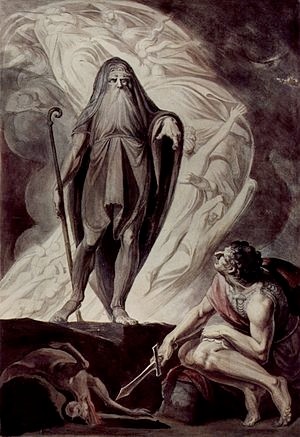
black adam and eveA couple of posts ago, I channeled the late Joseph Campbell and echoed his contention that myths should be considered deep unconscious poetic projections that embody profound truths rather than as demonstrably false tales from antiquated religions. Echoing Northrop Frye, Campbell believed that myths provide models that help us navigate the progression of our lives through the blooming and withering we’re all heir to, maps, as it were, handed over to us from old Tiresias to help us find our way to our ultimate destination – oblivion.

Tiresias appearing to Odysseus by Johann Heinrich Füssli

Tiresias appearing to Odysseus by Johann Heinrich Füssli

For example, the requisite trip to Hades that epic heroes like Odysseus and Dante suffer might correspond to the midlife depressions many of us undergo, journeys that though abysmal provide us with secret knowledge, in Odysseus’s case how to navigate his way back to Ithaca and in our case a deeper perspective on what it means to be human.

Take the Eden myth. It offers many interesting possibilities for interpretation. Given that it is a post-agrarian myth (besides death, Adam’s curse is tilling barren soil by the sweat of his brow), I wonder if the myth harkens back to the simpler and more organic lifestyle of hunting and gathering when our ancestors ran around naked picking berries, spearing rabbits, and living communally.

Perhaps knowledge here means the knowledge of agriculture, and if you want to fault anyone for that, why not women, who probably through their foraging discovered that seeds can be cultivated, which led to settled communities, caste systems, factories, ghettos, and ultimately reality television shows like Boy Meets Boy, Megan Wants a Millionaire, and Sarah Palin’s Alaska.

Sarah Palin and Offspring

Sarah Palin and Offspring

In the mid-90’s, I took two graduate anthropology courses to satisfy certification requirements. For my midterm take-home exam, I had to provide my opinion on an essay claiming that agriculture has been disastrous for most of humankind. I can’t find the essay, but here’s the first paragraph of my test essay, which summarizes the argument:

In his essay “The Worst Mistake in the History of the Human Race,” Jared Diamond argues that agriculture is responsible for a diminution in the quality of life for the majority of humans who have lived since its inception. Diamond argues that food foragers enjoy a healthier diet procured with less labor and that the population explosion that accompanied the agricultural revolution has given rises to epidemics of infectious diseases. Furthermore, agriculture is directly responsible for class stratification and the subjugation of women. In essence, Diamond’s essay is the Eden myth revisited: food foraging Adam takes up the hoe, and paradise is lost. Diamond could have taken it even further, I suppose, and argued that agriculture, which gave rise to industrialization, can also be traced as a root cause of an ensuing ecological disaster as cultural evolution outstrips biological adaptation. The ultimate balance of life is being destroyed as holes appear in Gaia’s ozone umbrella, oxygen-producing rain forests are slashed and burned, and the water supply disappears.*


*By the way, I received an A- on this essay, the minus probably attributable to its last paragraph: “The question of whether or not agriculture was humankind’s greatest mistake, like most questions, ultimately ends up being an existential one. If I were huddled in an inner-city tenement or wielding a pick in an Appalachian coal mine, I might prefer non-existence and rue the day agriculture came into being. Indeed, food foragers possess a oneness with nature I truly envy. However, at the present moment (which is ultimately all we ever have), I’m off for the summer, preparing to end this essay and grab my surfboard. The agricultural revolution has been kind to the people I love. Jared Diamond would, no doubt, brand me an elite, but then again, I am just a high school English teacher and have never voted for a Republican. Everything is relative. Diamond has probably never been writhing in the Kalahari Desert with an abscessed tooth. [Instructor’s only comment: I get your point, which is indeed elite by world standards].


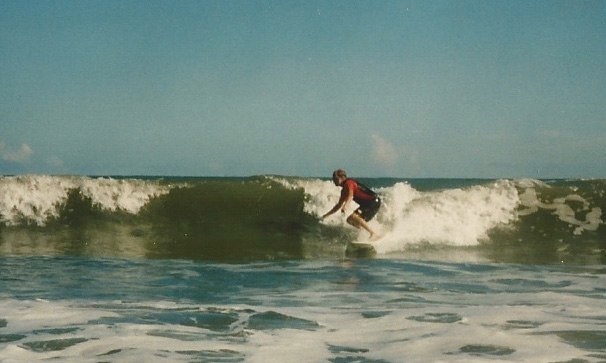
yours truly surfing in the mid-90's

yours truly surfing in the mid-90’s

To return to the Eden myth, Adam and Eve run around naked, pick berries, in essence live off the great bounty that Yahweh has provided, but that damn woman who always has to stick her nose into everything upsets the divine plan by discovering a way to produce food differently. Humankind now possesses the knowledge of how to cultivate the land, but it takes hard work. Eating the apple symbolizes the shift from relying on natural food to being dependent on cultivated food. Hunting is more fun than plowing, making clothes is labor, etc. We have abandoned meaningful communal simplicity for complex stratified world of civilizations.

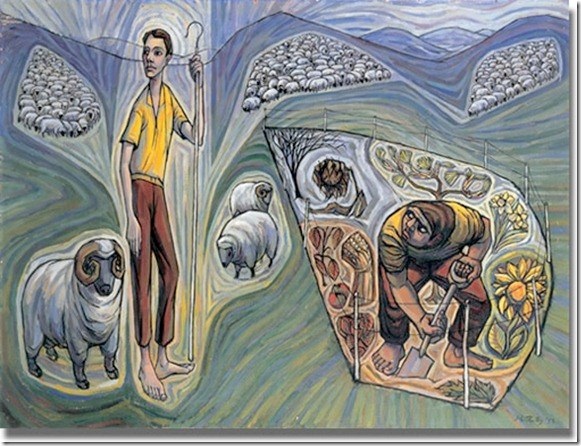
"Cain and Abel" artist unknown

“Cain and Abel” artist unknown

As it happens, a very rarely encountered non-agrarian Peruvian tribe upset by incursion into their territory confronted park rangers this week. In investigating the tribe, the Mashco-Piro, I found video of another tribe, this one from Brazil.

These folks are essentially naked and so far off the grid that they don’t even have immunity to the common cold. Perhaps, Diamond was right after all. Perhaps in the very long run humanity might have had a longer lease on survival if Eve had just left well enough alone.

I’ll leave you with a passage from Mario Vargas Llosa’s The Story Teller as a shaman-like wanderer from tribe to tribe who relates myths to various clans that explain their origins and ways of life:

Thanks to Tsaurinchi, the firefly seripigari, I’m never bored when I’m traveling. Nor sad, thinking: how many moons still before I meet the first man who walks? Instead, I start listening. And I learn. I listen closely, the way he did. Go on listening, carefully, respectfully. After a while the earth feels free to speak. It’s the way the way it is in a trance, when everything and everyone speaks freely. The things you’d least expect speak. There they are: speaking. Bones, thorns. Pebbles, lianas. Little bushes and budding leaves. The scorpion. The line of ants dragging a botfly back to the anthill. The butterfly with rainbow wings. The hummingbird. The mouse up a branch speaks, and circles in the water. Lying quietly, with closed eyes, the storyteller is listening. Thinking: let everyone forget me. Then one of my souls leaves me. And the Mother of something that is all around comes to visit me. I hear, I am beginning to hear. Now I can hear. One and all have something to tell. That is, perhaps, what I have learned by listening. The beetle as well. The little stone you can hardly see, it’s so small, sticking out of the mud. Even the louse you crack in two with your fingernail has a story to tell. If only I could remember everything I’ve been hearing. You’d never tire of listening to me, perhaps.

Now that’s what I call being alive.