Holiday in Spain: Jerez, Days 1 & 2

Here in our first full day in Jerez, a lovely, laidback city in Cadiz Province in Andalucía,[1] a solution to the over development of South Carolina’s Lowcountry dawned on me, plopped upon my head like that proverbial Newtonian apple.

The county councils of Charleston, Berkeley, and Dorchester counties should impose mandatory siestas from 3 to 6 pm every day of the week. [cue John and Yoko’s “Imagine.”]

For example, here is a normally busy street in Jerez at 4 pm.  And let me tell you, it’s as quiet as it is empty.

IMG_E2143

In my dream world where Americans love themselves more than lucre, business chains in the Lowcountry would relocate for the sake of shareholders because 3 hours of closure each day would harm the bottom line. With fewer people, traffic with its incumbent pollution (air and sound) would decrease.  Workers and school children could nap, listen to music, watch soap operas, or catch up on homework.  Returning refreshed, their productivity would soar, and the nighttime, so squandered in the USA, could be reclaimed as a time of comingling with humans outside the narrow confines of condo or apartment (not to mention ranch home or McMansion).

Of course, the odds of this happening are as unlikely as Clemson deciding to change the school colors from orange to fuchsia or Donald J Trump coming up with a nugget of self-deprecating humor.

Suggested example: Trump to Kim:  You’re having a bad hair day!  Christ, you don’t know the meaning of bad hair day.

AP_18163043466325.1528765924

Nevertheless, in the world of retirement, where I am the master of my time and I can enjoy socialized medicine, I shall live like an Andalucían.

After a my extended nap, I’ll ride my bicycle to Chico Feo (but not Taco Boy).


Fun Facts/ Personal Notes

People here speak with a lisp.  Cerveza is pronounced cerveztha and gracias, gracthia (no-s).

Like in Germany (and probably every other country in Europe), you get a ticket from a parking meter machine and place it on your dashboard.

Here are a couple of photos of our two-bedroom apartment (hat tip to Charlie and Caroline for finding and booking it).

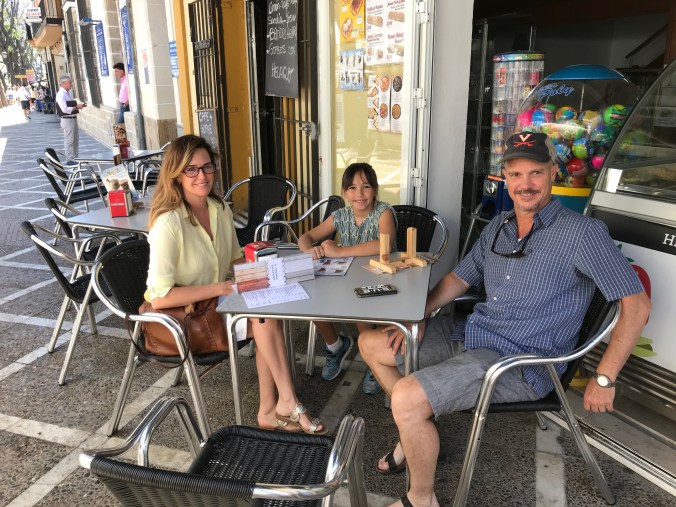
And here’s a photo of Caroline, Brooks, and Charlie.

IMG_2127

Charlie, by the way, has recently become a bit of a celebrity in Spain.  Here are a couple of reasons:

Check him out.


[1]I suspect calling any city in Andalucia laidback reeks of redundancy.

A Footnote to the Previous Post RE Bill Clinton and Gabriel Garcia Marquez

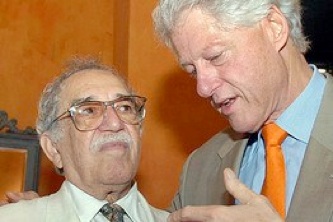
A not-so-quick footnote to yesterday’s post:  During the Reagan Administration, Garcia Marquez was labeled a subversive and denied visas to enter the US.  After Clinton was elected President, he lifted the travel ban.  Here’s a snippet from an article from Salon that is no longer available detailing Garcia Marquez’s first meeting with Clinton at William Styron’s house with the Mexican novelist Carlos Fuentes also in attendance:

Garcia Marquez with Clinton

Dinner began at 8, with some 14 guests around the table, and lasted until midnight.  Bit by bit, the conversation came down to a kind of literary round table involving the president and the three writers.  The first topic that came up was the forthcoming Summit of the Americas.  Clinton had wanted it held in Miami, where it did take place.  Carlos Fuentes considered that New Orleans or Los Angles had stronger historical claims, and he and I argued strongly for them until it became clear that the president had no intention of changing his plans because he was counting on reelection support from Miami.

“Forget the votes, Mr. President,” Carlos said to him.  “Lose Florida and make history.”  That phrase set the tone.  When he spoke of the problem of narco-traffic, the president heard me out generously.

“Thirty million drug addicts in the US go to show that the North American mafia are more powerful than those in Colombia, and the authorities much more corrupt.”  When I spoke to him about relations with Cuba, he seemed more receptive.  “If Fidel and you could sit and talk face to face, all problems would completely disappear.”

When we talked about Latin America in general, we realized that he was much more interested than we supposed, although he lacked some essential background.  When the conversation stiffened a bit, we asked him what his favorite movie was, and he answered “High Noon,” by Fred Zimmerman, whom he had recently honored in London.  When we asked him what he was reading, he sighed and mentioned a book on economic wars of the future, author and title unknown to me.

“Better to read ‘Don Quixote,” I said to him.  “Everything’s in there.” Now the ‘Quixote’ is a book that is not read nearly as much as is claimed, although very few admit to not having read it.  With two or three quotes, Clinton showed that he knew it very well indeed.  Responding, he asked us what our favorite books were.  Styron said his was “Huckleberry Finn.”

I would have said “Oedipus Rex,” which has been my bed table book for the last 20 years, but I named “The Count of Monte Cristo,” mainly for reasons of technique, which I had some trouble explaining.

Clinton said his was the “Meditations of Marcus Aurelius,” and Carlos Fuentes stuck loyally to “Absalom, Absalom,” Faulkner’s stellar novel, no question, although others would choose “Light in August” for purely personal reasons.  Clinton, in homage to Faulkner, got to his feet and, pacing around the table, recited from memory Benji’s monologue, the most thrilling passage, and perhaps the most hermetic, from “The Sound and the Fury.”

Faulkner got us talking about the affinities between Caribbean writers and the cluster of great Southern novelists of the United States.  It made much more sense to us to think of the Caribbean not as a geographical region surrounded by its sea but as a much wider historical and cultural belt stretching from the north of Brazil to the Mississippi Basin.

Mark Twain, William Faulkner, John Steinbeck, and so many others would then be just as Caribbean as Jorge Amado and Derek Walcott. Clinton, born and raised in Arkansas, a Southern state, applauded the notion and professed himself happy to be a Caribbean.

Gabriel Garcia Marquez

Whippersnappers, Stage Moms vs. the Would-Be Wisdom of the Elders (starring Gabriel Garcia Marquez)

For decades social critics have grown hoarse decrying the indisputable fact that North American culture has declined into a cult of youth.  Among other touchstones, they cite sitcoms that almost universally depict adults (especially males) as intellectually inferior to the wisecracking ten-year-old ironists who ultimately rule the ranch(-style) houses of Televisionland. No matter that in real life these child stars possess all of the autonomy of their collie colleague, Lassie, as whip-cracking stage mothers, robbing them of their childhoods, herd them into blinding klieg lights.

Remember Brittany Spears?

I can’t resist.  Check out these before and after pix of Brittany:

Before

After

And, of course, if you buy into perverse premise that aging is horrible, you’re pretty much doomed to a life of diminishing satisfaction as hairlines recede, varicose veins branch out, dogs die, and crowsfeet deepen into talons.  What traditionally has offered recompense for this physical decay is an accumulation of remembered experiences that have formed patterns of meaning that ultimately lead to an august understanding that the life cycle is natural and that death is the mother of beauty. [cue: Ecclesiastes, the Byrds]

However, and here’s the rub, many 21st Century citizens mostly experience “life” through the looking glass of mass media. For example, I calculate that my stay-at-home maternal grandmother spent the last forty years of her life in 16-hour stints of non-stop TV.  If that’s your lifestyle, the patterns you’re accumulating are illusions concocted to sell products and services, so ultimately, you’re experiencing a wildly disappropriate number of happy endings and a constant barrage of eye-pleasing artifacts and sculpted spokespeople who sell the concept that beauty is skin deep.  In the above scenario, the TV saturated senior citizen glued to reruns of Murder She Wrote or, worse, Fox News is less likely than the sober-minded 30-something social worker in providing good advice.

On the other hand, some old soul who has experienced an intense, widely travelled existence, who has weathered childhood, young adulthood, parenthood, widowhood, disease, exaltation, depression, and compassion should be treasured, the way I treasure the planet’s greatest novelist of the last quarter of the previous century.  I’m talking about my man, Gabo, i.e., Gabriel Garcia Marquez.  And when that old soul transformed his experience into a novel, what we got (and get) is not a concoction, but a revelation, the embodiment of wisdom.

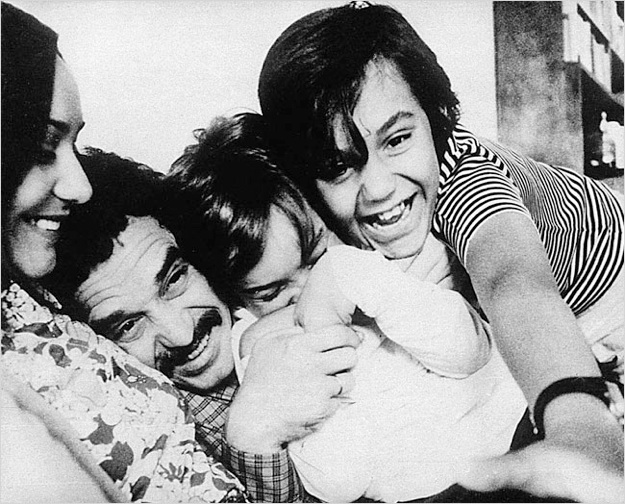
Gabriel Garcia Marquez, his wide Mercedes, and their two sons in Barcelona, c. 1960

A late novel, Love in the Time of Cholera, offers a case in point.  Ostensibly, the narrative explores an incurable romantic’s life.  Quixotic Florentino Ariza has had a lifelong fixation on an instantaneous infatuation, which, as far as I can determine, has only resulted in one happy ending (see La Comedia Divina).  Love in the Time of Cholera depicts long-lived lives in which wisdom alchemizes from the dross of life, particularly the life of Fermina Daza Urbino, who stands out as one of the greatest female characters of the last fifty years.  Here she is via free indirect speech (in Edith Grossman’s translation) thinking of her dead husband:

For now she understood him better than when he was alive, she understood the yearning of his love, the urgent need he felt to find in her security that seemed the mainstay of his public life and that in reality he never possessed.  One day, at the height of her desperation, she had shouted at him:  “You don’t understand how unhappy I am.”  Unperturbed, he took off his eyeglasses with a characteristic gesture, he flooded her with the transparent waters of his childlike eyes, and in a single phrase he burdened her with the weight of his unbearable wisdom: “Always remember that the most important thing in a good marriage is not happiness, but stability.”  With the first loneliness of her widowhood she had understood that the phrase did not conceal the miserable threat that she attributed to it at the time, but was the lodestone that had given them so many happy hours.

Here are Florentino Ariza and Fermina Daza finally consummating their love in their seventies, a scene that no doubt would send most of my current students to the medicine cabinet for some Dramamine:

She took him to the bedroom and, with the lights on, began to undress without false modesty.  Florentino Ariza was on the bed, lying on his back and trying to gain control, once again not knowing what to do with the skin of the tiger he had slain.  She said, “Don’t look.” He asked why without taking his eyes off the ceiling.

“Because you won’t like it,”  she said.

Then he looked at her and saw her naked to her waist, just as he had imagined her.  Her shoulders were wrinkled, her breasts sagged, her ribs were covered by flabby skin as pale and cold as a frogs [. . .]

It was the first time she had made love in twenty years, and she had been held back by her curiosity how it would feel after so long a respite, but he had not given her time to find out if her body loved him too.  It had been hurried and sad, and she thought: Now we’ve screwed everything up.  But she was wrong: despite the disappointment that each of them felt, despite his regret for his clumsiness and her remorse for the madness of the anisette, they were not apart for a moment in the days that followed [. . .] They did not try to make love again to much later, when the inspiration came to them without looking for it.  They were satisfied with the simple joy of being together.

Carpe diem indeed!


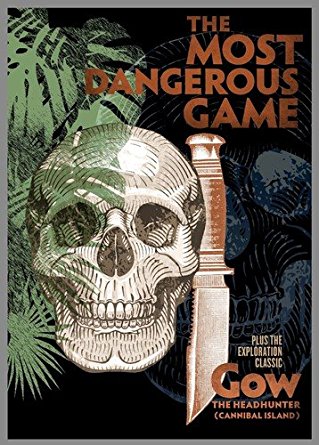
How Not to Teach “The Most Dangerous Game”

The first lesson I remember teaching in high school was the Richard Connell’s “The Most Dangerous Game,” one of the most idiotic short stories ever written.  Not only does plot pull the plug on your “suspension of disbelief,”[1] but also the prose is as bad as grammatical prose can be.

For example,

“You’ve good eyes,” said Whitney, with a laugh, “and I’ve seen you pick off a moose moving in the brown fall bush at four hundred yards, but even you can’t see four miles or so through a moonless Caribbean night.”

Girls and boys, this is called exposition, background information, and, of course, no one talks like that.

“Hi, Judy, your balding husband of twelve years has arrived home after teaching high school English to a group of high achieving, mostly upper-income adolescents who live in and about the city where the Civil War began!  How about rustling me up a Heineken, stay-at-home mom, since it’s 1985 and feminism hasn’t kicked in yet down here?”

Actually, the late Lawrence Perrine put the story first in his text Literature, Sound, and Sense to demonstrate why commercial fiction shouldn’t be taken seriously.  Of course, most of the kids liked the story before I began my butchering.  You got clearly defined good and evil, not to mention “Malay Mancatchers” and “Burmese Tiger pits.”  My method was to mock the story in the mode of stand up comedian, to act out some of the scenes.

The plot goes like this. Sanford Rainsford, an American big game hunter, is talking on a yacht in the Caribbean about how he has no sympathy for the prey he pursues.  Happily, in an act of idiocy that could land him a Darwin Award nomination, he falls overboard.

[After hearing gunfire,] Rainsford sprang up and moved quickly to the rail, mystified.  He strained his eyes in the direction from which the report had come, but it was like trying to see though a blanket.  He leapt upon the rail [as if that would help] and balanced himself there, to get greater elevation; his pipe, striking a rope, was knocked from his mouth.  He lunged for it; a short, hoarse cry came from his lips as he realized he had reached too far and had lost his balance. The cry was pinched off short as the blood-warm waters of the Caribbean Sea closed over his head.

As he swims toward Shipwreck Island, he hears more gunplay, and we’re treated to perhaps the most ludicrous dialogue prompt in the history of world literature:

“Pistol shot,” muttered Rainsford, swimming on. [Here I pantomime an Australian crawl, and as my head emerges from the water I mutter “pistol shot” and then continue swimming].

As it turns out, Shipwreck Island is the home of proto Bond villain General Zaroff, a Russian aristocrat so cartoonish he makes Boris Badenov from Bullwinkle look like Fyodor Paviovich Karamazov.

Rainsford makes it to the island, manages to sleep on the beach until “late afternoon” and begins to engage in Cartesian interpretations of physical nature:

“Where there are pistol shots, there are men.  Where there are men, there is food,” he thought.

He discovers some human footprints that lead to General Zaroff’s compound.  Oddly, Rainsford loses confidence in his powers of observation, like maybe he’s flashing back on some windowpane acid he dropped back at Yale after WW1.

“Mirage,” thought Rainsford. But it was no mirage, he found, when he opened the tall spiked gate.

Whew!

At the door he’s greeted by Ivan, Zaroff’s henchman, “ a gigantic creature, solidly made and black-bearded to the waist.”

ZZ Top meets Andre the Giant.

Rainsford is conducted to a room where “Ivan had laid out an evening suit.”  As he puts it on, Rainsford notices “that it came from a London tailor who ordinarily cut and sewed for none below the rank of duke.”

Oh, those were the days.

Zaroff serves Rainsford a vague meal consisting of unspecified “cocktails” and “a particularly well cooked fillet mignon.”  Was it cooked to perfection or cooked well done? Who knows?

As it turns out, the tables are turned on Rainsford.  Zaroff’s hobby is hunting human beings, i.e., “the most dangerous game.”

When Rainsford voices outrage at the concept of hunting humans, Zaroff replies, “I refuse to believe that so modern and civilized young man as you seem to be harbors romantic ideas about the value of human life.”

Boo! Hiss!

The game doesn’t seem all that fair to this non-hunter.  Ivan supplies Rainsford with hunting clothes, food, and a knife whereas Zaroff gets a pack of hounds, Ivan, and an armory of high-powered weaponry.  If Rainsford manages to elude his predator for three days, he’ll be placed “on a the mainland near a town.”  Zaroff adds, “I will give you my word of honor as a gentleman and sportsman.”

So now the fun really begins.  As Zaroff tracks Rainsford through the jungle, Rainsford engages in the very un-Darwinian habit of talking out loud to himself.

“I will not lose my nerve, I will not.”

Cat and mouse. Rainsford fashions a “Maylay man-catcher” and – the highlight of the story for me — a Burmese Tiger Pit.

Rainsford “stepped back from the quicksand a dozen feet or so, and like some huge prehistoric beaver, he began to dig.”

A Beaver!  Why a beaver?  Remember studying about pre-historic beavers the size of mastadons? I don’t.

Of course, good triumphs over evil. Trapped at the end of the story, Rainsford jumps off a cliff, presumably to his death.

Here’s how it ends.

When the general and his pack reached the place by the sea, the Cossack stopped. For some minutes he stood regarding the blue-green expanse of water. He shrugged his shoulders. Then be sat down, took a drink of brandy from a silver flask, lit a cigarette, and hummed a bit from Madame Butterfly.

General Zaroff had an exceedingly good dinner in his great paneled dining hall that evening. With it he had a bottle of Pol Roger and half a bottle of Chambertin. Two slight annoyances kept him from perfect enjoyment. One was the thought that it would be difficult to replace Ivan; the other was that his quarry had escaped him; of course, the American hadn’t played the game–so thought the general as he tasted his after-dinner liqueur. In his library he read, to soothe himself, from the works of Marcus Aurelius. At ten he went up to his bedroom. He was deliciously tired, he said to himself, as he locked himself in. There was a little moonlight, so, before turning on his light, he went to the window and looked down at the courtyard. He could see the great hounds, and he called, “Better luck another time,” to them. Then he switched on the light.

A man, who had been hiding in the curtains of the bed, was standing there.

“Rainsford!” screamed the general. “How in God’s name did you get here?”

“Swam,” said Rainsford. “I found it quicker than walking through the jungle.”

The general sucked in his breath and smiled. “I congratulate you,” he said. “You have won the game.”

Rainsford did not smile. “I am still a beast at bay,” he said, in a low, hoarse voice. “Get ready, General Zaroff.”

The general made one of his deepest bows. “I see,” he said. “Splendid! One of us is to furnish a repast for the hounds. The other will sleep in this very excellent bed. On guard, Rainsford.” . . .

He had never slept in a better bed, Rainsford decided.

So that’s it. Rainsford puts on his pajamas and falls asleep in Zaroff’s bed.

The end, no contemplation of what he’d just experienced.  Let’s hope he loots the joint or at least cops that duke grade tuxedo.


[1]This is Coleridge’s term for our willingness to allow magic carpets to defy Newtonian physics for the sake of the story. However, we readers (or movie watchers) will tolerate only so much.  Cf. Mystery Science Theater 3000.

A Tribute to David Bromberg

I discovered David Bromberg late, in ’76, during my farcical impersonation of a graduate school student. Instead of [forgive the vulgar patriarchal terminology] boning up on feminist theory, I was tending bar with a broken heart until about midnight, and as you bartenders know (right Charlie?), you don’t get off and go straight home.  You go to some early morning alcohol dispensary to wind down, which makes showing up an eight o’clock class on 18th Century English journalism seem as unlikely as Jackie Collins winning the Nobel Prize for Literature.

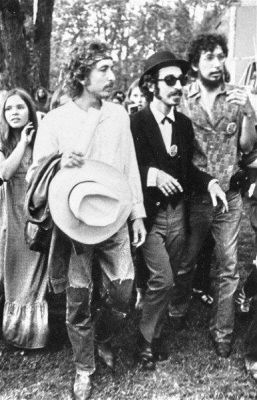
From left to right, Bob Dylan, Leon Redbone, and David Bromberg

But I digress.  This post is about David Bromberg, whom I consider a woefully underappreciated American treasure.  The first record of his I copped was this one: David Bromberg Songs (1972).  Two tunes that really caught by attention were “Delia,” an obscure yet widely covered (if that’s possible) murder narrative and “Sammy’s Song,” a Hemingwayesque tale about a sixteen-year-old’s uncle-sponsored trip to a brothel.

Take a listen to this snippet from “Delia.”


And here’s “Sammy’s Song.”


Although most noted for his superb guitar playing, whether he’s laying down blues licks on a Son House cover or finger picking bluegrass at breakneck velocity, it’s Bromberg’s distinctive narrow ranged voice that slays me.  Rather than trying to imitate African Americans or white Southerners, Bromberg employs his very own Tarrytown baritone to great effect.  In addition to the acoustic, electric, and pedal steel guitars, he also plays fiddle and dobro in an eclectic array of genres: bluegrass, blues, folk, jazz, country and western, and rock-n-roll.

I finally got to see him live last March at the Pour House.  His quintet featured Nate Grower on fiddle, Mark Cosgrove on guitar and mandolin, Josh Kanusky on drums, and Butch Amiot on bass.  They ran through a fifteen song set whose highlights included his great cover of Ian and Sylvia’s “Summer Wages,” an acapella rendition of “Will You Still Love Me Tomorrow,” and his signature version of  “New Lee Highway Blues.”

David Bromberg at the Pour House, photo by Wesley Moore

And, oh yeah, and “Delia.” He provided a more complete history of the song’s origin, which is absolutely fascinating. Delia Green was a 14-year-old girl shot on Christmas Day in 1900 in Savannah. For whatever reason, her murder inspired several songs, the two most famous by Blind Willie McTell and Blake Alphonso Higgs.  In addition to Bromberg, Bob Dylan, Josh White, Pete Seeger, Harry Bellafonte, Burl Ives, the Kingtson Trio, Bobby Bare, Waylon Jennings, and Johnny Cash have all covered the song.  Of yeah, one more, Pat Boone.

Pat Boone? WTF?

Anyway, do yourself a favor and go out and buy a couple of his records, and if you ever get the chance to see him live, jump at it.

I’ll leave you with this.


Trolls

For something sufficiently toad troll-like
Squats in me, too.
Bastardization of Larkin’s “Toads”

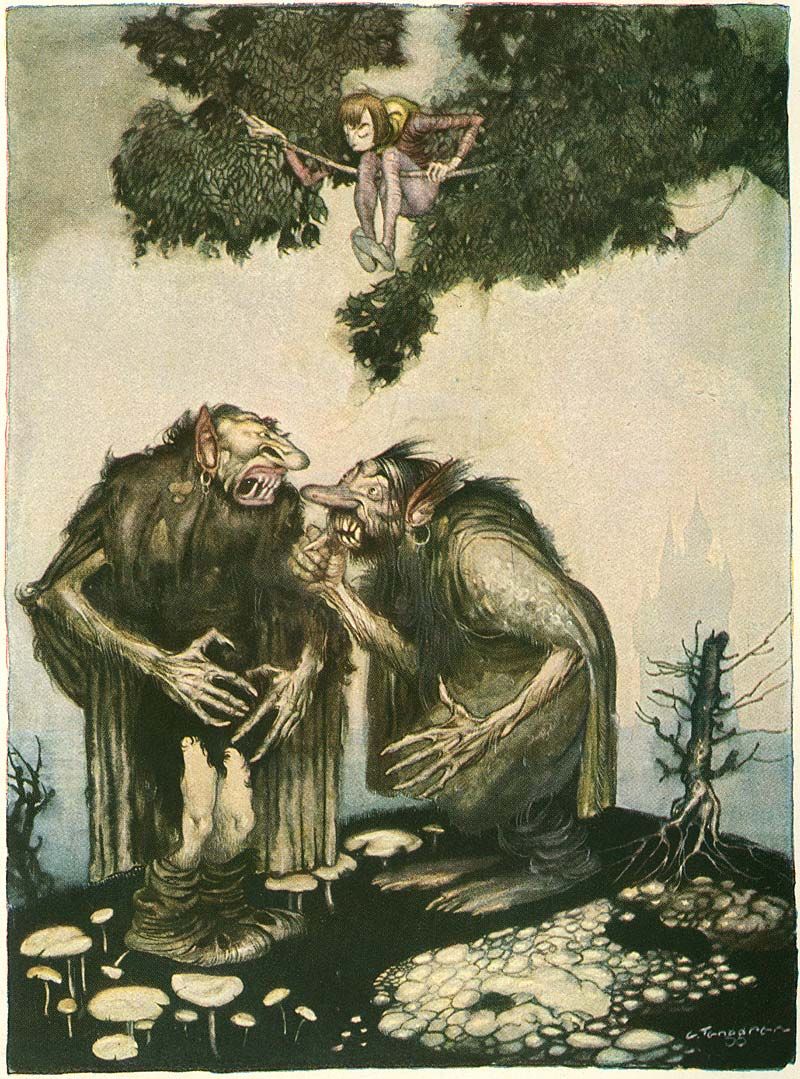
Originating in the dark caverns of the Scandinavian subconscious, trolls have undergone a sort of metamorphosis over the ages. Here’s the OED’s definition:

One of a race of supernatural beings formally conceived as giants, now, in Denmark and Sweden as dwarves or imps, supposed to inhabit caves or subterranean dwellings.

“Or under bridges” the scholars might have added, given the first troll we encounter as children is that creature who confronts the Three Billy Goats Gruff*, protagonists of a Norwegian folk take that appeared in English in 1859.


*”De tre bukkene Bruse

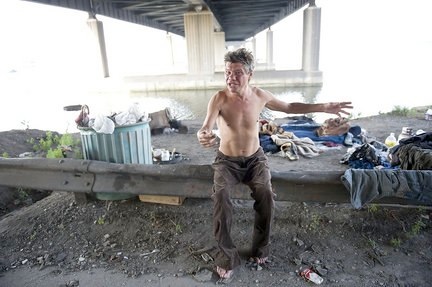
As a child, I associated trolls with the frightening old drunks I’d sometime encounter in Azalea Park in Summerville, those grizzled reeking jug-toting vagrants who might snatch you and eat you alive. (Or, more likely, though I was innocent of such horrors, drag you underneath a bridge and molest you).

William Leonard of Jersey City

Of course, now troll has a new denotation as one of those belligerent threadjackers who disrupt internet colloquies with ad hominem attacks that ignore the subject at hand, whether it be Melania Trump’s anti-bullying campaign or Hillary Clinton’s views on cannabis legalization.

Although Rizzuto’s wit may fall short of say, Alexander Pope’s, at least he uses his real name and provides a photo of himself. Given the nature of the Internet, it’s all too easy to troll anonymously under various nom-de-nets like PatriotMom or GodfearingRaptor.

Here anonymity can breed fearsome ad hominem assaults in the worst of taste, sometimes alluding to family tragedies, as if the fact that your late uncle drove off a bridge in the early Seventies killing a passenger undercuts your argument that immigration reform is a pressing legislative priority.

Pope illustration by Marianne Goldin

Although I confess that something troll-like squats in me as well, I hope the term provocateur better describes what I sometime do on Facebook and in this blog. The difference is that the insults I sling appear in the context of some sort of argument (regardless of the argument’s validity). In other words, when I insult Tim Scott, for example, by calling him an Uncle Tom, it’s in the context of his political philosophy that favors the rich white super minority over those who can’t make ends meet and rely on food stamps and subsidized school lunches.

In no way am I comparing myself to HL Mencken in wit or writing ability, but he, I think, represents what I mean by being a provocateur rather than a troll. Although what Mencken says below is immoderate, if not downright cruel (especially since it appears in an obituary), he is, in fact, summing up an argument that he had presented in previous paragraphs:

Trump Bryan was a vulgar and common man, a cad undiluted. He was ignorant, bigoted, self-seeking, blatant and dishonest. His career brought him into contact with the first men of his time; he preferred the company of rustic ignoramuses. It was hard to believe, watching him at Dayton, that he had traveled, that he had been received in civilized societies, that he had been a high officer of state. He seemed only a poor clod like those around him, deluded by a childish theology, full of an almost pathological hatred of all learning, all human dignity, all beauty, all fine and noble things. He was a peasant come home to the dung-pile. Imagine a gentleman, and you have imagined everything that he was not.

I am, I confess, looking forward to the day in the not too distant future when I can let the dog of my discontent off the leash of my contractual obligation to represent my place of employment 24/7 as a sterling representative of discretion and moderation in all things. Now, I dare not confront certain subjects – like the schism in the Episcopal Church; however, when I retire, I’ll be able to pursue my twilight dream to become the Crazy Jane of the Internet.

Crazy Jane Talks With The Bishop

I met the Bishop on the road
And much said he and I.
‘Those breasts are flat and fallen now,
Those veins must soon be dry;
Live in a heavenly mansion,
Not in some foul sty.’

‘Fair and foul are near of kin,
And fair needs foul,’ I cried.
‘My friends are gone, but that’s a truth
Nor grave nor bed denied,
Learned in bodily lowliness
And in the heart’s pride.

‘A woman can be proud and stiff
When on love intent;
But Love has pitched his mansion in
The place of excrement;
For nothing can be sole or whole
That has not been rent.’

William Butler Yeats

“The Waste Land” vis-à-vis “Apocalypse, Now”

Eliot and CoppalaJoyce would call it an epiphany – I’d call it a cartoon light bulb flashing above my head —  me slouching in a seat of a movie theater located in a strip shopping center off Sam Rittenberg Boulevard.  Apocalypse, Now had just come to town, and I was catching it at the first matinee I could.

I teach Heart of Darkness and was, of course, interested in how the transplantation from the Congo to Viet Nam would work out.

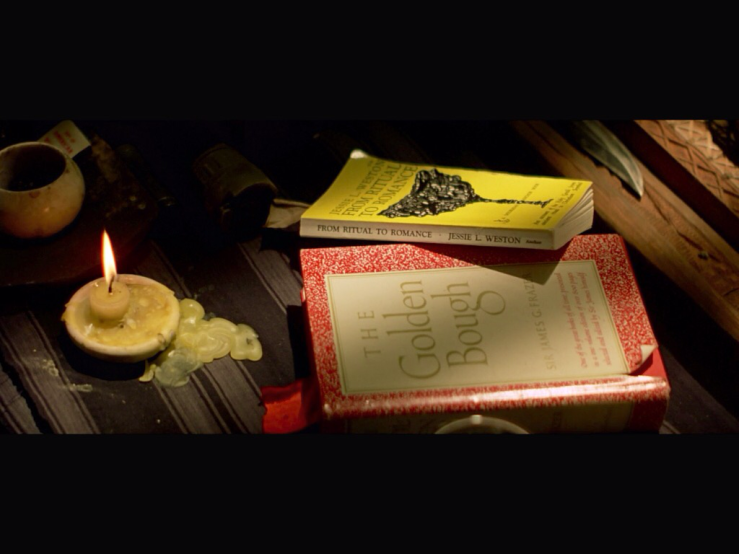
Here’s what switched on the light:

image from Apocalypse, Now

And here, Ol’ Possum, Groucho’s pal, TS Eliot hisself letting us in on a secret about his sources for “The Waste Land.”

Not only the title, but the plan and a good deal of the incidental symbolism of the poem were suggested by Miss Jessie L. Weston’s book on the Grail legend: From Ritual to Romance (Macmillan, Cambridge) Indeed, so deeply am I indebted, Miss Weston’s book will elucidate the difficulties of the poem much better than my notes can do; and I recommend it (apart from the great interest of the book itself) to any who think such elucidation of the poem worth the trouble. To another work of anthropology I am indebted in general, one which has influenced our generation profoundly; I mean The Golden Bough; I have used especially the two volumes Adonis, Attis, Osiris. Anyone who is acquainted with these works will immediately recognise in the poem certain references to vegetation ceremonies.[1]

Originally Eliot wanted Mistah Kurtz’s last words “the horror, the horror” to serve as the epigraph, but know-it-all il miglior fabbro Ezra nixed Kurtz’s utterance as “not weighty enough” and suggested this admittedly weightier snippet from Petronius’s Satyricon to serve the purpose of cross reference point.

“Nam Sybillam quidem Cumis ego ipse oculis meis vidi
in ampulla pendere, et cum pueri illi dicerent: Στβμλλ
τί Θέλεις; respondebat illa: άπσΘνειν Θελω.”[2]

So I say that “The Waste Land” and its sources From Ritual to Romance and The Golden Bough are key in understanding Willard’s relationship with Kurtz, the ritual double sacrifice of caribou and the colonel, which/who are obviously linked.

Trigger warning:  This clip is not for the squeamish; two mammals are hacked to death.


Amphetaminetic  Synopsis of “The Waste Land”

Part 1:  The Burial of the Dead

Chaucer’s Whan that Aprille with his shoures soote becomes

April is the cruellest month, breeding

Lilacs out of the dead land, mixing

Memory and desire, stirring

Dull roots with spring rain.

This is Eliot’s MO – picking up post WW1 shards of Western Civilization’s shattered stained glass window and collagificating [copyright pending] them back together in ironic juxtapositioning. In Chaucer’s day, spring was a blessed rebirth, in Eliot’s god-vacated poem, a dreaded reoccurrence.

You see, winter is preferable to resurrection when we can keep warm beneath forget snow.

ZAP!

We’re in a Biblical desert among stony rubbish where Isaiah shows us

[. . . ] something different from either

Your shadow at morning striding behind you

Or your shadow at evening rising to meet you;

I will show you fear in a handful of dust.

The Sibyl!

ZAP!

A tarot reading where Madame Sosostris, famous clairvoyante doesn’t find The Hanged Man, i.e., a god to be resurrected, not only a harbinger of spring, but what engenders the spring.
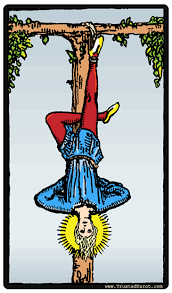
But there he  is – the Hanged Man — at Colonel Kurtz’s compound in Apocalypse, Now.

image from Apocalypse, Now

ZAP!

We’re in Danteville, headed to Hades/Hell/Work:

A crowd flowed over London Bridge, so many

I had not thought death had undone so many.


 Jacobean echoing, a corpse “planted,”  dogs digging up that corpse, which is beginning to sprout.


There I saw one I knew, and stopped him, crying: “Stetson!

“You who were with me in the ships at Mylae!

“That corpse you planted last year in your garden,

“Has it begun to sprout? Will it bloom this year?

“Or has the sudden frost disturbed its bed?

“Oh keep the Dog far hence, that’s friend to men,

“Or with his nails he’ll dig it up again!


Baudelaire:  “You! hypocrite lecteur!—mon semblable,—mon frère!”


Part 2: A Game of Chess

Cleopatra hanging at the equivalent of Dorian Gray’s where a golden Cupidon peep[s] out among sevenbranched candelabra.

Among the ornate decorations

Above the antique mantel was displayed

As though a window gave upon the sylvan scene

The change of Philomel, by the barbarous king

So rudely forced; yet there the nightingale

Filled all the desert with inviolable voice

And still she cried, and still the world pursues,

“Jug Jug” to dirty ears.

ZAP!

Neurotic banter:

My nerves are bad tonight. Yes, bad. Stay with me.

“Speak to me. Why do you never speak. Speak.

  “What are you thinking of? What thinking? What?

“I never know what you are thinking. Think.”

ZAP!

Those are pearls that were his eyes.

ZAP!

O O O O that Shakespeherian Rag—

It’s so elegant

So intelligent

So mechanical, so not Shakespeare, so-so-so civilization-in-decline.

ZAP!

We’re eavesdropping in on working class abortion gossip in a pub as the barkeep trumpets England’s equivalent to “last call for alcohol”:

HURRY UP PLEASE ITS TIME

HURRY UP PLEASE ITS TIME

Goonight Bill. Goonight Lou. Goonight May. Goonight.

Ta ta. Goonight. Goonight.

Speaking of death by water, enter Ophelia:

Good night, ladies, good night, sweet ladies, good night, good night.[2]


Part 3:  The Fire Sermon

Spenser:  Sweet Thames, run softly, till I end my song.

Not so sweet the Thames in the 1920s.

empty bottles, sandwich papers,

Silk handkerchiefs, cardboard boxes, cigarette ends

But wait!  The river bears no empty bottles, sandwich papers,

Silk handkerchiefs, cardboard boxes, cigarette ends.

 The city is empty.

ZAP!

The Fisher King:

While I was fishing in the dull canal

On a winter evening round behind the gashouse

Musing upon the king my brother’s wreck

And on the king my father’s death before him.

Human sacrifice, the king must die to generate the spring, like Jesus does every spring — dead, buried, resurrected — like those Neolithic god-kings Frazer writes about in The Golden Bough whose health and sickness are associated with fertility and famine.  They must be sacrificed and replaced, i.e. must die and be resurrected, to insure healthy crops, like Osiris, Attis, Adonis.

White bodies naked on the low damp ground

And bones cast in a little low dry garret,

Rattled by the rat’s foot only, year to year.

 ZAP!

Gay hotel assignation, barren sex as far as procreation goes.

Under the brown fog of a winter noon

Mr. Eugenides, the Smyrna merchant

Unshaven, with a pocket full of currants

C.i.f. London: documents at sight,

Asked me in demotic French

To luncheon at the Cannon Street Hotel

Followed by a weekend at the Metropole.

ZAP!

Enter voyeuristic but blind double-sexed Tiresias who witnesses arid copulation in interlocking sonnets:

At the violet hour, when the eyes and back

Turn upward from the desk, when the human engine waits

Like a taxi throbbing waiting,

I Tiresias, though blind, throbbing between two lives,

Old man with wrinkled female breasts, can see

At the violet hour, the evening hour that strives

Homeward, and brings the sailor home from sea,

The typist home at teatime, clears her breakfast, lights

Her stove, and lays out food in tins.

Out of the window perilously spread

Her drying combinations touched by the sun’s last rays,

On the divan are piled (at night her bed)

Stockings, slippers, camisoles, and stays.

I Tiresias, old man with wrinkled dugs

Perceived the scene, and foretold the rest—

I too awaited the expected guest.

He, the young man carbuncular, arrives,

A small house agent’s clerk, with one bold stare,

One of the low on whom assurance sits

As a silk hat on a Bradford millionaire.

The time is now propitious, as he guesses,

The meal is ended, she is bored and tired,

Endeavours to engage her in caresses

Which still are unreproved, if undesired.

Flushed and decided, he assaults at once;

Exploring hands encounter no defence;

His vanity requires no response,

And makes a welcome of indifference.

(And I Tiresias have foresuffered all

Enacted on this same divan or bed;

I who have sat by Thebes below the wall

And walked among the lowest of the dead.)

Bestows one final patronising kiss,

And gropes his way, finding the stairs unlit . . .


She turns and looks a moment in the glass,

Hardly aware of her departed lover;

Her brain allows one half-formed thought to pass:

“Well now that’s done: and I’m glad it’s over.”

When lovely woman stoops to folly and

Paces about her room again, alone,

She smoothes her hair with automatic hand,

And puts a record on the gramophone

ZAP!

Wagnerian canoe coitus:

Trams and dusty trees.

Highbury bore me. Richmond and Kew

Undid me. By Richmond I raised my knees

Supine on the floor of a narrow canoe.


la la


Part 4:  Death by Water

Here’s the whole shebang:

Phlebas the Phoenician, a fortnight dead,

Forgot the cry of gulls, and the deep sea swell

And the profit and loss.

                                   A current under sea

Picked his bones in whispers. As he rose and fell

He passed the stages of his age and youth

Entering the whirlpool.

                                   Gentile or Jew

O you who turn the wheel and look to windward,

Consider Phlebas, who was once handsome and tall as you.


Part 5:  What the Thunder Said

We’re thirsty!

If there were only water amongst the rock

Dead mountain mouth of carious teeth that cannot spit

Here one can neither stand nor lie nor sit

There is not even silence in the mountains

But dry sterile thunder without rain

There is not even solitude in the mountains

But red sullen faces sneer and snarl

From doors of mudcracked houses


Things fallin’ apart:

Falling towers

Jerusalem Athens Alexandria

Vienna London

Unreal

ZAP!

I have heard the key

Turn in the door once and turn once only

We think of the key, each in his prison

Thinking of the key, each confirms a prison

 We’re talking Holy Grail gone missing:

I sat upon the shore

Fishing, with the arid plain behind me

Shall I at least set my lands in order?

London Bridge is falling down falling down falling down

Poi s’ascose nel foco che gli affina

Quando fiam uti chelidon—O swallow swallow

Le Prince d’Aquitaine à la tour abolie

These fragments I have shored against my ruins

Why then Ile fit you. Hieronymo’s mad againe.

Datta. Dayadhvam. Damyata.

Shantih     shantih     shantih


The End!


So as Eliot relied on Frazer’s The Golden Bough and Weston’s From Ritual to Romance as subtext so Coppola uses “The Waste Land” in a similar fashion.

When Willard kills Kurtz, he’s the new god, yet he gives up that honor to return to Babylon, so to speak. I’ve read that Coppola filmed two different endings, one in which Willard goes home and one in which he stays in the jungle.  The studio viewer-tested the ending, and, of course, the rabble wanted Willard to return to home-not-so-sweet home, to the cinema in the strip shopping center off Sam Rittenberg Boulevard where he would have a roof over his head.

I’ll give Conrad’s Marlow the last word.

I found myself back in the sepulchral city [i.e., Brussels after his ordeal in the Congo] resenting the sight of people hurrying through the streets to filch a little money from each other, to devour their infamous cookery, to gulp their unwholesome beer, to dream their insignificant and silly dreams. They trespassed upon my thoughts. They were intruders whose knowledge of life was to me an irritating pretence, because I felt so sure they could not possibly know the things I knew. Their bearing, which was simply the bearing of commonplace individuals going about their business in the assurance of perfect safety, was offensive to me like the outrageous flauntings of folly in the face of a danger it is unable to comprehend. I had no particular desire to enlighten them, but I had some difficulty in restraining myself from laughing in their faces so full of stupid importance.


[1 ]i.e., rituals of human sacrifice

[2]With my own eyes I saw the Sybil of Cumae hanging
in a bottle; and when the boys said to her: Sybil,
what do you want?” she replied: “I want to die.”

[3]Once again, the low and high are juxtaposed


Mom: One Year Later

My son Ned on his mother’s demise.

kingofnowhere's avatarKing of nowhere

It’s been a year. Things feel normal now. Those moments of realization come still, but it’s now, “Mom’s dead. Oh.” Hard to believe, but I’m tethered to Earth again. It’s not dissimilar to those mornings I’d wake up in Kiel and realize I was thousands of miles away from home. Hard to believe, yes, but nothing revolutionary. The worst is over, though I’d being lying if I said there hasn’t been a wave building the past few weeks, spikes in anxiety and homesickness, old memories coming back to life. 

Mom rescuing me from St. Andrews pre-school. The smell of the cleaning agent. The cheaply tiled floor. The relief.

It’s hard to believe how much of grieving is self-centered. How much of Mom I always carried with me, how she was always a part of my reality. “I can’t wait to think tell Mom about this,” I thought multiple times…

View original post 594 more words

Matthew Arnold vs. Thomas Friedman

Whenever I participate in interviews for prospective administrators or humanities teacher candidates at my school, my first question goes something like this:

Matthew Arnold once wrote that education’s primary purpose was “getting to know [. . .] the best that has been thought and said in the world.” I’ve recently attended a couple of conferences devoted to the brave new world of “21st Century education.” The lecturers at these conferences argue we should be preparing students for global capitalism, making sure they can command computers, work together in groups, plan and implement projects, etc.[1]  A survey of British literature, for example, comes off as impractical in this context.  After all, understanding how WWI’s shattering of Western Civilization’s stained glass window relates to the fragmentary nature of Eliot’s “The Waste Land” isn’t going to have much practical value in negotiating an international real estate transaction.

What’s your take on this dichotomy?  Should we jettison the great books and literature survey courses in exchange for a more practical, hands-on approach to dealing with data?  Does understanding the sequence of the history of thought have any practical value?

Of course, it’s not an easy question, but that’s the point.  And, of course, an astute listener will detect my bias in framing the question.

The truth of the matter is that British literature surveys in high schools are hobbling towards extinction.  Only my school’s sophomore honors classes encounter the historical sequence that features, among other riches,  Romanticism’s rejection of Augustan rationality (cf. the 60’s vis-à-visthe 50’s); the non-honor classes explore the British canon thematically, e.g., Beowulf and Frankenstein headlining a unit on “monsters.”

Instead of a tapestry, they get a quilt.

The counterargument, which I concede has merit, is that students need to understand non-Western cultures in our rapidly shrinking world.  On the other hand, reading a Chinese poem in translation means forsaking sound, which is what poetry is all about.  I would argue that understanding how Keats employs caesura to slow down the lines of “An Ode to a Nightingale” to convey exhaustion might have more analytical merit that engaging with naked poetic ideas from afar stripped of the original interconnections of sound and sense that enhanced their meanings.

* * *

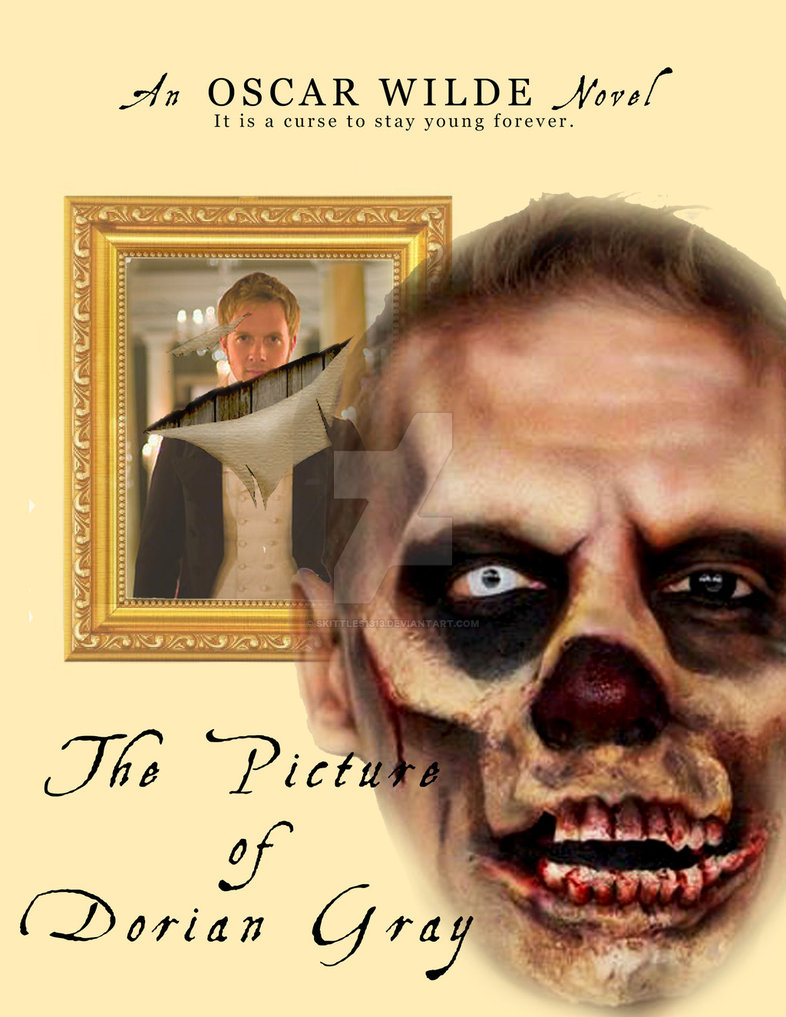
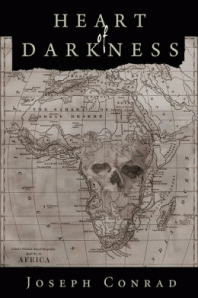
What has sparked this post is a happy coincidence that has occurred in the 9th grade genre course I teach.  This year in the 9th grade we replaced 1984 with The Picture of Dorian Gray as our second semester novel.  As my fortitudinous non-plan planning has had it, I find myself simultaneously teaching The Picture of Dorian Gray (1890) to freshmen and Heart of Darkness (1899), to sophomores.

Although I concede you could teach both in the monster unit — Gray versus Kurtz – students would be ignorant of the Victorian background that makes the contrasts of these two works and their characters so meaningful.  They would miss out the connection between this:

[Dorian] was seated at the piano, with his back to them, turning over the pages of Schumann’s “Forest Scenes.”

And this, Marlow in “Heart of Darkness” talking about his European colleagues in the Belgium Congo:

“The word ‘ivory’ rang in the air, was whispered, was sighed. You would think they were praying to it.”

“21st Century” educational question:  “Are Dorian/Lord Henry/Kurtz’s ‘Intended’ complicit in the slaughter of African elephants?”


Dig this; here’s our first peek at Lord Henry, the villain of TPoDG:

From the corner of the divan of Persian saddle-bags on which he was lying, smoking, as was his custom, innumerable cigarettes, Lord henry Wotton could just catch the gleam of the honey-sweet and honey-coloured blossoms of a laburnum . . .  [my italics]

Here’s our first peek at Conrad’s alter ego:

Marlow sat cross-legged right aft, leaning against the mizzen-mast. He had sunken cheeks, a yellow complexion, a straight back, an ascetic aspect, and, with his arms dropped, the palms of hands outwards, resembled an idol.  [my italics]

Indulge me on last contrast, a contrast in how one feels about lying, which is of particular political import right now in the USA.

“Let’s go to the theater tonight,” said Lord Henry.  “There is sure to be something on, somewhere. I have promised to dine at White’s, but it is only with an old friend, so I can send him a wire to say I am ill, or that I’m prevented from coming in consequence of a subsequent engagement.”

Marlow, on the other hand:

You know I hate, detest, and can’t bear a lie, not because I am straighter than the rest of us, but simply because it appalls me. There is a taint of death, a flavour of mortality in lies – which is exactly what I hate and detest in the world – what I want to forget. It makes me miserable and sick, like biting something rotten would do.

I’ve been highlighting snippets from the other novel to both ninth and tenth grade classes.  I pretend that the two events, Marlow’s telling his horrific story of what he saw in Africa on the Nellie in the Thames and Lord Henry lounging on the divan in Mayfield, are taking place simultaneously.

And, of course, they were.

1010226_1431056643796011_1891552011_n1


[1]Not surprisingly, this information is provided via lecture, rather than having the attendees discover it in group work,