2024 Carolina/Clemson Football Recap: Post Hoc Ergo Propter Hoc Edition

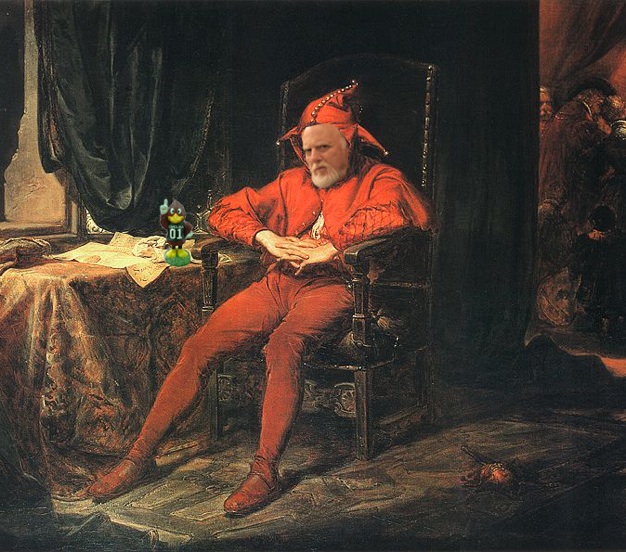
It’s a rare Saturday after Thanksgiving when I can celebrate a South Carolina Gamecock victory over the Clemson Tigers in the so-called Palmetto Bowl.[1] In two weeks I celebrate my 72nd birthday, and in that span of time, which began in the last month of the Truman Administration and ends in the last month of the Biden Administration, a sizable chunk of two centuries that  includes the Korean Conflict, McCarthyism; the British pop invasion, Viet Nam, the King and Kennedy assassinations, the Carter malaise, the Reagan Revolution, the Fall of the Soviet Union, William Jefferson Clinton, 9/11, Iraq and Afghanistan, no drama Obama, way-too-much-drama Trump, COVID, not to mention a whole lotta of other shit. 

Anyway, during this span of my existence, the Gamecocks have only managed to beat Clem[p]son on 27 occasions, i.e., .375% of the time.[2]

I’ve actually written a parody of the USC alma mater, which some of my fellow alums find distasteful:

We curse thee, Carolina, 

And sing our dismay.

Heart-breaking losses

Haunting our days.

Anyway, fair weather fan that I am, during abysmal Gamecock stretches — they lost 21 consecutive games in 1998 and 1999 — I don’t squander precious moments fretting over my alma mater’s dismal war record. However, when they’re doing well, like this year, I tune in. 

And this year’s game was a big, big deal with both teams ranked in the top 15 with a chance of being included in the inaugural 12-team National Championship playoffs.

At least for me, it’s difficult to cull any positive expectations when it comes to the Clemson game with all those muffed punts, pass interference penalties, and missed arm tackles festering beneath the pond scum of my consciousness. Nevertheless, this year, I did feel a pang of hopefulness. After all, we had one five in a row, three against ranked opponents, and three on the road in hostile environments. And Clemson didn’t look all that great against Louisville and Pitt.

I thought it might even be a blowout.

It wasn’t. We turned the ball over three times, racked up 67 yards of penalties in typical Gamecock fashion — and yet, and yet — we pulled it off in the last five minutes, scoring the winning TD and intercepting a pass deep in Gamecock territory with 16 seconds left on the clock.

Though many attribute the victory to the heroics of LaNorris Sellers, who off the field resembles a Black Clark Kent, but on the gridiron is a superhero, a Fran Tarkenton/Harry Houdini escape artist clone, I’m fairly certain we won because fellow long-sufferer Harvey Rodgers donned his magic hat at the beginning of the fourth quarter when we outscored the Tigers 10-zip.

So thank you, Harvey (and LaNorris and Coach Beamer and everyone else on the staff).

Yay, us, for a change.

PS. And, dear reader, if you’re lucky enough to be the area, here’s an invitation for you. Please RSVP, though. Cheers!


[1] For those unfamiliar with the upstate South Carolina agricultural university, “Clemson” is pronounced CLEMP-son, not CLEMS- son.  The P is invisible. 

[2] To paraphrase one of my muses, Mary Flannery O’Connor, “Don’t ever overestimate the intelligence of your readers,” I included that rather tedious catalogue of historical events to suggest that the outcome of annual football games are not matters of serious discourse. But I lie. I spent almost the same degree of worry about yesterday’s contest as I did about this month’s presidential election.

AI Has Its Place But It Ain’t Above My Mantle

The other day on Facebook, every septuagenarian’s favorite social media platform, I posted this confession:

“I’ve just come to the terrible realization that I’m a professional dilettante!”

I meant the quip, of course, to be humorous given the oxymoronic pairing of professional, denoting lucrative compensation for someone who can claim to be an expert, and dilettante, which describes a poser, an amateur who dabbles in the arts.[1]

A few kind responders begged to differ, claiming that I was the real deal, which I appreciate, but don’t buy, especially when it comes to what I have come to call my “fake paintings,” which are essentially photocollages filtered to look like paintings and printed on canvases. Not that they’re not eye-catching in a good way. My friend the painter and filmmaker David Boatwright ­ — the antithesis of a dilletante — finds them amusing.[2] So even though I call them “fake,” I do think they qualify as “art,” but it’s amateur art. When in a groove, I can crank one out in a couple of hours.[3] David, on the other hand, toils over his canvases and murals for months, not ceasing until every last miniscule detail is right.

Which brings me to the central subject of these ramblings — AI generated illustrations. 

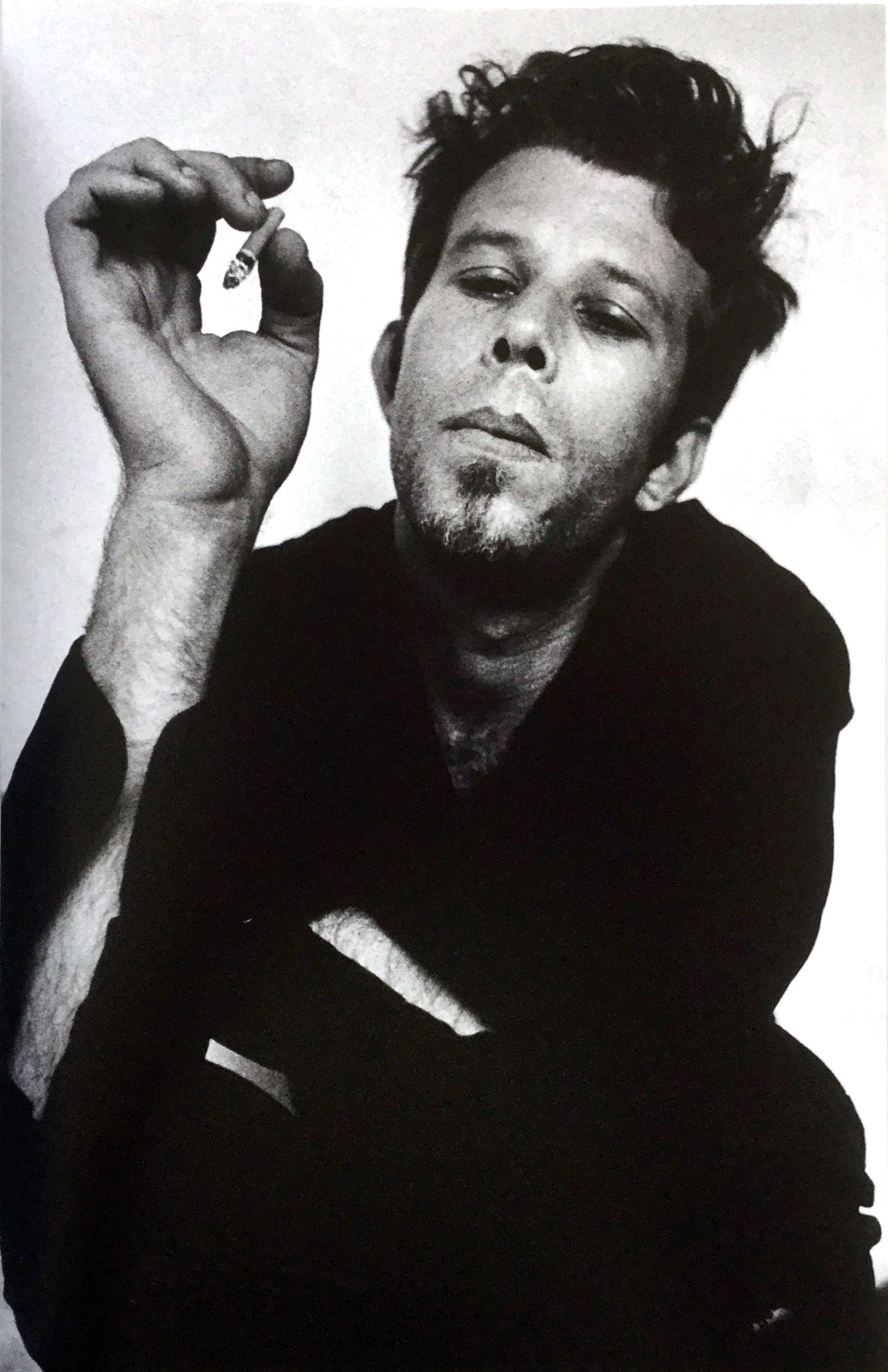
A while back a Facebook friend lamented that AI-generated “art” was going to put people like me out of business, but I begged to differ. “AI hasn’t listened to Tom Waits while smoking Thai sticks,” I responded. It can’t, by its very essence, be original. It ain’t got soul. 

Last night my wife Caroline and I were looking at my two latest canvases, and I said, “There’s no way AI could come up with either one of these.”

“Let’s do a little experiment and see what AI comes up with,” she said. 

So we did, prompting the software to create something similar. 

Before we begin the comparison, I’ll explain briefly how I go about making a fake painting. 

I start with a high resolution photograph. In my latest (see below) TGIF Chico Feo, I took a photo of the bar area when I was the only customer in the establishment. 

I upload the photograph to Photoshop and add an artistic filter, in this case, the “Dry Brush” filter.

Almost always, I have no preconceived notions about what I’m looking to create. In this case, I googled “pulp cover paperbacks bar scenes” and scored the couple kissing from a novel entitled Divorce. Of course, the man wasn’t leaning over a bar to kiss his lover, but I determined I might be able to cut the couple out and paste them into the photo, and, damn, it worked. Next, I found the woman sitting to the couple’s left and did likewise, and once again, I was successful.

I thought it might be amusing to have an organ grinder in the foreground, but I couldn’t find any illustrations that suited; however, I did find the begging monkey with the cup and tried him in various locations until I hit upon placing him on the bar, interrupting the passionate kiss. 

I decided to place a large figure in the foreground and went Screaming-Jay-Hawkins hunting. I experimented with various Hawkins iterations, but the vibe wasn’t right, and then the proverbial cartoon light bulb went off above my fedora. Louis Armstrong, Satchmo!

And boom![4]

So here are my TGIF Chico Feo and AI’s response to the prompt “create a picture of Louis Armstrong playing at a beach bar.”

See what I mean.

One more example. 

Two of my favorite artists are Bruegel the Elder and Hironimus Bosch. 

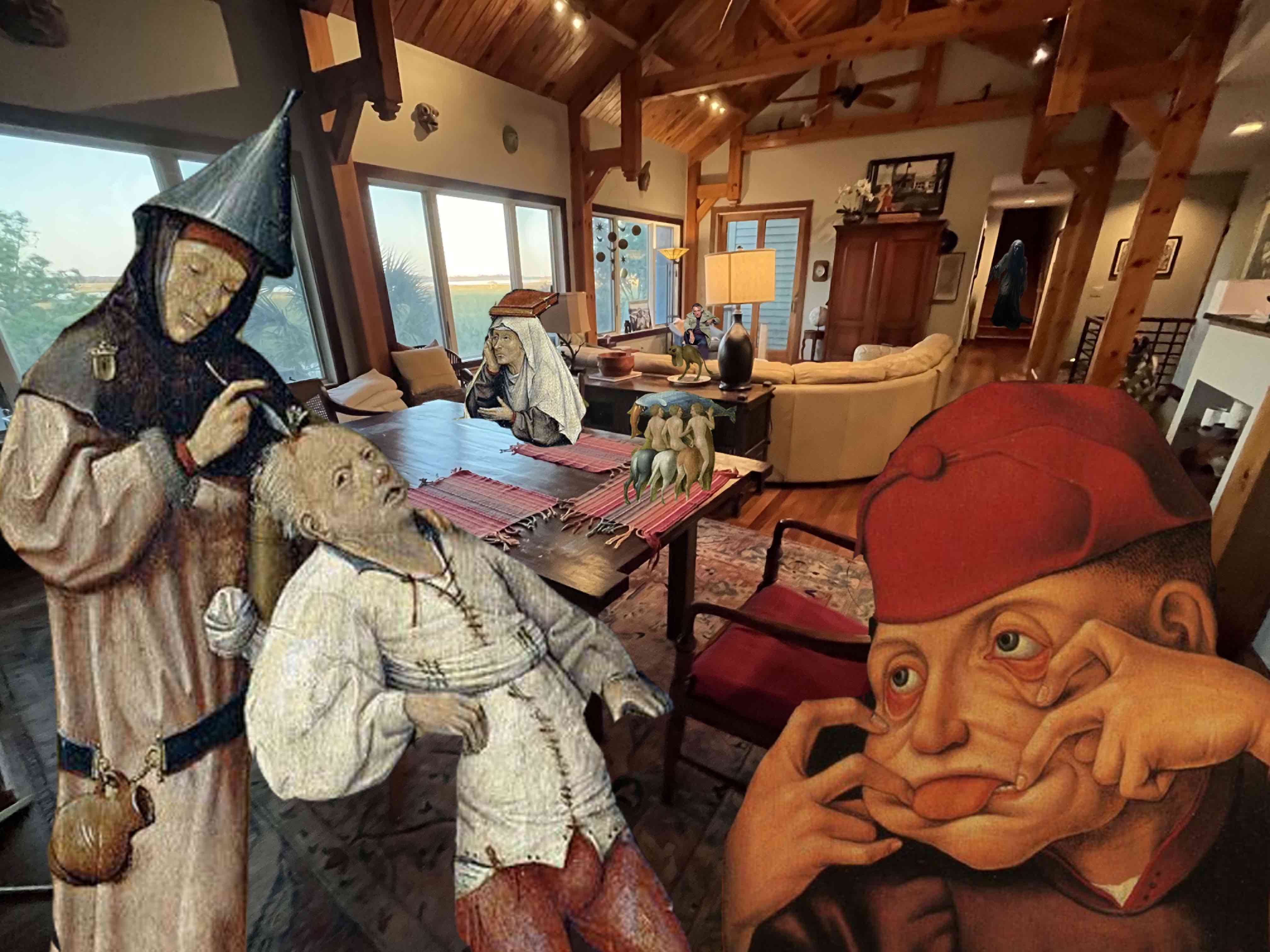
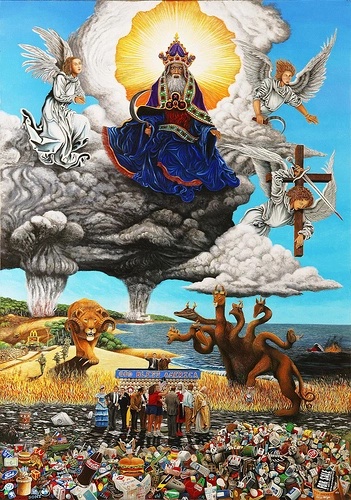
I took a photo of our living room, which struck me as sort of Flemish-looking so I peopled it with Bosch figures, being in a mocking post-election funk. 

Here’s the final product.

And here’s what AI came up with when prompted “Boschian style weird people and one Boschian monster in a regular modern beach house living room.”

Of course, AI is likely to put some illustrators out of business. In fact, because Caroline subscribes to AI software, I might ask her to provide me images to illustrate some of my blog posts. However, for book covers, I always prefer scruffy over slick. 

Which cover would you guess Caroline and I chose?


[1] The awkwardly phrased sentence this footnote references is proof in and of itself of my dilettantism. A professional, a true wordsmith, would devote time to express these ideas in a more cogent fashion, spending perhaps an hour or so insuring that every word was in its proper place and that the clauses melded in pleasant fluidity. but [cue Bob Dylan]. “[That] ain’t me, babe. 

[2] BTW, David has written a screenplay for a 15-minute film based on the poolroom chapter of my novel Today, Oh Boy and is just 50K short of having the funds to start production, so if you happen to be wealthy and want to be an art patron and contribute to making a really cool indie film, contact me, and I’ll forward your info to David. 

[3] I have had a one-man show at Studio Open and have sold a couple of dozen, two of which went for $500, so there’s that.

[4] I also Hitchcock like, try to make a cameo appearance in the “paintings.” In this case, it’s the cover photo of my next book Long Ago Last Summer. Can you find it?

Him Plenty Dead, Kemosabe

Him Plenty Dead, Kemosabe[1]

Curmudgeon iconoclast that I am, I’ve decided to ask my loved ones that my memorial service be dubbed “an acknowledgement of death” as opposed to “a celebration of life.”[2]

Look, I get the sentiment, know Ecclesiastes/ Byrds song — a time to be born, a time to die and all that jazz. Focus on life, not death. Dear departed Uncle so-and-so did some good things, navigated life okay, so let’s reminisce, let’s celebrate the years at the Navy Yard but not mention the racist jokes. 

But here’s what I really bugs me: the phrase “Celebration of Life” is clunky, wordy, awkward.

            “Hey. Josh, let’s go surfing.”

            “Can’t, dude. Gotta go my Uncle Tims’s celebration of life ceremony.”

            “Bummer, dude.” 

What’s wrong with calling the postmortem get together a “memorial service?”

BTW, I hate fucking euphemisms, especially fucking Chamber of Commerce euphemisms. 

So there!

Emily Dickinson, First Year Medical Student

their Nightingales and psalms

Far removed from vanity
The old man lies exposed,
His organs sporting flags
Like holes of a golf course.

Nose and Ears are hairy;
He used to be a Man
Who ate beets – burped – blinked in the Sun –
It used to be Man.

Now disarticulated,
The antithesis of sentimentality,
Resting in pieces
Like left over turkey.

Yes, I have become accustomed
To hanging out with the Dead,
Assuming a cool, ironic air,
Pulling intestines like thread,

But when I die, I want my Lodging
As plush as plush can be,
For I have learned this lesson
In Gross Anatomy:

In spite of all
The noble palaver,
It’s impossible to respect
A desiccated cadaver.

[1] a line from Tonto from an episode of the Lone Ranger circa 1958-ish

[2] I wish I could demand it, but I realize that corpses are in a weak position as far as negotiations go.  

A Spotty Religious Education

My mother’s people were Baptists, serious Baptists, no drinking, no playing cards on the Sabbath, no dancing, though where would they have danced in rural Orangeburg County if given the chance? Juke joints were devil dens. Maybe there were barn dances, but I doubt it.

On the other hand, my daddy’s people were indifferent Methodists. In the 19th Century, they must have been devout because my great-great grandfather Wesley, a Confederate foot soldier and later prisoner of war, named his son Luther, and I’m one of four descendants named Wesley in honor of the founder of the Methodist Church.

However, by my grandfather’s generation, none of the Moores I know of attended church. We did pray, mumbled the same rote grace every meal, but otherwise, the only time God’s name was uttered in our house, it was taken in vain by my father in anger.

Other families I occasionally ate with might ad-lib their blessings, mentioning current events, family members, and on one occasion, me, which made me feel somewhat uneasy for whatever reason. Obviously, praying was meaningful to them, an attempt at communication with the Lord rather than the empty abracadabra lip service we recited at our dinner table.

For a year or two, when I was eight nine, my mother, my brothers, and I sporadically showed up at Summerville Baptist Church where my grandmother Hazel worshipped. Pathologically shy, I despised going because I felt out-of-place, like an intruder; plus the place smelled strange, chemically odd, like they overdid the disinfectant. I’d much rather been at home smelling stale cigarette smoke dreading Monday reading the funny papers.

My mother wasn’t enamored with Summerville Baptist, yet sought a spiritual haven, so she joined St. Paul’s Episcopal Church, willing to be tarred with the accusation of being a social climber. So here I was again intruding in a strange place of worship, this one with ritualistic recitations, head-bowing, and kneeling that were alien to me. But Mama was serious this go around. She signed me up for confirmation classes. 

I hated being two years older than the other confirmation students, yet once I started attending, I did learn the basics of Judeo-Christianity, that the Old Testament was a covenant between God and Moses, and the New Testament a covenant between God and us mediated by his only begotten son. We had to memorize the names of the books of the Torah and the names of the first six books of the New Testament. I scored a 100 on the exit exam, was confirmed, and became a member of St. Paul’s. 

Back then, we used the 1928 version of the Book of Common Prayer which employed Jacobean English, and because of my uncanny ability to retain verse, song lyrics, and in this case liturgy, in a few years I could recite “The Order of Morning Prayer” by memory.[1]  

Here’s my favorite ditty from the Rite of Holy Communion: “If any man sin we have an Advocate with the Father, Jesus Christ the Righteous, and he is the Propitiation for our sins.”

Has a ring to it, doesn’t it.

Anyway, once I became an adult and married Judy Birdsong, who had been a Young Lifer in high school, lost her religion at Presbyterian College in Clinton, SC, “a small Christian College for small Christians,” as Judy used to say, I bid adieu to Christianity. 

We had our two sons baptized, but other than a short two-month stint at Sullivan’s Island’s Church of the Holy Cross when the boys were five and six, we didn’t go to church. However, they did attend Porter-Gaud, an Episcopal School, and sat in chapel every other week. 

My cousin Zilla, my great aunt Ruby’s daughter, an incredibly nosy and outspoken Baptist, once asked me if I had seen to my sons’ spiritual needs, and I could honestly say they frequently attended services at their school.

As I’ve written more than once, I envy people blessed with faith. It must be an enormous comfort, especially in the waning days of the American Empire.

O God, the Father of Our Lord Jesus Christ, our only Saviour, the Prince of Peace; Give us grace seriously to lay to heart the great dangers we are in by our unhappy divisions. Take away all hatred and prejudice, and whatsoever else may hinder us from godly union and concord.

Amen!


[1] This “uncanny ability” of memory doesn’t, alas, kick in with people’s names. 

In Times of Trouble Marcus Aurelius Comes to Me

In times of trouble, it’s not Mother Mary who comes to me, but Marcus Aurelius whose Meditations provide a practical response to the woes we face, and there’s no question that because of the election of Donald J Trump, the Western World is going to go through some things, especially Eastern and Western Europe. My father used to say that Russia will take us over without firing a shot. It certainly seems as if he might have been right.

Here, in the US, we have a patchwork of abortion laws, some so strict that so-called pro-lifers would rather a woman bleed to death than receive treatment during miscarriage. Trump has promised to put crackpot Robert Kennedy in charge of health and Elon Musk in charge of transforming the civil service into a Soviet-like bureaucracy of yes men. Most galling to me is that this adjudicated rapist, convicted felon, incorrigible liar and his servile minions are now in full celebration mode, not to mention that my faith of the good will of the American people has been severely compromised.

Yes, I’m heartbroken, but I am powerless at the moment to change the situation; however, I do have the power to herd my thoughts from the edge of a cliff to safer ground.

Here’s Aurelius:

“The first rule is to keep an untroubled spirit. The second is to look things in the face and know them for what they are.”

Of course, maintaining an untroubled spirit is much easier said than done.[1] However, “if you are pained by external things,” as Aurelius writes, ‘it is not they that disturb you, but your own judgement of them. And it is in your power to wipe out that judgement now.”

By judgement, I think he means your thinking of them, dwelling on them at the expense of the mundane joys of life, like looking up and seeing a formation of geese flying overhead, listening to Lester Young speaking through his tenor saxophone, enjoying the taste of olives plucked from a bowl that has been cured in a kiln, the bowl, a thing of beauty, which guides your thoughts to Keats’ great ode in which he sings, “a thing of beauty is a joy forever.”

Our moments are too precious to squander in barren speculation. What will be will be. I’ll attempt to employ what the Buddhists call mindfulness. I’ll try to pay attention to what is in front of me rather than the agonizing over what may or not be. I’ll attempt not to dwell in the shadows dark speculations.

In short, 

Live a good life. If there are gods and they are just, then they will not care how devout you have been, but will welcome you based on the virtues you have lived by. If there are gods, but unjust, then you should not want to worship them. If there are no gods, then you will be gone, but will have lived a noble life that will live on in the memories of your loved ones.

Marcus Aurelius, Meditations

To a Friend Whose Work Has Come to Nothing

Now all the truth is out,
Be secret and take defeat
From any brazen throat,
For how can you compete,
Being honor bred, with one
Who were it proved he lies
Were neither shamed in his own
Nor in his neighbors’ eyes;
Bred to a harder thing
Than Triumph, turn away
And like a laughing string
Whereon mad fingers play
Amid a place of stone,
Be secret and exult,
Because of all things known
That is most difficult.

WB Yeats


[1] Here’s a link to a piece I wrote called “The Art of Not Thinking.”

Swashbuckling Pundit Wesley Moore’s Prediction for the 2024 Presidential Election

Look, if you’ve ever been sucked into one of those social media video medical advertisements where some physician or chemist claims to have discovered a ridiculously easy way to detox the superfund-grade contamination of your liver without dieting or exercising or giving up your Jim Beam, you know you’re going to have to endure twenty plus minutes of tease before the secret is revealed that for $59.99 for can purchase a magical elixir, the great great great grandchild of 19th Century snake oil, and presto, no more liver problems.

But I’m not going to put you through that. I’m going to explain right away why Kamala Harris is going to win the presidency, maybe by a comfortable margin, and I wouldn’t be risking my stellar reputation as internet sage the weekend before the election if I were not positive.[1]

Let’s start unscientifically by plumbing the rich grotto of my intuition, a storehouse of data and sensations forming what the vulgar call “a gut feeling,” or what I’d prefer to call “an intestinal foreshadowing.”[2]

Okay, let’s get this show on the road.

Although I don’t believe that yard signs and crowd sizes are accurate predictors of election outcomes, this cycle seems somewhat different. At her rallies, Kamala’s audiences hang on her every word as she catalogues a future marked by communal problem solving whereas the less populous crowds at the Trump rallies tend to leave early during Trump’s interminable dystopian descriptions of mongrel hordes laying waste to municipalities or children exiting their school buses an entirely different gender than when they boarded in the morning. Any sane person who doesn’t reside inside the un-fun house of QAnon conspiracy theories knows that Trump is lying and/or delusional. Not a good look for someone entrusted with nuclear codes.

He offers no specific plans, but all the world’s and the nation’s ills will be solved, like the magic liver elixir, by his magical presence.

Slathered with orange make-up and topped with clownish platinum hair, like a cartoon character in the same clothes, he shambles around the nation in a haze that very well could be drug-induced.  I mean who falls asleep during his own felony trial? At any rate, his campaign has devolved into a Roman circus where he cosplays fast food minimum wage earners or sanitary workers. Yesterday, the garbage truck driving in circles with Trump staring out the window seems an apt metaphor for the campaign’s final stages. It’s almost as if his staff wants him to lose.

Segueing into a more data-driven arguments, early voting seems very promising for Kamala.  Although Republicans have been voting early, unlike in 2020, the voters have tended to be elderly high propensity voters, and Jen O’Malley Dillion, Kalama’s campaign chair, says, “We feel really good about what we’re seeing out there.” Even in Nevada where early voting rural Republicans have established a red fire wall, Dillion says in the last two days in Clark County, a Democratic stronghold, “we’ve had higher turnout from young voters than we have at any other point in this cycle.” She adds, “We are seeing Republicans voting early, but these are Republicans that are going to vote no matter what. So what they’re doing is that they’re changing their mode of voting. They were going to vote on Election Day, now they’re voting early.” She also claims that in other states low propensity voters are voting Democratic early. Polls also show that undecided voters are more open to voting for Kamala, not to mention than more women than men are voting with reproductive rights being one of the major issues.

Then there’s the discrepancy in the ground games. The Democratics boast a well-trained, well-staffed group of dedicated, enthusiastic doorknockers, postcard writers, phone-callers and texters whereas the Republicans are relying on paid workers, mercenaries you might say, to attempt to get the undecided to vote.

In short, the Republicans are, like their Dear Leader, disorganized (cf. Trump’s stashing classified documents in his bathroom). In the last days of the campaign you have Mike Johnson promising to end Obamacare if Trump wins, you have Elon Musk predicting Trump’s slashing spending will create temporary economic hardship, and Nikki Haley trashing the campaign. I suspect that Kamala will win at least 10% of Republican voters and a majority of independents. After all, Dick Cheney and Karl Rove are voting for Kamala. 

Lastly, the Democrats have several pathways to 270 electoral college votes, even if they were to lose Pennsylvania, which seems unlikely with a half-a-million pissed off Puerto Ricans living there.

Last, but certainly not least, the last three heart-breaking presidential loses in 2000, 2004, and 2016 featured wooden candidates incapable of warming the hearts of non-partisans. Obviously, Kamala is charismatic, out-Obama-ing Obama in my opinion.

Now that’s it. Excuse me while I check out some new promising dietary supplements. Cheers!


[1] Caveat: I’m not as positive that fawning Republican state legislatures and/or Speaker Mike Johnson will allow the certification of a Harris victory.

[2] Please note, I have now removed my tongue from my cheek. 

Wesley’s Weave: Dark Musings on Election Eve

Apocalypse by Adrian Kenyon

Donald Trump has dubbed his rambling speeches “the weave,” claiming that if you connect the dots of his zigzags, a unified picture appears. So I thought I’d give it a try myself.

Here goes.

The other night, after suffering through a self-righteous, ill-informed screed from a Facebook follower, I found myself listening to Bob Dylan’s masterful protest song “Hurricane,” a cinematic narrative recounting the arrest and trial of Rubin Hurricane Carter, a boxer wrongly convicted of a triple homicide in 1966 in Patterson, New Jersey.

Meanwhile, far away in another part of town
Rubin Carter and a couple of friends are drivin’ around
Number one contender for the middleweight crown
Had no idea what kinda shit was about to go down

When a cop pulled him over to the side of the road
Just like the time before and the time before that
In Paterson that’s just the way things go
If you’re black you might as well not show up on the street
‘Less you want to draw the heat

Near the end of the song Dylan sings,

How can the life of such a man
Be in the palm of some fool’s hand?
To see him obviously framed
Couldn’t help but make me feel ashamed to live in a land

Where justice is a game

Now all the criminals in their coats and their ties
Are free to drink martinis and watch the sun rise
While Rubin sits like Buddha in a ten-foot cell
An innocent man in a living hell

As I was listening, the long gone idealism of the 60s came to mind. Dylan himself — and Joan Baez –performed at the March on Washington, sharing the stage with Martin Luther King. They heard firsthand the “I Have a Dream Speech.”  They’re both still alive sixty-one years later.

In 1963, the American people considered communism the greatest threat to the nation’s sovereignty, and the Soviet Union was our greatest enemy whose spy agency the KGB eventually became the employer and training ground for Vladimir Putin, whom Donald Trump so idolizes, along with Kim Jong Un, the North Korean dictator. 

According to Trump, outside forces like Russia and North Korea aren’t the greatest threat to American sovereignty; no, it’s “the enemy within,” American citizens, news organizations, and celebrities tarred with the paradoxical disapprobation “woke.”  It’s Joe McCarthy redux, and McCarthy’s corrupt lawyer Roy Cohn was Donald Trump’s mentor.

Trump and his followers bring to mind WB Yeats’s lines from “The Second Coming”:

The best lack all conviction, while the worst

Are full of passionate intensity.

Fueled by the fifth deadly sin wrath, these resentful white supremist faux Christian cultists seem to prefer a dictatorship of oligarchs to the teachings of their would-be Savoir who famously preached

Blessed are the meek, for they shall inherit the earth.

Blessed are the merciful, for they shall obtain mercy.

Meanwhile,  

The blood-dimmed tide is loosed, and everywhere

The ceremony of innocence is drowned.

Connect these dots and what do you get?

[a] rough beast, its hour come round at last,

Slouch[ing] towards Bethlehem to be born.

James, Huck, and James McBride: A Review of Percival Everett’s “James”

After reading Dwight Garner’s laudatory review of Percival Everett’s James, I was eager to check it out, especially since I’m a huge fan of Huckleberry Finn

Here’s a snippet of Garner’s paean:

Percival Everett’s majestic new novel, James, goes several steps further. Everett flips the perspective on the events in Huckleberry Finn. He gives us the story as a coolly electric first-person narrative in the voice of Jim, the novel’s enslaved runaway. The pair’s adventures on the raft as it twisted down the Mississippi River were largely, from Huck’s perspective, larks. From Jim’s — excuse me, James’s — point of view, nearly every second is deadly serious. We recall that Jim told Huck, in Twain’s novel, that he was quite done with “adventures.”

Garner goes on to say, “This s Everett’s most thrilling novel, but also his most soulful.”

Alas, when reading James, I was never able to suspend my disbelief, to lose myself in the flow of action and forget that the narrative I was reading was a fictive construction. In his retelling of Huckleberry Finn from the perspective of Jim, Everett creates the conceit that the antebellum argot of slaves, the “Else’n they takes you to the post and whips ya[s]” is a linguistic ruse to appease the white population by making them feel superior. The narrator James (aka Jim) speaks (and thinks) in English so standard that he uses “one” instead of “you.”  In short, for me the novel is a contrivance; it’s created in a way that seems artificial and unrealistic.

Everett’s relating the events from James’ perspective in easy-to-decipher prose makes a lot of practical sense; however, the regionless diction of the retelling of Jim and Huck’s escape robs Jim of a breathing individual’s voice –– he could be from 21st Century Dayton, Ohio –– there are no quirks in his phraseology, no flashes of individuality, few regional linguistic markers, which divorces him from time and place and therefore relegates him into the status of a character in a novel rather than a person whom we believe is real. 

That said, Everett does an outstanding job of effectively depicting the horrors of slavery, the never-ending degradation, the perennial fear of having your family disbanded, the horrors of being horsewhipped, the constant verbal abuse. And the novel, especially after James hooks up with a minstrel show, becomes a real page turner, a sort of thriller with cliffhanging chapter endings as he and Huck manage a series of hairbreadth escapes a la The Perils of Pauline. Everett also creates a rich array of colorful characters that you care enough to keep reading, though you might grow a bit weary of the episodic nature of the plot bequeathed by Clemons. 

I couldn’t help unfavorably comparing James to James McBride’s The Good Lord Bird, which is also narrated by a slave, Little Onion, who is “liberated” by the historical abolitionist John Brown.  

Here’s Little Onion describing his liberator:

The old face, crinkled and dented with canals running every which way, pushed and shoved up against itself for a while, till a big old smile busted out from beneath ’em all, and his grey eyes fairly glowed. It was the first time I ever saw him smile free. A true smile. It was like looking at the face of God. And I knowed then, for the first time, that him being the person to lead the colored to freedom weren’t no lunacy. It was something he knowed true inside him. I saw it clear for the first time. I knowed then, too, that he knowed what I was – from the very first.

This is a person talking, not the idea of a person talking, which creates a depth of character that James lacks.

Compare McBride’s description with this: 

I was afraid of the men, but I was considerably more afraid of the dogs I’d heard coming our way. I could only imagine that they were after me, and so I was left confused by the presence of these two white men in our boat. Adding to the absurdity was the fact that they were opposite in nearly every way. The older man was very tall and gaunt, while the younger was nearly as short as Huck and fat. The younger had a head full of dark hair. The older was completely bald.

That’s not what I would call “cooly electric first person narrative.” In fact, when I taught composition, I would not allow my students to use the phrase “was the fact that.”

But, hey, look, as I’ve said elsewhere and often, writing a novel is a very difficult undertaking, and James is well worth reading, even though it falls short of my censorious standards for the high praise it has received.  It’s an audacious effort to reconfigure the novel that Hemingway credited with being the root of “all American literature.”  Also, the idea of seeing Huck’s world from Jim’s perspective is existentially cool, underscoring Hamlet’s observation that “There is nothing either good or bad but thinking makes it so.” 

I’d give it a B+ overall.

Hurricane Hugo Anniversary Ramblings

Today, 21 September 2024, happens to be the autumnal equinox, and here on Folly Beach, the Edge of America, the weather is perfect, not a cloud overhead, the temperature Edenic, downright Elysian — no flies at Chico Feo, no mosquito swatting needed on my walk home from the bar. 

However, today also happens to be the 35th anniversary of Hurricane Hugo. As you can see above, Hugo was, “a mighty, mighty storm.”[1] Ask any Lowcountry resident who opted not to evacuate, and you’re likely to hear tales ranging from extreme discomfiture to abject terror.

Our family – Judy Birdsong, sons Harrison (5) and Ned (3), springer spaniels Jack and Sally, and I-and-I lived on the Isle of Palms, a barrier island that lay in the crosshairs of a cone of inevitability – in other words, Charleston was going to get clobbered by a monster category 4 cyclone.

On Wednesday evening before Thursday’s late night landfall, before we drove to my parents’ house in Summerville to drop off the dogs and spend the night before fleeing further inland to Columbia, I drove downtown to Charleston to hear Allan Gurganus read from his just published novel The Oldest Living Confederate Widow Tells All. I bought a copy, had Allan inscribe it, then drove back home and nailed plywood over sliding glass doors.

As it turned out, the novel, which deals with Reconstruction, offered a parallel to what we were about to endure. My father-in-law Ralph Birdsong compared the post-Hugo Isle of Palms and Sullivans Island to the bombed out towns of Europe he witnessed in World War II. 

Sullivan’s Island 22 September 1989

Reconstruction indeed.

We left Summerville first thing Thursday morning and arrived at my friend’s Jake’s house around noon where we watched the storm swirl closer and closer to the coast on a television screen. That evening, we had dinner at a restaurant in Five Points. We had been lately listening to Lyle Lovett’s most recently released album, which featured a song called “Here I Am.” 

Here’s are the lyrics from the last verse, which is spoken rather than sung:

Look, I understand too

little too late.

I realize there are things

you say and do

you can never take back.

But what would you be if

you didn’t really try?

You have to try.

So after a lot of thought

I’s like to reconsider.

Please if it’s not too late,

Make it a cheeseburger.

When it was time to order our meal, I asked three-year-old Ned what he would like to eat, and he said in a tiny little Lyle Lovett voice, “Please make it a cheeseburger.”

That almost made the entire ordeal worth it.

Almost, but nor entirely. Because the only bridge to the islands was destroyed, we became homeless for 17 long days, moving from family to family, devoured by anxiety. However, once we finally made it to the island via a ferry and walked from the marina to our home, he were delighted to see it standing in one piece. The ground floor had received about two inches of water, a tree had smashed through a back door into our bedroom, the floors were warped, so we had tons of work to perform, but we could sleep upstairs.

Sullivan’s Island Bridge (photo credit Judy Birdsong)

Ever it be so pounded, there’s no place like home. 


[1] I copped that quote from the Black spiritual about the Galveston hurricane of 1900.