There’s a scene in Woody Allen’s early movie Bananas that reminds me of Trump’s first two weeks in office.
Here, take a look.
Remind you of anybody?
Obviously, the power has gone to Trump’s thick-as-the-walls-of-Troy skull.
Here’s his first social media message of the day via the Economic Times.
“Therefore, Canada should become our Cherished 51st State,” he wrote on his Truth social media platform, claiming the move would bring “much lower taxes, and far better military protection for the people of Canada – AND NO TARIFFS!”
“Um,” as the cynical sitcom kids sarcastically say, “that’s sure to work.”
And they’re right. Canada has cooked up some retaliatory tariffs of their own, tariffs aimed at red states targeting Kentucky Bourbon and Florida oranges.
So if you voted for Trump because you thought groceries were too high, you’re in for some pocketbook disappointment.
Good thing I don’t like avocados on my pizza.
Good thing there are midterm elections.
Good thing there’s the 22nd Amendment.
But until then, strap yourself in, because we’ve all boarded the roller-coaster from Hell.
Speaking of Hell, I’ll give Milton’s Satan the last word:
But wherefore let we then our faithful friends, Th’associates and co-partners of our loss Live thus astonish on th’oblivious Pool, And call then not to share with us their part In this unhappy Mansion, or once more With rallied arms to try what may be yet Regain’d in Heav’n, or what more lost in Hell?”
Once a month or so when I was a child, my mother would drive her mother, my younger brother, and me from Summerville to visit my great aunt Ruby, who lived on Warren Street in downtown Charleston. The two older women, the daughters of a prosperous Orangeburg County farmer, were Baptists and considered alcohol Satan’s saliva, the most detestable substance known to humankind. On the other hand, they deemed the painkillers and mood enhancers prescribed by their physicians to be the Balm of Gilead and freely exchanged these brightly colored pills the way we did Halloween candy after trick-or-treating.[1] I also remember their complaining of their various ailments, an epic catalogue of aches and pains, a tedious topic of conversation for a ten-year-old to endure. I dreaded these visits that took me away from wooded yet-to-be-subdivided acres surrounding our neighborhood in Summerville where we built forts and played Davey Crockett.
On my father’s side, it was my great grandfather and grandmother whose visits I dreaded. My great grandfather, Fleming David Ackerman, had been a pharmacist who owned a drug store on the corner of Spring Street and Ashley Avenue in Charleston during the Depression. He was a hypochondriac extraordinaire who actually slept in a hospital bed. Mama’s daddy, Kiki, a spry bantam rooster of a man, used to say that Grandaddy Ackerman “enjoyed bad health,” which would elicit a smoker’s cackle from my mother, who somehow had managed to grow up open-minded, unlike Aunt Ruby’s daughter Zilla, whose embrace of puritanism would give Carrie Nation a run for her money.
Carrie Nation
Of course, ten-year-olds don’t fret about their own eventual senescence until that distant day in the unreckoned future when they too will stiffen, as TS Eliot put it, “in a rented house.” Alas, for me, that day has arrived, sneaked up on me like ninja, one day my urine jetting in a beautiful arc into an empty Coke bottle, the next sprinkling weakly as if from a watering can.[2] Rolling over several times a night in bed is necessitated by lower back issues, and to me even more vexing is the tinnitus I’ve recently developed, which in my case isn’t a ringing of the ears, but a frenetic clicking, as if mice are sending out desperate messages via telegraphs, a fitting soundtrack for the insomnia that visits me nightly.
So here I am, like Aunt Ruby and Grandmama Hazel and Grandaddy Ackerman, taking pleasure in complaining about ill health.
Ah, but here’s an antidote:
Thou hast nor youth nor age, But as it were an after-dinner’s sleep
Dreaming on both, for all thy blessèd youth Becomes as agèd and doth beg the alms Of palsied eld; and when thou art old and rich, Thou hast neither heat, affection, limb, nor beauty
To make thy riches pleasant. What’s yet in this
That bears the name of life? Yet in this life Lie hid more thousand deaths; yet death we fear, That makes these odds all even.
Measure for Measure, 3.1 34-43
[1] I remember in grad school actually copping a tranquilizer from my grandmother to assuage my nervousness before delivering an oral report in one of my classes.
The death of the brilliant film director David Lynch has spurred my wife Caroline and me to revisit his oeuvre.[1]
We started with the Jon Nguyen’s 2016 Lynch documentary The Art of Life, the culmination of four-year’s worth of conversations, twenty in all, recorded at Lynch’s home in LA. I had not been aware that Lynch was a painter, a highly skilled and prolific one at that.
Throughout the documentary, we listen to Lynch narrate his life story while watching him in the act of creating paintings and sculptures. Interspersed are 8mm home movies of him and his family from the ’50s and ’60s. If you love Lynch, you’ll love this film, enjoy its leisurely pace and artful presentation.
What struck me most was Lynch’s revelation that “moving pictures” could be “moving paintings.”
So post epiphany off Lynch went to the American Film Institute where he resided in stables owned by the institute, and there he made his first feature film Eraserhead, transforming the narrow halls and small rooms of the stables into movie sets.
By the way, I first saw Eraserhead in 1989 as a refugee from Hurricane Hugo, a dozen years after its original release, the again in the mid-’90s, and for the third time last night with Caroline.[2]
Dr. Caligari’s Great-Great Grandchild
In the fall of 1973 or 4, at the University of South Carolina, I had the great fortune to enroll in a multi-departmental course on German Expressionism, the prominent artistic movement of the Wiemer Republic. This class really broadened my intellectual horizons. We read Hesse, Kafka, and Bertolt Brecht; analyzed the paintings of Ernst Ludwig Kirchner, Karl Schmidt-Rottluff, and Emil Nolde; listened to the music of Schoenberg and Alban Berg; and watched each week in the student union’s theater an expressionistic Wiemer film. We began with the Cabinet of Dr. Caligari and ended with Fritz Lang’s Metropolis. Murnau’s original Nosferatu was also among the films we saw and analyzed. It was, by far, the most interesting and rewarding course I’ve ever taken.
Obviously, Caligari heavily influenced Eraserhead in its set designs, dark themes, and murky black-and-white lighting. Also, Eraserhead is essentially a silent movie with only four minutes of dialogue in its 89-minute running time. The protagonist Henry, played by Jack Nance, waddles Chaplin-like throughout the film in what amounts to a Kafka nightmare. Though Eraserhead’s billed as a surrealistic horror movie, both Caroline and I found it to be hilariously funny. I can’t remember the last time I saw a film that produced so many out-loud laughs.
On the other hand, one significant way in which Eraserhead doesn’t resemble a silent movie is in its soundtrack. Unlike a silent movie whose soundtrack is more or less pasted on afterward, the soundtrack of Eraserhead consists of irritating sounds arising from the action, sounds like rain hissing, a radiator hissing, the mewling and crying of that abomination of a baby whose arrival marks the turning point of the plot. Caroline aptly described these background noises as “a plaid of sounds,” which provides a sort of underlying mechanical, menacing buzzing.
Caroline also suggested that the central theme lay in Lynch’s hatred of fatherhood, though I saw it more as a strangely puritanical parable about the dangers of premarital sex. Ends up Caroline was correct. Lynch’s daughter Jennifer was born with severally clubbed feet and had to undergo several corrective surgeries as an infant, and she considers her birth defects as the major inspiration for the infant of the film.
At any rate, we had a fun night and look forward to checking out Lynch’s next film The Elephant Man, which, although more mainstream, shares with Eraserhead a very malformed human being at the center of the action.
[1] Why do I feel guilty using “oeuvre” when EB White would applaud its economical aptness? Perhaps because American anti-intellectualism lurks in the shadowy shotgun shack of my subconscious mocking me like the bully it is?
[2] Caroline, who minored in art history and has a master’s in psychoanalytical criticism, is the perfect companion and provides a wealth of cogent observations that would have escaped me otherwise.
Our planet suffers from too much sorrow/too many troubles–– fluorocarbons, cows, prequels, Subarus, homo sapiens, ads, tin pot dictators, lone gunmen, South African billionaires, etc., etc. etc.
Earth Mama Gaia seems to be doing all she can to shake off these fleas of infestation.
To wit, in the last four years, we’ve had a plague, Biblical-scale floods in Appalachia, and now these Southern California fires whose widespread devastation makes the great conflagrations of London 1666, Charleston 1861, and Chicago 1871 seem like pep rally bonfires in comparison, at least when it comes to total square miles of smoldering rubble and the billions of dollars of property loss.
because we’re too distracted squinting at tiny screens informing us of the latest sorrows/horrors from practically every square inch of the Planet Earth. Hey, our synapses evolved back in those non-agrarian days of yore on savannas rich in birdsong but devoid of the blare of leaf blowers, so our brains are ill-equipped to deal with all this over-stimulation, the incessant din of our ailing empire–– honk, honk, bang, bang, ahooga, ahooga–– and the never ending volcanic avalanche of distressing news.
No wonder so many of us is gone cruzy and taken to self-medication.
Envy the nuns and monks of cloisters and monasteries, Mother Teressa and Thich Nhat Hahn, but come to think of it, they’re dead, and to quote Mary Flannery O’Connor, “you can’t be any poorer than dead.”
Here’s another quote, this one from a poem by my wife Caroline Tigner Moore –– “The Earth will outlive this human plague.”So on that note, “Good night ladies, goodnight, sweet ladies, goodnight,
Each year right before Xmas, I digitally leaf through my blog posts and select what I think are the best ones (or most representative) and repost them in the hopes of selfishly boosting my hits and visitor numbers. Her are the all-time stats:
Views 281,304
Visitors 174,752
Posts 1,140
Comments 1,816
The exercise also provides me with touchstones to what was going on in my life. For example, I appeared on a few podcasts, but that seems like it was two years ago, not this year.
Anyway, fun ahoy, let’s get started.(Hit the headline in the box to trigger the link).
January
I love the blues and jazz, so that means I love Etta James.
I’ve been reading Ariel and Will Durant’s short collection of essays entitled Lessons of History, a remarkable condensation of 5,000 years of various civilizations’ modi operandi. The Durants organize their treatise according to twelve categories: History and the Earth, Biology and History, Race and History, Character and History, Morals and History, Economics and History, Socialism and History, Government and History, History and War, Growth and Decay, ending with the question: Is Progress Real?
Some of this seems dated, especially the chapter on race; however, I found the chapters on Economics and Socialism to be especially eye-opening. I’d really never considered the distribution of wealth in pre-industrial cultures, but as it turns out, the battle between oligarchs and peasants, the haves and have-nots, is as old as the pyramids, stretching from ancient Greece to China.
Here’s the last paragraph of their essay “Economics and History”:
We conclude that the concentration of wealth is natural and inevitable, and is periodically alleviated by violent or peaceful partial redistribution. In this view all economic history is the slow heartbeat of the social organism, a vast systole and diastole of concentrating wealth and compulsive recirculation.
In the United States, a country that doesn’t provide affordable healthcare for many of its citizens, the top 1% of households (or penthouseholds) control 30%, or about a third, of the country’s wealth. Counterintuitively, the working class overwhelmingly opted to elect billionaire Donald Trump who has joined forces with Elon Musk to continue the redistribution of wealth upward, threatening to cut social security and replace the ACA with something or another. There would seem to be no agitation among what used to be called the proletariat about the inequities of current wealth distribution. These voters eschewed Kamala Harris’s plans for free in-home care for the elderly and voted for even more tax cuts for the super wealthy.
But bam! (excuse the bad taste in diction) the murder of United Healthcare CEO Brian Thompson has generated a tsunami of vitriol from citizens who actually approve of the murder.[1] Often when a murderer somehow slips through the Orwellian ubiquity of surveillance cameras, on-line sleuths attempt to aid authorities in apprehending the assailant. However, according to the New York Times, “in a macabre turn, some people seem to be more interested in rooting for the gunman and thwarting the police’s efforts,” and “civilian efforts to find Mr. Thompson’s killer have appeared muted.”
In fact, a look alike contest based on surveillance photos of the murderer was held in Lower Manhattan yesterday, and the winner (see below) said he celebrated the killer’s action.
The words “deny, defend, depose,” which were etched on the bullet casings and are presumed to refer to insurance companies’ tactics in withholding benefits, have become a sort of rallying cry. According to the Times, a jacket similar to the one worn by the killer “is flying off the shelf.”
More from the Times: “Alex Goldenberg, a senior adviser at the Network Contagion Research Institute, which tracks online threats, said the internet rhetoric had left experts ‘pretty disturbed’ by the glorification of the murder of Brian Thompson and the ‘lionization of the shooter.’
““It’s being framed as some opening blow in a broader class war, which is very concerning as it heightens the threat environment for similar actors to engage in similar acts of violence,’ Mr. Goldenberg said.”
No doubt the murderer’s James-Bond-like ability to slip through the sieves of our contemporary spying-on-each-other network of cameras and microphones has something to do with his lionization.
Perhaps as I type this he is undergoing plastic surgery in some underground bunker.
[1] Presumedly even opponents of capital punishment are applauding the killing of this father of two.
The other night Caroline and I stumbled across the 1928 silent film Our Dancing Daughters on TCM and watched the whole damn thing. As the hepped up actors herky-jerkyed across the screen, it occurred to me that I wouldn’t mind living within the confines of a silent movie. For one thing, I’m practically deaf, so how convenient it would be to have utterances appear in writing, floating in the air long enough for even the slowest of readers to decipher.
Also, facial cues are a breeze to pick up on in a silent flick. In my adulthood, on more than one occasion, I’ve had a highschool friend tell me that she had a crush on me back in the day. Well, in a silent movie, picking up on flirting is less of a problem.
On the other hand, music in silent films is generally melodramatic, a solo piano tinkling or a muted orchestra holding forth. James Brown, the Godfather of Soul, the hardest working man in showbiz, would be wasted in a silent movie, though his amped-up dancing might give Buster Keaton or Charlie Chaplin a run for his money.
The Godfather came up in conversation last night at the Blind Tiger Porter-Gaud alumni party. I was chatting with former student Jamie Ewing, reminiscing about driving his cousin Willy Hutcheson to school in the 90s with the late Erin Burton and my two sons. On our trip from the IOP and Sullivan’s Island, we listened to various CDs Monday thru Thursday, but Friday mornings were dedicated to JB.
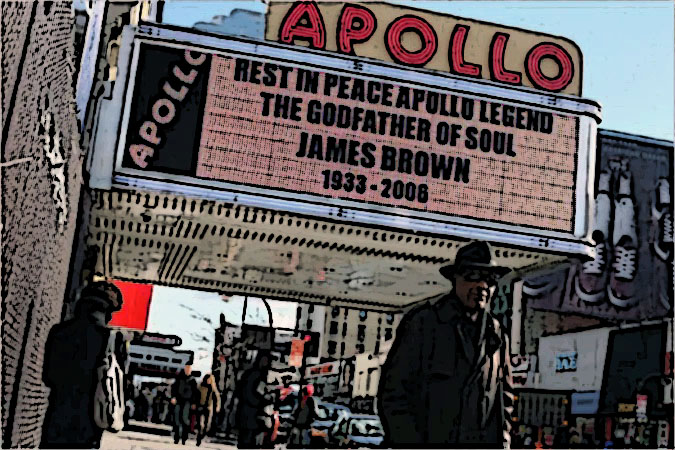
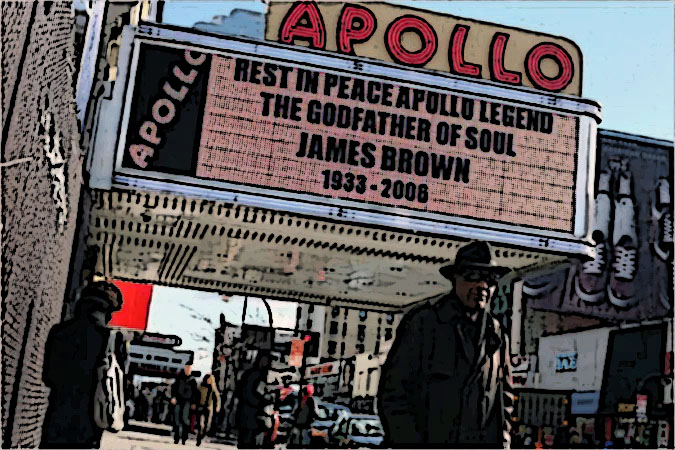
I told Jamie that I saw the Godfather live in ’75 at the Carolina Coliseum, one of the few white folks to attend that extravaganza. Then Jamie floored me with this revelation: he waited in line at the Apollo Theater in Harlem[1] to see James Brown lying in state, one of the hundreds to file past the coffin.
I mean, one of the greatest albums of all time is Brown’s 1963 Live at the Apollo, and Jamie can boast that he saw James Brown dead at the Apollo.
Bravo, Jamie, and RIP Barnwell, South Carolina’s, most famous citizen, the hitmaker who gave us “Pass the Peas,” “Gimme Some More,” “It’s a Man’s World,” “Papa’s Got a Brand New Bag” . . .
[1] I know “in Harlem” is redundant, but ain’t everybody as hip as you and me.






















 You Do Hoodoo