Seems to me that if you’ve read somewhere that a Covid vaccine reshuffles your DNA or magnetizes your epidermis or implants monitoring devices into your metabolism so that Satanic pedophiles can keep tabs on your comings and goings, that you’d want to wear a mask to avoid contracting a disease so mighty that it actually hospitalized superhuman Donald J Trump, who boasts an immune system so powerful your everyday microorganisms spontaneously combust if they dare enter the inner sanctum of his imperial badassness.
But, hell no, your garden variety anti-vaxxer is also an anti-masker. I saw a video today that captured a Tennessee school board meeting where health professionals arguing that masks help to stem infection were verbally ambushed by a pack of sign-bearing parents fearful that requiring their children to wear masks during a virulent resurgence of a pandemic would be the first step down a slippery slope of freedom-confiscation that eventually would lead to the United States becoming a country where citizens receive affordable healthcare.
Here’s the great Asheville cover band Pleasure Chest’s opening number from last night’s Chico Feo gig featuring Erich Hubner’s killer surf guitar solo.
The above mid-century snippet certainly demonstrates that times have changed. It’s hard to imagine anyone outside a Montana militia camp or Pentecostal rattlesnake farm who would adhere to the childrearing principles practiced by the vengeful patriarch of the song (spurred on, it would seem, by a brother who suffers a case of sibling rivalry that makes Edmund’s hatred of Edgar in Lear seem like mere disgruntlement). The song also projects a Taliban-like sexism in its relegation of females into the realm of property.
Of course, the lyrics are meant to be humorous, but it’s hard to imagine their not offending a large number of North American citizens of both sexes.
The word sadistic comes to mind.
another Arthur Godfrey knee-slapper
No, we middle class denizens of the Late Empire no longer treat our children as property, nor beat them with belts nor switch them with switches, which is all to the good. However, elevating them to the status of major deity might not be such a hot idea either. If judging from some of the Facebook posts of the current generation of DNA replicators and actual 3-D encounters with their offspring, a number of millennial parents seem to be transforming childrearing into some sort of strange counter-intuitive fetish in which the power of household management is ceded to tiny monomaniacs whose accumulated world wisdom would not fill one dimple of a thimble.
Idolatry!
Father to 5-year-old-daughter: Anastasia, tell Mr. Wesley where you went today.
Anastasia: [sullen silence, no eye contact]
Mr. Wesley: Yeah, Helen. I’m just dying to know where you went today.
Father [frowning]: Helen?
Mr. Wesley: Yeah, as in Helen Keller.
Anastasia [frowning]: Why did he call me Helen, Daddy?
Father: [squatting to accomplish eye-level conversation]. Because you didn’t answer Mr. Wesley, honey, so he was pretending that you were Helen Keller, a very accomplished person. Helen Keller was a famous girl, who well, had some obstacles to overcome. She couldn’t hear, so she didn’t know how to talk, but a wonderful woman named Anne Sullivan worked with Helen and taught her how not only to talk, but to write, and Helen Keller became a world-renowned writer –
Mr. Wesley: And she lived happily ever after even though she was blind as well.
Anastasia [tugging at parent]:
Father: Um, nice seeing you, Wesley. Say goodbye to Mr. Wesley.
Anastasia: [sullen silence, no eye contact]
My late wife Just Birdsong inherited a book from her mother Emily entitled Our Darlings’ ABCs, which sort of blew my very-difficult-to-blow mind.
A pretty book of A B C’s
The tiny folk is sure to please;
So here it is in colors bright,
With every letter placed in right,
And more than this, a rhyme as well
That will some Bible story tell,
To help the children learn with ease
The puzzling list of A B C’s.
Sounds innocuous enough, right? Well, it doesn’t take us long – the B’s in fact – to discover that childrearers around the turn of the previous century (the book appeared 40 years before Godrey’s recording of “Slap Her Down Again”) were a bit more brutal back in the day. Here are the facing pages for B.
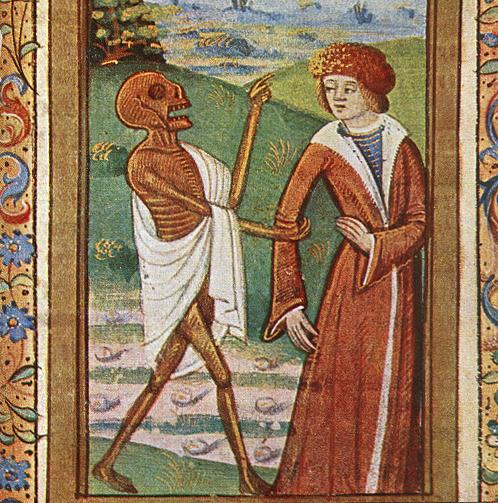
As one who like Elisha has “no hair on the top of his head,” I find the children’s taunt of “Go up, thou bald head” hurtful in the extreme and agree with the author’s observation “How unkind to speak of his head in that way.” Certainly, Elisha’s wish to punish the children is understandable, and God knows, they certainly will never commit that unkindness again because “God heard and sent two large bears out of the woods. The bears were very fierce, and they soon tore forty-two of the children in pieces.”
Nighty night. Sweet dreams, sugarplum.
That’ll teach them to mock their elders
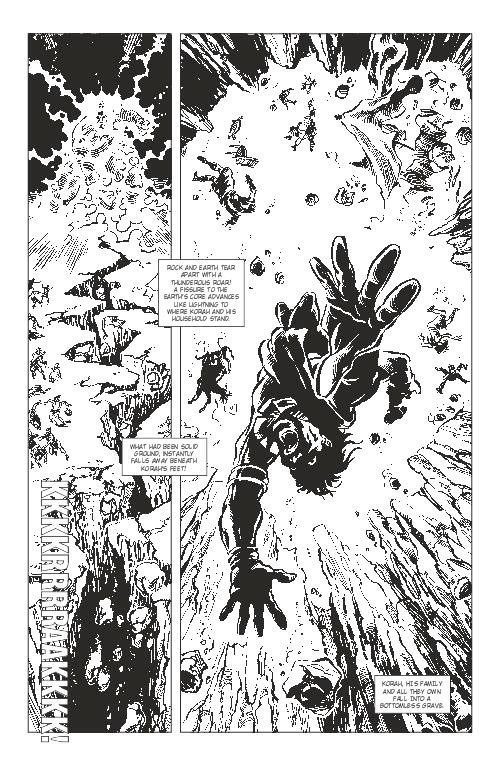
As I was perusing the alphabet and encountering Bible stories with which I was not familiar (e.g., how Moses told his people “to hasten away from Korah’s home” before “the ground opened up and swallowed Korah”). I couldn’t help but think of the ABC book I have written and how it reflects the kinder, gentler world of 2012.
Or [have you ever] barbered* a barbarian?*
*You can read the entire primer here and my complete guide to childrearing here.
We both use the same method, alliteration and assonance – “bad bald back” and “barbered barbarian” and offer illustrations to complement our lessons, though my primer is a tad bit less didactic.
As in most cases, the Middle Way is better – too much rod = brutish child and too much parental kowtowing = loutish child.
Anyway, I doubt if many millennials are reading goodnight stories from the O.T.
Well, enough. Good night, and may God bless!
Korah, his family and all they own fall into a bottomless grave.
Editor’s Note: Anthony Proveaux, a musician, photographer, and novelist based in Eugene, Oregon, has shared with me this coming-of-age essay about the social stresses of being a high school freshman in the small Southern town of Summerville, South Carolina, in a time of social upheaval. Enjoy!*
I’d suggest reading the text below the YouTube link as you listen to Anthony tell his story.
Change comes slow to small southern towns like Summerville South Carolina, where I was born and raised. But in the late 1960s, the times they were a-changin’ fast in our little slice of Mayberry. There, like in most places across America, we sat in front of our new color TVs and watched a world that was changing too fast for the times. The nightly news broadcast images of unrest across the nation, followed by stories of flower-power and love-ins, in faraway places like Haight Ashbury and not-so-far away places like Piedmont Park in Atlanta. It was hard to tell if the country was coming apart or coming together.
For young people, there was a definite sense of change in the air. Everywhere, hair was getting longer, and music was getting louder. Down at the local Tastee-Freez, the new sounds of Hendrix, Cream, and Creedence could be heard blasting from the 8-track players in the muscle-cars that cruised the loop. And in school, long hair was starting to challenge the dress-codes. Those were heady days for an impressionable young teen like myself, and like kids everywhere, I was totally swept up in the current of events.
Of course, the elephant in America’s living room at the time, and source of much of the nation’s angst, was the very real war going on in Vietnam. Our town, like so many other places across the country, had patriotically sent their sons “over there,” but sadly, an increasing number of them weren’t coming home. But I was too young to worry about the dreaded draft notice yet, and I couldn’t make much sense of it anyway.
In the late 60s I was in the thick of that awkward age of early teen hood and still learning to navigate the perils of post-puberty ‘boy’s life’. Over the course of a few short years, I’d evolved from science-fair kid with a crew cut, to a mop top teen, tie-dying t-shirts on the back porch. And the most challenging part of the teenage gauntlet lay just ahead, because I was about to partake in that great social experiment called high school.
In the fall of 1969, I was a fifteen-year-old freshman at the newly opened Summerville High. Walking those shiny hallways in the new modern buildings, passing the juniors and seniors that I had mostly only seen in my big sister’s yearbooks, was like entering a brave-new-world. It was also downright intimidating, but I was determined to fit in, and maybe even get my face above the crowd a little bit.
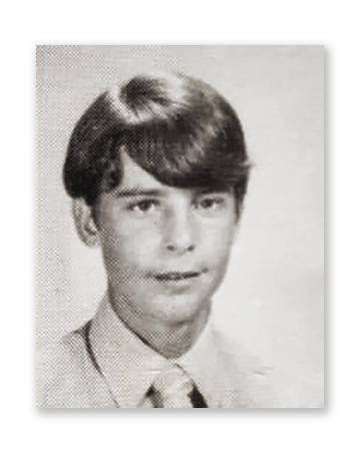
portrait of the artist as a 9th grader
I’d always been a good student with good grades, but by high school my studies had turned more towards girls, music, and teen trends (in that order). To get girls to notice you at that age, though, you had to be more than just a bright kid. You had to either be somebody, or be cool. Unfortunately, I was neither. Being a shy kid from a working-class family, I was three or four rungs down on the social ladder, and about as cool as a glass of day-old water. I definitely had some branding work to do.
So, shortly after entering the ninth grade, I began walking around Summerville High with a copy of Tom Wolfe’s The Electric Kool-Aid Acid Test in my back pocket. Making sure the title was showing, of course. It was a book I could barely get through. The writing was way over my head, and I’d never even been properly buzzed on beer, much less done “drugs.” But the paperback sure had a cool cover, with that psychedelic sugar cube, in Peter Max wrapping paper. The K in cool really meant something back then.
That little stunt only succeeded in making me look even more nerdy than I was. I quickly realized that if I wanted to be cool, I needed to hang out with the cool kids. In Summerville that meant teens like the Folly Beach surfers, guys that played in bands, and the college-bound students from the sophisticated families around town. At the new high school, I noticed that during lunch time the “in-crowd” hung out in the breezeway down by the cafeteria. So, I gradually started lurking around on the fringes of the group, half-hoping I wouldn’t be noticed, but desperately hoping that I would.
Of course, that group of cool guys and classy young ladies had no use for a gangly ninth grader, hanging around trying to infiltrate their noontime social club. No one was particularly rude to me. Genteel Summerville had good manners, and those with social status were always graciously “stuck-up.” So, I was politely, but pretty much totally ignored, save for a few “get lost” looks from some of the jocksters.
However, there was one dude who noticed me lurking and actually tried to bring me into the conversation a few times. It was Rusty Moore, a quick witted red-headed junior whom almost everyone seemed to like, except perhaps a few of the local rednecks who took his wit the wrong way on occasion.
Rusty even gave me a comeback line once. After some snobby kid cut-me-down about this loud paisley shirt I was wearing, Rusty leaned over and whispered in my ear. “Tell him his belt looks like it’s made out of beer can pop-tops” (my antagonist was wearing one of those ‘60s belts made with metal rings). Unfortunately, I totally blew the delivery of the comeback line and just further embarrassed myself. It was a pretty pathetic stab at a touché, but I really appreciated the encouragement from Rusty.
I only lasted a week or so hanging with those hipsters. I was still a mighty-green teen, and way out of my class. And in Summerville class was still taken seriously. Our family was somewhere below the middle of the social line. So I was definitely bumping my head on the class-ceiling, trying to break into those trendy social circles.
Fortunately, cool came to our neighborhood, when a family with several rambunctious and attractive teenage daughters moved in right across the street. And as you can imagine, it wasn’t long before cool dudes were hanging around. My big sister and I soon found our own little tribe of early Summerville heads. She met a free-spirited guy, and a few years later, when I’d just turned seventeen, we followed him out to California, where we hitch-hiked, hopped trains, and bummed around for about a year. Now that was a real education. In the early 1970s, the highways were filled with on-the-road youths of every color and class, out to “Look for America.” I ended up staying on the west coast, went to college, and finally settled down in Oregon.
I never lived in Summerville again, but still have fond memories of growing up there. Navigating the perils of the teenage years and high school sticks with us all, and that early attempt at trying to climb my way up the social ladder, and falling off, always stayed with me for some reason.
During that time, I also never got to know Rusty Moore, the kid who threw me a lifeline when I tried to swim-with-the-sharks. He was a few grades above me, and I left Summerville early on. He’d certainly never remember that insignificant event anyway, but it made an impression on me. When you’re young, those little nudges along the way do make a difference. So a shout out to Rusty Moore for the nudge.
by Anthony Proveaux
*You can purchase Anthony’s historical novel Finding Charlie Patton: A Historical NovelHERE
Here’s a video modern-day Anthony (on harmonica) making music during the quarantine.
One of the benefits of retirement is that “dicing time” becomes less thinly sliced, its passage vaguer, elapsing as it did before that infernal invention the clock transliterated the overhead sun into 12:00 P.M. Because I no longer have workday pressures that dictate how I spend my hours – no essays to grade, no lessons to plan, no report cards to crank out – I can take my own sweet time.
For example, on road trips, rather than enduring a regimented slab of interstate stretching forth with its green mile markers clicking past tick-tock like, you can opt for the back roads, which, if you’re driving from Athens, Georgia, to Folly Beach, South Carolina, means you motor through mostly farmland – cornfields, peach orchards, but also tiny towns in various stages of civic decay.
Sometimes, if you’re fortunate, you can run across something truly remarkable, as my wife Caroline and I did outside of the tiny town of Wrens, Georgia.
What caught Caroline’s eye
***
We had dropped Brooks off at Camp Illahee[1] and spent a couple of nights outside of Athens with our friends Jim and Laura. Both they and our friend Ballard, whom we met tending bar at Five & Ten, suggested we take the backroads home.
The route we chose took us through Thomson, Georgia, the birthplace of Blues legend Blind Willie McTell, whom I had discovered on a compilation LP called The Story of the Blues, a gift I received for my nineteenth birthday. So Blind Willie and I go way back.
I mentioned to Caroline that Blind Willie had been born in Thomson, so for a moment she abandoned her post as navigator and googled “Blind Willie.” She reported that there was a statue of Blind Willie in Statesboro but also that he was buried about eight or so miles outside of Thomson in Jones Grove Baptist Church Cemetery. So, as upright Protestants used to say – what the hay – we decided to take a side pilgrimage to pay our respects to Blind Willie. As Bob Dylan put it in one of his greatest compositions: “No one can sing the blues like Blind Willie McTell.”
***
I’ve visited Oscar Wilde’s and Jim Morrison’s graves at The Père Lachaise in Paris, both graves bedecked with flowers, notes, and in Wilde’s case, lipstick-like kisses imprinted on the stone obelisk that marks his resting place.
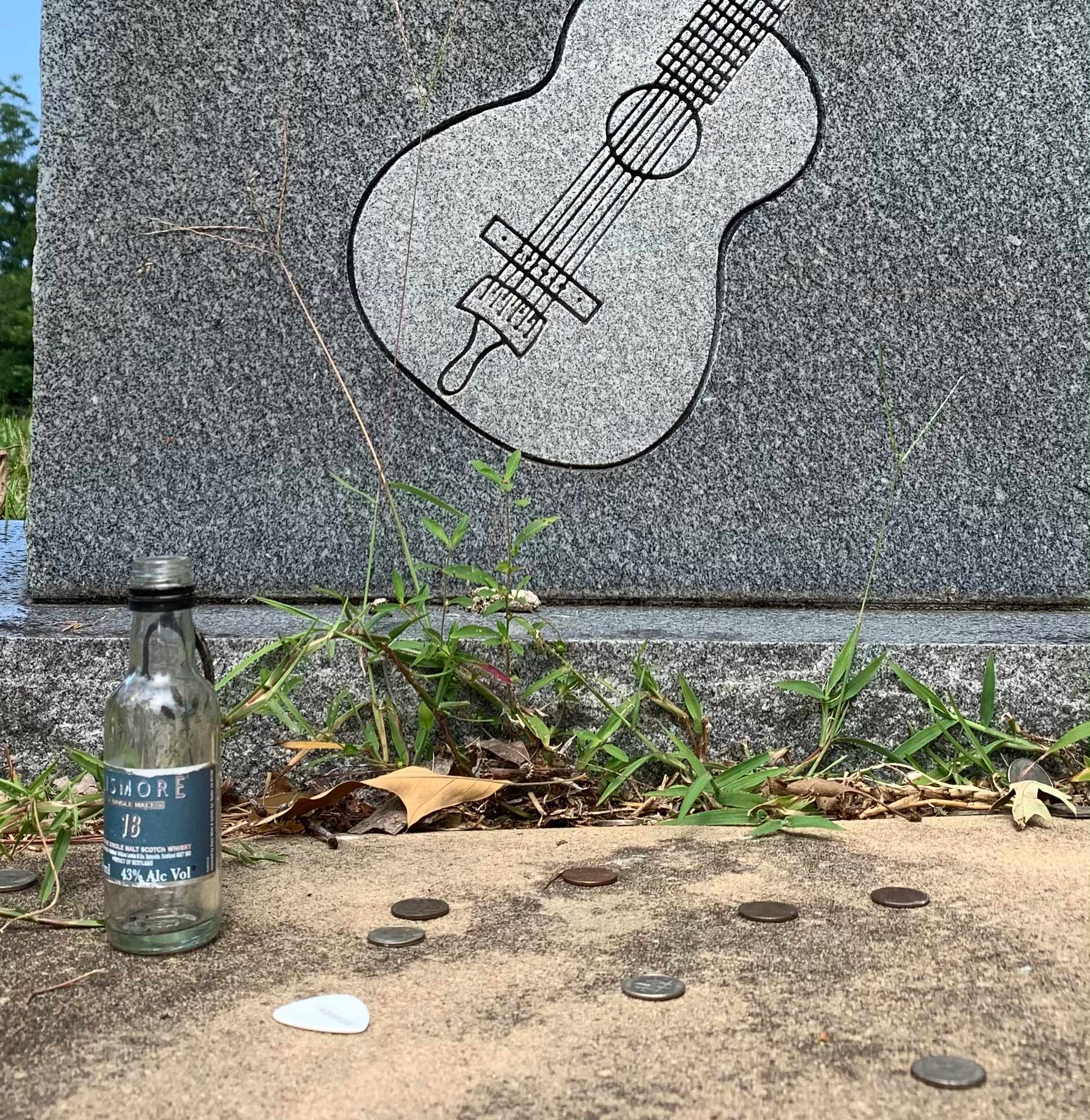
Not surprisingly, McTell’s grave is not as rich in gifts bestowed. There were no flowers, only a sprinkling of pocket change that wouldn’t cover the cost of a Coca Cola, a mini bottle, and a guitar pick.
Rather than backtracking to return to our original route, we improvised, GPS-ing out a more southerly passage. As I was tooling along, Caroline let out a “Whoa, what was that!”
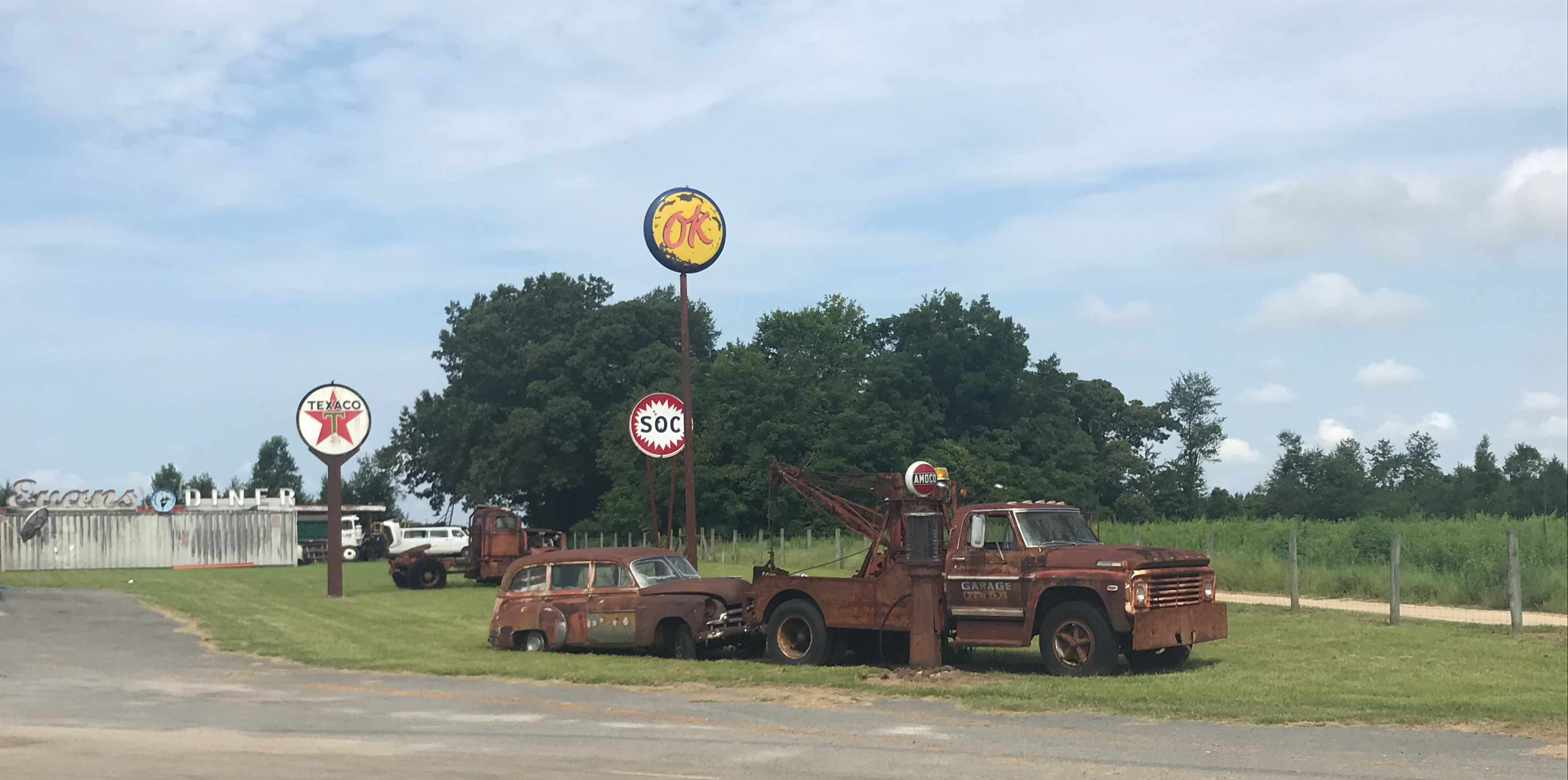
“We ought to turn around,” she suggested. “We need to check it out.” Which we did.
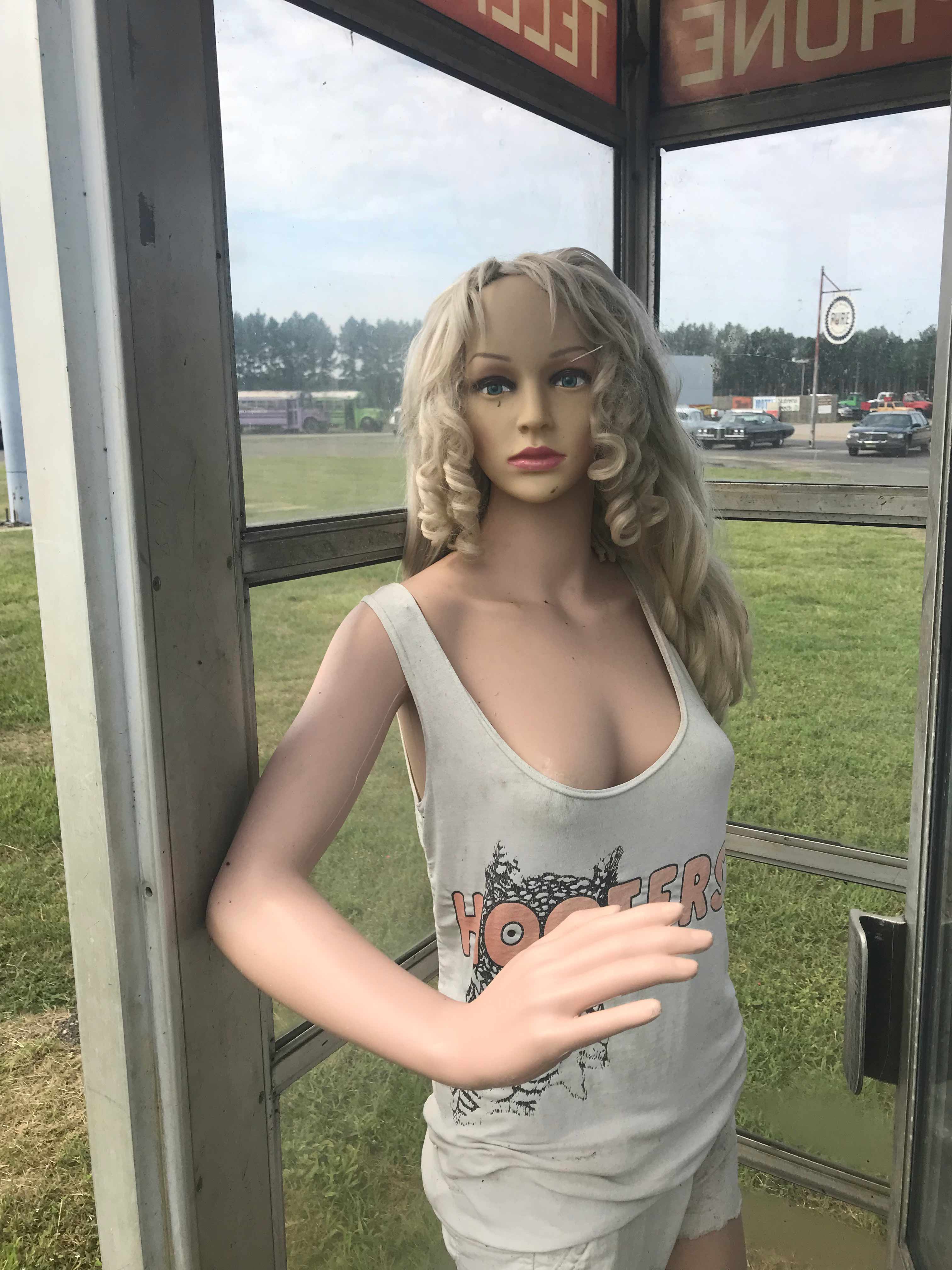
Now you can check it out. Southern Gothic Deluxe.
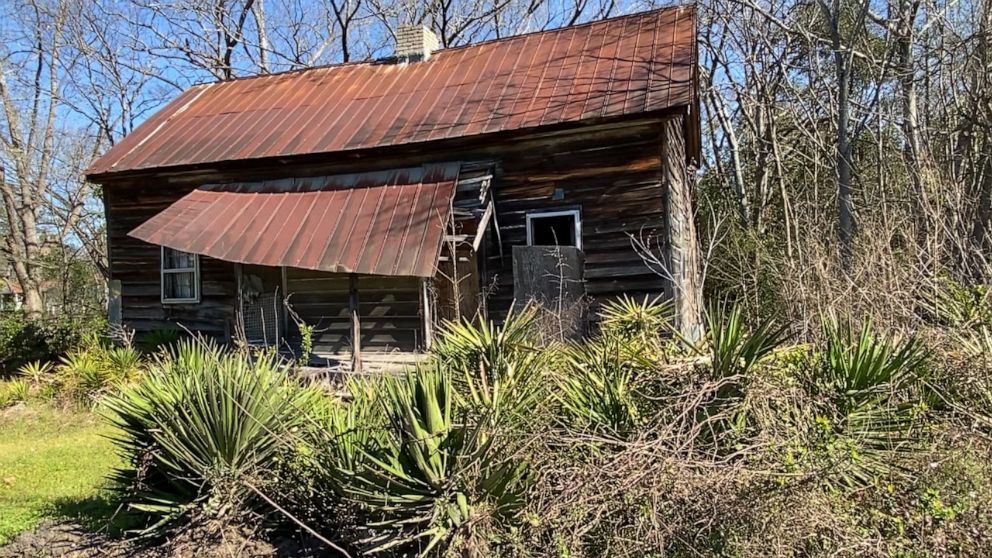
After ten or so minutes taking in this remarkable outdoor installation, we continued to Allendale, the county seat of the poorest county in South Carolina. Not to put too fine a point on it, Allendale is the po-dunk equivalent of a Blade Runner hellscape, a stalled freight train of shuttered businesses lining the highway in succession, not to mention human habitations in various stages of collapse.
abandoned motel, image courtesy of ABC newsimage courtesy of ABC News
At any rate, we arrived at the kennel to pick up KitKat, who, was beyond ecstatic to see us, and headed back to Folly, which, of course, offers its own offbeat pleasures.
I’ll leave you with a snippet of Dylans'”Blind Willie McTell
Seen them big plantations burning Hear the cracking of the whips Smell that sweet magnolia blooming See the ghost of the slavery ship I can hear them tribes moaning Hear the undertakers bell Nobody can sing the blues like blind Wille McTell
[1] What a gorgeous-sounding word, Cherokee for “heavenly world.”
Sam Cooke’s plaintive, moving civil rights ballad “A Change Is Gonna Come” was born in 1963 of discrimination after he and his wife were turned away from a segregated Holiday Inn at Shreveport, Louisiana. Incensed when the desk clerk lied and claimed no vacancies, Sam made a scene in the lobby, vociferously protesting, and while driving off, he and his entourage honked horns and lobbed insults like Molotovs as their taillights disappeared into the night.
When Sam and company arrived at the Black hotel downtown, the police were waiting. However, the arrests created abysmal p.r. north of the Mason-Dixon line after the NY Times and UPI caught wind and publicized the discriminatory arrest of an affable fellow (at least he sounded affable on his records) who only wanted a place to sleep after twisting the night away. In 2019, Shreveport’s mayor apologized to the Cooke family and awarded Sam a key to the city – a mere fifty-six years after Cooke’s death at thirty-three. Nothing like a posthumous award to salve the wounds of a no-longer-sentient being.
According to Peter Guralnick’s biography Dream Boogie: The Triumph of Sam Cooke, Dylan’s “Blowin’ in the Wind” also spurred Sam to compose “A Change Is Gonna Come.” Sam, the story goes, felt chagrined that a White fellow had written such a moving civil rights song. In fact, Sam admired “Blowin’ in the Wind” so much that he included it in his live performances not long after its release.
Of course, the songs are much different. In “Blowin’ in the Wind,” Dylan asks in third person a series of questions that ponder “how long” it’s going to take to end discrimination. “A Change Is Gonna Come,” on the other hand, is deeply personal, written in first person, and cites incidents of hurtful slights and expresses existential despair. However, despite the dirge-like tone of the song, the narrator feels certain that eventually “a change is gonna come” and justice will prevail, so the overall effect is hopeful rather than depressing.
Well, despite the election of Obama and the proliferation of people of color in national advertising, we’re not quite there yet, and it seems that many in the South have recently become emboldened to unfurl and wave their inner Stars-and-Bars, not to mention Republican-led state legislatures’ ongoing successful attempts to make voting more difficult for African Americans.
In fact, to me, 2021 feels an awful lot like 1961, though at least now, Sam would have no trouble checking into a Holiday Inn – though he might turn up his nose at one – and Confederate statues are coming down as opposed to being erected.
Perhaps boasting non-stop about my superhuman immune system for the last thirty years wasn’t all that judicious. Oh, you should have heard my cock-a-doodle-doing![2].
My immune system makes Arnold Schwarzenegger look like Denver Pyle.
I haven’t been ill since the fall of the Berlin Wall.
An airborne virus does a one-eighty when it sees me bopping down the boulevard, etc.
And it’s true that in my thirty-four years at Porter-Gaud, I maybe missed ten or so days in total, most often because of laryngitis.[3]
Well, comeuppance has arrived, taken off his mask, and sneezed in my face. For the last four days, when it comes to coughing fits, I’ve been giving tubercular John Keats and DH Lawrence a run for their money. Although doubly vaccinated, I drove the day before yesterday for a Covid test, which unsurprisingly was negative. Afterwards, I retreated to bed, ministered to by nurse Caroline, who throughout my malady has plied me with chicken broth, hot tea, and good advice, like not going the Singer/Soapbox Open Mic the previous Monday[4]
Let’s face it: a summer cold isn’t exactly kidney stones or a case of the shingles (not to mention bone cancer), so the source of this whine festival lies not so much in physical discomfort but in the boredom I’ve experienced, borderline ennui. I felt so drained Wednesday afternoon, I couldn’t read anything longer than a tweet, and scrolling down my feed is disheartening, with all that talk of the decline of democracy coming from the likes of Steve Schmidt and Bill Kristol. And I have two books I’m rarin’ to read, Peter Guralnick’s Looking to Get Lost: Adventures in Music and Writing and James McBride’s The Good Lord Bird, which until today lay on my bedside table like a couple of concrete blocks, heavy, cumbersome. Petite misère but for a second or two, misery nonetheless.
But, hey, I must be on the mend because I’m sitting at my desk and taking this opportunity to roll my right foot over a frozen water bottle to combat a king hell case of plantar fasciitis I’ve developed walking to and from bars on Folly Beach in flip flops.
Like they, say, there’s no fool like an aged, wounded epicurean.
still from WF Murnau’s film The Last Laugh
[1] No one can accuse me of click-baiting with that title.
[2] And no doubt you have if you know me personally.
[3] I also took a couple of personal days along the way, one to see the third game of the ’91 World Series, another to see the Stones in Columbia, and several during my late wife’s last week.
Missing school is a drag. It’s more work to miss than to trudge through (and I never got close enough to students infect, I’d like to think).
[4] I’d made a solemn promise to Kelly West I’d be there for her debut poem, and who would break a solemn vow because of what at that time was merely a scratchy throat?
Exactly five years ago an ambulance carted me off the MUSC emergency room after I bonked my head on the floor, lost consciousness, and came to suffering from a strange case of amnesia.
The bedroom smoke detector had gone off, and I leapt to my feet before my blood could be pumped into my brain. My late wife Judy described my falling “as straight-backed like a tree – timber!” When I regained consciousness, the first thing I said was, “Judy, why are you bald?”
She looked surprised. “I have cancer. Don’t you remember?”
I [forgive me] absent-mindedly wandered to my study and got on the computer as Judy awakened our neighbor Jim who waited with us – I think – until the ambulance arrived.
When I got to the hospital, physicians began quizzing me. “Who’s running for President?”
Although it was July and Hillary and Trump had secured the nominations, I catalogued who had run against them in the primaries as if those contests hadn’t been settled. The last six months had been erased from my memory.
So, they wheeled me down to run tests, and over the course of a couple of hours, my memory slowly returned.
Before releasing me, a doctor asked, “Now, how far back can you remember?”
I recited the first couplet of The Canterbury Tales.
“WHAN that Aprille with his shoures soote
The droghteof Marche hath perced to the roote . . . “
So, memorizing the first twenty lines did have some practical utility after all!
[1] It’s strange that I hadn’t forgotten the types of lymphoma, which I had learned after Judy’s diagnosis.
“An idle mind is the devil’s workshop” – English Proverb
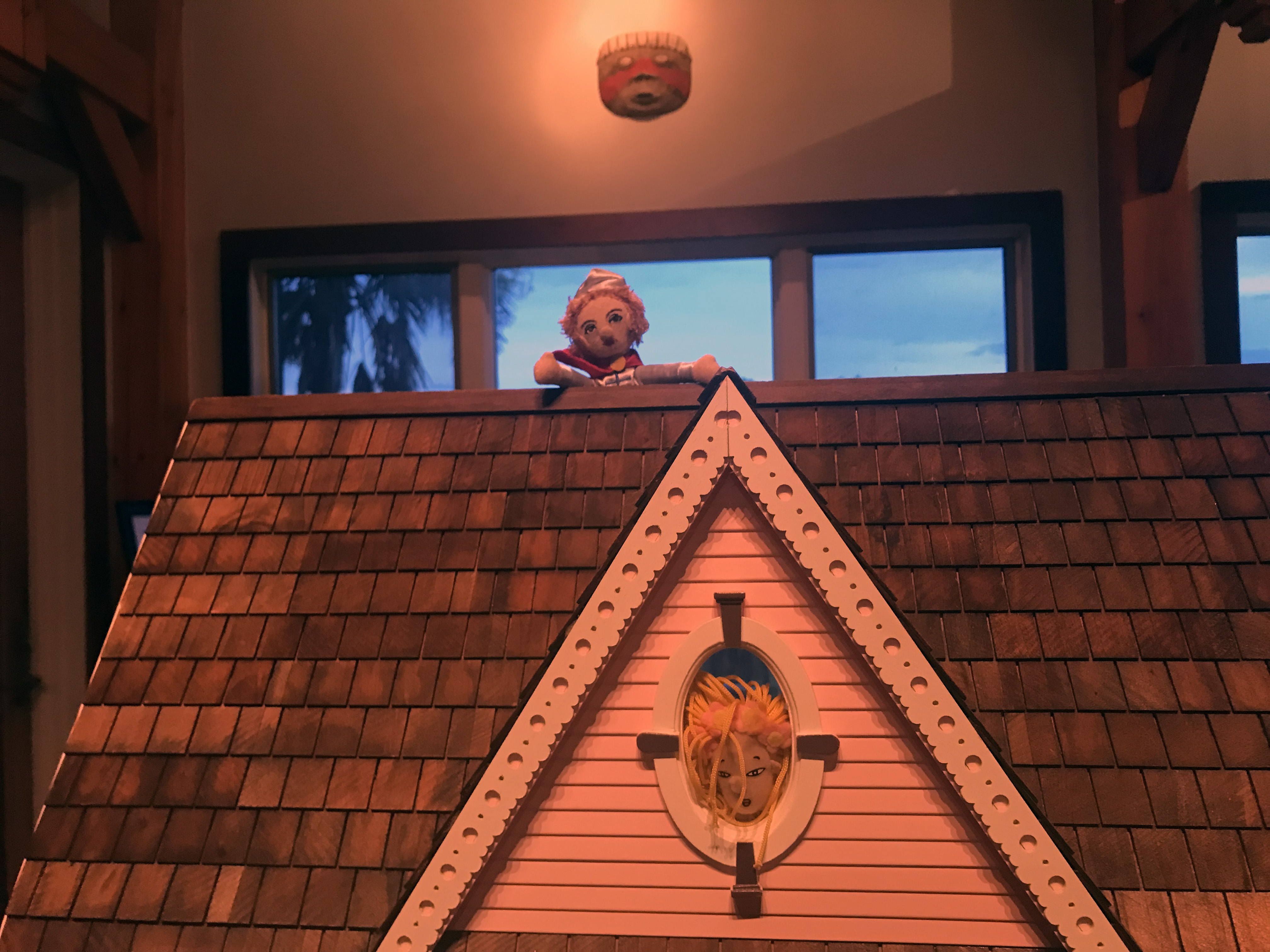
Some weirdness going down on the back side of the Edge of America.
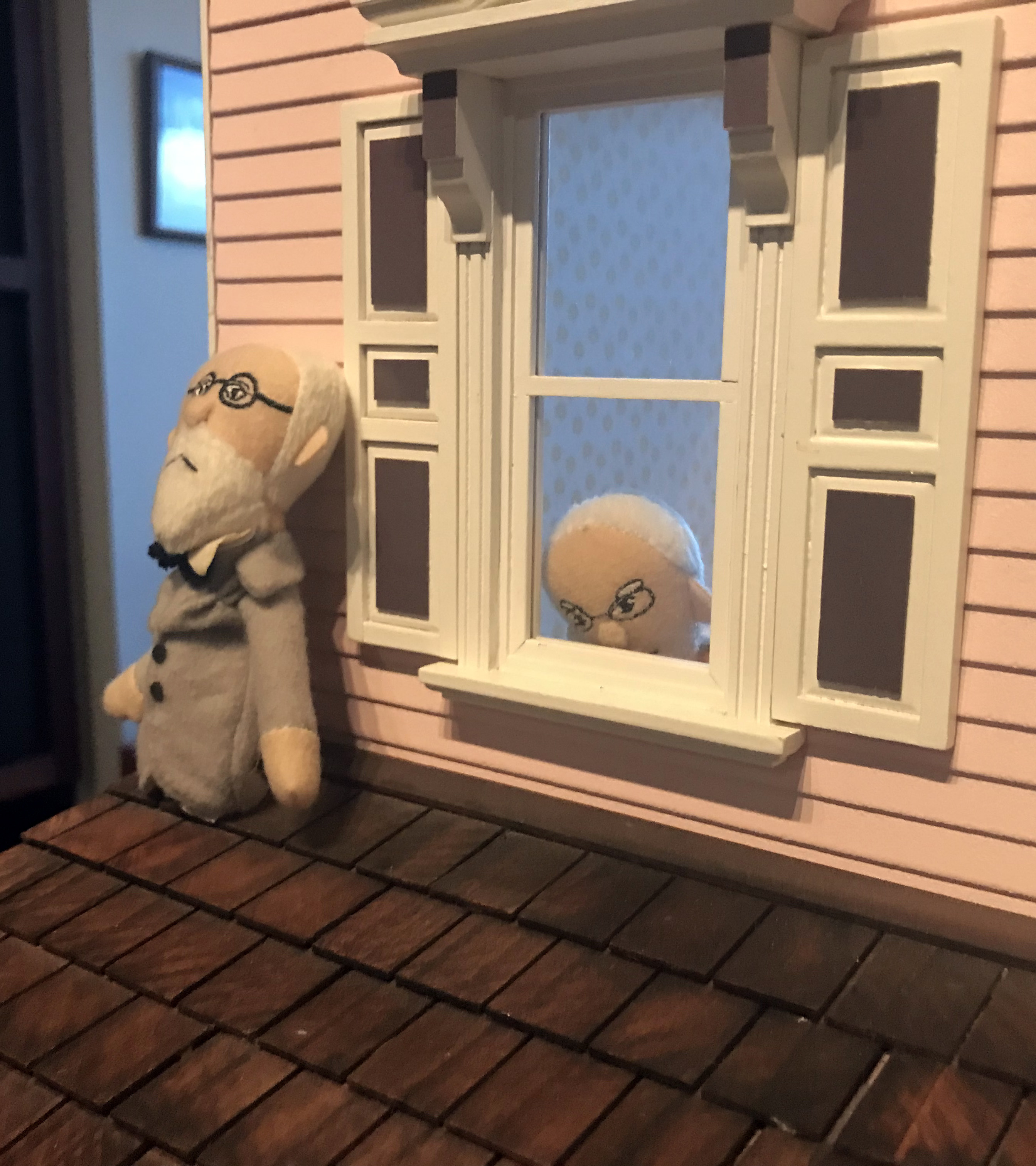
Freud is about to leap from the second story, and Jung is whispering, “Jump, jump, jump.”
We have a madwoman in the attic, and a saint on the roof, Ophelia and St. Joan.
“Her sin is her lifelessness.”
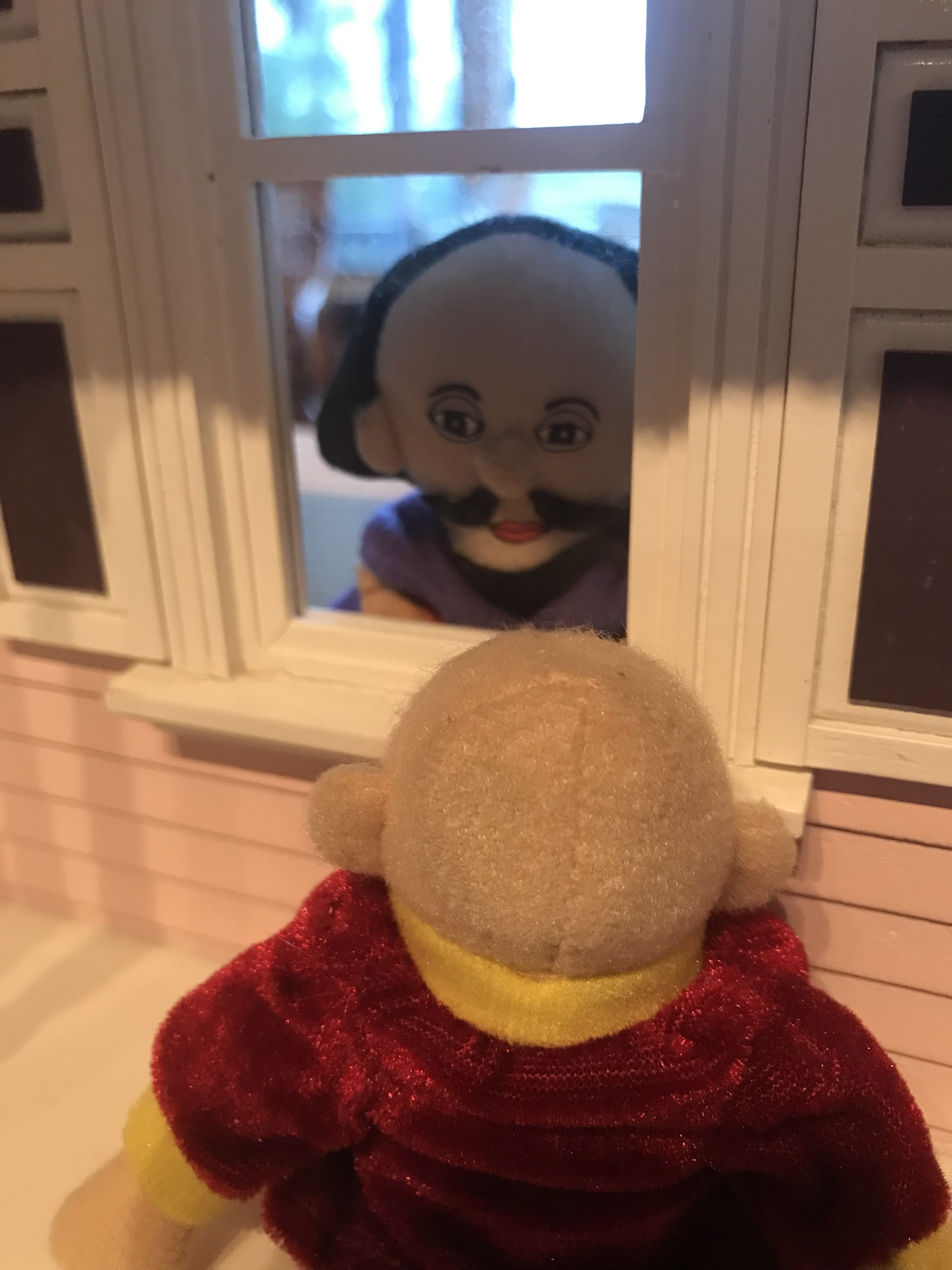
Master Will and the Dalai Lama engaged in a staring contest.
All these people that you mentioned Yes, I know them, they are quite lame I had to rearrange their faces And give them all another name Right now I can’t read too good, don’t send me no more letters, no Not unless you mail them from Desolation Row
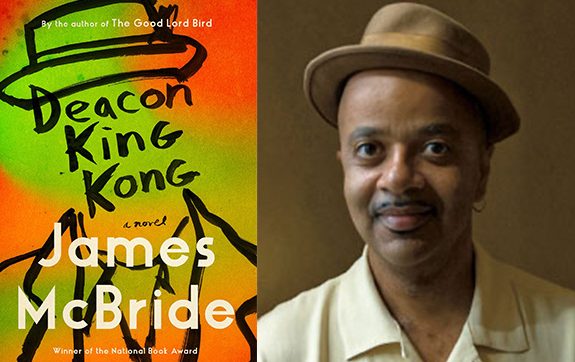
After finishing James McBride’s Deacon King Kong, I’m rechristening the author Zora Neale Samuel Clemens Brer Fox McBride.[1] Not OMG! But Do Lawd! What a blast – jazz riffing Gullah-lite, not indiscriminately slung but fashioned into a plot that, though somewhat improbable in its tidy tying up at the end, delineates a complicated saga populated by characters we care enough about to shed tears.
Even if the story hadn’t moved me, I would have kept reading for the sheer pleasure of its sentences.
Here are three:
“She was coming off her once-a-year sin jamboree, an all-night, two-fisted- booze-guzzling, swig-faced affair of delicious tongue-in-groove-licking and love-smacking with her sometimes boyfriend, Hot Sausage, until Sausage withdrew from the festivities for lack of endurance.”
“After practice on lazy summer afternoons, he’d gather the kids around and tell stories about baseball players long dead, players from the old Negro leagues with names that sounded like brands of candy: Cool Papa Bell, Golly Honey Gibson, Smooth Rube Foster, Bullet Rogan, guys who knocked the ball five hundred feet high into the hot August air at some ballpark far away down south someplace, the stories soaring high over their heads, over the harbor, over their dirty baseball field, past the rude, red-hot projects where they lived.”
And then this masterpiece:
“And there they stayed, a sole phenomenon in the Republic of Brooklyn, where cats hollered like people, dogs ate their own feces, aunties chain-smoked and died at 102, a kid named Spike Lee saw God, the ghosts of the departed Dodgers soaked up all possibility of new hope, and penniless desperation ruled the lives of suckers too black or too poor to leave, while in Manhattan the buses ran on time, the lights never went out, the death of a single white child in a traffic accident was a page one story, while phony versions of black and Latino life ruled the Broadway roost, making white writers rich – West Side Story, Porgy & Bess, Purlie Victorious – and on it went, the whole business of the white man’s reality lumping together like a giant, lopsided snowball, the Great American Myth, the Big Apple, the Big Kahuna, the City That Never Sleeps, while blacks and Latinos who cleaned apartments and dragged out the trash and made the music and filled the jails with sorrow slept the sleep of the invisible and functioned as local color.”[2]
Ultimately, Deacon King Kong is a comic novel, which provides McBride some leeway when it comes to implausibility. Moreover, it takes place among a community of believers, which is a prerequisite for magic realism. Some of the best dialogue comes from the protagonist Deacon Cuffy Jasper Lambkin[3] (aka Sportscoat) and the ghost of his wife Hettie, who naggingly haunts him throughout the novel, despite her having drowned two years before the action begins.
“Well, Hettie, if I weren’t taking that white man’s good hundred dollars on principle, I surely ain’t gonna take no mess from you ‘bout some fourteen dollars and nine pennies you done squirreled up in Christmas Club money and hid someplace.”
You’re not going to find ghosts or a systematic invasion of ants in The Stranger.
***
I suppose some plot summary is in order. Deacon King Kong is set in 1969 in Causeway Housing Projects in South Brooklyn with the majority of the characters members of the Five Ends Baptist Church. Sportscoat, drunk as a coot on a potent moonshine known as King Kong, stumbles into the project courtyard and shoots Deems Clemens[4] with an antiquated .38 pistol. Back in the day, Sportscoat taught Deems Sunday School and coached him in baseball. Deems had been a bone fide big league prospect before he abandoned that escape route for the easy money of drug trafficking. Smart, strategic, Deems is a force to be reckoned with, compassionate despite the heroin trafficking and its at its attendant horrors.
Damn, this summarizing is way too hard. I’m gonna cop out and quote the back cover.
“McBride brings to vivid life the people affected by the shooting: the victim, the African American and Latinx residents who witnessed it, the local cops assigned to investigate, the members of Five Ends Baptist Church where Sportscoat was deacon, the neighborhood’s Italian mobsters, and Sportscoat himself.”
Ultimately, it’s a novel of redemption, a glorious amalgam of love and violence, greed and generosity, teeming with vibrant characters who do justice to the human race. It’s easily the most enjoyable piece of long fiction I’ve read since Infinite Jest, which means it’s most enjoyable novel I’ve read in a quarter of a century, the most enjoyable novel I’ve read this century.
Do yourself a favor and go check it out.
[1] Kudos to former student Rachel Lauren Wolf for turning me on to this gem she described as “a cross between Flannery O’Connor and Gabriel Garcia Marquez.”
[2] As my wife Caroline is wont to say, “Bartender, I’ll have what he’s having.”
[3] Note the name symbolism. BTW, virtually all of the characters have nicknames.





















 You Do Hoodoo