In Times of Trouble Marcus Aurelius Comes to Me

In times of trouble, it’s not Mother Mary who comes to me, but Marcus Aurelius whose Meditations provide a practical response to the woes we face, and there’s no question that because of the election of Donald J Trump, the Western World is going to go through some things, especially Eastern and Western Europe. My father used to say that Russia will take us over without firing a shot. It certainly seems as if he might have been right.

Here, in the US, we have a patchwork of abortion laws, some so strict that so-called pro-lifers would rather a woman bleed to death than receive treatment during miscarriage. Trump has promised to put crackpot Robert Kennedy in charge of health and Elon Musk in charge of transforming the civil service into a Soviet-like bureaucracy of yes men. Most galling to me is that this adjudicated rapist, convicted felon, incorrigible liar and his servile minions are now in full celebration mode, not to mention that my faith of the good will of the American people has been severely compromised.

Yes, I’m heartbroken, but I am powerless at the moment to change the situation; however, I do have the power to herd my thoughts from the edge of a cliff to safer ground.

Here’s Aurelius:

“The first rule is to keep an untroubled spirit. The second is to look things in the face and know them for what they are.”

Of course, maintaining an untroubled spirit is much easier said than done.[1] However, “if you are pained by external things,” as Aurelius writes, ‘it is not they that disturb you, but your own judgement of them. And it is in your power to wipe out that judgement now.”

By judgement, I think he means your thinking of them, dwelling on them at the expense of the mundane joys of life, like looking up and seeing a formation of geese flying overhead, listening to Lester Young speaking through his tenor saxophone, enjoying the taste of olives plucked from a bowl that has been cured in a kiln, the bowl, a thing of beauty, which guides your thoughts to Keats’ great ode in which he sings, “a thing of beauty is a joy forever.”

Our moments are too precious to squander in barren speculation. What will be will be. I’ll attempt to employ what the Buddhists call mindfulness. I’ll try to pay attention to what is in front of me rather than the agonizing over what may or not be. I’ll attempt not to dwell in the shadows dark speculations.

In short, 

Live a good life. If there are gods and they are just, then they will not care how devout you have been, but will welcome you based on the virtues you have lived by. If there are gods, but unjust, then you should not want to worship them. If there are no gods, then you will be gone, but will have lived a noble life that will live on in the memories of your loved ones.

Marcus Aurelius, Meditations

To a Friend Whose Work Has Come to Nothing

Now all the truth is out,
Be secret and take defeat
From any brazen throat,
For how can you compete,
Being honor bred, with one
Who were it proved he lies
Were neither shamed in his own
Nor in his neighbors’ eyes;
Bred to a harder thing
Than Triumph, turn away
And like a laughing string
Whereon mad fingers play
Amid a place of stone,
Be secret and exult,
Because of all things known
That is most difficult.

WB Yeats


[1] Here’s a link to a piece I wrote called “The Art of Not Thinking.”
Wesley’s Weave: Dark Musings on Election Eve

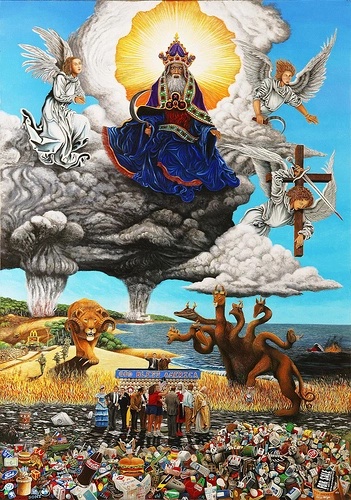
Apocalypse by Adrian Kenyon

Donald Trump has dubbed his rambling speeches “the weave,” claiming that if you connect the dots of his zigzags, a unified picture appears. So I thought I’d give it a try myself.

Here goes.

The other night, after suffering through a self-righteous, ill-informed screed from a Facebook follower, I found myself listening to Bob Dylan’s masterful protest song “Hurricane,” a cinematic narrative recounting the arrest and trial of Rubin Hurricane Carter, a boxer wrongly convicted of a triple homicide in 1966 in Patterson, New Jersey.

Meanwhile, far away in another part of town
Rubin Carter and a couple of friends are drivin’ around
Number one contender for the middleweight crown
Had no idea what kinda shit was about to go down

When a cop pulled him over to the side of the road
Just like the time before and the time before that
In Paterson that’s just the way things go
If you’re black you might as well not show up on the street
‘Less you want to draw the heat

Near the end of the song Dylan sings,

How can the life of such a man
Be in the palm of some fool’s hand?
To see him obviously framed
Couldn’t help but make me feel ashamed to live in a land

Where justice is a game

Now all the criminals in their coats and their ties
Are free to drink martinis and watch the sun rise
While Rubin sits like Buddha in a ten-foot cell
An innocent man in a living hell

As I was listening, the long gone idealism of the 60s came to mind. Dylan himself — and Joan Baez –performed at the March on Washington, sharing the stage with Martin Luther King. They heard firsthand the “I Have a Dream Speech.”  They’re both still alive sixty-one years later.

In 1963, the American people considered communism the greatest threat to the nation’s sovereignty, and the Soviet Union was our greatest enemy whose spy agency the KGB eventually became the employer and training ground for Vladimir Putin, whom Donald Trump so idolizes, along with Kim Jong Un, the North Korean dictator. 

According to Trump, outside forces like Russia and North Korea aren’t the greatest threat to American sovereignty; no, it’s “the enemy within,” American citizens, news organizations, and celebrities tarred with the paradoxical disapprobation “woke.”  It’s Joe McCarthy redux, and McCarthy’s corrupt lawyer Roy Cohn was Donald Trump’s mentor.

Trump and his followers bring to mind WB Yeats’s lines from “The Second Coming”:

The best lack all conviction, while the worst

Are full of passionate intensity.

Fueled by the fifth deadly sin wrath, these resentful white supremist faux Christian cultists seem to prefer a dictatorship of oligarchs to the teachings of their would-be Savoir who famously preached

Blessed are the meek, for they shall inherit the earth.

Blessed are the merciful, for they shall obtain mercy.

Meanwhile,  

The blood-dimmed tide is loosed, and everywhere

The ceremony of innocence is drowned.

Connect these dots and what do you get?

[a] rough beast, its hour come round at last,

Slouch[ing] towards Bethlehem to be born.

Damn, Why Aren’t Our Moral Compasses Working?

But Jesus called them unto him, and said, Suffer little children to come unto me, and forbid them not: for of such is the kingdom of God. Verily I say unto you, Whosoever shall not receive the kingdom of God as a little child shall in no wise enter therein.” Matthew 19, 13-14.


Wendy Brown, the swashbuckling political theorist from UC Berkeley, has a hifaultin theory on how we as a culture have arrived at a point where Greg Abbott, the Governor of Texas, can dump immigrant children on the street in sub-freezing temperatures on Christmas Eve, the next day tweet Christmas blandishments, and suffer no pangs of conscience (and nary a word of censure from mainstream Republicans who claim to be followers of Jesus).

Brown’s theory is complicated, somewhat “over my head,” but worth thinking about, so I thought I’d take a stab at explaining a simplified version as I understand it.

She begins with Nietzsche’s contention that nihilism begins “with the rise of reason and science as challenges to God and other forms of authority, challenges that reveal all meaning to be constructed and all facts to be without inherent meaning.”[1]

In other words, God’s edicts were set in stone; the winds of time have effaced them. Science is not set in stone; it is self-correcting. For example, quarks have replaced electrons as the tiniest bits of matter. Relativity sets in and begets argumentum ad ignorantiam taunts that “you can’t prove it.” Anything that you believe, I can not believe better.

“Unmoored from their foundations,” in an arena of disenchantment and desacralization, “the Christian virtues along with democracy, equity, truth, reason and accountability […] become fungible, superficial and easily instrumentalized.”

Brown offers these examples:

“When a Martin Luther King Jr. speech about public service is used to advertise Dodge trucks during the Super Bowl, when Catholic clergy are revealed to have molested thousands of children while their superiors looked away, when ‘moral values’ politicians are exposed for consorting with prostitutes or making abortion payments for mistresses— these things bring not shock, but a knowing grimace, nihilism’s signature.”

In her view, unwittingly, neoliberalism has created a Frankenstein’s monster by monetizing every aspect of life in the West. “As we all become human capital,” she writes, “all the way down and all the way in, neoliberalism makes selling one’s soul quotidian, rather than scandalous. And it reduces the remains of virtue to branding, for capital large and small.”

Thus, the heavy repression of Christian values, especially the repression of sexuality, becomes, to use Herbert Marcuse’s term, “desublimated,” and capitalist culture subsumes pleasure.

Just do it, Nike says, as opposed to Yahweh’s thou shall not.

“Pleasure, instead of being an insurrectionary challenge to the drudgery and exploitation of labor, becomes capital’s tool and generates submission.  Far from dangerous or oppositional, no longer sequestered in aesthetics or utopian fantasy, pleasure becomes part of the machinery.”

Brown further argues that “as late capitalist desublimation relaxes demands against the instincts, but does not free the subject for self-direction, demands for intellection are substantially relaxed. Free, stupid, manipulable, absorbed by if not addicted to trivial stimuli and gratifications, the subject of repressive desublimation in advanced capitalist society is not just libidinally unbound, released to enjoy more pleasure, but released from more general expectations of social conscience and social comprehension.”

Values, no longer byproducts of the Divine, have been devalued, which leads to the weakening of conscience, not only conscience concerning individual misdeeds but also conscience concerning the misdeeds of our tribe, especially when these misdeeds are waged against “Others” and “Outsiders.”

So rather than outrage from evangelicals over Abbott’s performative cruelty, we get chuckles.

I’ll give Brown the last word.

Bringing Marcuse’s version together with Nietzsche’s, the historically specific nihilistic depletion of conscience and desublimation of the will to power perhaps explains several things. To begin with, it may animate what is commonly called a resurgence of tribalism, but is better framed as a broken relation to the world demographically outside and temporally after one’s own. It may be the decoding key for Melania Trump’s infamous “I really don’t care, do u?” emblazoned Zara jacket worn on her visit to migrant children separated from their parents at the Texas border. It may explain the routinized mocking, on rightwing websites and in comments sections, of “libtard” concern with human suffering, injustice, or ecological devastation.

Happy New Year!


[1]  All quotes are from Wendy Brown’s In the Ruins of Neoliberalism: The Rise of Antidemocratic Politics in the West.

Ayn Rand, Charles Bukowski, and I-and-I

Charles, Ayn, and Wes

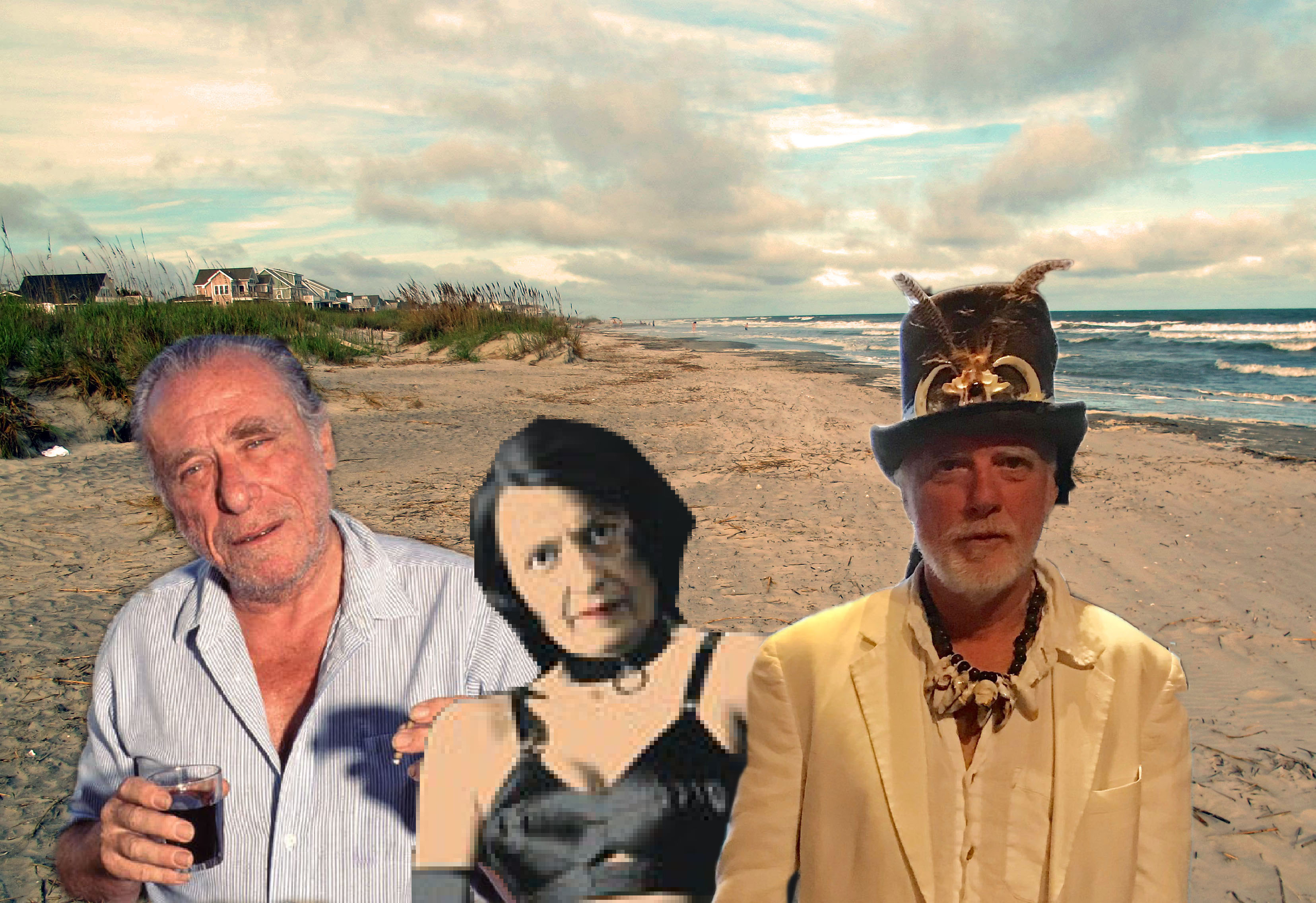
Charles, Ayn, and I-and-I enjoying  walk on Folly Beach

Yesterday, as a sort of throw-off laugh line, I mock-consoled a friend on Facebook who mock-lamented that his fourteen year-old-daughter had discovered Charles Bukowski.[1]  So I replied to his message: “Look on the bright side, at least she’s not reading Ayn Rand.”

This attempt at humor pissed off a couple of folks who consider Ayn Rand worth reading, who implied I was narrow minded in suggesting that my friend’s daughter should not be exposed to Rand’s[2] philosophy of Objectivism.

Anyway, in case you haven’t read Rand, here are the first four paragraphs from “Introduction to Objectivism,” from the Ayn Rand Institute’ website:

Ayn Rand’s philosophy, Objectivism, begins by embracing the basic fact that existence exists. Reality is, and in the quest to live we must discover reality’s nature and learn to act successfully in it.

To exist is to be something, to possess a specific identity. This is the Law of Identity: A is A. Facts are facts, independent of any consciousness. No amount of passionate wishing, desperate longing or hopeful pleading can alter the facts. Nor will ignoring or evading the facts erase them: the facts remain, immutable.

In Rand’s philosophy, reality is not to be rewritten or escaped, but, solemnly and proudly, faced. One of her favorite sayings is Francis Bacon’s: “Nature, to be commanded, must be obeyed.”

Reality — that which exists — has no alternatives, no competitors, nothing “transcending” it. To embrace existence is to reject all notions of the supernatural and the mystical, including God.

***

In my teaching days, in trying to explain existentialism to 15-year-olds, I first established that the images we perceive depend upon the nature of our sense organs.  For example, my late dog Saisy wasn’t aware that she didn’t perceive colors, so if she could understand and answer my question, “What color is a bullfighter’s cape,” she’d probably say “grey.”

Of course, I’m able to perceive the color red, but the fact that Saisy couldn’t – that she perceived the world differently – didn’t make her world any less real.  I certainly couldn’t detect those magnetic odors that drove her to abandon eye for nose on our walks, but, likewise, my inability to perceive those smells didn’t make my world any less real, only less detailed.

As Saisy zigzagged, huffing her way along the shoulder of 6th Street staring at the ground and I glanced upwards at an autumn moon in the blue of the sky, we inhabited two very different universes, yet, of course, they are essentially the same place.

saisy eye

Self-portrait in Saisy’s Eye

The great American poet Richard Wilbur makes the same point much more powerfully in these lines from his poem “Epistemology.”[3]

Kick at the rock, Sam Johnson, break your bones:
But cloudy, cloudy is the stuff of stones.

To narrow the discussion, the differences between the perceptions of individual human beings can also be radically different.  For example, when I read a novel, I never encounter visual images; no movie plays in my head.  Rather, I hear the sounds of words that conjure associations that engender vague cloud-like impressions.  When I read, I don’t really look at the construction of words, hence my atrocious spelling, not to mention my piss poor proofreading.  I sometimes wonder if the fact that at 72 still don’t need reading glasses lies in that I have virtually never peered hard at anything in my life.

My wife Caroline, however, does “see” when she reads, so, in essence, our reading experiences are much, much, different; we inhabit two different reading universes, as it were.

None of this, of course, is news.  Wordsworth in 1798 writes of a world that “we half perceive and half create,” and John Hiatt agrees in “A Thing Called Love” when he sings “Whether your sunglasses are off or on/You only see the world you make.”

william and john

William and John

If you take these ideas to the extreme – that we possess a unique world that is ours –  then, as Sartre says, “everything is permitted,” and you end up with a whole lot of solipsism.

The sages of the East provide a better alternative, I think.  Yes, the world we see is an illusive reflection of our senses, the veil of Maya.  However, rather than granting each individual absolute dominion over the world he “creates,” the sages posit that the very idea of individuality is what is illusive – that my perceiving myself apart from that pine right outside my window is false.  I breathe its oxygen while it takes in carbon dioxide; the sun above is actually is embedded in the page I turn, a page that once existed in pine tree wood pulp.

The entire subatomic world is one – I and the universe am one – and to see more clearly, I need to dismantle the elaborate ego I have constructed, that pompous museum filled with flattering self-portraits, films projected on the broken mirror of memory, and other artifacts that distort what is.

museum

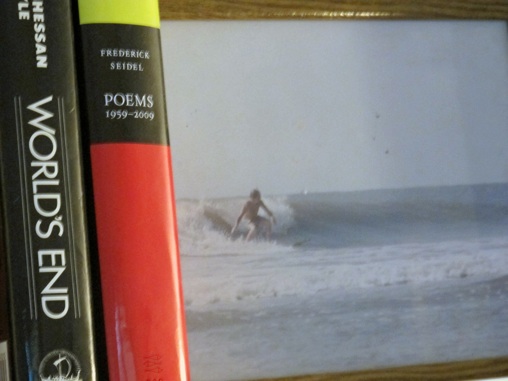
From the surfing wing of the WMoore Museum of Memory

This philosophy – the opposite of Rand’s radical individualism – offers , I think, some hope for an endangered planet: if people could accept the complex inter-relatedness of everything, they might so blithely be building golf courses in deserts on a planet with a finite water supply.

Perhaps somewhere out there – some carpenter’s son, some itinerant carpet salesman, some software engineer  –  is about to receive an updated revelation to shed some much-needed light.

It does seem to happen every 500 years or so, so we’re long overdue.

***

Anyway, bravo for intellectual curiosity, and for Charles Bukowski, who, like Ayn Rand, is not to everyone’s taste.

Here’s a link to a poem of mine extolling poor ol’ Charles.


[1] I think in reality he was rightfully proud of her intellectual curiosity rather than upset that she might be exposed to what Baptist preachers call “filth-uh.”

[2] My wife Caroline pointed out that no one ever refers to Ayn Rand as Rand, the way they do with other philosophers like Marx, Kant, Hume, etc.

[3] Boswell’s account of the incident that prompted Wilbur’s lines: After we came out of the church, we stood talking for some time together of Bishop Berkeley’s ingenious sophistry to prove the nonexistence of matter, and that every thing in the universe is merely ideal. I observed, that though we are satisfied his doctrine is not true, it is impossible to refute it. I never shall forget the alacrity with which Johnson answered, striking his foot with mighty force against a large stone, till he rebounded from it — “I refute it thus.” Boswell: Life