A year or so ago, Buxton Books invited me to recite a favorite poem for their on-line series, “The Power of Poetry” as part of the promotion for my novel Today, Oh Boy. However, I don’t think the clip was ever posted, so in honor of Yeats’ 159th birthday, I’m posting it here. The text of poem itself is below the video.
We sat together at one summer’s end, That beautiful mild woman, your close friend, And you and I, and talked of poetry. I said, ‘A line will take us hours maybe; Yet if it does not seem a moment’s thought, Our stitching and unstitching has been naught. Better go down upon your marrow-bones And scrub a kitchen pavement, or break stones Like an old pauper, in all kinds of weather; For to articulate sweet sounds together Is to work harder than all these, and yet Be thought an idler by the noisy set Of bankers, schoolmasters, and clergymen The martyrs call the world.’ And thereupon That beautiful mild woman for whose sake There’s many a one shall find out all heartache On finding that her voice is sweet and low Replied, ‘To be born woman is to know— Although they do not talk of it at school— That we must labour to be beautiful.’ I said, ‘It’s certain there is no fine thing Since Adam’s fall but needs much labouring. There have been lovers who thought love should be So much compounded of high courtesy That they would sigh and quote with learned looks Precedents out of beautiful old books; Yet now it seems an idle trade enough.’
We sat grown quiet at the name of love; We saw the last embers of daylight die, And in the trembling blue-green of the sky A moon, worn as if it had been a shell Washed by time’s waters as they rose and fell About the stars and broke in days and years.
I had a thought for no one’s but your ears: That you were beautiful, and that I strove To love you in the old high way of love; That it had all seemed happy, and yet we’d grown As weary-hearted as that hollow moon.
Like its older sibling A Visit from the Goon Squad, Jennifer Egan’s 2022 novel The Candy House consists of a series of interlinked short stories written in various voices featuring a host of characters we meet and reencounter at various unchronological stages of their lives. Its narrative structure is in a sense digitalized, modeled on various Internet modes such as Facebook, email, texting, and constructs a sort of narrative labyrinth of mirrors where the virtual is privileged over the corporeal.
Or to paraphrase the abstract of my son’s PhD dissertation[1], The Candy House (and other contemporary novels of its ilk) explore how new media technologies affect psychological and sociological structures and blur the boundaries “between history and fiction, physical and virtual spaces, as well as public and private notions of the self.”
The novel demonstrates that not only has the richness of raw “undigitalized” reality been diminished by our habit of staring into screens, but also that “authenticity” becomes incredibly problematic as we scroll through the filtered sunsets captured by our Facebook friends whose profile pictures have also been filtered.
A plot summary is virtually (pun intended) impossible. But here’s a stick figure drawing.
Miranda Kline, an anthropologist and the ex-wife of a famous record producer Lou Kline, writes a book called Patterns of Affinity that creates an algorithm that explains what makes people like and trust one another. Based on Kline’s theory, Bix Bouton creates a technology that allows humans to upload their consciousnesses to a cloud and starts a company called Mandala where you can pay to have your consciousness uploaded and then tap into it to relive your past. Also, you can pay to have access to anyone else’s consciousness who has agreed to buy a subscription to Collective Consciousness.[2]
As far as point-of-view is concerned, now even first person narrators can be omniscient. For instance, Lou Kline’s eldest daughter Charlene, after accessing Collective Consciousness, relates her father’s introduction to cannabis during an expedition into a forest, which took place when she was only six.
Other characters, often interrelated by kinship or friendship, find themselves attempting to experience authenticity. One character works at a startup where his job is to reduce possible events in fiction to algebraic equations, e.g. “(a (+ drink) x (action of throwing drink) = a (- drink) + i/2.”
Another chapter is narrated in the second person by a chip implanted in a spy’s brain to provide instructions during a dangerous mission:
Spread apart your toes and
gently reinsert the plug, now
magnetically fused to
your subject’s phone, into your
Universal Port.
Yet another chapter consists of texts featuring a medley of characters attempting to set up an interview with a famous fading movie star.
The Candy House is quite a tour de force.
I wonder, though – despite its brilliant polyphonic orchestration of narrators’ voices, its imaginative story telling techniques, and its construction of an all too real Brave New World – if the novel itself abstracts itself from the corporeal richness of the very best of literary fiction.
It’s a bit of a paradox: the fragmentation of its narrative mode, which reflects the shattered lives of its characters, makes reading the novel a mental exercise of sorts, something akin to solving a puzzle, which abstracts the reader from the characters. But then again, this may be Egan’s point: people have become, to riff on my main man Will Shakespeare, walking shadows, or better yet, walking holograms.
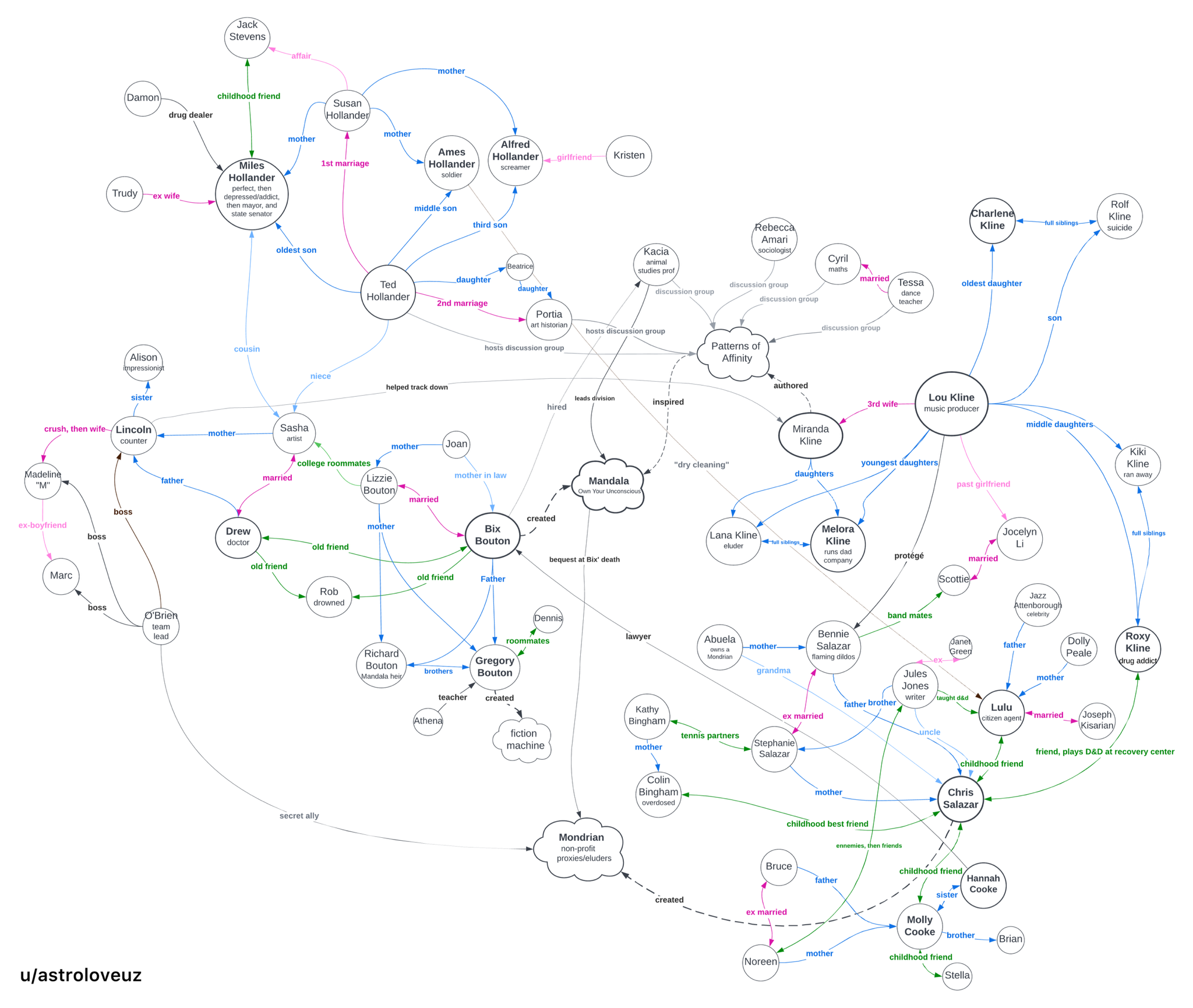
Here’s a character cloud created by someone who goes by u/astroloveuz on Reddit.
In the last twenty or so years, parents have been opting for phonetic spellings for their children’s names, which often increases the number of letters needed to convey the sound of the name. The other day in the obituaries I ran across a survivor, a grandchild, whose first name was Kennidee. (I’m not sure of the pronunciation: Is it Kennedy or Ken-a-DEE?). I’m assuming Kennidee’s a girl because these cutesy spellings almost invariably are assigned to female names – Ashlee, Emmalee, Brandee, etc. Also, sometimes parents invert the vowels E and A to create a sort of Celtic look, rendering Haley as Haeley, for example.
Obviously, it’s none of my business what parents name their progeny, and I’m not claiming that my family’s names are particularly stellar. My maternal great grandparents, David and Minnie Fairey Hunt, named their daughters Ruby and Pearl, and Aunt Ruby named her daughter Zilla. Sister Pearl christened one of her sons Fairey, so his name ended up being Fairey Goodman, which sounds like a character in a nursery rhyme fantasy.[1] My own grandmother, the younger sister of Ruby and Pearl, was named Hazelwood Ursula Hunt, a mouthful, if you ask me, which became even more of a mouthful after she wed Jerome Kistler Blanton and became Hazelwood Ursula Hunt Blanton.[2]
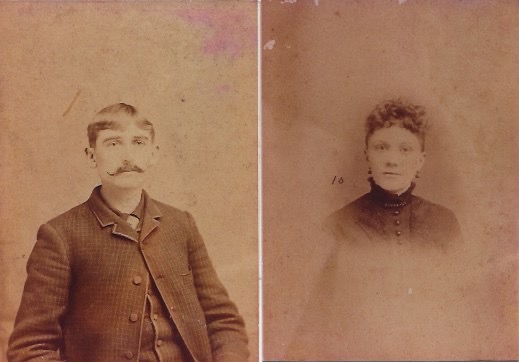
Lewis David Hunt, born 1863; Minnie Anna Fairey Hunt, born 1873
Given that I’m a fiction writer, I’m in the business of naming characters, and for me it’s a lot of fun because I try to imbue my characters’ names with symbolic meaning. For example, I tagged the protagonists of a break-up story Abby Huffington and Ashton Gray, she quick to take offense, he as drab as sackcloth. In Today, Oh Boy, the main character’s Rusty Boykin’s name weds incompetence and immaturity, and conveniently Boykin is a traditional South Carolina surname.
His foil and eventual friend’s name is Ollie Wyborn, a transplant from Minnesota with Nordic roots. Ollie is an intellectual, a questioner, so I chose Wyborn to suggest that Ollie possessed a philosophical bent.
Anyway, it must be nice to have a distinctive name. For example, if you google Wesley Moore you get hundreds of thousands of hits, from the current governor of Maryland to Wesley Charles Moore serving 30 years in Michigan for child molestation. Wes Moore is about as distinctive a name as John Smith when you get down to it.
But I’m not complaining. I grew up around the corner from a girl named April Lynn Paris.
[1] I have a copy of the Fairey family tree. The first American Fairey’s name was John, born in Ireland in 1720 and killed at the Battle of Hanging Rock in 1780 during the American Revolution. When I first visited Ireland, I told the proprietor of the B&B where we were staying that some of my ancestors came from Ireland, the Faireys, and he looked at me as if I were daft and said, “Now, there’s a name I’ve not heard of.”
[2] Grandmama Hazel wanted to name my mother Barbara Ursula, but the doctor talked her into shortening it to Bobbi Sue, a name my mother detested because she considered it way too country cute.
Today in Manhattan in a dingy 14th floor courthouse with inadequate heating, lawyers will present their opening arguments in Donald Trump’s first trial of 2024. He’s accused, of course, of falsifying business records to hide $130,000 paid to a porn actress so that the American people would not find out that he and she had engaged in adulterous sex during his first run for the presidency.
Pundits speculate that the prosecution’s first witness will be David Pecker.
David Pecker was then the publisher of the National Enquirer. When I was a child, I used to peek at the Enquirer at the magazine rack at Kramer’s Pharmacy in segregated Summerville, South Carolina. Back then, it published photographs of splattered suicides who had leapt from high rise windows and other violent images. I confess I’ve always had a morbid imagination.
This dark memory has engaged in the jukebox of my subconscious Peggy Lee’s rendition of “Is That All There Is,” a sad, decadent tune that sounds as if originated in a cabaret in Berlin during the Weimer Republic. I suspect that Tom Waits loves this song.
To exorcise the tune, I’ve gone to YouTube and discovered this wonderful video of Bette Midler covering the song. Here it is.
And also dig this: Tom and Bette doing a duet in which virtually every line of the song is a cliche.
A veteran who has interviewed over 800 authors, Rodger is a real pro. I’m fortune to have had the opportunity to discuss my novel “Today, Oh Boy” with him.
Years ago I saw Barbara Walters interview Jack Nicholson on one of her specials. The British actor Hugh Grant had just been busted for solicitation, so Barbara asked Jack why someone as goodlooking and famous and rich as Hugh Grant would require the services of prostitutes.
Jack donned his patented devilish grin and said, “Peculiarities. Peculiarities.”
Which brings us to Louis CK.
I first caught Louis on the Letterman Show back in the days of VCRs when I prerecorded Dave for civilized midmorning viewing. If I remember correctly, Louis didn’t do standup that night but walked over and took a seat next to Dave. Louis started riffing on the entitlement of whiny airline passengers who carp about minor inconveniences while soaring o’er the plains of Nebraska where wagon trains once rambled through “Injun” territory in months-long treks.
“You’re sitting in a seat in the air, for Christsakes!”
[c.f. Cormac McCarthy’s Blood Meridian.]
Earlier this evening, perched on a barstool at Chico Feo, I almost texted my wife Caroline, who is in New York City, to complain that my boredom was approaching John Berryman red alert levels:
Dream Song 14
Life, friends, is boring. We must not say so. After all, the sky flashes, the great sea yearns, we ourselves flash and yearn, and moreover my mother told me as a boy (repeatedly) ‘Ever to confess you’re bored means you have no
Inner Resources.’ I conclude now I have no inner resources, because I am heavy bored. Peoples bore me, literature bores me, especially great literature, Henry bores me, with his plights & gripes as bad as achilles,
Who loves people and valiant art, which bores me. And the tranquil hills, and gin, look like a drag and somehow a dog has taken itself and its tail considerably away into mountains or sea or sky, leaving behind: me, wag.
John Berryman
But I didn’t want to darkcloud any fun Caroline was having, and anyway, I got into a conversation with a travelling nurse named Elise who is doing preop duty for a couple of months at Roper Hospital where my late wife Judy Birdsong stayed every other two weeks getting 96 hours of continuous chemo during the first stint of her cancer. Yet, the thing is, I don’t have a negative feeling about Roper. I told Elise how I had come to appreciate the nurses there. They were absolutely wonderful. They knew/know life from a perspective of pain. They are brothers and sisters of mercy.
I asked her what she was reading. She said she didn’t enjoy reading, had never enjoyed reading, that she would rather “watch things,” so of course I told her I was novelist, which elicited headshaking and a rueful chuckle.
We continued to make small talk. I asked her superficial questions about her life, thinking I might create a character like her for a minor role in some future fiction, maybe a confidant. I appreciated her forthrightness.[1]
On my walk home, Bob Dylan’s “Just Like Tom Thumbs Blues” got stuck in my head, so I started singing it, walking along singing, checking out the afternoon’s fading, shimmering, almost nervous sunlight. When I-and-I am afflicted by these songs looping in my head, the only cure is to listen to the song as a form of exorcism.
Like Louis CK’s disgruntled flier, I had forgotten that I live in an age of miracles. Now I am sitting in front of my computer listening to Bob sing “Tom Thumb’s Blues” and reading the lyrics against the static background of the iconic Highway 61 Revisited album cover that – look – I’ve conjured from a Cloud and presented below.
But now I realize that for fifty years I have misheard the lyrics. For example, the first line isn’t “When you’re down in Wallace”; it’s “When you’re down in Juarez,” which makes a lot more since given that “Sweet Melinda speaks good English” and “the authorities just sit around and boasts.” In other words, the song is about being down and out in Mexico. I also mistook “Rue Morgue Avenue” for “Remark Avenue,” which I sort of like better. My favorite line from the song is “Well, I started off on burgundy but soon hit the harder stuff,” which I always thought was “hardest,” which definitely would be better, going from burgundy to heroin, instead of going from burgundy to Jim Beam.
Anyway, I’ve exiled my boredom to an ice floe in Antarctica. “It’s all good,” as the young people say after you’ve bumped into them and apologized.
I’ve always been a big fan of allusions because they infuse whatever the writer is conveying with even more meaning, offering subtext or cross references that deepen. If you don’t pick up on the references, no harm done. If you do, God is in his heaven, and all’s right with the world.[1]
Here’s what I’m talking about: in the Richard Wilbur ‘s poem “A Late Aubade,” the speaker is trying to talk his lover into cutting class so they can continue to lie in bed in what I’m assuming is an interlude between another session of lovemaking.
Here’s, as the vulgar say, the money shot:
It’s almost noon, you say? If so, Time flies, and I need not rehearse The rosebuds-theme of centuries of verse.
If you must go,Wait for a while, then slip downstairs And bring us up some chilled white wine, And some blue cheese, and crackers, and some fine Ruddy-skinned pears.
Rehearse, as in re-hearse, as in death mobiles, black limousines, but then – BAM – the allusion to Robert Herrick’s, “To the Virgins to Make Much of Time”:
Gather ye rosebuds while ye may, Old Time is still a-flying; And this same flower that smiles today Tomorrow will be dying.
Carpe Diem!
Or, as Andrew Marvell put it:
The grave’s a fine and private place,
But none, I think, do there embrace.
ILLUSTRATION: YAO XIAO
[1] BTW, I wish I did, but I don’t believe in anthropomorphic Semitic deities. “God is in his heaven” is an allusion, albeit an ironic one, to the Victorian poet Robert Browning.
[In episode 2, My ex-pat son Ned and I wended our way through backroads headed to Reynolds, formally known as Reynolds Plantation, just outside of Greensboro, Georgia, to reunite with his Aunt Becky at Uncle Dave].
Around four-thirty on Thursday, Ned and I arrived at Reynolds where we negotiated the security gate rigamarole. At the house, Becky and Dave greeted us warmly, plied us with drinks after our long (well, six hour) journey, and we did some catching up. It turns out that Becky and Dave had recently suffered a hair-raising flight from New Jersey to Atlanta, the inside of the plane perpetually rocked by turbulence for the entire time they were airborne. As she was exiting the plane, Becky found it especially disconcerting to see the pilot and copilot exchanging high fives. She informed Ned if she were going to visit him in Nuremberg, she was likely to take an ocean liner.
On Friday, Dave, who is overseeing the construction of one of the houses his son Scott is building in Reynolds, headed off to work, and Becky drove Ned and me to Eatonton so we could check out the Georgia Writer’s Museum, home of the Georgia Writer’s Hall of Fame.
Eatonton is a lovely, sleepy verdant town that reminds me of the Summerville of my youth. It seems like a pleasant place to retire, that is, if you’re not a Folly Beach hedonist hellbent on cha-cha-cha-ing yourself to death.
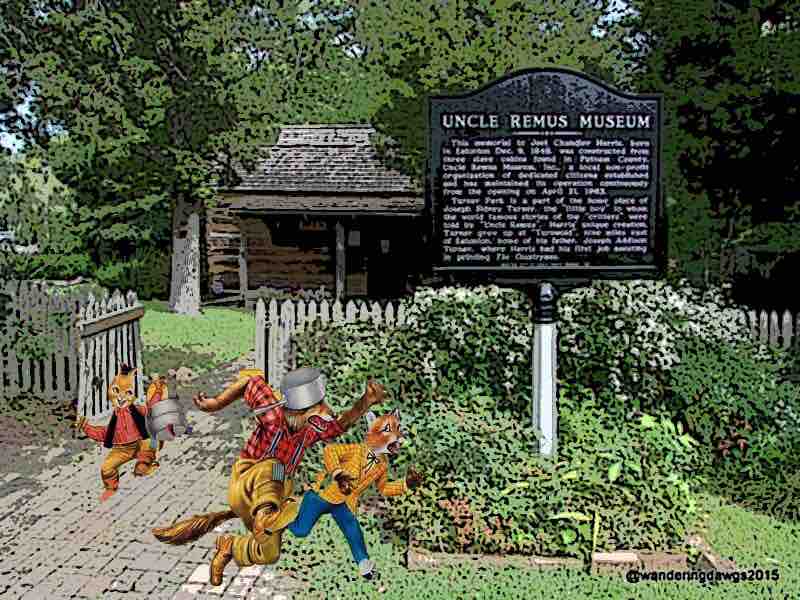
The museum itself, located in a coffeeshop, struck me as the literary equivalent of a science fair, consisted of tables lined up with poster board information. Eatonton and its environs have produced a remarkable number of noteworthy writers including Alice Walker, Jean Toomer of Harlem Renaissance fame, and Joel Chandler Harris, who adapted African folk tales in book form, creating the Uncle Remus stories. Milledgeville, the home of Flannery O’Connor, is a mere twenty miles south.
The museum houses both Joel Chandler Harris’s and Flannery O’Connor’s typewriters, plus an exhibit delineating the evolution of machines of writing, starting with primitive typewriters and ending with a progression of computers getting smaller and sleeker through the decades.
As I slowly strolled along the exhibits, The fact that Joel Chandler Harris had been born in the Barnes Inn and Tavern caught my eye. Being born in a tavern seemed odd, colorful, so I read on.
Here’s a short version of his life:
The year of his birth is uncertain, either 1845 or 1848. His mother Mary, an Irish immigrant who worked at the inn, was impregnated by a cad who abandoned his infant son and Mary. She named the baby Joel Chandler Harris after her attending physician.
Of course, illegitimacy, as it was called in my youth, was especially problematic in the antebellum South.[1] In addition to that disadvantage, Joel was redheaded and stammered, which made him a target for bullies.[2] The stigma of his “lowly” birth haunted him throughout his youth and early adulthood.
Fortunately, Dr. Andrew Reid, a prominent Eatonton physician, provided Mary and Joel with a small house behind his mansion. He also paid for Joel’s tuition (in those days public education didn’t exist in the South). Mother Mary fostered Joel’s future literary prowess by reading to him out loud, which helped him to develop the remarkable memory he would utilize in assembling the Uncle Remus tales. She read him Goldsmith’s The Vicar of Wakefield so often that he could recite lengthy passages by heart.
At fourteen, Harris dropped out of school and went to work for a newspaper, Joseph Addison Turner’s The Countrymanwith a circulation around 2,000. There Harris mastered the basics, including typesetting. Addison allowed Harris to publish his own stories and poems. Eventually, Harris moved into Turnwold Plantation, Addison’s home, located nine miles outside of Eatonton. Here Harris had access to a voluminous library and where he began devouring the classics and contemporary authors such as Dickens, Thackery, and Poe.
At Turnwold, Harris spent hundreds of hours in the slave quarters. Wikipedia claims that Harris’s “humble background as an illegitimate, red-headed son of an Irish immigrant helped foster an intimate connection with the slaves. He absorbed the stories, language, and inflections of people like Uncle George Terrell, Old Harbert, and Aunt Crissy,” who in amalgam became the narrator of the Brer Rabbit Tales, Uncle Remus.
I was unfamiliar with Harris’s biography, but what strikes me as truly remarkable is that he replicated these stories in dialect without any written sources. He essentially gave voice to and preserved these tales that had been stored in the brains of Africans, transported across the Atlantic in slave ships, and told and retold in slave cabins throughout dark nights of captivity.
Because of the Disney movie, Song of the South, Harris has been tarred (pun intended) as being a racist, which is unfortunate. What Harris did was preserve a rich trove of folklore featuring an African trickster who used his wiles to outfox foxes, tales where the underdog prevails. Of course, you can accuse Harris of cultural appropriation, but to my mind, the dialect enriches the tales, making them much more linguistically interesting.
After the war, Harris moved up in the world of journalism, working at the Atlanta Constitution for nearly a quarter century, and addition to the Remus tales, he published novels, short stories, and humorous pieces. Luminaries such as Theodore Roosevelt and Mark Twain were among his admirers. Alas, he was an alcoholic, and died from complications from cirrhosis of the liver at 59.
After our visit to the museum, Becky gave us a driving tour of the area, which includes a dilapidated chapel where Alice Walker’s ancestors are buried. We arrived back at Reynolds in the early afternoon, looking forward to Cousin Scott’s arrival the next day. At the museum, Ned had bought me Jean Toomer’s Cane, a literary mosaic of poems and short stories that brings to life a subculture, which reminds me of my work-in-progress Long Ago Last Summer, an up close and personal exploration of real life Sothern Gothic.
In short, it was a very meaningful morning and afternoon for Ned and me.
Alice Walker’s Childhood Home around 1910
[1] Of course, “bastard” was the preferred 19th Century nomenclature.
[2] As a former redhead, I can emphasize. If interested, check this LINK out.








 You Do Hoodoo