A Post Labor Day Meditation

A Post Labor Day Meditation

I said, ‘It’s certain there is no fine thing   

Since Adam’s fall but needs much labouring.

WB Yeats, “Adam’s Curse”

It’s the Tuesday after Labor Day, and, as if on cue, the weather has turned a tad cooler.  The trees outside my second story office are swaying, nodding, trembling in a brisk breeze. In the back yard, morning glory vines have carpeted the Asiatic jasmine with purple flowers while the untended Elaeagnus is broadening its realm and sprouting ugly baldish shoots skyward. 

So this morning, armed with swing blade and hedge clippers, I braved the mosquitos to do a bit of long overdo maintenance, which oddly enough brought to mind Milton’s Paradise Lost where Eve and Adam are tasked by their Creator to tend to the garden’s growth. They must “lop” or “prune” or “bind,” but nevertheless “wanton growth derides” and the garden “tends to wilde” (sic). So, channeling her inner Adam Smith, Eve suggests she and Adam divide their labor, which leaves her isolated and vulnerable to the blandishments of Satan’s forked tongue and phallic charms:

            [The Serpent] Address’d his way, not with indented wave,
            Prone on the ground, as since, but on his reare,
            Circular base of rising foulds, that tour’d
            Fould above fould a surging Maze, his Head
            Crested aloft and Carbuncle his Eyes; 

            With burnisht Neck of verdant Gold, erect[1]
            Amidst his circling Spires . . . 

This seduction, of course, leads to the fall of humankind, so farewell, delightful gardening, hail back-breaking farm labor.

Thus, Adam’s curse is twofold: death and labor.

Yet, I think that without meaningful labor we humans tend to wither, and how horrible a terrestrial eternal life would be! Just ask Petronius’s Sibyl: 

I saw with my own eyes the Sibyl at Cumae hanging in a cage, and when the boys said to her: “Sibyl, what do you want?” she answered: “I want to die.”[2]            

                                                                                                Petronius, The Satyricon

Or the old man in Chaucer’s “The Pardoner’s Tale”:

            Thus I walk, like a restless wretch,

            And on the ground, which is my mother’s gate,

            I knock with my staff, both early and late,

            And say, “Dear mother, let me in!”

                                                            Chaucer, “The Pardoner’s Tale”

So, we should be thankful for Original Sin. Otherwise, we’d be stuck in a never-ending cycle of gardening, which would delight some of my friends, but is not to my taste.

I’ll give Wallace Stevens the last word:

            Is there no change of death in paradise?

            Does ripe fruit never fall? Or do the boughs

            Hang always heavy in that perfect sky,

            Unchanging, yet so like our perishing earth,

            With rivers like our own that seek for seas

            They never find, the same receding shores

            That never touch with inarticulate pang?

            Why set the pear upon those river-banks

            Or spice the shores with odors of the plum?

            Alas, that they should wear our colors there,

            The silken weavings of our afternoons,

            And pick the strings of our insipid lutes!

            Death is the mother of beauty, mystical,

            Within whose burning bosom we devise

            Our earthly mothers waiting, sleeplessly.

                                                                        Wallace Stevens, “Sunday Morning”


[1] Emphasis mine. But while I’m at it here below, shouldn’t some vice crusader alert Moms for Liberty that this filth is hiding in virtually every high school library in America! 

[2] “The Sibyl of Cumae was a prophetess in service to Apollo and a great beauty. Apollo wished to take her as his lover and offered her anything she desired. She asked to live for as many years as there were grains in a handful of dust. Apollo granted her wish, but still she refused to become his lover. In time, the sibyl came to regret her boon as she grew old but did not die. She lived for hundreds of years, each year becoming smaller and frailer, Apollo having given her long life but not eternal youth. When Trimalchio speaks of her in the Satyricon, she is little more than a tourist attraction, tiny, ancient, confined, and longing to die.”  from a hyperlink in windingway.org’s hypertext version of TS Eliot’s “The Waste Land”

A Malcontent Remembers It’s Bloomsday

Hey, I got a beef with whoever writes the narratives of the PBS series Nature.  It really bugs me when the narrator – and it happens all the time – says stuff like the panther chameleon’s eyes have been engineered  by nature to rotate independently as they stalk their prey.

Panther Chameleon by Robbie Labanowski

Note to the science writers at Nature: check out Charles Darwin’s The Origin of the Species.  Natural Selection ≠ Engineering.  Natural Selection is a horrifically random process that includes genetic mutations, asteroids colliding with the Earth, etc.  Your use of the word engineering suggests the decrepit teleological intelligent-design argument (as if having an asteroid smack into the planet is an efficient way for an engineer to facilitate the rise of mammals).

I’ll give Robert Frost the last word on this topic:

Design

I found a dimpled spider, fat and white,
On a white heal-all, holding up a moth
Like a white piece of rigid satin cloth —
Assorted characters of death and blight
Mixed ready to begin the morning right,
Like the ingredients of a witches’ broth —
A snow-drop spider, a flower like a froth,
And dead wings carried like a paper kite.

What had that flower to do with being white,
The wayside blue and innocent heal-all?
What brought the kindred spider to that height,
Then steered the white moth thither in the night?
What but design of darkness to appall?–
If design govern in a thing so small. 

Now, that’s what I call engineering: a Petrarchan sonnet that through pattern debunks the argument from design!

Hey, what’s all this negativity, mon?  It’s Bloomsday, for Joyce’s sake and Father’s Day to boot, not to mention Sherry Browne’s birthday.

Let’s not squander this day bellyaching.  Why not in honor of the Master spend your day wandering the streets of Folly, breakfasting on Guinness and kidney, writing love letters using a nom de plume, hitting a funeral, lunching in a pub on cucumber sandwiches, visiting a library and then another pub, releasing some tensions at the beach, getting into an altercation with a one-eyed anti-semite, dropping in on a maternity ward and then a brothel, bringing home a troubled young man, peeing together in your garden as you bid him adieu, then crawling into bed with your wife who has fond memories of you in your youth.

O and the sea the sea crimson sometimes like fire and the glorious sunsets and the figtrees in the Alameda gardens yes and all the queer little streets and pink and blue and yellow houses and the rosegardens and the jessamine and geraniums and cactuses and Gibraltar as a girl where I was a Flower of the mountain yes when I put the rose in my hair like the Andalusian girls used or shall I wear a red yes and how he kissed me under the Moorish wall and I thought well as well him as another and then I asked him with my eyes to ask again yes and then he asked me would I yes to say yes my mountain flower and first I put my arms around him yes and drew him down to me so he could feel my breasts all perfume yes and his heart was going like mad and yes I said yes I will Yes.

Hell yes!

Cheers, oh my brothers and sisters! Cheers!

art by Sherry Browne

Lurking in Some Obscure Corner

Like a shortwave radio attempting to tune into a remote overseas station, my threadbare synapses sometimes spit out static as I try to remember the point of story I’m trying to tell. 

Maybe it’s the cannabis, maybe the onset of dementia, or to harken back to Big Brother and the Holding Company, “a combination of the two.”

For the uninitiated, “A Combination of the Two” is the opening track of Big Brother’s album Cheap Thrills featuring the incomparable Janis Joplin. I had always assumed that the song was a live recording, but as it turns out, the audience noise and Sam Andrew’s introduction of the band, “Four gentlemen and one great, great broad,” have been dubbed in to create the illusion of a live recording. Well, it certainly had me fooled for over a half century.

BTW, the great Robert Crumb did the cover art.

In my novel Today, Oh Boy, as Will Waring is popping Cheap Thrills into his van’s 8-track tape player, he says out loud to himself, “Four gentleman and one great, great broad.”  Recently, when Rodgers Nichols interviewed me on his podcast Cover to Cover, he mentioned the allusion, said as a former radio DJ he really appreciated it.[1]

Anyway, what was my point?

Oh, yeah, forgetfulness.

The name of the author is the first to go
followed obediently by the title, the plot,
the heartbreaking conclusion, the entire novel
which suddenly becomes one you have never read,
never even heard of,

as if, one by one, the memories you used to harbor
decided to retire to the southern hemisphere of the brain,
to a little fishing village where there are no phones.

Long ago you kissed the names of the nine Muses goodbye
and watched the quadratic equation pack its bag,
and even now as you memorize the order of the planets,

something else is slipping away, a state flower perhaps,
the address of an uncle, the capital of Paraguay.

Whatever it is you are struggling to remember,
it is not poised on the tip of your tongue,
not even lurking in some obscure corner of your spleen.

It has floated away down a dark mythological river
whose name begins with an L as far as you can recall,
well on your own way to oblivion where you will join those
who have even forgotten how to swim and how to ride a bicycle.

No wonder you rise in the middle of the night
to look up the date of a famous battle in a book on war.
No wonder the moon in the window seems to have drifted
out of a love poem that you used to know by heart.

“Forgetfulness” by Billy Collins


[1] You can catch the interview HERE.

The Hyper Southern Gothic Murdaugh Saga: Hunter S Thompson Edition

If Hunter S. Thompson hadn’t blown his brains out, he’d be 85, perhaps too old to book a flight to Atlanta, too old to drive the back roads through Flannery O’Connor country past Blind Willie McTell’s grave, past that weird ass art installation that practically defies description, past the “Hell Is Real” billboards, over the Savannah River Bridge, through the desolation of the town of Allendale on his way to the Colleton County Court House in Walterboro to cover the double homicide murder trial of Alex Murdaugh.[1]

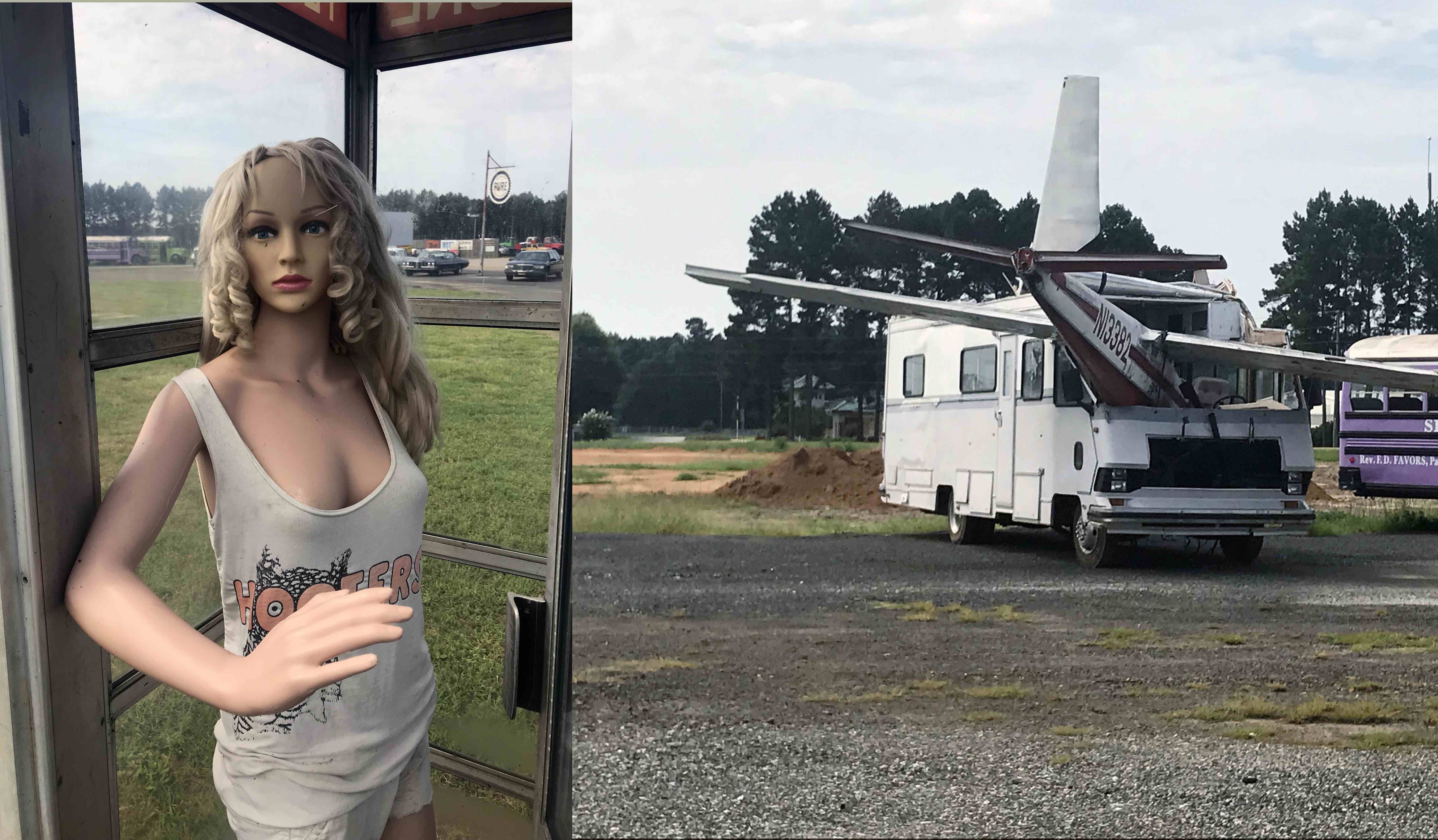
two photos of that “weird ass art installation” located outside of Thomson, GA

If you’re unfamiliar with the horror show, here’s a link to a New Yorker article that provides an excellent overview. New Yorker. Or, if you’d prefer a briefer version compressed into poetry, click HERE.

I would love to read Hunter’s drug-fueled take on the drug-fueled mess, what he’d make of the prosecution’s scattershot case, a shotgun blast of so much disassociated information that Immanuel Kant couldn’t follow it. Then there’s defense attorney Dick Harpootlian, shuffling papers, fumbling for his reading glasses, the food trucks outside the courthouse, the moss-draped oaks minding their own business as they always have.

But, alas, as the final song of the Stones’ album Let It Bleed says, “You can’t always get what you want.”


[1] I realize the phrase “homicide murder trial” is redundant, but it sounds so much better than either adjective by itself.