Novels Vis-a-Vis Screenplays

Novels Vis-a-Vis Screenplays

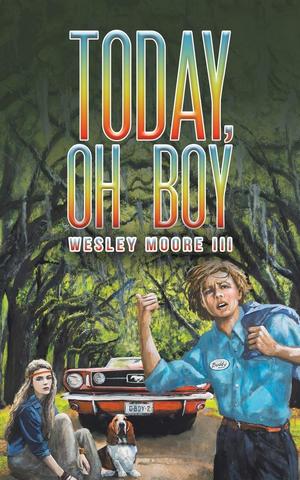
At the request of an actor who’s interested in pitching my novel Today, Oh Boy to producers he’s worked with, I’ve written an adaptation of the novel for the screen.[1] It’s not an official screenplay per se, but a roadmap for the actor to determine what scenes he will use to produce a short “teaser” reel consisting of would-be shots from the would-be movie. I have no idea how this is done. Via AI I suspect.  Anyway, with the final proofs from the novel to the right of my iMac’s screen and a blank Word document on the left, I began writing and cutting and pasting.

The good news is that originally, using present tense and employing crisp visual imagery, I consciously composed Today, Oh Boy to read like a movie progressing. For example, here’s the opening of the novel.

A mango-hued, pockmarked bulletin board hangs on a classroom wall of pale lime green concrete blocks, the bulletin board pencil-stabbed and compass point-gouged. Among the graffiti are the names of the star-crossed lovers: Sandy + Tripp. Tragic Tripp, whose body was found last week tangled in blackberry bushes along the banks of the Ashley River, his skull smashed after falling off Bacons Bridge.

S-A-N-D-Y + T-R-I-P-P.

Rusty Boykin, a skinny, freckled redhead sitting on the bulletin board row in Mrs. Laban’s homeroom, traces his index finger in the depression of Sandy’s name. He supposes it’s Tripp’s work – the letters inartistic, juvenile. Sandy hasn’t been to school since Tripp’s death, four class days ago, and now it’s Monday, and she’s still not here. She should be sitting right in front of Rusty, her honey-colored hair hanging like a curtain to her waist. 

How to adapt this for the screen?  One way, you could have Rusty tracing his finger in Sandy’s name and then suddenly cut to Tripp falling off the bridge, or you could begin with Tripp’s accident. What I did was to begin with Tripp’s last meeting with Sandy, a conversation through her open bedroom window, his leaving in a rage, jumping into his GTO, pealing off, and ultimately driving his car off the road at Bacons Bridge into the Ashley River.

Actually, Tripp’s death is what Hitchcock called a McGuffin, a misleading device that’s irrelevant to the overall narrative.  After all, Today, Oh Boy is a comedy. Its title comes from the Beatles’ song “A Day in the Life.”

I read the news today oh boy

About a lucky man who made the grade

And though the news was rather sad

Well I just had to laugh 

So, by having Tripp drive off the bridge rather than falling off the bridge, what I gain in cinematic excitement, I lose in the comic pairing of his first and last names. As it turns out, Tripp was a bully, a high school version of Trump.  At one point in the book, Alex Jensen, a junior at Summerville high, says to a friend Will, “Your last name is Trotter, you name your son Tripp, and he falls off a bridge to his death. What a surprise.”

In addition, the novel employs a great deal of what critics call “indirect discourse,” a device that allows a narrator to report what someone is thinking without using his exact words. For example, in the above excerpt, the sentence, “She should be sitting right in front of Rusty, her honey-colored hair hanging like a curtain to her waist” is rendered second-hand through Rusty’s consciousness. In a screenplay, you have to “show” rather than tell “tell,” which can lead to really awkward exposition, like you find in bad fiction like “The Most Dangerous Game”:

You’ve good eyes,” said Whitney, with a laugh,” and I’ve seen you pick off a moose moving in the brown fall bush at four hundred yards, but even you can’t see four miles or so through a moonless Caribbean night.”

That I couldn’t use direct narration or indirect discourse meant I had to omit some characters, like Camilla Creel, the impoverished girl who lives in an abandoned school bus with her mother and sister, and Weeza Waring, Will’s mother, who added several comic touches throughout the narrative.

So, overall, the script is much tidier than the novel, much more streamlined, yet not as rich in my attempt to capture the zeitgeist of Summerville, South Carolina in 1970, during integration, the beginning of the counterculture, and during an influx of Northerners moving to what at the time was a staid, conservative community.

Then again, I’m sure a professional screenwriter could do a much better job.


[1] By the way, it’s on sale at Amazon for a mere $10. 

Eraserhead Revisited

From Painter to Filmmaker

The death of the brilliant film director David Lynch has spurred my wife Caroline and me to revisit his oeuvre.[1]

We started with the Jon Nguyen’s 2016 Lynch documentary The Art of Life, the culmination of four-year’s worth of conversations, twenty in all, recorded at Lynch’s home in LA. I had not been aware that Lynch was a painter, a highly skilled and prolific one at that. 

Throughout the documentary, we listen to Lynch narrate his life story while watching him in the act of creating paintings and sculptures. Interspersed are 8mm home movies of him and his family from the ’50s and ’60s. If you love Lynch, you’ll love this film, enjoy its leisurely pace and artful presentation.

What struck me most was Lynch’s revelation that “moving pictures” could be “moving paintings.”

So post epiphany off Lynch went to the American Film Institute where he resided in stables owned by the institute, and there he made his first feature film Eraserhead, transforming the narrow halls and small rooms of the stables into movie sets. 

By the way, I first saw Eraserhead in 1989 as a refugee from Hurricane Hugo, a dozen years after its original release, the again in the mid-’90s, and for the third time last night with Caroline.[2]

Dr. Caligari’s Great-Great Grandchild

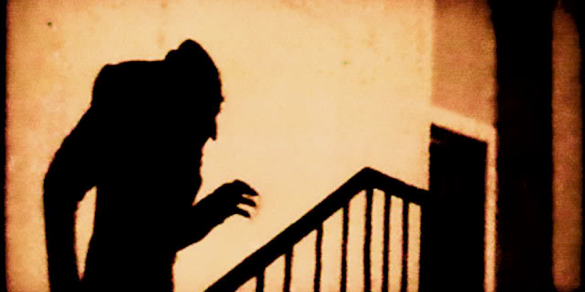
In the fall of 1973 or 4, at the University of South Carolina, I had the great fortune to enroll in a multi-departmental course on German Expressionism, the prominent artistic movement of the Wiemer Republic. This class really broadened my intellectual horizons. We read Hesse, Kafka, and Bertolt Brecht; analyzed the paintings of Ernst Ludwig Kirchner, Karl Schmidt-Rottluff, and Emil Nolde; listened to the music of Schoenberg and Alban Berg; and watched each week in the student union’s theater an expressionistic Wiemer film. We began with the Cabinet of Dr. Caligari and ended with Fritz Lang’s Metropolis. Murnau’s original Nosferatu was also among the films we saw and analyzed. It was, by far, the most interesting and rewarding course I’ve ever taken. 

Obviously, Caligari heavily influenced Eraserhead in its set designs, dark themes, and murky black-and-white lighting. Also, Eraserhead is essentially a silent movie with only four minutes of dialogue in its 89-minute running time. The protagonist Henry, played by Jack Nance, waddles Chaplin-like throughout the film in what amounts to a Kafka nightmare. Though Eraserhead’s billed as a surrealistic horror movie, both Caroline and I found it to be hilariously funny. I can’t remember the last time I saw a film that produced so many out-loud laughs.

On the other hand, one significant way in which Eraserhead doesn’t resemble a silent movie is in its soundtrack. Unlike a silent movie whose soundtrack is more or less pasted on afterward, the soundtrack of Eraserhead consists of irritating sounds arising from the action, sounds like rain hissing, a radiator hissing, the mewling and crying of that abomination of a baby whose arrival marks the turning point of the plot. Caroline aptly described these background noises as “a plaid of sounds,” which provides a sort of underlying mechanical, menacing buzzing. 

Caroline also suggested that the central theme lay in Lynch’s hatred of fatherhood, though I saw it more as a strangely puritanical parable about the dangers of premarital sex. Ends up Caroline was correct. Lynch’s daughter Jennifer was born with severally clubbed feet and had to undergo several corrective surgeries as an infant, and she considers her birth defects as the major inspiration for the infant of the film.

At any rate, we had a fun night and look forward to checking out Lynch’s next film The Elephant Man, which, although more mainstream, shares with Eraserhead a very malformed human being at the center of the action.


[1] Why do I feel guilty using “oeuvre” when EB White would applaud its economical aptness? Perhaps because American anti-intellectualism lurks in the shadowy shotgun shack of my subconscious mocking me like the bully it is? 

[2] Caroline, who minored in art history and has a master’s in psychoanalytical criticism, is the perfect companion and provides a wealth of cogent observations that would have escaped me otherwise.

Sure, I’m a Marxist

During the 50s and 60s, my grandmother’s television, a small black-and-white model perched on a metal stand, played constantly, both day and night, commencing with Dave Garraway’s Today Show and ending with Jack Paar’s Tonight Show[1]

When I spent the night with Mama Blanton, she allowed me stay up as long as I could keep my stinging eyes open. As a young child, I fought sleep as if it were an enemy, as if it were death itself. At home, I had to be in bed by 7:30 on weekdays and nine on weekends, so I always looked forward to staying over at Mama Blanton’s on Saturday nights and watching those old black-and-white movies, which seemed in my naivety ancient artifacts from a more glorious age.[2]

When I was five or six, I recall watching a Marx Brothers movie – probably Duck Soup – and making it past midnight. The Brothers’ antics enthralled me, especially horn-honking Harpo. I struggled mightily that night to stay awake but eventually succumbed to the Sandman’s strangle hold. Mama Blanton let me sleep on the couch until the movie ended, then led me, shuffling like a blind boy, to bed. I can’t recall if I realized then that the Groucho in the movie was the same Groucho (now twenty years older) who hosted the gameshow You Bet Your Life. However, I do I remember some time after the movie purchasing one of those Groucho masks featuring glasses, nose, eyebrows, and mustache.

I didn’t see another Marx Brothers’ film until college when my high school friend and Citadel cadet Gene Limehouse visited USC for a weekend.  High on whatever, we decided to catch a matinee screening of A Night at the Opera at the Russell House theater in the student union building. Fifteen or so years had passed since that first taste of manic Marx Brothers madness at Mama Blanton’s, but once again, I was laughing out loud, though now appreciating more than the slapstick, taking note of the verbal cleverness and also the mockery of the upper classes, most deliciously, Groucho’s offering a tuxedoed opera attendee a tip for retrieving his top hat that had fallen from the balcony. “Go buy yourself a stogie,” Groucho says, leaning over the railing and offering the fuddy-duddy a coin, which he refuses in a huff.

Yet another fifteen years later when I taught AP English and we studied Marxian criticism, I’d show A Night at the Opera on the week of Porter-Gaud’s musical, offering exhausted students a reprieve of sorts. I’d explain how the promotion of the impoverished tenor, the rollicking fun the peasant passengers below deck enjoy on the trans-Atlantic voyage (as opposed to the stiff stiltedness of the first-class passengers), and the Marx Brothers’ revolutionary takeover of the performance of La Traviata conform to Karl Marx’s theories.

Although students back then – perhaps still do – balked at anything in black-and-white, the classes eventually got into it, sometimes applauding at the film’s conclusion.

A Night at the Opera, Marx Brothers’ movie with a Marxian message.

At any rate, I appreciate my grandmother’s liberality in allowing me to wander into her late-night adult world and watch movies not not necessarily suited for children, a benefit I passed along to my boys when they were growing up. 

Despite the clucking of a few disapproving tongues at the time, I’d say we turned out okay.


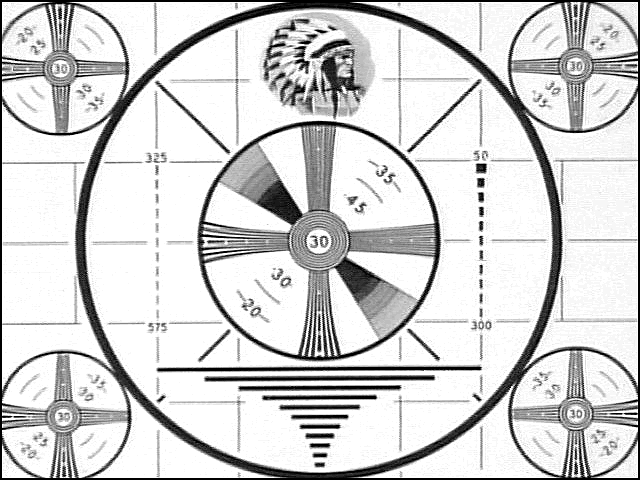
[1] I remember the local NBC station’s signing off with the National Anthem, followed by a short film featuring the poem “High Flight,” and then an announcer’s canned spiel about kilowatts and licensing. That done, the Indian head test pattern appeared with its accompanying high-pitched whine. Finally, exactly at one a.m., a blizzard of static would obliterate the test patten. Time to go nighty-night.

[2] Ironically, many had been filmed during the Depression.

A Man Called Adam, a Mensch Called Satchmo

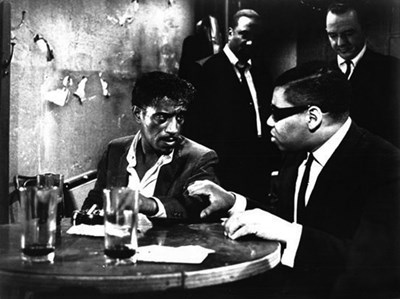
Last night on TCM, Caroline and I watched the 1966 film A Man Called Adam. In the introduction, host Eddie Muller mentioned that the film’s protagonist Adam Johnston, played by Sammy Davis, Jr., was based “very loosely” on Miles Davis. Muller didn’t mention that in 1966 Miles Davis was alive (if not well)[1] and had started a relationship with Cicely Tyson, who interestingly enough, plays Adam Johnson’s love interest.

The movie features Louis “Satchmo” Armstrong portraying a fictional character, Willie “Sweet Daddy” Ferguson. Ossie Davis, and Frank Sinatra, Jr. also co-star. In addition, Mel Tormé bops in for a number, which, for me, is the highlight of several superb musical performances, including one featuring Satchmo himself. Benny Carter composed songs for the movie and served as musical director and conductor.

Although some of the acting isn’t exactly topnotch (Frank Sinatra, Jr. was not nominated for an academy award), those above-mentioned performances, interesting racial dynamics, and its pivotal place in the timeline of civil right make the movie worth watching.  It’s a period of transition: some characters look ‘50s with their skinny black ties, others ‘70s with afros and pointy sideburns. For the most part, white and blacks dig each other, whether they be musicians or audience members in the jazz clubs.

Adam, like Miles himself, is a demon-haunted trumpeter. Years before, he drunkenly crashed his car, killing his wife and child. In addition, society’s underlying racial injustice stokes his anger.  He alchemizes this heartache and rage, blows them out of his horn in soaring, anguished, increasingly frenetic solos, syncopated banshee wails that can raise the hair on your arms (if you haven’t waxed them away).

Oh yes, he’s harassed by the police who want to see his arms, because, after all, being black is a sure sign of heroin addiction. Adam doesn’t take shit from anyone – though he does dump bulldozer loads on his agents, friends, and fellow musicians  –  and for a diminutive man gives the cops a fairly good fight.[2]

Ultimately, though, I don’t dig Adam. Genius, in my book, doesn’t excuse you from treating non-geniuses like lesser beings, doesn’t give you a license to shatter time-honored traditions of civilized decorum, not to mention nearly full whiskey bottles.

No, give me Louis Armstrong, who rose from poverty, did delinquent time at the Colored Waif’s Home in New Orleans, rose to prominence, became an international ambassador for jazz, but was no Uncle Tom. He called President Eisenhower “two-faced” and gutless” during Little Rock’s desegregation and cancelled a State Department tour to the Soviet Union. “The way they’re treating my people in the South, the government can go to hell,” he said as he pulled out of the show.

Anyway, if you’re into jazz or civil rights history, check it out. 


[1] In ’66 Miles spent three months in a hospital because of a liver infection. 

[2] Perhaps not coincidentally, Philip Marlowe, the protagonist of the noir 1953 novel I’m now reading, also gets worked over by the cops. Hmmmmm. 

The Allure of Vampires: Secret, Unfriendly, Pale, Possessed

nostro

Sexual repression isn’t exactly a hallmark of the Late Empire, an era in which conservative moms who advocate abstinence-only sex education sit smiling in studio audiences and applaud their daughters’ sexualized performances.  This aging ethnologist purposely skipped Bristol’s Palin’s much ballyhooed tango with whomever on Dancing with the Stars a few years back*; however, I trust conservative Palin-hater Andrew Sullivan wasn’t far off the mark when he described the couple’s gyrations as “dry humping.”  


*There’s a limit to the suffering I’m willing to endure for the sake of science.


Given that so much is so out in the open nowadays (and so instantaneously available), it seems counterintuitive that vampires are all the rage.  After all, adolescents (not to mention their tween siblings) can with a white lie and a click of a mouse peep through any number of prurient holes and so forego the tiresome teasing cliche-ridden tropes of genre.  

I won’t hazard to guess how many billions of dollars these virulent bat-morphed blood sucking late sleepers (I’m talking about vampires, not teenagers) have generated in the last few decades.  The catalogue of works is Homeric – The Vampire Diaries, Buffy, Twilight, HBO’s True Blood, Crucible of the Vampire, – just to name a few – in addition to collateral consumer products like comic books, Halloween costumes, retractable fangs, etc.

dracula comic

Supposedly, Lord Byron, the most successful club-footed sexual swashbuckler on record,** served as the model for English prose’s first vampire, Lord Ruthven, a suave, insatiable, stalker. Another early bloodsucker was Carmillia, a lesbian predator who appeared in Sheridan Le Fanu’s novel of the same name.  Le Fanu’s rendering heavily influenced fellow Irishman’s Bram Stroker’s Dracula, the so called “master work” of the genre. (I’ll let some Dublin based anthropologist unravel the political/social implications of two Irishmen creating the English-speaking world’s most beloved monsters).***


** Okay, the only club-footed sexual swashbuckler on record.

*** There is also something vampiric about Irishman Oscar Wilde’s Dorian Grey.


220px-Carmilla

These Victorian vampires – essentially sublimated sex fiends – glide into the bedrooms of virgins, go all Freudian with their fangs, infect the innocent with their insatiable lust (for blood)  – a repressed-friendly form of eroticism for puritans. 

Less obvious sublimations lurk.  Not only is Count Dracula undead, but he’s also a foreigner, which makes his deflowering all the more menacing with its dark undertones of alien infiltration and conversion.  After all, vampires’ victims assume the (non)lifestyles of their seducers, those “outside agitators” who introduce them to alternative lifestyles. 

Mike Pence would not approve.

However, if you can detach yourself from what has become so familiar via Bela Lugosi, Christopher Lee, Tom Cruise, etc. the concept of vampires is creepy in a way that out-creeps even that peculiar-bachelor-uncle kind of creepiness.  

No one is particularly found of mosquitoes or bats, but here’s a preposterously popular sub genre that features undead human beings transforming into flying rodents, flitting through windows (and no doubt shitting blood all over those priceless Persian floor coverings), then transforming back into fang-sporting bipeds who slip into the boudoir of a Prudence or Victoria, supine on her bed and radiant in gorgeous, semi-diaphanous lingerie.  Baring these beauties’ necks, the bloodsucker drains the victims of their blood, perhaps copping a feel as he produces the hickey that is forever and forever and forever.

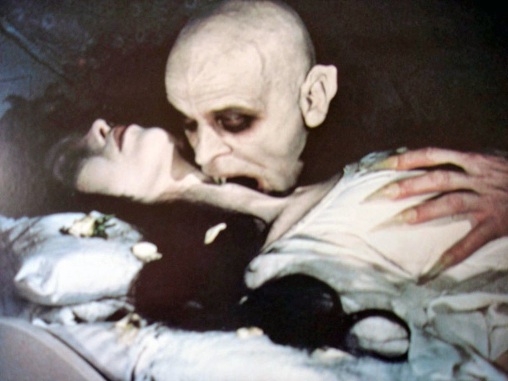
kinski-nosferatu

2008 was a particularly potent year for the genre with Twilight and True Blood both making their debuts.  Once again, I can’t give you first hand knowledge, but both seemed to be more about romance than blood-thirst. 

In True Blood, from what I can gather, 1) the the sex wasn’t sublimated and 2) the series confronted the alien aspect of vampirism by having these bayou vampires seeking equal rights [a pharmaceutical company has engineered some sort of methadone-like substitute for human blood so that vampires can lead somewhat normal lives (if you consider living a deathless existence even approaching “normal”)].

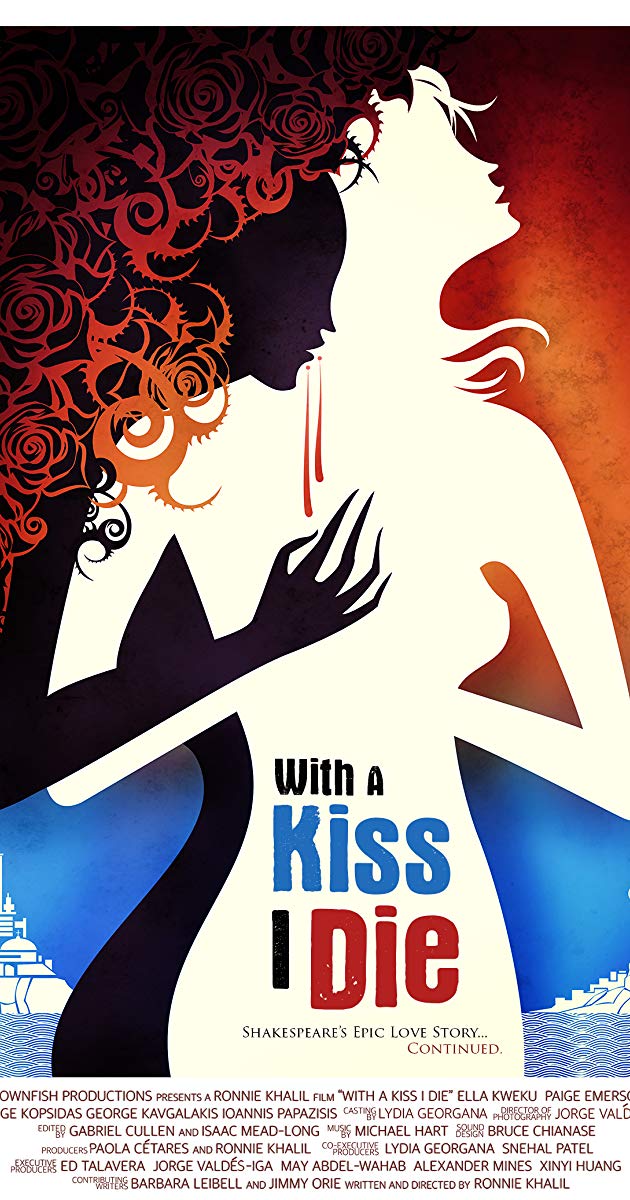
At any rate, producers are still cranking them out.  The website TheCinemaholic (sic) ranks the ten best vampire movies of 2018, the best being, according to them is Vamp, a Russian film set in the 18th century; however, the one that caught my eye was With a Kiss I Die, the title an allusion to Romeo’s last words.

Here’s TheCinemaholic’s synopsis:

The tragic story of William Shakespeare’s ‘Romeo and Juliet’ ended when both the protagonists died in a romantically heart-breaking way. That was the end for Romeo, but not for Juliet. After she stabs herself with Romeo’s dagger and dies right by his side, she wakes up as a vampire. Dejected by the fact that the love of her life has been lost to her and is never coming back, she spends her days waiting for death to come to get her for good. She is a unique vampire, though. Because she has never killed anyone, because she hasn’t tasted blood yet, the limitation of the sun has not been placed upon her. Unlike others of her kind, she is free to walk about during the day with as much ease as she walks during the night. And it is on a day that she meets a woman who makes her re-evaluate her thought that true love is once in a lifetime thing. Juliet falls in love with this woman but secretly fears that like her first love, this might as well end in a tragedy. And she is not being paranoid. The other vampires are trying to bring Juliet to the dark side and they will not hesitate from using her new love to their advantage.

MV5BNGMwNzlkMjMtNTY0YS00NzBiLWIyMDMtYzA4OWUxMGQzNWY0XkEyXkFqcGdeQXVyNjg2MDY4NzY@._V1_UY1200_CR90,0,630,1200_AL_

Alas, I must leave you without solving the mystery of vampirism’s popularity among sexually liberated late capitalists.  Certainly, forbidden sex has always had its allure, and the genre still features plenty of that, though openly now, and the modern bias against body hair essentially rules out werewolves as desirable partners. Then there’s the idea of vampire as crazy mixed-up exotic outsider, a rebel if you will, but let’s face it, mass conformity is really the hallmark of the Late Empire with its manufactured ripped jeans, the ubiquity of tattooing, the umbilical connection of the cellphone.  

Before I go, thought I’d share with you the full version of Richard Wilbur’s “The Undead,” no doubt the best poem ever written about vampires:

The Undead

Even as children they were late sleepers,

Preferring their dreams, even when quick with monsters,

To the world with all its breakable toys,

Its compacts with the dying;

From the stretched arms of withered trees

They turned, fearing contagion of the mortal,

And even under the plums of summer

Drifted like winter moons.

Secret, unfriendly, pale, possessed

Of the one wish, the thirst for mere survival,

They came, as all extremists do

In time, to a sort of grandeur:

Now, to their Balkan battlements

Above the vulgar town of their first lives,

They rise at the moon’s rising. Strange

That their utter self-concern

Should, in the end, have left them selfless:

Mirrors fail to perceive them as they float

Through the great hall and up the staircase;

Nor are the cobwebs broken.

Into the pallid night emerging, 

Wrapped in their flapping capes, routinely maddened

By a wolf’s cry, they stand for a moment

Stoking the mind’s eye

With lewd thoughts of the pressed flowers

And bric-a-brac of rooms with something to lose,–

Of love-dismembered dolls, and children

Buried in quilted sleep.

Then they are off in a negative frenzy,

Their black shapes cropped into sudden bats

That swarm, burst, and are gone. Thinking

Of a thrush cold in the leaves

Who has sung his few summers truly,

Or an old scholar resting his eyes at last,

We cannot be much impressed with vampires,

Colorful though they are;

Nevertheless, their pain is real,

And requires our pity. Think how sad it must be

To thirst always for a scorned elixir,

The salt quotidian blood

Which, if mistrusted, has no savor;

To prey on life forever and not possess it,

As rock-hollows, tide after tide,

Glassily strand the sea.

Pulp Fiction Aficionado: the Genre of Once Upon a Time . . . in Hollywood

A few critics have panned Quentin Tarantino’s Once Upon a Time in  . . . Hollywood because it affectionately depicts a past that predates political correctness. For example, Richard Brody of The New Yorker notes that some have called the movie “Tarantino’s most personal film,” then adds, “and that may well be true—it’s far more revealing about Tarantino than about Hollywood itself, and his vision of the times in question turns out to be obscenely regressive.”

Never mind that Tarantino’s Jackie Brown features a working class African-American heroine as protagonist, Once Upon a Time, in Brody’s words, “reserves the glory moments of actorly allure, swagger, and charisma for male actors: when [character Sharon]Tate blithely admires herself, it’s for the role of the ‘klutz’ who falls on her ass for Dean Martin’s amusement and titillation.”

Brody ends his review with this observation: “Once Upon a Time . . . in Hollywood is about a world in which the characters, with Tarantino’s help, fabricate the sublime illusions that embody their virtues and redeem their failings—and then perform acts of real-life heroism to justify them again. Its star moments have a nearly sacred aura, in their revelation of the heroes that, he suggests, really do walk among us; his closed system of cinematic faith bears the blinkered fanaticism of a cult.”

C’mon, there ain’t nothing “real life” about Once Upon a Time, as the first four words of its title suggest.  It’s a comedy dressed up like a spaghetti western, often cartoonish. We have essentially two protagonists a la a buddy film, Rick Dalton, an actor, and his best friend, Clint Booth, his stunt double. When stunt double Rick repairs his pal Clint’s roof TV antenna, he foregoes a ladder, acrobatically propelling himself skyward, leaping from roof to roof like a ninja. It’s supposed to be funny, not realistic. Speaking of ninjas, Clint also out-martial-arts Bruce Lee with some spectacular kung fu fighting on a movie set. Unlikely to say the least. Oh yeah, Rick happens keeps a flamethrower at his hill top ranch house, which comes in very handy in the climactic scene. Think the Marx Brothers, not Joan Didion.

In other words, Tarantino’s goal is to entertain us, not to provide a commentary on the ‘60s.  So what if the protagonists don’t like hippies (and I was one sort of back then); most people didn’t.  Anyway, Tarantino doesn’t view the world through the annals history; he views it through what appeared on movie screens throughout the history of the cinema.

He’s not a social critic; he’s a pulp fiction aficionado.