James, Huck, and James McBride: A Review of Percival Everett’s “James”

After reading Dwight Garner’s laudatory review of Percival Everett’s James, I was eager to check it out, especially since I’m a huge fan of Huckleberry Finn

Here’s a snippet of Garner’s paean:

Percival Everett’s majestic new novel, James, goes several steps further. Everett flips the perspective on the events in Huckleberry Finn. He gives us the story as a coolly electric first-person narrative in the voice of Jim, the novel’s enslaved runaway. The pair’s adventures on the raft as it twisted down the Mississippi River were largely, from Huck’s perspective, larks. From Jim’s — excuse me, James’s — point of view, nearly every second is deadly serious. We recall that Jim told Huck, in Twain’s novel, that he was quite done with “adventures.”

Garner goes on to say, “This s Everett’s most thrilling novel, but also his most soulful.”

Alas, when reading James, I was never able to suspend my disbelief, to lose myself in the flow of action and forget that the narrative I was reading was a fictive construction. In his retelling of Huckleberry Finn from the perspective of Jim, Everett creates the conceit that the antebellum argot of slaves, the “Else’n they takes you to the post and whips ya[s]” is a linguistic ruse to appease the white population by making them feel superior. The narrator James (aka Jim) speaks (and thinks) in English so standard that he uses “one” instead of “you.”  In short, for me the novel is a contrivance; it’s created in a way that seems artificial and unrealistic.

Everett’s relating the events from James’ perspective in easy-to-decipher prose makes a lot of practical sense; however, the regionless diction of the retelling of Jim and Huck’s escape robs Jim of a breathing individual’s voice –– he could be from 21st Century Dayton, Ohio –– there are no quirks in his phraseology, no flashes of individuality, few regional linguistic markers, which divorces him from time and place and therefore relegates him into the status of a character in a novel rather than a person whom we believe is real. 

That said, Everett does an outstanding job of effectively depicting the horrors of slavery, the never-ending degradation, the perennial fear of having your family disbanded, the horrors of being horsewhipped, the constant verbal abuse. And the novel, especially after James hooks up with a minstrel show, becomes a real page turner, a sort of thriller with cliffhanging chapter endings as he and Huck manage a series of hairbreadth escapes a la The Perils of Pauline. Everett also creates a rich array of colorful characters that you care enough to keep reading, though you might grow a bit weary of the episodic nature of the plot bequeathed by Clemons. 

I couldn’t help unfavorably comparing James to James McBride’s The Good Lord Bird, which is also narrated by a slave, Little Onion, who is “liberated” by the historical abolitionist John Brown.  

Here’s Little Onion describing his liberator:

The old face, crinkled and dented with canals running every which way, pushed and shoved up against itself for a while, till a big old smile busted out from beneath ’em all, and his grey eyes fairly glowed. It was the first time I ever saw him smile free. A true smile. It was like looking at the face of God. And I knowed then, for the first time, that him being the person to lead the colored to freedom weren’t no lunacy. It was something he knowed true inside him. I saw it clear for the first time. I knowed then, too, that he knowed what I was – from the very first.

This is a person talking, not the idea of a person talking, which creates a depth of character that James lacks.

Compare McBride’s description with this: 

I was afraid of the men, but I was considerably more afraid of the dogs I’d heard coming our way. I could only imagine that they were after me, and so I was left confused by the presence of these two white men in our boat. Adding to the absurdity was the fact that they were opposite in nearly every way. The older man was very tall and gaunt, while the younger was nearly as short as Huck and fat. The younger had a head full of dark hair. The older was completely bald.

That’s not what I would call “cooly electric first person narrative.” In fact, when I taught composition, I would not allow my students to use the phrase “was the fact that.”

But, hey, look, as I’ve said elsewhere and often, writing a novel is a very difficult undertaking, and James is well worth reading, even though it falls short of my censorious standards for the high praise it has received.  It’s an audacious effort to reconfigure the novel that Hemingway credited with being the root of “all American literature.”  Also, the idea of seeing Huck’s world from Jim’s perspective is existentially cool, underscoring Hamlet’s observation that “There is nothing either good or bad but thinking makes it so.” 

I’d give it a B+ overall.

A Little Too Much Frankness

Richard Ford photoshopped into Chico Feo from a photo taken by Wesley Moore III at the Circular Congregational Church in Charleston, SC.

Frank Bascombe and I go way back to 1986, the year my second son Ned was born. Frank and I first met when I read Richard Ford’s third novel The Sportswriter, a book I absolutely dug, essentially because I loved Frank’s voice, which he himself describes as “a frank, vaguely rural voice more or less like a used car salesman: a no-frills voice that hopes to uncover simple truth by a straight-on application of the facts.”  

Frank has narrated four subsequent novels: Independence Day, which won the Pulitzer, The Lay of the LandLet Me Be Frank with You, and Be Mine, which was published earlier this year. 

Reading the first three of the Bascombe novels was like hanging out with my eloquent best friend Jake Williams, someone who can clearly perceive and then articulate how the messed-up moving parts of the human condition combine (or clash) to create, more often than not, heartache. Frank, like Jake, is stubbornly and stoically determined to remain semi-cheerful through most of its travails. Neither is a whiner; they’ve read their Aurelius. 

By most people’s standards. Frank’s life has been fraught with disappointment. His first son Ralph died of Reye Syndrome at nine, he’s been divorced twice, traded in a promising literary career for sports writing, then abandoned journalism for selling real estate. His son Paul, a troubled individual throughout his childhood, adolescence, and middle age, dies at the end of Be Mine at 47, the victim of ALS. 

Yet, unlike my experience reading the first four of the Bascombe novels, I was not sad to see the story end, not sad to be separated from the companionship that Frank afforded me, because in his old age Frank has become somewhat of a mansplainer. He’s too much of a know-it-all, too ready to diminish his fellow humans by pigeon-holing them into stereotypes. Here’s his description of one of the well-meaning greeters at the Mayo Clinic where Paul is receiving treatment:

He’s pushing a wheelchair and wearing a blue Mayo parka and a big, coffee-breath, come-on-in grin, as if he knows not only my car but everything about us. These fellows are mostly 60-ish, jowly-jovial Rotarian types with hamburger laughs, ex-military or retirees out of the sheet metal trade, who’d otherwise be home with the wife watching TV.

Here’s his take on his Mrs. Harald, who runs with her husband a motel near Sioux Falls, South Dakota:

Mrs. H seems like the best ole raw-boned gal you want to have be your cousin. But I’m willing to bet, after a couple of Crown Royals, she’ll be laying the cordwood to immigrants, ethnics, socialists, elites, one-worlders, the UN, Kofi Annan and whatnot – anyone else who fails to believe property rights outweigh human ones.

To me, on the other hand, she seems like a well-meaning Southern transplant who sympathizes with Frank and Paul and who benignly ignores Paul’s foul mouth. 

Anyway, I’m not saying that the novel is not well-plotted, rich in characterization, or worthy of Ford’s magnificent body of work. I’m only saying that Frank and I have drifted apart, a phenomenon that has happened often to him with others throughout the novels. Chances are Frank and I won’t be meeting again, not because I wouldn’t read a subsequent Bascombe novel, but because I doubt if they’ll be another. Frank seems to suffering the onset of memory issues. 

Here is the end of Be Mine.

I hear my name called. “Where are you, Frank? I’m coming. I have something you’re going to like. Something very different and new.” I turn to see who it is. The empty time I’ve missed has gone quietly closed from both sides. “Okay,” I say, “I’m ready for something different.” I smile, eager to know who is speaking to me.

Of course, I wish Frank only the best. He’s ultimately a good guy, and the pleasure of having known him far outweigh my current niggling complaints. 

Adieu, Frank.

A Teacher’s Recommendation for Holden Caulfield

image courtesy of Early Bird Books

Just for the hell of it, since I’m soon to become a YA author, I decided to reread A Catcher in the Rye.[1] Although Salinger wrote the novel for adults, it was until recently a mainstay in high school English curriculums. However, because sixteen-year-old first-person narrator Holden Caulfield frequently spews vulgarities, occasionally references sexual encounters, smokes like a fiend, and uses alcohol to excess, the novel has also been a favorite target of priggish parents demanding it be banned, not only from classrooms, but from libraries as well.[2]

As a teacher, I never explored Catcher in class but did include it on ninth grade independent reading lists. Unfortunately, most of my freshmen didn’t like the book – some even hated it – because they considered Holden too negative, too judgmental.[3] I will add that my former school lacked (and still does) a vibrant counterculture to counterbalance the preppies, jocks, and Jesus followers who dominate social life. Perhaps if we had had a more diverse student body, more hipsters and out-of-the-closet gays, old Holden would have had more admirers.

Hey, I’ll admit Holden can be off-putting. He’s self-centered, whiny, and way too judgmental, but he’s not self-righteous. A frequent target of his own disapprobation, he acknowledges his own immaturity, admitting that although “seventeen,” he “sometimes acts as if [he’s] about thirteen.”  Nevertheless, he’s not, as  Kaitlyn Greenridge, claims, an asshole:

I think it’s a detriment to how that book is taught that so many people feel like [Holden’s assholedom is] somehow a new revelation that nobody has talked about before, when, hopefully, a teacher teaches that book as like, this guy is an a-hole. We’re going to read about him. He’s going to piss you off. And we’re going to talk about how the author made that happen on the page and what are the things that are making you mad about this character. And then, hopefully, the next level is, you’re all the same age as this character, so what are the things that this character is doing that’s similar to what you are doing right now . . .

My go-to guy when it comes to asshole designation is Aaron James, whose book Assholes, a Theory defines an asshole as someone who “systematically allows himself to enjoy special advantages […] out of an entrenched sense of entitlement” and who “is immunized by his sense of entitlement against the complaints of other people.”[4] This definition certainly doesn’t describe Holden, who is rather generous. For example, he lends his coat to his roommate Stradlater and his turtleneck to an unpopular student, a mere acquaintance.[5]  Later, unprompted, he donates ten dollars, a considerable amount of money in those days, to nuns he encounters at a diner.  Also, he’s not at all vindictive. He may be many things, but according to Aaron James (and I-and-I), he’s no asshole.

I950s teenagers hanging out

Okay, what is he then?

He’s a depressed, alienated adolescent grieving for his beloved dead brother; he’s a fallen idealist who treasures childhood innocence but has been pushed beyond the brink of coping – in other words, he’s a crazy, mixed-up kid, literally a crazy mixed-up kid.

When I read the novel as an adolescent, I identified with Holden because I, too, was a lapsed idealist, a developing cynic angry that the “real world” didn’t adhere to the platitudinous blandishments of teachers and coaches who told us the good guys always come out on top. Of course, it was stupid of me to be so naive. After all, I had floated down the Mississippi with Huck and Jim, hung out on an island with Ralph and Piggy, and come to think of it, had sat in a segregated waiting room for my doctor’s appointments.

We don’t know what will become of Holden. Although I don’t find the ending optimistic, I do wish him the very best.

I’ll give him the last paragraph:

“Anyway, I keep picturing all these little kids playing some game in this big field of rye and all. Thousands of little kids, and nobody’s around – nobody big, I mean – except me. And I’m standing on the edge of some crazy cliff. What I have to do, I have to catch everybody if they start to go over the cliff – I mean if they’re running and they don’t look where they’re going I have to come out from somewhere and catch them. That’s all I’d do all day. I’d just be the catcher in the rye and all. I know it’s crazy, but that’s the only thing I’d really like to be. I know it’s crazy.”


[1] Reckless confession. I’m not a fan of YA. One reason I didn’t enjoy teaching seventh grade was having to spend hours in a house on Mango Street and other adolescent haunts.

[2] Ezra Pound’s phrase, “vice crusaders farting through silk” comes to mind.

[3] Most of my students, like Holden, were wealthy, so at least they didn’t complain that he should be thankful for his cushy life.

[4] See Donald Trump.

[5] The acquaintance, James Castle, throws himself out of a dorm window while being mercilessly bated by a gang of dorm-mates, who do qualify as assholes. Although Holden doesn’t try to intervene, he’s sympathetic. He’s no hero and more than once describes himself as “yellow.”

Philip Roth’s Authorized Biography Goes Awry

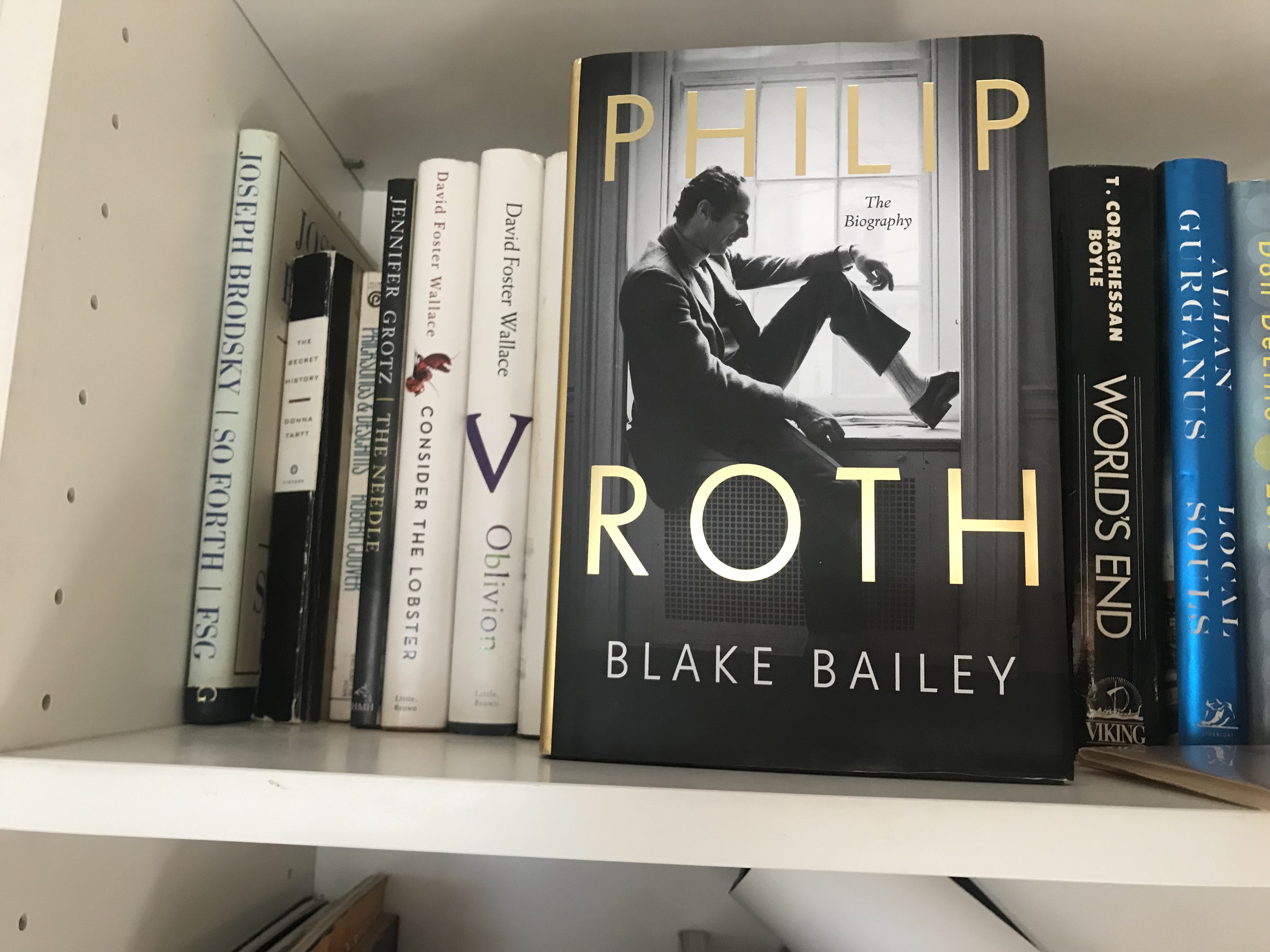
I’m currently reading Blake Bailey’s authorized biography of Philip Roth, a work removed from the shelves of America’s bookstores (not to mention from Amazon warehouses) after its publisher WW Norton suspended shipping and promotion as a consequence of several women accusing Bailey of sexual misconduct, including assault, which he adamantly denies. An independent publisher called Skyhorse has acquired the rights and issued a paperback edition, so the book is still available, though in a less glamorous format.[1]

Before tackling the biography (wrapping it in my arms and driving it to gridiron), I revisited Portnoy’s Complaint, one of the funniest books I’ve ever read, and though it came out in 1969, the prose is as fresh as this morning’s oven-extracted loaf of Jewish rye, except that Portnoy uses the c-word as both an anatomical descriptor and as a synecdoche for womankind in general.[2] Of course, Portnoy’s a madman, so we shouldn’t hold Roth personally responsible for his creation’s misogynistic language, any more than we should lambaste Nabokov for Humbert’s pederasty, except that throughout the biography, Roth himself uses the c-word in the same manner, anatomically and collectively.[3] This unfortunate habit tends to conflate the biographer with his subject.

Indeed, it seems that like Portnoy and perhaps Blake Bailey, Roth was sex obsessed. When interviewing Bailey for the job of authorized biographer, he produced a photo album devoted to his ex-girlfriends, which reminded me of the scene in Carnal Knowledge when the Jack Nicholson character projects a slideshow of photos of his sexual conquests. On the other hand, Bailey writes that the album was “an artifact attesting to the only passion that ever rivaled his writing. He doted on these women and vice versa; several of them came to his bedside while he lay dying, as did I.” 

In her review of Philip Roth the Biography, entitled “In ‘Philip Roth,’ a Life of the Literary Master as Aggrieved Playboy,” Parul Sehgal writes that Bailey’s book is “a narrow portrait of a wide life. We know the ’60s have arrived because we are told that Roth is now regularly propositioning women in the elevator. When he travels to Thailand, Bailey speculates: ‘Perhaps he was most struck by the ubiquitous availability of sex.”’

Also, there is the conundrum of Roth’s relationship with Judaism. Again, Sehgal, “Whether he was pilloried as the Jewish second coming of Goebbels (‘What is being done to silence this man?’ the president of the Rabbinical Council of America wrote to the Anti-Defamation League) or a woman hater, he held to the notion of novelist as the ‘nose in the seam of the undergarment,’ the enemy of public relations. And now, he who found liberation in sex and work reported being rid of the tyranny of both.”

Ultimately, though, it’s the Roth’s literary output that I’m eager to see analyzed. I mean, his body of work inspires awe: American PastoralThe Human StainThe Plot Against AmericaThe Ghost Writer, etc. To me, his not being chosen for a Noble Prize borders on criminality. So what if Roth was arrogant, self-obsessed, vengeful, it’s the work that matters. Look at Yeats, Eliot, Hemingway, Faulkner, Philip Larkin – they all possessed more than their share of human frailties. I’m only 100 pages in Bailey’s bio but haven’t seen much critical contemplation of Roth’s fiction. It reminds me of David Lipsky’s Although of Course You End Up Being Yourself, an assessment of David Foster Wallace that essentially ignores his work. What makes Roth and Wallace interesting is their art, not their foibles. 

The bad news for Roth is that Blake Bailey’s own sexual misconduct may have tainted the biography, to have, in the words of Alexandra Alter and Jennifer Schuessler, “intensified a parallel conversation about Roth’s treatment of women, adding fuel to the questions of whether Bailey’s account of Roth’s sexual and romantic relationships was overly sympathetic and oversimplified” despite Roth’s attempt to, as one critic put it, through Bailey “ghost write his own biography.” 

The best laid schemes of mice and men.

Roth in 2010, photo by Nancy Crampton

[1] I actually possess the hardback edition, which I copped from independent bookseller Buxton Books right after Norton yanked it out of print. I’m hoping that one day it will be considered a rare first edition and I’ll be able to swap it for a bottle of Pappy Van Winkle.  (BTW, I’m weary of Microsoft Word EB-White-ing out every goddamned adverb I carefully insert in my sonorous sentences). They want me to ax “actually” which I actually don’t want to do.

[2] “Synecdoche is a literary trope in which a part stands for the whole, as in “I should have been a pair of ragged claws/Scuttling across the floors of silent seas,” or more familiarly, “Donald Trump is an asshole.” 

[3] The late James Hillman made a cogent observation about the ugliness and violence of English vernacular terms dealing with sex, e.g., “nailed her,” “fucked her eyes out,” “gash,” etc. as opposed to Hindi’s “jade stalk” for penis and “pearled temple” for vagina, suggesting, of course, very different attitudes toward sex, one diseased, the other reverential.

Rockin’ in the Projects

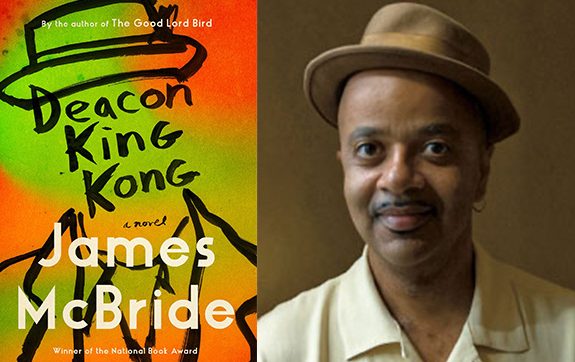
After finishing James McBride’s Deacon King Kong, I’m rechristening the author Zora Neale Samuel Clemens Brer Fox McBride.[1] Not OMG! But Do Lawd! What a blast – jazz riffing Gullah-lite, not indiscriminately slung but fashioned into a plot that, though somewhat improbable in its tidy tying up at the end, delineates a complicated saga populated by characters we care enough about to shed tears. 

Even if the story hadn’t moved me, I would have kept reading for the sheer pleasure of its sentences.

Here are three:

“She was coming off her once-a-year sin jamboree, an all-night, two-fisted- booze-guzzling, swig-faced affair of delicious tongue-in-groove-licking and love-smacking with her sometimes boyfriend, Hot Sausage, until Sausage withdrew from the festivities for lack of endurance.” 

“After practice on lazy summer afternoons, he’d gather the kids around and tell stories about baseball players long dead, players from the old Negro leagues with names that sounded like brands of candy: Cool Papa Bell, Golly Honey Gibson, Smooth Rube Foster, Bullet Rogan, guys who knocked the ball five hundred feet high into the hot August air at some ballpark far away down south someplace, the stories soaring high over their heads, over the harbor, over their dirty baseball field, past the rude, red-hot projects where they lived.”

And then this masterpiece:

“And there they stayed, a sole phenomenon in the Republic of Brooklyn, where cats hollered like people, dogs ate their own feces, aunties chain-smoked and died at 102, a kid named Spike Lee saw God, the ghosts of the departed Dodgers soaked up all possibility of new hope, and penniless desperation ruled the lives of suckers too black or too poor to leave, while in Manhattan the buses ran on time, the lights never went out, the death of a single white child in a traffic accident was a page one story, while phony versions of black and Latino life ruled the Broadway roost, making white writers rich – West Side StoryPorgy & BessPurlie Victorious – and on it went, the whole business of the white man’s reality lumping together like a giant, lopsided snowball, the Great American Myth, the Big Apple, the Big Kahuna, the City That Never Sleeps, while blacks and Latinos who cleaned apartments and dragged out the trash and made the music and filled the jails with sorrow slept the sleep of the invisible and functioned as local color.”[2]

Ultimately, Deacon King Kong is a comic novel, which provides McBride some leeway when it comes to implausibility. Moreover, it takes place among a community of believers, which is a prerequisite for magic realism. Some of the best dialogue comes from the protagonist Deacon Cuffy Jasper Lambkin[3] (aka Sportscoat) and the ghost of his wife Hettie, who naggingly haunts him throughout the novel, despite her having drowned two years before the action begins.

“Well, Hettie, if I weren’t taking that white man’s good hundred dollars on principle, I surely ain’t gonna take no mess from you ‘bout some fourteen dollars and nine pennies you done squirreled up in Christmas Club money and hid someplace.”

You’re not going to find ghosts or a systematic invasion of ants in The Stranger.

***

I suppose some plot summary is in order. Deacon King Kong is set in 1969 in Causeway Housing Projects in South Brooklyn with the majority of the characters members of the Five Ends Baptist Church. Sportscoat, drunk as a coot on a potent moonshine known as King Kong, stumbles into the project courtyard and shoots Deems Clemens[4] with an antiquated .38 pistol. Back in the day, Sportscoat taught Deems Sunday School and coached him in baseball.  Deems had been a bone fide big league prospect before he abandoned that escape route for the easy money of drug trafficking. Smart, strategic, Deems is a force to be reckoned with, compassionate despite the heroin trafficking and its at its attendant horrors.

Damn, this summarizing is way too hard. I’m gonna cop out and quote the back cover.

“McBride brings to vivid life the people affected by the shooting: the victim, the African American and Latinx residents who witnessed it, the local cops assigned to investigate, the members of Five Ends Baptist Church where Sportscoat was deacon, the neighborhood’s Italian mobsters, and Sportscoat himself.”

Ultimately, it’s a novel of redemption, a glorious amalgam of love and violence, greed and generosity, teeming with vibrant characters who do justice to the human race. It’s easily the most enjoyable piece of long fiction I’ve read since Infinite Jest, which means it’s most enjoyable novel I’ve read in a quarter of a century, the most enjoyable novel I’ve read this century.

Do yourself a favor and go check it out.


[1] Kudos to former student Rachel Lauren Wolf for turning me on to this gem she described as “a cross between Flannery O’Connor and Gabriel Garcia Marquez.”

[2] As my wife Caroline is wont to say, “Bartender, I’ll have what he’s having.”

[3] Note the name symbolism. BTW, virtually all of the characters have nicknames.

[4] Ditto above.

Warren Moise’s “The Class of ’71”

My college roommate and later housemate Warren Moise has written an extraordinary account of the desegregation of Sumter High School in 1971. He’s given me permission to post here the congratulatory letter I sent him this morning upon finishing the book.

You can purchase it here.

Dear Warren,

Wow, man. I knew that The Class of ’71 was going to be good, but I had no idea that by the end of the book I would consider it a brilliant tour de force.[1]

The weaving of personal anecdote with impeccably researched history produces a well-paced narrative. What we have here is not only a history of desegregation in Sumter, but also a mini history of the town itself, including a vivid snapshot of the transitional year of ’71. I mean, man, your compression of historical background is beyond remarkable, whether you’re cataloguing with precision the horrors of Abe Stern’s family’s journey from ghetto to concentration camps or the series of civil law cases that ultimately led to desegregation.  I loved the mini biographies of historical figures as well. Moreover, you do a masterful job of blending second-sourced details of the segregation with your personal memories of those distant days. You compress a helluva lot in 162 pages. 

Furthermore, your account is admirably nuanced. I suspect that most younger folks don’t realize that many Blacks resented integration, hated the idea of losing their traditions, their autonomy.[2] I admire that you don’t whitewash (regrettable verb choice) such paragons as Thurgood Marshall or Judge Waring, but even as you criticize their foibles, you also laud their attributes. In short, The Class of ’71 is fair and well-balanced, non-polemical historical take on a situation fraught with internecine emotion. 

Your personal anecdotes humanize events, bring to life that we’re talking about human beings here, not abstractions, and you balance well, I think, stories of both Whites and Blacks.  Your friends and peers are brought to life with brisk physical descriptions and dramatizations. Whether you’re talking about athletics, your band, or adolescent love, your humility is ever-present. In addition, the personal reminiscences provide respite from the heavier portions. 

I’ll end this paean with a note on style. I’m by training a critical reader when it comes to diction, syntax, and fluidity. I think I can count on one hand stylistic changes I would have made. I mean what’s not to like about sentences like these: “It was as if the 1960s were burning rubber in a Chevelle V-8 Super Sport on Highway 15 leaving town toward Paxville. At the same moment, the 1970s were rollin’ into town on Highway 15 North inside a Volkswagen van painted with slogans of peace, love, and daises.”

Bravo, my friend![3] It’s truly an honor to know and to have known you, and I hope the book gets the attention it deserves. 

Let’s get together one of these days.

All the best,

Rusty

__________________________________________________________________________________________

[1] Pardon the redundancy.

[2] Gamecock High, by the way, was much more liberal than Summerville High, where we kept both our mascot and school colors

[3 And thanks for dropping my name on page 148.

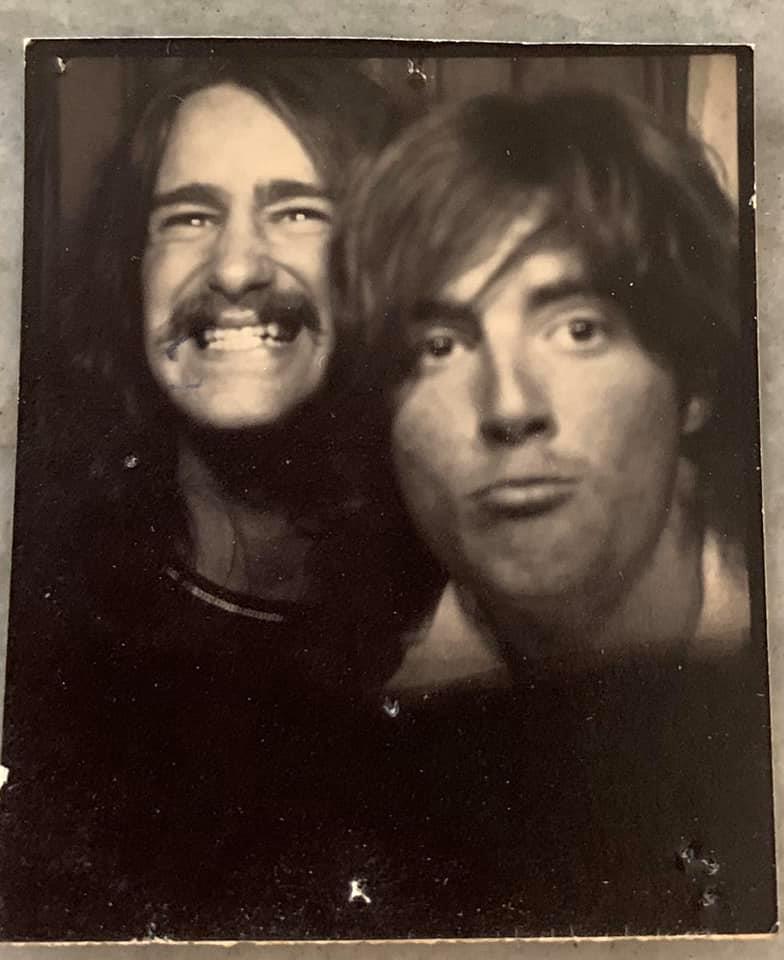
Warren and yours truly circa 1972

Booze Hounds Extraordinaire

Willie and Ernesto

Although sometimes mocked, often parodied, Ernest Hemingway’s prose is clean and compact. 

Here is prepubescent Nick Adams, who has just witnessed a Caesarian operation and a simultaneous suicide, headed back to camp after an emergency call with his physician father.

They were seated in the boat, Nick in the stern, his father rowing. The sun was coming up over the hills. A bass jumped, making a circle in the water. Nick trailed his hand in the water. It felt warm in the sharp chill of the morning. 

In the early morning on the lake sitting in the stern of the boat with his father rowing, he felt quite sure that he would never die. 

Prolife: sunrise, a bass jumping, warm water.

Here’s Nick a decade or so later after a stint in the trenches:

The coffee was bitter. Nick laughed. It made a good ending to the story. His mind was starting to work. He knew he could choke it because he was tired enough. He spilled the coffee out of the pot and shook the grounds loose into the fire. He lit a cigarette and went inside the tent. He took off his shoes and trousers, sitting on the blankets, rolled the shoes up inside the trousers for a pillow and got in between the blankets.

Nick’s practicing the art of un-seeing, concentrating on simple actions to shut down synapses so they won’t flash like artillery fire in the darkness of the night. Eight mechanical declarative sentences without introductory clauses or phrases to describe a series of mechanical, mundane actions. Mindfulness to choke off memories.

I wonder how Nick would get along with Quentin Compson, one of William Faulkner’s offspring?

Here’s Quentin in Absalom, Absalom ruminating about the legend of Thomas Stupen’s arrival in Yoknapatawpha:

Out of quiet thunderclap he would abrupt (man-horse-demon) upon a scene peaceful and decorous as a schoolprize water color, faint sulphur-reek still in hair clothes and beard, with grouped behind him his band of wild [racial epithets] ]like beasts half tamed to walk upright like men, in attitudes wild and reposed, and manacled among them the French architect with his air grim, haggard, and tatter-ran. Immobile, bearded, and hand palm-uplifted the horseman sat; behind him the wild blacks and the captive architect huddled quietly, carrying in bloodless paradox the shovels and picks and axes of peaceful conquest. Then in the long unamaze Quentin seemed to watch them overrun suddenly the hundred square miles of tranquil and astonished earth and drag house and formal gardens violently out of the soundless Nothing and clap them down like cards upon a table beneath the up-palm immobile and pontific, creating Sutpen’s Hundred, the Be Sutpen’s Hundred like the oldentime Be Light.

Like Faulkner’s prose, Quentin is overwrought.

Although we don’t know what eventually happens to Nick Adams in his later life, we do know where Quentin’s going to end up, self-drowned in the Charles River. And, of course, we do know what happens to Nick’s alter ego, Ernesto himself, dispatched in Idaho by a self-inflicted shotgun blast.[1]

We in the West insist on judging. Who is the greater author, Hemingway or Faulkner? I would say Hemingway is the better writer; I find his crisp cinematic prose superior to Faulkner’s adjective-laden forays into over-description. They’re working at cross purposes, though; Hemingway wants you peel back the prose that leaves so much unsaid to explore what’s underneath while Faulkner wants you to see and feel the rush of reality as it sweeps past in torrents. 

That said, I believe that Matthew Arnold would agree that Faulkner is the greater author. After all, he created an intricately linked multigenerational population of men and women, flesh and blood, White, Black, and Red, who embody two centuries of history. That’s not to say Hemingway isn’t great. In fact, I can’t think of a more powerful, better crafted story than his “A Clean Well-Lighted Place” – if you want to judge by one piece rather than a body of work.

I happen to admire both immensely and applaud their tragic visions, admire their courage in exploring godless darkness, empathize with their need to self-medicate. 

For me, Hemingway is rum, Faulkner whiskey. It’s Hemingway in the summer, and Faulkner in the winter for me.

Bless their moldering corpses, I say. And yours, too, Mr. James Joyce, another booze hound extraordinaire. 


[1] Faulkner, on the other hand, drank on and on until his 64th year.

Boon Companions on the Road to Stoicism

John Austen

Over my long reading career, I have come to esteem several fictional literary characters and consider them, if not friends, boon companions, individuals whose company I continue to enjoy. I’m talking about people[1] like Mark Twain’s Huck Finn, Jane Austen’s Elizabeth Bennet, Joseph Conrad’s Charlie Marlow, and Richard Ford’s Frank Bascomb.  

When you come to revere such characters, finishing a novel or play becomes somewhat bittersweet because you really hate to see them hit the road. 

My favorite, given his high intelligence and depth of feeling, is Hamlet the Dane. I wouldn’t go so far as Harold Bloom and claim that Shakespeare via Falstaff and Hamlet “invented the human” by setting in motion “the spark of human consciousness.” However, to me Hamlet is as real a person as my barstool companions at Chico Feo or my Great Aunt Lou, a formidable woman, but one not nearly as self-aware as the black clad prince. 

Come to think of it, Aunt Lou is dead except in the minds of a diminishing number of Social Security recipients, whereas Hamlet has been alive now for over 400 years. The bottom line is that I feel great affection for him, and in an excellent stage performance, his death can still bring me to tears, and I don’t cry easily.

Of course, not everyone likes Hamlet as a person, which makes sense given that he is multifaceted and possesses an abundance of flaws.

Here’s the critic, director, and playwright Charles Marowitz:

I despise Hamlet. He is a slob. A talker, an analyzer, a rationalizer. Like the parlor liberal or paralyzed intellectual, he can describe every facet of a problem, yet never pull his finger out. Is Hamlet a coward, as he himself suggests, or simply a poseur, a frustrated actor who plays the scholar, the courtier, and the soldier as an actor (a very bad actor) assumes a variety of roles to which he is not naturally suited? And why does he keep saying everything twice? And how can someone talk so pretty in such a rotten country given the sort of work he’s got cut out for himself? You may think he’s a sensitive, well-spoken, and erudite fellow, but, frankly, he gives me a pain in the ass.

“Sensitive, well-spoken, and erudite,” but also witty, Churchillian in his ability to instantaneously whip up a bon mot or devastating insult. For example, here’s Polonius confirming to Hamlet that he acted in the university.

LORD POLONIUS: 

I did enact Julius Caesar. I was killed i’ the

Capitol. Brutus killed me.

HAMLET:

It was a brute part of him to kill so capital a calf
there. Be the players ready?

Here he is in so many words calling his “uncle-father” a piece of shit:

King Claudius: 

Now, Hamlet, where’s Polonius?

HAMLET

At supper.

KING CLAUDIUS

At supper! where?

HAMLET

Not where he eats, but where he is eaten: a certain
convocation of politic worms are e’en at him. Your
worm is your only emperor for diet: we fat all
creatures else to fat us, and we fat ourselves for
maggots: your fat king and your lean beggar is but
variable service, two dishes, but to one table:
that’s the end.

KING CLAUDIUS

Alas, alas!

HAMLET

A man may fish with the worm that hath eat of a
king, and eat of the fish that hath fed of that worm.

KING CLAUDIUS

What dost you mean by this?

HAMLET

Nothing but to show you how a king may go a
progress through the guts of a beggar.

KING CLAUDIUS

Where is Polonius?

HAMLET

In heaven; send hither to see: if your messenger
find him not there, seek him i’ the other place
yourself. But indeed, if you find him not within
this month, you shall nose him as you go up the
stairs into the lobby.

KING CLAUDIUS

Go seek him there.

To some Attendants

HAMLET

He will stay till ye come.

“He will stay till ye come” could have come out of the mouth of James Bond.

To harken back to Bloom, how’s this for a 21st Century diagnostic catalogue of symptoms of depression delivered in the early 17th Century:

HAMLET:

I have of late, —but wherefore I know not, —lost all my mirth, forgone all custom of exercises; and indeed it goes so heavily with my disposition that this goodly frame, the earth, seems to me a sterile promontory; this most excellent canopy, the air, look you, this brave o’erhanging firmament, this majestical roof fretted with golden fire, why, it appears no other thing to me but a foul and pestilent congregation of vapours. What a piece of work is a man! How noble in reason! how infinite in faculty! in form, in moving, how express and admirable! in action how like an angel! in apprehension how like a god! the beauty of the world! the paragon of animals! And yet, to me, what is this quintessence of dust? man delights not me; no, nor woman neither, though, by your smiling, you seem to say so.

I could go on and on, but the point is that multifaceted fictional characters and poetic personae can provide for us in times of trouble some solace. One of the great fortunes of my life was stumbling into a teaching job at Porter-Gaud School where by necessity I was forced to reread time and time again great works of literature that provided vicarious lessons in the wisdom of stoicism. As I have said elsewhere:

“What I discovered in Thebes and Elsinore and Yoknapatawpha is that suffering is universal. To quote Rick from Casablanca, “It doesn’t take much to see that the problems of three little people don’t amount to a hill of beans in this crazy world.”   In other words, suffering doesn’t make you special; it makes you human.”[2]


[1] Yes, I consider them people, people with complex inner worlds who change as they strut and fret through plot entanglements, finding at last (in most cases ) resolution, whether it be at their wedding or among the carnage of a corpse strewn stage. 

[2] “The Art of Grieving.”

Hell Hath No Fury Like YA Authors Scorned

mourning bride

image by Violet D’Art via Flicker

As I was destroying my eyesight Wednesday simultaneously watching the Impeachment Hearing /Twitter feeds on the screen of my desktop computer, I ran across a linked tweet concerning a literary brouhaha originating at South Dakota’s Northern State University. A recent graduate named Brooke Nelson has provoked outrage from several Young Adult novelists for suggesting that a novel by best-selling YA author Sarah Dessen was too simplistic to qualify as mandatory reading.  As a junior, Ms Nelson had served on a committee to select a book all incoming freshman at Northern State University would be required to read. Several members on the committee, according to the Washington Post, “were pushing for a young adult novel by best-selling author Sarah Dessen.”

A quote in the local paper, the Aberdeen, ignited the ensuing furor: “[Dessen]’s fine for teen girls,” Brooke Nelson said, “ but definitely not up to the level of Common Read. So I became involved simply so I could stop them from ever choosing Sarah Dessen.”

Somehow Dessen caught wind of this slight diss.[1] Directly addressing Nelson by name, Dessen tweeted the following to her legion of followers:

Authors are real people. We put our heart and soul into the stories we write often because it is literally [my emphasis] how we survive in this world. I’m having a really hard time right now and this is just mean and cruel. I hope it made you feel good.

Let’s just say Nessen’s fans were not happy, including published YA authors Jodi Picoult and Roxane Gay.  Jennifer Weiner accused Nelson of being misogynistic:

“It’s hard to know what’s sadder: that Brooke Nelson has internalized misogyny to the extent that she can see nothing of worth in books beloved by “teen girls” but is presumably impressed with the merits of a book centered around video game culture that is beloved by teenage boys; that Nelson joined the committee not to champion a book or a genre but to keep a specific author’s work out of contention; that she bragged about her actions, as if she’s done some great service to literature, or that Nelson graduated with an English degree, is pursuing graduate work in English, and will someday be foisting her sexism and elitism on the next generation of readers.”

However, this comment ignores the question of whether the work possesses the complexity that required reading should possess. Are Nessen’s novels more profound than The Hand Maid’s Tale?  Are today’s in-coming freshman incapable of reading adult literature?  I was the English Department Chair of an independent school for six years and a teacher there for thirty-four, and I can assure you we never had a YA novel on our required summer reading list for the Upper School.

Here’s last year’s list, the last year I taught there:

9th grade  On the Beach by Neville Shute

10th grade: 1984 by George Orwell

11th grade: The Adventures of Huckleberry Finn by Mark Twain

12th grade The Hand Maid’s Tale by Margaret Atwood

AP Language and Composition: The Grapes of Wrath by John Steinbeck

AP Literature and Composition: Crime and Punishment by Fyodor Dostoyevsky

The majority of complaints from the YA authors cited in the Post story ignore the quality issue and focus on how Nelson’s quote marginalizes teenaged girls.  Here’s Jodi Picoult: “[Nelson’s quote] suggests stories about young women matter less. That they are not as worthy or literary as those about anything but young women. That their concerns and hopes and fears are secondary or frivolous.”

But Nelson didn’t say that novels about teenaged girls “matter less.”  She said that Nessen’s novels essentially didn’t “cut the mustard,” as we Boomers used to say.  I suspect that Nelson wouldn’t have any qualms with Sylvia Plath’s The Bell Jar or Josephine Humphrey’s Rich in Love being required reading.

Well, Nessen should be gratified because Nelson has found it necessary to suspend her social media accounts because of a barrage of incoming hatred.  And Northern State University has publicly apologized to Nessen.

It brings to mind Dylan’s line “at pettiness that plays so rough.”


[1] I consider it a “slight diss” because I believe that it’s not terribly insulting to suggest one’s work doesn’t rise to the level of mandatory reading for all incoming freshmen of a college.  In fact, although it’s considered a classic, I don’t think To Kill a Mockingbird rises to that level because of its black and white (no pun intended) portrayal of good and evil.  What I would consider a genuine diss is Carrie Courogen’s summation of Dessen’s work as “formulaic patronizing garbage of the lowest hanging fruit variety and deserves every criticism leveraged against her.” Courogen added in a subtweet “sarah dessen books are nicholas sparks but by a woman and even dumber and slightly less christian.”  I haven’t read any of Dessen’s books, so all I’ll say is that I can’t imagine they possess the ambiguity, complexity, and depth that would elevate them into the realm of serious art.

The Widow of Ephesus Conquers Her Eating Disorder

The Widow of Ephesus by Philip Banken


Bid her awake; for Hymen is awake,

And long since ready forth his maske to move . . .

Edmund Spenser, “Epithalamion


It was Federico Fellini who first turned me on to Petronius the Arbiter, the Oscar Wilde of Nero’s reign, a witty hedonist famed for his exquisite taste.   In fact, Petronius’s official function in Nero’s court was to determine what was tasteful (or not), hence his title arbiter elegantiarum, judge of elegance.

Scholars don’t know much about him.  Here’s a snippet from Tacitus’s Annals copped from Wikipedia:

He spent his days in sleep, his nights in attending to his official duties or in amusement, that by his dissolute life he had become as famous as other men by a life of energy, and that he was regarded as no ordinary profligate, but as an accomplished voluptuary. His reckless freedom of speech, being regarded as frankness, procured him popularity. Yet during his provincial government, and later when he held the office of consul, he had shown vigor and capacity for affairs. Afterwards returning to his life of vicious indulgence, he became one of the chosen circle of Nero’s intimates, and was looked upon as an absolute authority on questions of taste in connection with the science of luxurious living.

Unfortunately, however, like so many in Nero’s circle, Petronius was tried and convicted of treason.  Rather than waiting for the inevitable sentence, the Arbiter took matters into his own hands.

Again, Tacitus:

Yet he did not fling away life with precipitate haste, but having made an incision in his veins and then, according to his humour, bound them up, he again opened them, while he conversed with his friends, not in a serious strain or on topics that might win for him the glory of courage. And he listened to them as they repeated, not thoughts on the immortality of the soul or on the theories of philosophers, but light poetry and playful verses. To some of his slaves he gave liberal presents, a flogging to others. He dined, indulged himself in sleep, that death, though forced on him, might have a natural appearance. Even in his will he did not, as did many in their last moments, flatter Nero or Tigellinus or any other of the men in power. On the contrary, he described fully the prince’s shameful excesses, with the names of his male and female companions and their novelties in debauchery, and sent the account under seal to Nero. Then he broke his signet-ring, that it might not be subsequently available for imperiling others.

At any rate, none of this would be of any interest if Petronius had not written the Satyricon, a fragmentary mishmash of verse and prose that satirizes Roman life in the first century BC.  I actually wrote a paper on this picaresque “novel” in the spring semester of my senior year, but alas, like many sections of the Satyricon itself, that work of genius has been lost to the ages [cue sarcastic cough].

Click below, if you dare, to watch the trailer of Fellini’s Satyricon.


Although “Trimalchio’s Dinner” is the most famous section of the Satyricon (Fitzgerald at one point thought about entitling The Great Gatsby as Trimalchio in West Egg), my favorite section is the vignette “The Widow of Ephesus,” an oft-repeated tale that traditionally has been interpreted as an invective against the fickleness of women; however, in Petronius’s version, sophisticated readers might see it, to quote Douglas Galbi, as showing “the imperatives of the living trumping respect for the dead.”

In other words, reading it as “pro life” in the best sense of that phrase,

Amphetaminic Synopsis of  Petronius’s “The Widow of Ephesus”[1]

A widow renowned for her chastity goes apeshit after her husband dies, and with over-the-top historonics  (exposing her breast and beating it, e.g), she follows his corpse’s funeral parade into an underground crypt.

There, attended by a “most loyal slave-woman,” the widow keens, gouges her face, and yanks out her tresses with the intention to starve herself so she can join her husband in Oblivionville.

Impervious to the pleadings of her parents and her loyal slave, for five days, without food or drink, the widow continues her frenzied mourning, out-Niobe-ing  Niobe,  “tearing her hair, plac[ing] the tresses on the corpse of her dead husband.”

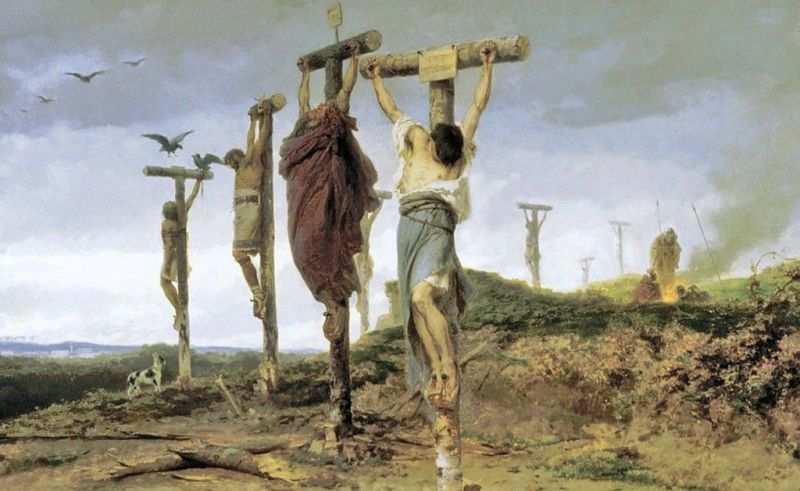
Meanwhile, a soldier stationed to guard two crucified robbers hears the widow and abandons his post to see what’s going on.[2]  Once he’s hip to the scoop, he returns with food, which she refuses, but the slave woman “seduced by the odor of wine,” indulges, and once renourished, starts in on her mistress.

”What good will this do you, if you will have been undone by starvation? — if you will have buried yourself alive? — if you will have poured forth your life’s breath when you have not yet been condemned to die, before the fates demand it?”

As Margaret Atwood once noted, “Hunger is a powerful reorganizer of the conscience,” and the widow gives in. Once she’s sated, the soldier starts cajoling her to ditch her chastity.  Though we don’t get to hear his love talk, it must have been Barry-White-like and coming from the mouth of one sexy [insert noun from two-word Prince title that begins with “Sexy.”]

Click arrow below for an example of what I mean by “Barry-White-like”:


She submits.

So they as my mother would put it, “shack up” in the sepulcher, he sneaking out now and then to procure food and presents.

During his frequent absences from his station, a relative snatches one of the crucified men and buries him. When the soldier notices the missing body, he knows he’s a goner, so he decides to dispatch himself before the judge’s sentence comes crashing down.[3]

He informs the widow and asks “her only allot him a place, since he was doomed to die, and make the fatal tomb common to both her friend and her husband. “

Here’s the key passage:

The woman, who was no less merciful than chaste, [my italics] said, ”May the gods not allow that — that I should at the same time look upon the deaths of the two men most dear to me. I prefer to sacrifice the dead man rather than to kill the one who is alive.” In accordance with this pronouncement, she orders the corpse of her husband to be lifted out of its coffin and affixed to that cross which was empty. The soldier made use of the ingenious scheme of that most judicious woman, and the next day all the townspeople marveled at how the dead man had gone onto the cross.”

Oil paining of crucified slaves in ancient Rome

As Horace Walpole famously said, “Life is a tragedy for those who feel, but a comedy for those who think.”  One equipped with a tragic vision might turn this story into a heartbreaker, the widow refusing to the very end, her gaunt body wild-eyed as she hallucinates tender scenes from her married life.  However, there’s something deep down in every living thing that prompts it to live.  Even if buried beneath the cement of a sidewalk, a weed will attempt to push its way through the cracks towards the sun.

There lives the dearest freshness deep down things;
And though the last lights off the black West went
Oh, morning, at the brown brink eastward, springs —

Gerard Manly Hopkins, excerpt from “God’s Grandeur”


[1]Quotes are from John R. Porter’s translation.

[2]He’s guarding them so their relatives won’t remove the bodies to give them proper burial. Some scholars claim this alludes to Jesus’s crucifixion story, but if it does, then it doesn’t jive with Petronius’s dates.

[3]Note how eerily similar this is to Petronius’s eventual fate.