Deaf Heaven, Bootless Cries, Sha La La La La Live for Today

Like the recurring characters in Cheers, I show up most afternoons at what the quaint call “a local watering hole.”  Chico Feo, my bar of choice, is one part Cannery Row, one part Key West tourist mecca, one part – as far as the cooks and bartenders go – extended family.  

I enjoy watching people interact, hearing the latest gossip, and, if the opportunity arises, engaging tourists with meaningful conversations. After all, I suspect my obituary will mention that among other things I was a fiction writer, and as I often inform total strangers, I’m constantly gathering “data” about this and that, which I might use in creating a character. It’s a way to justify my personal questions about their lives.  To me, constructing characters that readers care about is the most gratifying aspect of fiction-writing.

Unfortunately, today I happened to sit next to a borderline asshole. He was in his late 20s sporting muscles, tattoos, and the ubiquitous baseball cap worn backyards.  On the plus side, he might end up in one of my stories and receive the karmic comeuppance he deserves. 

Solle, perhaps the most effective bartender I’ve encountered in a drinking career that spans over a half a century, asked me how my book promo TV interview went, and the aforementioned borderline asshole said, “I saw it!”

I informed the borderline asshole that his having seen it was impossible in the current space/time continuum because the interview hadn’t aired yet.  Then he said, “I saw you at the studio.”  It occurred to me that he might be a camera person, so I asked him if he worked for FOX 24, and he said, laughing, “No, I’m just fucking with you.”

I was not amused.

He and his friend started talking about how great it must be to live on Folly, and I agreed it was, that I was very fortunate.  They live in West Ashley, and I said that was a convenient place to live because it’s near everything – the airport, downtown Charleston, Folly itself.

A few minutes later, the borderline asshole asked me what the book was about, so I clicked off some sound bites from the interview.  “It’s a memoir,” I said, “but it’s as much about the South as it is about me – antebellum plantations, shotgun shacks, Pentecostal churches, juke joints.  It’s a collection of short stories, essays, and poems, each of which can stand alone and be enjoyed separately, but if you read it cover to cover you get a history of the South from segregation through the civil rights movement and the cultural revolution of the 60s.”

“Wow, you must be a racist,” he said.

“What!!!??? Why do you say that?”

“If you’re not a racist, then why aren’t you?”

“Why not, because I grew up with Black people. I like most of them I’ve met.”

“I’m a racist,” he said.

No doubt I was scowling, because he immediately said, “Ha, ha, I’m not really a racist. I’m just fucking with you.”

Dark clouds were scudding overhead, so I decided it was time to walk home, which takes me past a melancholy memorial marking the spot where someone named Phillip died in a traffic accident.  For some reason – maybe because before I left the bartender Katarina clasped her hands in mock prayer asking the skies not to rain – my inner poetic jukebox cued a line from one of Shakespeare’s sonnets: “And trouble deaf heaven with my bootless cries” and then a line from A Midsummer’s Night’s Dream followed: “Chanting faint hymns to a cold fruitless moon.” And finally, a line from a Grass Roots song that I don’t even like: “Sha la la la la la live for today.”

I took a right on Erie, and as coincidence would have it, I encountered an interracial couple pushing a baby stroller. They were taking up the entire right hand lane, so I suggested they walk on the left so they could see the traffic coming.  The red-haired woman and her husband smiled. She said, “Thanks, but we’re staying right here” and disappeared into the yard of a rental.

So much for my mansplaining.

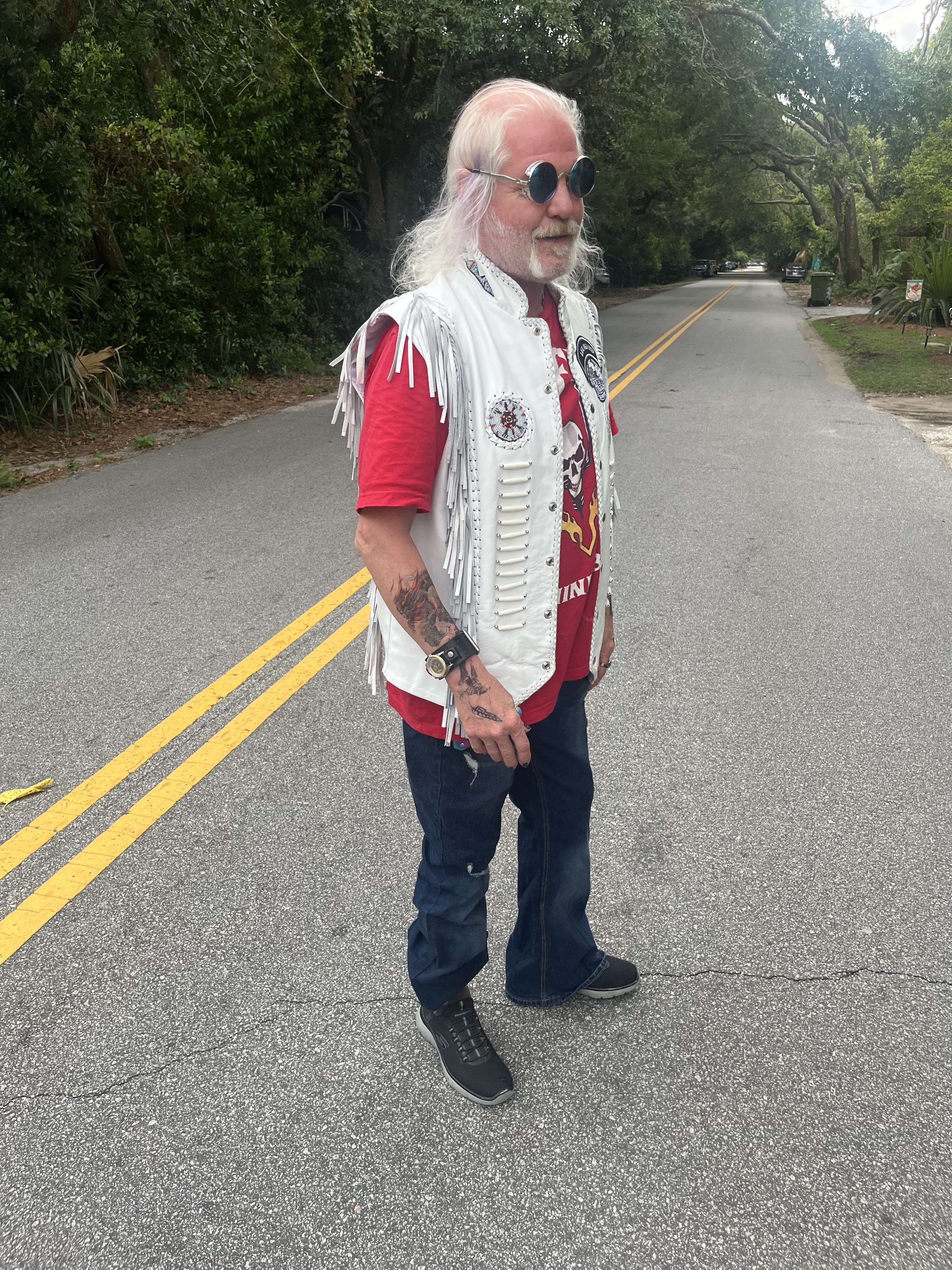
I decided to cross over to Hudson using a tree embowered beach access path and spotted through the tree tunnel a couple weaving past on skateboards.  Once I hit 5th Street, I bumped into my neighbor Lance.  I asked him about his outfit, a white fringed patch-bedecked vest over a red tee shirt emblazoned with a skull, and he explained the various patches and emblems.

As I said good-bye, he said, “I love you, man,” which was a nice way to end my excursion.  

Fa la la la la, live for today.
Random Thoughts from a Dry Brain in a Dry Season

Random Thoughts from a Dry Brain in a Dry Season

“Vacant shuttles/Weave the wind.”  – TS Eliot, “Gerontion”

One of the many positive aspects of retirement is that I am no longer bound by industrialization’s time clock. If I awaken at three a.m.– what Gerard Manley Hopkins called “the fell of dark, not day” – instead of trying to grunt myself back to sleep, I tiptoe out of the bedroom, fire up the ol’ iMac and play Spelling Bee, a word game on the NYT crossword page. To attain the designation of “Genius” takes me anywhere from five to forty minutes. Generally, I fall asleep again around four or so and reawaken around six. I sometimes take two naps a day, one in the morning and one in the afternoon.

A man of leisure at last.

In my previous life as an English teacher, I would spend those awakened hours brooding about my working life and/or what TS Eliot called “the immense panorama of futility and anarchy that is contemporary history.”

By the way, that most quotable of quotes comes from Eliot’s essay “Ulysses, Order, and Myth.” Here’s another far less quotable snippet from that same essay: “Mr. Aldington treated Mr. Joyce as a prophet of chaos; and wailed at the flood of Dadaism which his prescient eye saw bursting forth at the tap of the magician’s rod.”

You win some; you lose some.

Speaking of losing, I just received this very minute this message via What’s App:

Hi, I’m Ivana. Nice to meet you.

I am looking for the other half of my life, someone who can accompany me throughout my life.

I am 36 years old and single. I like polite men. If you are very similar to me, please leave me a WhatsApp message now. I believe we can be each other’s life partners.

We can share each other’s lives and understand each other better.

WTF, as the young people say. 

Then last Friday, at Chico Feo, Harlan, the bartender, told me that a young woman, an investigative reporter, wanted to interview me. I said, “Uh, okay,” so she, an attractive, twenty-something, sat on the stool next to me and asked if I were a writer. I had assumed she had known that, so I said yes, and she asked what I had written, so I told her about Today, Oh Boy,” a novel set in Summerville, South Carolina, which coincidentally is where she’s from. To cut to the chase, she’s doing an in depth investigation on the serial killer Richard Valenti, who murdered two teenaged girls on Folly Beach in 1973. I have a close friend who was also kidnapped by Valenti but who escaped along with two of her friends, which led to his arrest.

She asked if I minded being recorded, and I said no, so she pinned a mic on my lapel and started asking questions. She was impressively articulate, explained her interest in the case, and while we were talking, my wife Caroline arrived, so I invited her to join the conversation because Caroline is much smarter than I am. The reporter is also friends with one of the teens who escaped and is hesitant to ask her about it because “she might not want to reopen that door,” as she put it. Caroline jumped in and talked about how the patriarchy deals with women who have been sexually assaulted.  By the way, this was two days after Trump’s 83 million dollar fine.

So anyway, I got 99 problems but worrying about grading essays ain’t one of them.

Getting Wasted in Margaritaville

photo courtesy of Savannah Morning News via Latitude Margaritaville

When it comes to dead-end hedonism, I’m not one to wag my trembling finger at those Boomers who have opted to spend the twilight of their lives playing pickle ball, riding from bar to bar on golfcarts, or listening to classic rock on what they wished might be a never-ending loop.[1] In other words, I’d be a hypocrite to diss the 55-plus crowd who have decided to purchase expanded dorm suites in the Jimmy Buffet-themed retirement community of Margaritaville.

After all, nearly every afternoon, I shuffle down to Chico Feo to bask in its Caribbean vibe and consume two or three session IPAs (on Monday open mic night maybe six or even seven).  I will say, however, that Chico provides much more diversity than Margaritaville (which you can read about in this New Yorker article).

For one thing, Chico offers a range of ages, from minors unsuccessfully trying to pass off fake IDs, to surfer dudes with their bronze tans, bleached hair, and intricate tattoos; to middle-aged Folly denizens; to tourists, who come in all ages, shapes, and sizes; and finally, to codgers like I-and-I with, if not one foot in the grave, a big toe testing the temperature of the down below.[2]

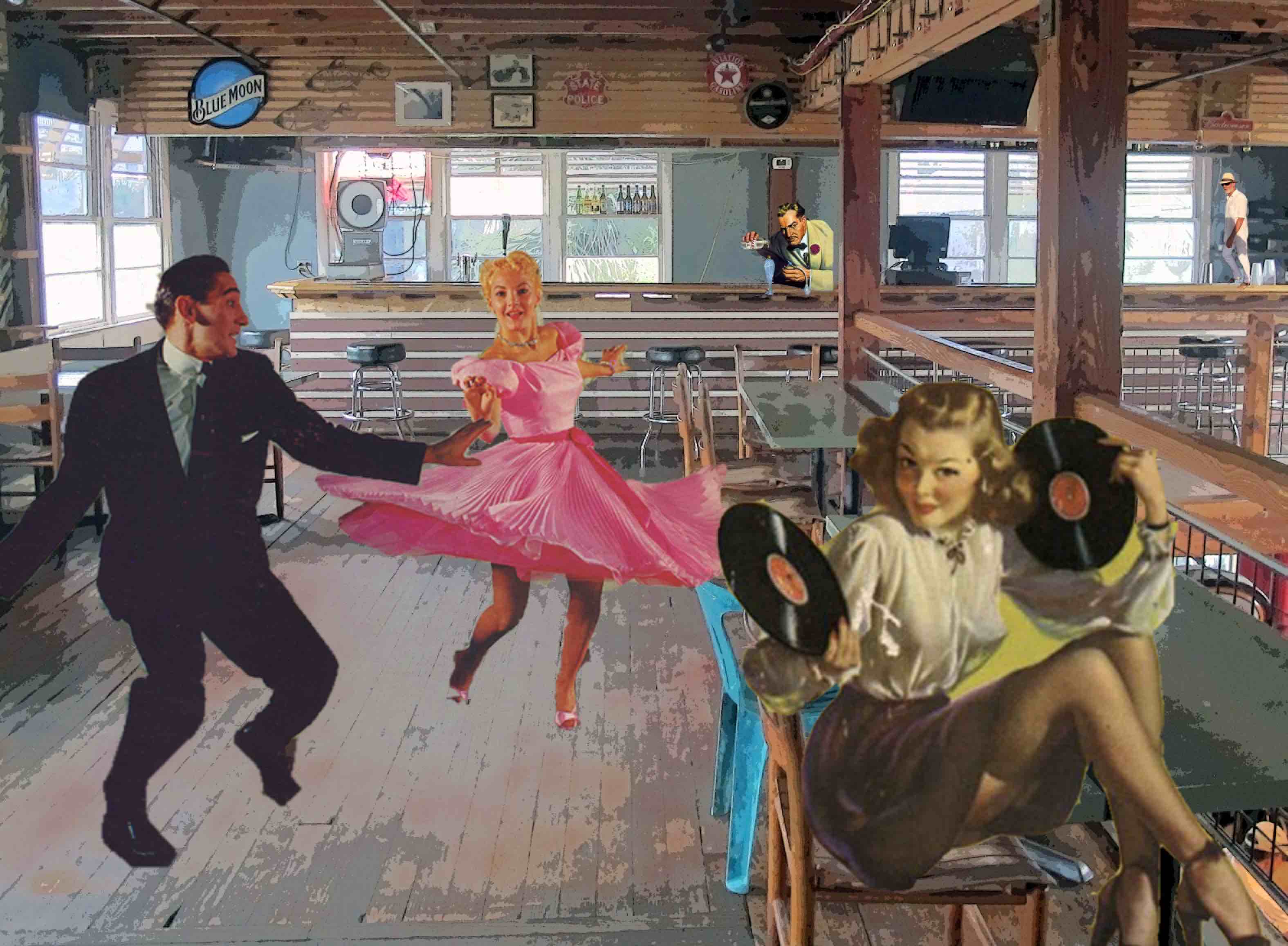
Chico Feo in the Morning, collage by Wesley Moore (for sale to a hip family)

Obviously, Margaritaville also lacks economic diversity, which Chico possesses in spades. Economic diversity, I might add, enriches those of us who hang with the day-to-day strugglers, which for many years I counted myself as one. Dishwashers and house painters don’t share their First World irritations but tend to embrace the swirling eddies of day-to-day existence where the future exists merely as tomorrow’s sunrise. 

Blind Willie McTell’s dishwasher never went on the fritz, which brings to mind that American musical culture comes to us from the bottom up, from Mississippi Delta shacks and hillbilly hovels, not from the gated communities where Bennington Rhodes is unsuccessfully attempting to tune his brand-new Stratocaster. 

Of course, Margaritaville has its share of house cleaners and maintenance workers, but they’re unlikely to be swapping tales with the parrot-shirted McSweenys, who have forsaken the high taxes of the Delaware for sunny, low-tax Daytona Beach.

Chico also possesses a modicum of racial diversity, and once again, I can’t imagine that many African Americans admire Jimmy Buffett’s meld of country and calypso.[3]  

A bright lightbulb just flashed on above my fedora: Some enterprising entrepreneurs should come up with a retirement community based on Willie Dixon’s music. I might seriously consider moving to Wang-Dang-Doodleville:

Tell fats and washboard sam
That everybody’s gonna jam
Just shake it boxcar joe
We got sawdust on the floor
Tell chicken head till I die
We’re gonna have a time
When the fish head fills the air
Be snuff juice everywhere
We’re gonna pitch a wang dang doodle all night long


[1] I suspect that Eric Burdon and War’s cover of “Mother Earth”: isn’t on the playlist:

Mother Earth is waitin’ for you, yes she is.
She is big and she’s round,
And it’s cold way down in the ground.

[2] They say teaching high school keeps you young because you spend many of your days with adolescents. I think this is true to an extent. Also, you don’t know how close I came to mixing metaphors with that sentence.

[3] Nor am I fan, except for his early album A-I-A.

The Gentrification of Folly Beach

In the halcyon days of the early century, when people asked me how long I’d lived on Folly, and I’d reply ten or fifteen – depending on the year –they’d inevitably respond, “Wow, you must have seen lots of changes.”

“Actually, not all that much on the East Side where I live,” I’d say. “There’s no sewage, so you can’t build a beach McMansion on a lot that doesn’t perk, or barely perks.”

Alas, however, that assessment predated the proliferation of Airbnbs that are popping up all over the island like irritating internet ads, infiltrating not only the commercial district but residential neighborhoods as well. The unpaved lane where our home stands, once the site of an idyllic neighborhood of mostly unmarried senior citizens, has been transformed into Little Fort Lauderdale. Houses that were zoned for one or two bedrooms now hold as many as fifteen to twenty defecators straining the unseen septic tanks over which they park their vehicles on lawns of well-tended rye. 

And, when night/ Darkens the streets, then wander forth the sons /Of Belial, flown with insolence and wine.[1]

Why rent your quaint beach cottage to a struggling musician or food and beverage worker when you can make more in three days than you would in a month by renting to bachelor party attendants or untanned wanna-be beachcombers rolling up in their exhaust-spewing Pathfinders?

I walk to the post office every weekday morning, and I’d guess seventy percent of the traffic consists of the white pick-up trucks of subcontractors, the plastic surgeons of construction, engaged in the soul-crushing transformation of gentrification.

However, it’s not really the funky real estate that makes Folly Folly; rather, it’s the long-term renters, the bartenders, cooks, and waitresses, the painters, the musicians, eking out their livings in a soulful setting.

The population of residents of Folly is in decline. Leave it to Springsteen to nail it:

Because there’s just different people coming down here now and they see things in different ways
And soon everything we’ve known will just be swept away.[2]

But look, there’s a conga line of bachelorette party weekenders! Hubbub-hubbub-bubba, swish boom Bah!


art by Wesley Moore III


[1] Paradise Lost, 1.500-3. Perhaps I should have titled this piece “Paradise Lost.”

[2] “Independence Day

Fun Stuff to Do During a Deluge

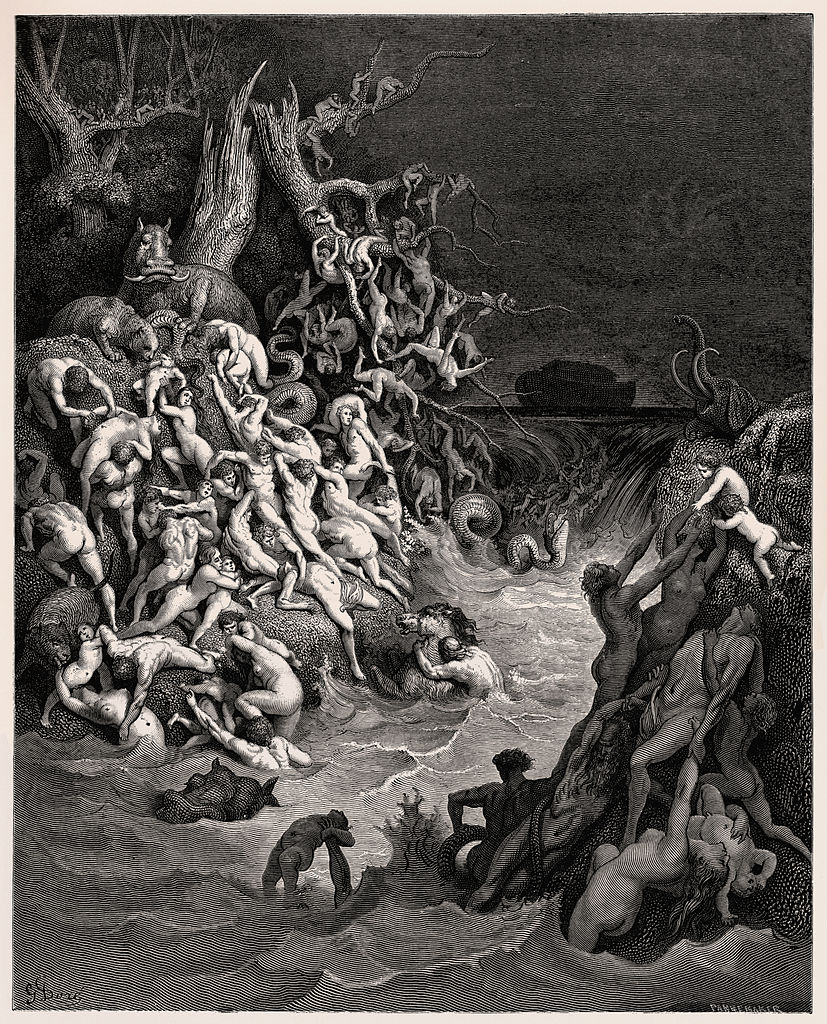
Dore’s Noah’s Flood, an illustration I first discovered in a volume called Illustrated Bible Stories for Children

Every once in a while, it’s fun to be cooped in a beach house during a bleak, dull, dark November day when clouds hang oppressively low in the heavens (and a storm from the ocean, aided and abetted by a king tide, pushes flood waters into the garage of the Airbnb next door – tee-hee). 

The Gothic grey weather practically demands you break out some Edgar Allan, peruse some of those exquisite Latinate sentences that provide delightful dead weight to so many of his tales, sentences like: 

We pored together over such works as the Ververt et Chartreuse of Gresset; the Belphegor of Machiavelli; the Heaven and Hell of Swedenborg; the Subterranean Voyage of Nicholas Klimm by Holberg; the Chiromancy of Robert Flud, of Jean D’Indaginé, and of De la Chambre; the Journey into the Blue Distance of Tieck; and the City of the Sun of Campanella. One favorite volume was a small octavo edition of the Directorium Inquisitorium , by the Dominican Eymeric de Gironne; and there were passages in Pomponius Mela, about the old African Satyrs and œgipans, over which Usher would sit dreaming for hours. His chief delight, however, was found in the perusal of an exceedingly rare and curious book in quarto Gothic — the manual of a forgotten church — the Vigiliae Mortuorum secundum Chorum Ecclesiae Maguntinae.

Still awake?

Or you, if you’re lucky enough to possess one, you can put together a jigsaw puzzle – literal recreation – or play a game of Scrabble, or, if you’re by yourself, a game of solitaire with an actual deck of cards, which make such delightful riffling sounds after you have scooped them up shuffling in preparation of losing once again. 

These activities, by the way, don’t require electricity.

Before the digital age, when I was a boy in Summerville, on a blustery autumn day like today, I’d sometimes put together model airplanes. I remember on one Saturday riding my bike in the rain to the Hobby Shop on North Main to buy a model of a Fokker Triplane, the plane that Baron von Richthofen flew. Oddly enough, he was one of my boyhood heroes, despite his being on the wrong side in a war that killed lovely poets like Wilfred Owen and Rupert Brooke.

By the way, did you know that Yeats’s poem “An Irish Airman Foresees His Death” is the first poem in English that places a person airborne in what they called back then an aeroplane? It occurs in the third stanza:

I know that I shall meet my fate
Somewhere among the clouds above;
Those that I fight I do not hate
Those that I guard I do not love;

My country is Kiltartan Cross,
My countrymen Kiltartan’s poor,
No likely end could bring them loss
Or leave them happier than before.

Nor law, nor duty bade me fight,
Nor public men, nor cheering crowds,
A lonely impulse of delight
Drove to this tumult in the clouds;

I balanced all, brought all to mind,
The years to come seemed waste of breath,
A waste of breath the years behind
In balance with this life, this death.[1]

That side trip prompted me to extract a collection of Blakes’ poems from the cliched voluminous library, the poems selected by Willie B himself, who wrote the introduction, which begins with this amusing snippet of biography:

“Early in the eighteenth century a certain John O’Neil got into debt and difficulties, these latter apparently political to some extent; and escaped both by marrying a woman named Ellen Blake, who kept a shebeen[2] at Rathmines Dublin and taking his name. He had a son James, I am told, by a previous wife or mistress, and this son took the name of Blake, and in due course married, settled in London as a hosier, and became the father of five children, one of whom was the subject of this memoir.”

So, it seems that Blake had a drop of Irish blood in his veins, which explains a lot.

At any rate, I’ve rambled enough. It’s time for me to reheat Thursday’s chili and check of the girls’ progress on that jigsaw puzzle.

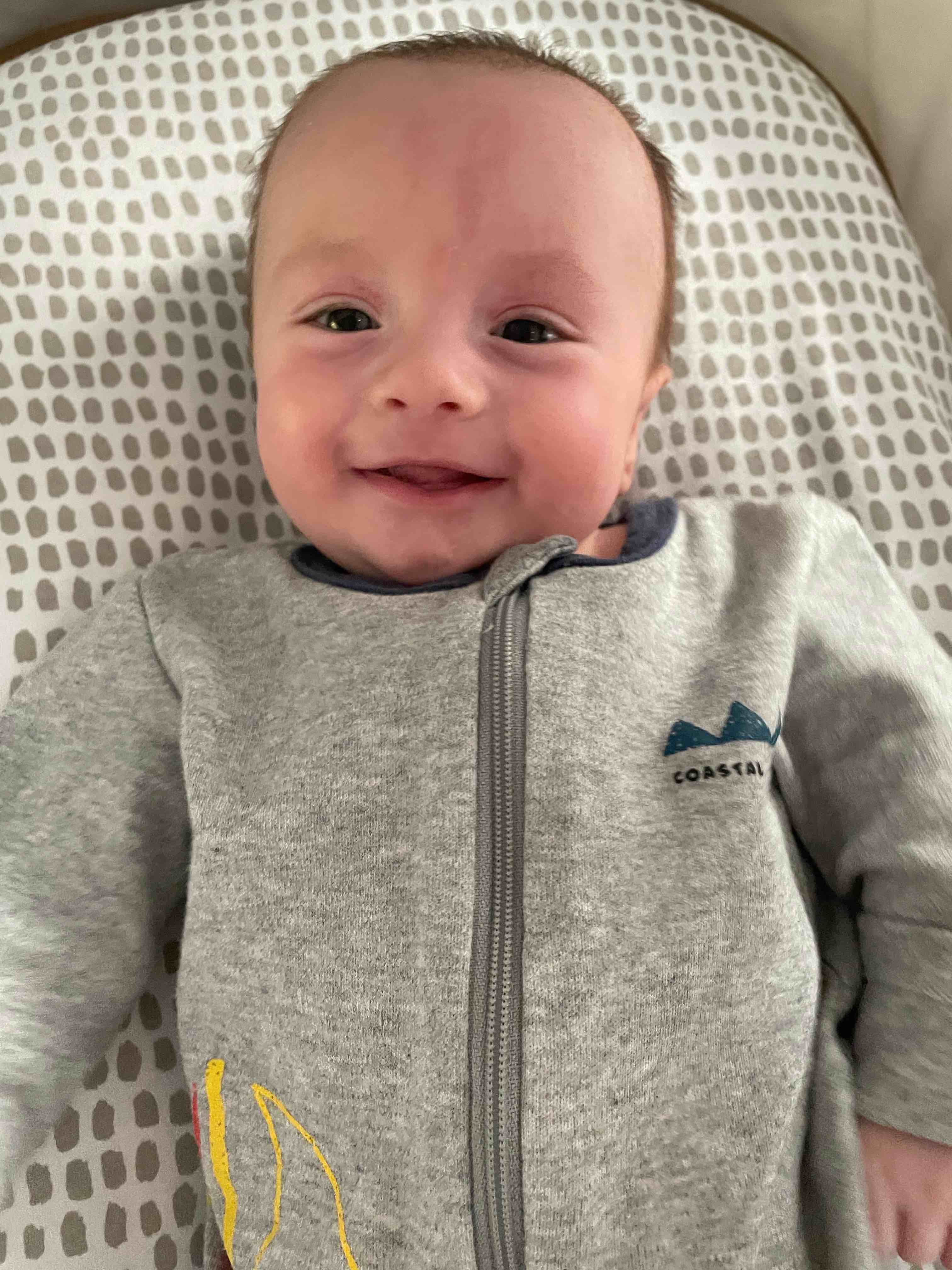
Cheers! And check out Grandson Julian, happy in the golden age before screens. Cackle on, my lovely.


[1] Talking about balance: four rhyming quatrains written in iambic tetrameter.” Four cubed.  

[2] An Irish term for an illicit bar or club trafficking in excisable alcohol without a license.

The Krushtones + The Sand Dollar Social Club = Federico Fellini

The Sound Track

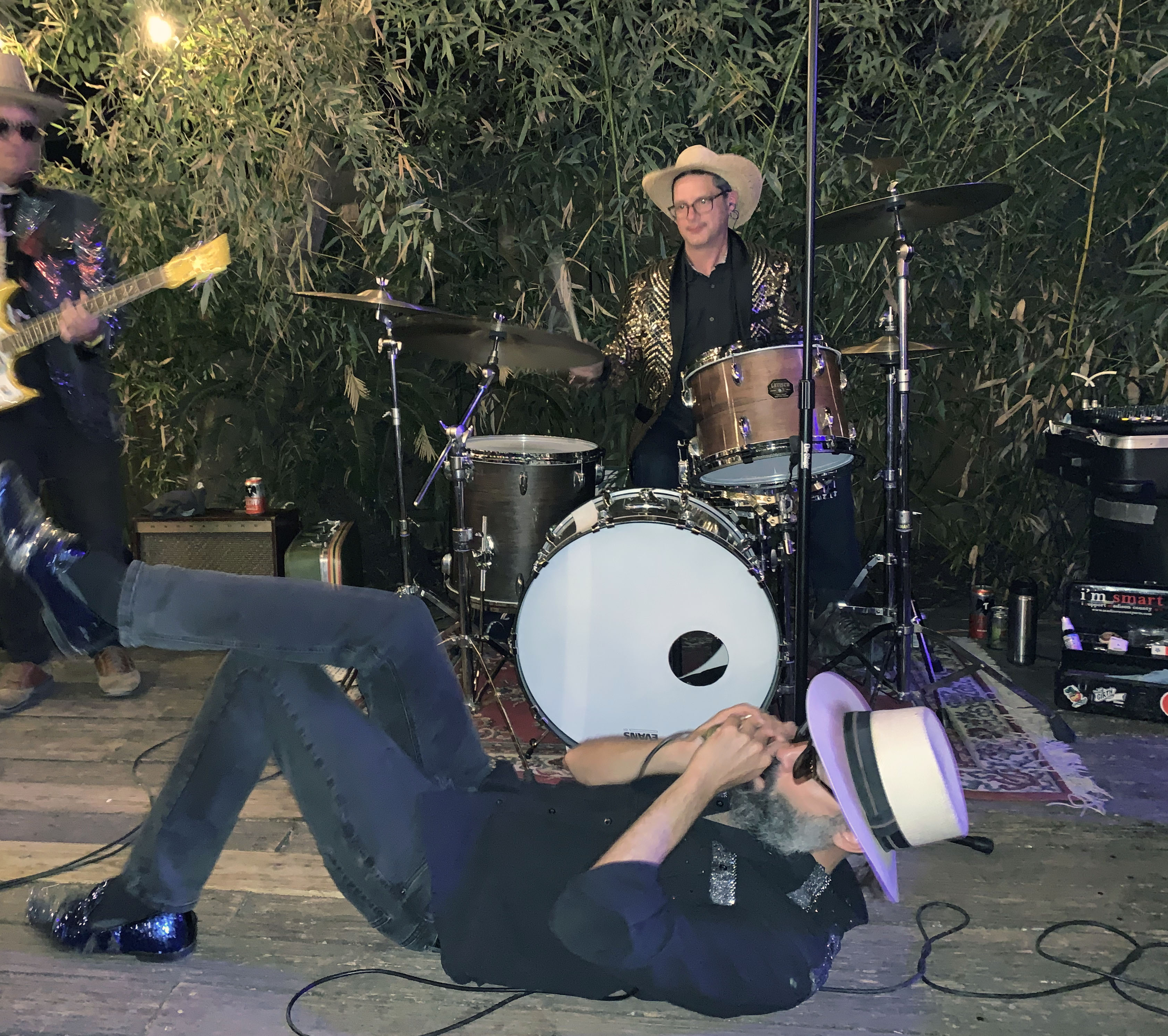
One of the most pleasurable rites of spring celebrated in the Lowcountry each year occurs at the Sand Dollar Social Club on Folly Beach when the Krushtones take the stage for their annual April gig.  

[Cue country preacher]: We’re talking glorification, brothers and sisters, talking bout light!

Krush-tones: (krùsh– tõns)  n. a band that features high-Watt[s] drumming; a bodacious bottom; a searing, eloquent guitar; and  a latter day Jerry Lee Lewis on keyboards.   

Joyous!  

I swear, even if they were a mediocre band, the Krushtones’ taste is so exquisite I’d pay to hear the song sets. Al Green/ Talking Heads, the Beatles, Stones, Chuck Berry.  But mediocre they ain’t.  They exude this palatable vibe of happiness that spreads in concentric circles as if a pearl has been dropped into a pool of sound.  

Make you want to dance and holler hallelujah!

The Sand Dollar itself is difficult to categorize.  As a private social club, it offers all of the exclusiveness of a subway station.  One dollar secures you a year’s membership, but you can’t actually enter the club until 24 hours after your card has been issued.  A typical Friday and Saturday night offers free live music, canned beer for a buck, and and an eclectic clientele that, depending on the vibe the night you happen to be there, ranges from Felliniesque to Lynchian.  

Bikers comprise a large contingent of the revelers, parking their Harleys (I don’t think I’ve ever seen a BMW) perilously close together out front like a chorus line of internally combustive Rockettes.  I dread the day some reeling rummy trips and sets them crashing domino style one after the other. Years ago, before the bikers arrived, I had parked my VW minibus just in front of the designated space.  When JB and I left for home, I was horrified to see at least twenty Harleys lined up about six inches from my back bumper and another car looming about a foot from my front bumper.  Luckily, the fellow pictured below, a regular, helped me successfully to negotiate the scores of gear shifts, wheel turns, and progressions/reversals that liberated me from that straitened space.

Joining the bikers as a discernible group are the long-in-the-tooth dead-end hedonists, who can be subdivided into old hippies and old shaggers.  These sybarites, who hated each other in high school  (the former letting their freak flag[s] fly, the latter sliding sockless feet into their Bass Weejuns) have mellowed over the years and appreciate each other in their shared ethos of self-medication and the never ending but increasingly difficult quest of getting laid.                

A calico combination of others rounds out the squad – attractive, young preppies; South of Broad slummers; working folk shooting pool; the occasional bombastic prophet-of-doom blogger. 

Lynchian vis-a-vis Felliniesque 

What’s the distinction, you may wonder, between these two cinematic adjectives denoting surrealism?  

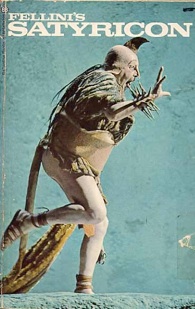
Although baroque, Fellini’s surrealism tends towards the comic/satiric.  His Satyricon, for example, counterbalances sensuous  shots with grotesque images of Late Empire overindulgence.  Carnivalesque might be an appropriate approximation. 

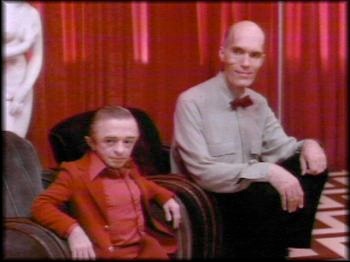
Lynch’s surrealism is darker, a world of evil where the hideous co-mingle with grotesquely bland clichés of Americana, a la the image of above, where the sinister red-clad midget sits beside someone who looks like he may be employed as a hardware store clerk in a Norman Rockwell painting or the son of the couple depicted in Grant Wood’s American Gothic.  Kafkalite-ish.

If I had to choose between the hellish dilemma of spending eternity in a Fellini film or a Lynch film, I’d definitely opt for the former.  Underneath all of the grotesqueness of Fellini lies a positive procreative impulse. Take “The Widow of Ephesus” segment of The Satyricon, for example, where  a woman who has decided to starve herself in her husband’s tomb is seduced by a soldier guarding crucified corpses.  

Now that’s what I call pro life.

Lynch, on the other hand, is anti-life.  Not that his films aren’t hugely enjoyable and laugh- out-loud funny.  Nevertheless, like the parents in Eraserhead, procreation begets monstrosity.  You don’t want to bring a child into David Lynch’s world.

In short, a Felliniesque evening at the Sand Dollar is more pleasurable Lynchian evening, 

Friday, 9 April 2010 

I’m not making this up.  During the Krushtones’ first set, I witnessed the departure of one of Charleston’s wealthiest septuagenarians and his seeing-eye trophy wife.  She, a blonde, a head taller and thirty years younger, held his hand mommy-like as she led him through the throng.  As they were leaving, three female dwarves dressed to the nines flowed past them and took their place at the corner of the stage.  I repeat, I’m not making this up.

Lynchian or Felliniesque?

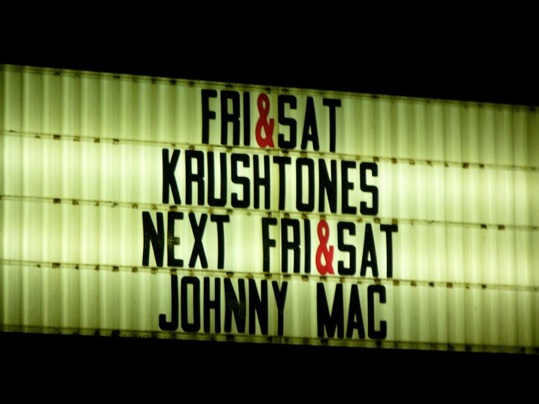
If Johnny Mac had been playing that night, a man deeply in love with the sound of his own guitar, or Jeannie Wiggins, thumping serviceable rock to her adoring groupies, the karma might have darkened the brain chemistry that ultimately determines the existential nature of my world.  However, with the Krushtones on stage, beaming, jumping, singing “Lady Madonna,”  the positive vibration was infectious.  Even the stern-faced bouncer who looks like the promotional US Marine of recruitment commercials cracked a smile.

Too bad the Krushtones were too young to play at Altamont.

An Anthropological Adventure Highlighting Late Pandemic Folly Beach Behaviors

The last time I donned the ol’ pith helmet and ventured inside the rich anthropological domain of Folly Beach, SC, was on 17 March 2020 at the beginning of the COVID-19 epidemic. Even though it was St. Patrick’s Day, a holiday associated with the consumption of intoxicating spirits, a day when inebriates typically jampack the bars of the so-called Edge of America, only a few foolhardy hedonists stumbled the streets that Saturday, their left hands clutching red cups, their right hands thumbing their noses, as it were, at Dr. Fauci’s fervent pleas to stay indoors to stem the contagion.

Why would I – whom sociologists classify as geriatric, advertisers term a golden ager, and young people consider an old fart – expose myself to possible infection? After all, at 67, I fell into the likely-to-die demographic. Why, you ask?  

Because I’m a scientist, damn it; that’s why.

Of course, I submitted a report of that field work, including video, which you can access here.

Well, 407 long days have elapsed since that death-defying foray onto the potentially contagious sidewalks of FBSC 17 March 2020. Now, with COVID cases waning nationwide (albeit spiking in India and elsewhere abroad) and having received two doses of the Moderna vaccine – the second one a month ago – I decided it was high time to investigate. With Caroline, my invaluable anthropological colleague, erstwhile grief counsellor, and crackerjack photographer at my side, we trekked to Center Street to determine to what degree behaviors have changed since the early days of the pandemic.

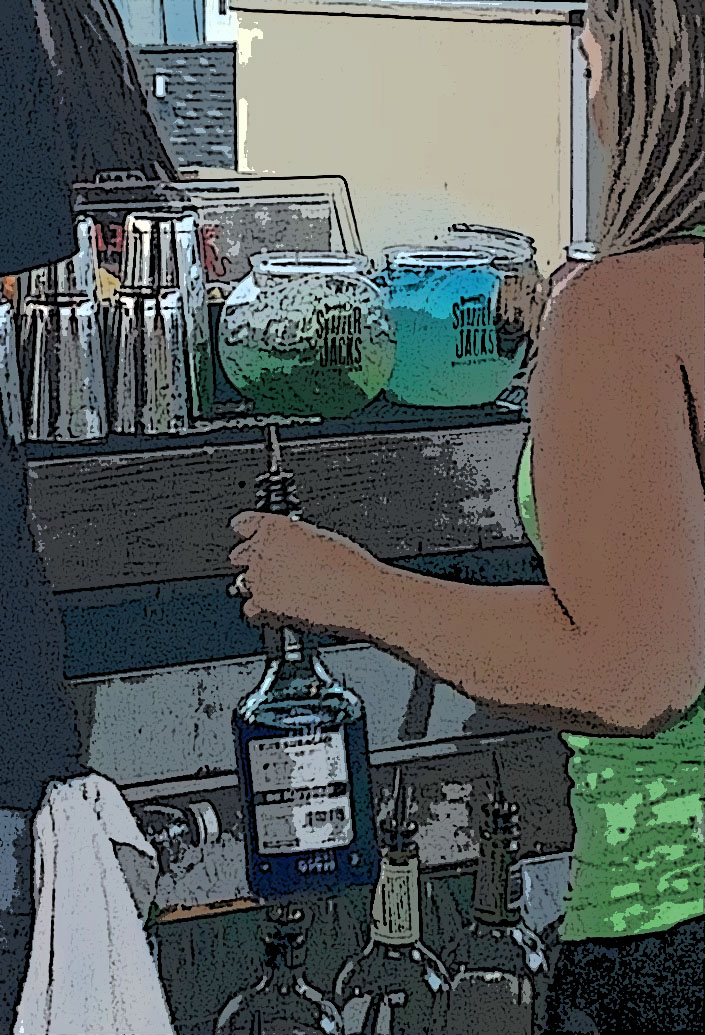
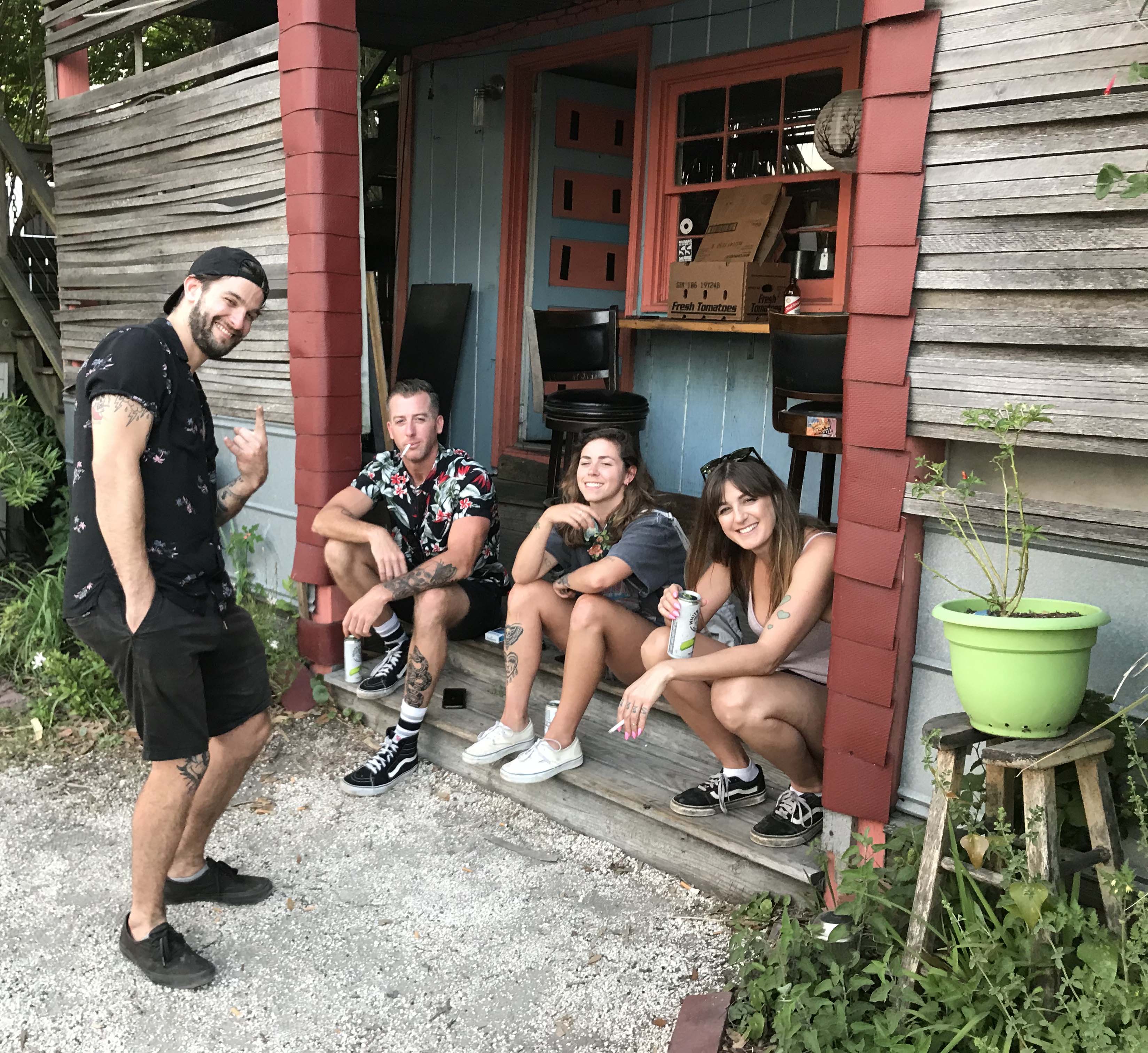
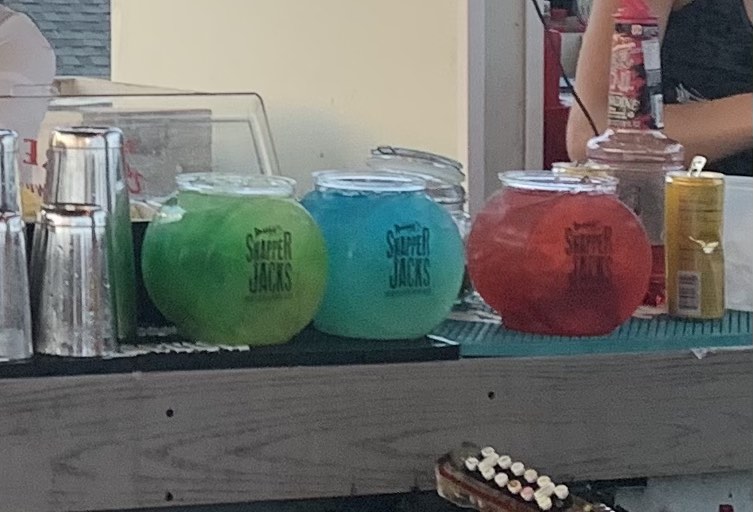
We set up base camp at Chico Feo and found that outdoor eatery a-swarm with Friday night foragers, mostly tourists, but a considerable number of local denizens lolled there as well. After one low-impact libation, Caroline and I decided to head straight to Ground Zero, the shitshow known as the Rooftop at Snapper Jack’s, a two-block walk. Before departing however, our sponsors, pictured below, suggested we be on the lookout for topers tippling drinks that Jenny (pictured far right) has dubbed “ho-a-canes” and “bro-nados.”

from left to right, Dylan, Patrick, Faith, and Jenny

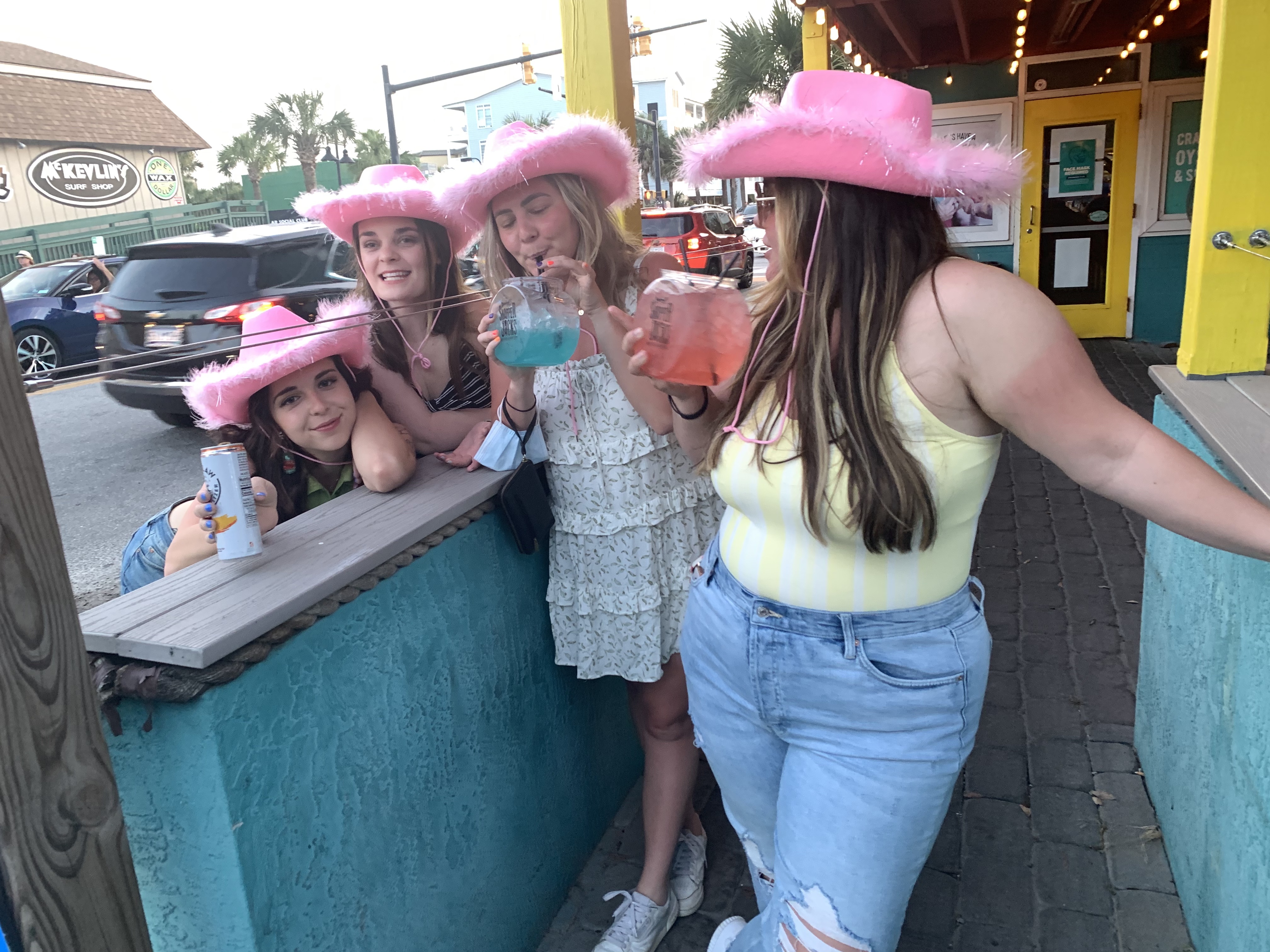
At the base of the stairs leading to Snapper Jack’s rooftop bar, we encountered our first bachelorette crew, pictured below. They seemed to me, despite the festive pink cowgirl hats, a bit subdued. Caroline and I peppered them with questions. The 23-year-old bride-to-be (second from the left) had found, according to her, the “man of her dreams,” but her companion, the most loquacious of the quartet (far right), said she was patiently waiting for a man who “worshipped the very ground she stood upon” and would settle for nothing less. Upon hearing this, my subconscious selected from its poetic jukebox these lines from Yeats’s “Never Give All the Heart”:

Never give all the heart, for love 

Will hardly seem worth thinking of 

To passionate women if it seem 

Certain, and they never dream 

That it fades out from kiss to kiss . . .

Anyway, we bade them good fortune, wished the bride-to-be a long happy and fruitful marriage, and climbed the stairs passing through a portal that ferried us to the Jersey shore.

No doubt these images can attest far better than my spendthrift prose.

Ladies and gentlemen, as far as these folks are concerned, the pandemic is kaput.


Pleasure Chest Rocks Chico Feo

What a blast we had digging on Pleasure Chest, an absolutely great show band with an eclectic repertoire of killer covers. We’re talking Booker T, Jimmy Reed, Ray Charles, Erma Thomas, and, drum roll, the Buckinghams. Time won’t let me, no it won’t and by the way, time ain’t on my side, no it ain’t.

Here’s a peek:

A Statistical Foray into the Funkification Ratios that Separate Folly Beach, SC from the Isle of Palms and Sullivans Island (Not to Mention Kiawah)

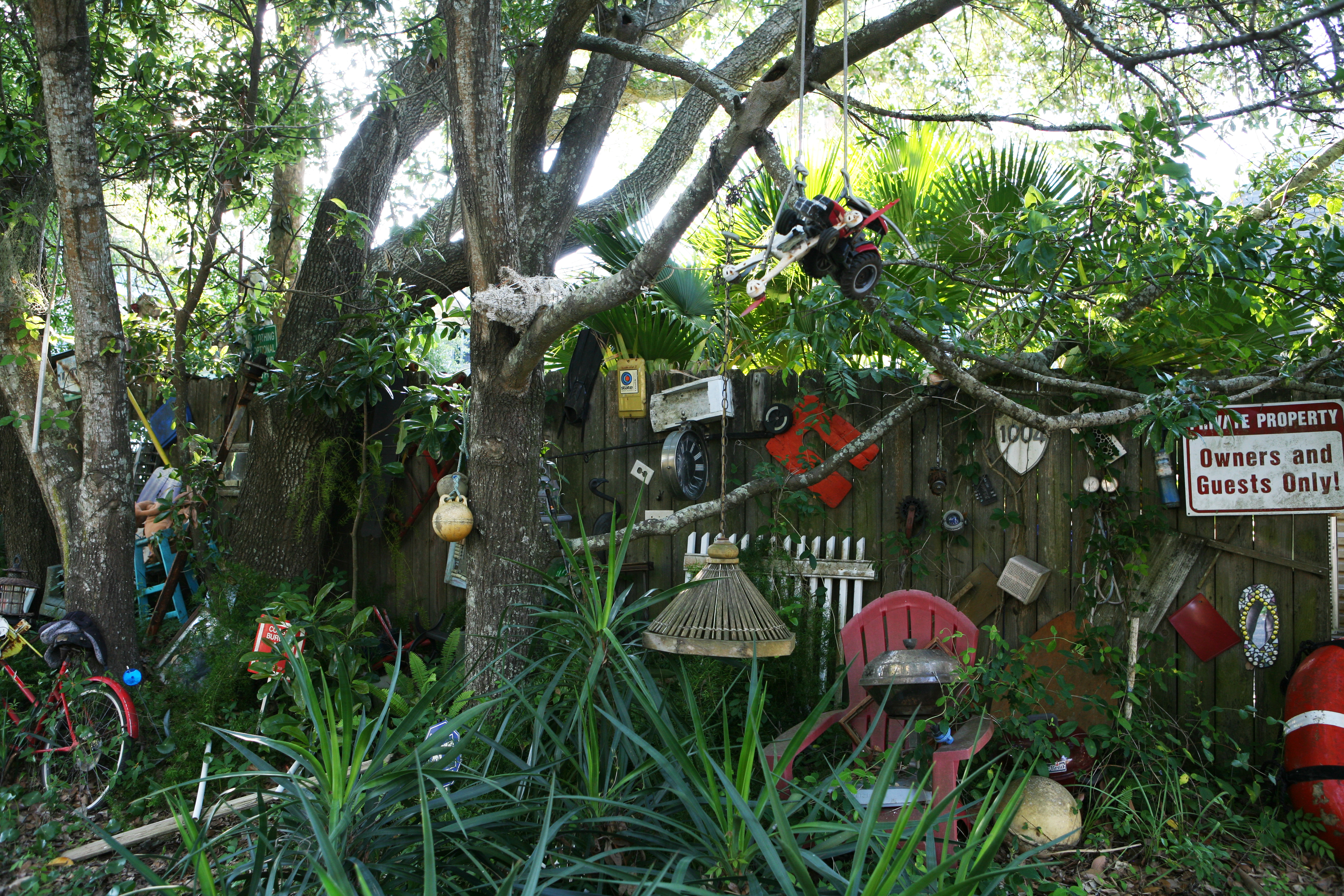
bill's art installation

photo by Caroline Tigner Moore

To say Folly Beach is peculiar is to say the sun is hot, night is dark, and that Marty Feldman never graced the cover of People magazine as the “Sexiest Man Alive.”  After all, Folly Beach is – in the now famous phrase coined by my friend and former boss Bill Perry – the Edge of America.[1]

marty

the late great Marty Feldman

I’ve always liked the sound of the word peculiar. According to my very own OED  (whose print Superman with telescopic vision would have difficulty decoding), peculiar comes to English from the Latin peculium, originally meaning “property in cattle.” That cow over there – let’s call her Elsa –  belongs to US Representative Devin Nunes. She’s peculiar to Representative Nunes in that she’s his alone. She’s peculiar to him.  But it’s also peculiar that Devin Nunes is suing the cow known as “Devin Nunes’ Cow.” I’m not making this up. [2]

Over time, as words are wont to do, the definition of “peculiar” branched out from the pasture of private ownership and took on the meaning of being different from others. Not surprisingly, being different acquired somewhat of a negative connotation, because to many, especially those intent on keeping up with the Joneses, being different (or unusual) is often not a good thing.

No PR person would ever come up with the phrase “Edge of America” to promote Kiawah Island. Kiawah doesn’t mind being different in an exclusive or unique way, but it certainly doesn’t want to come off as edgy, and it’s succeeded. Kiawah is about as edgy as Jack Nicklaus.

Not to be confused with Jack Nicholson.  I remember seeing an interview with Jack Nicholson not long after the actor Hugh Grant’s arrest for solicitation. The interviewer (maybe Barbra Walters) asked Jack why someone rich and good-looking and married to a beautiful woman (i.e., someone like Hugh Grant) would require the services of a prostitute.

“Peculiarities,” Jack said with his trademark leer, “peculiarities.”

So another denotation of peculiar  – actually the number one denotation – is “strange or odd,” like walking in “polka dots and checkered slacks,” to borrow a phrase from Elvis Costello (and to avoid examples of possible outré sexual inclinations that might have prompted Mr. Grant to seek peculiar connubial pleasures outside the bounds of his marriage).

Good God, I’ve wandered far afield from paragraph one. Actually, what I want to know is what makes so Folly different from its barrier island neighbors, the Isle of Palms and Sullivans Island?  What is it about Folly that makes it so peculiar?

folly pc

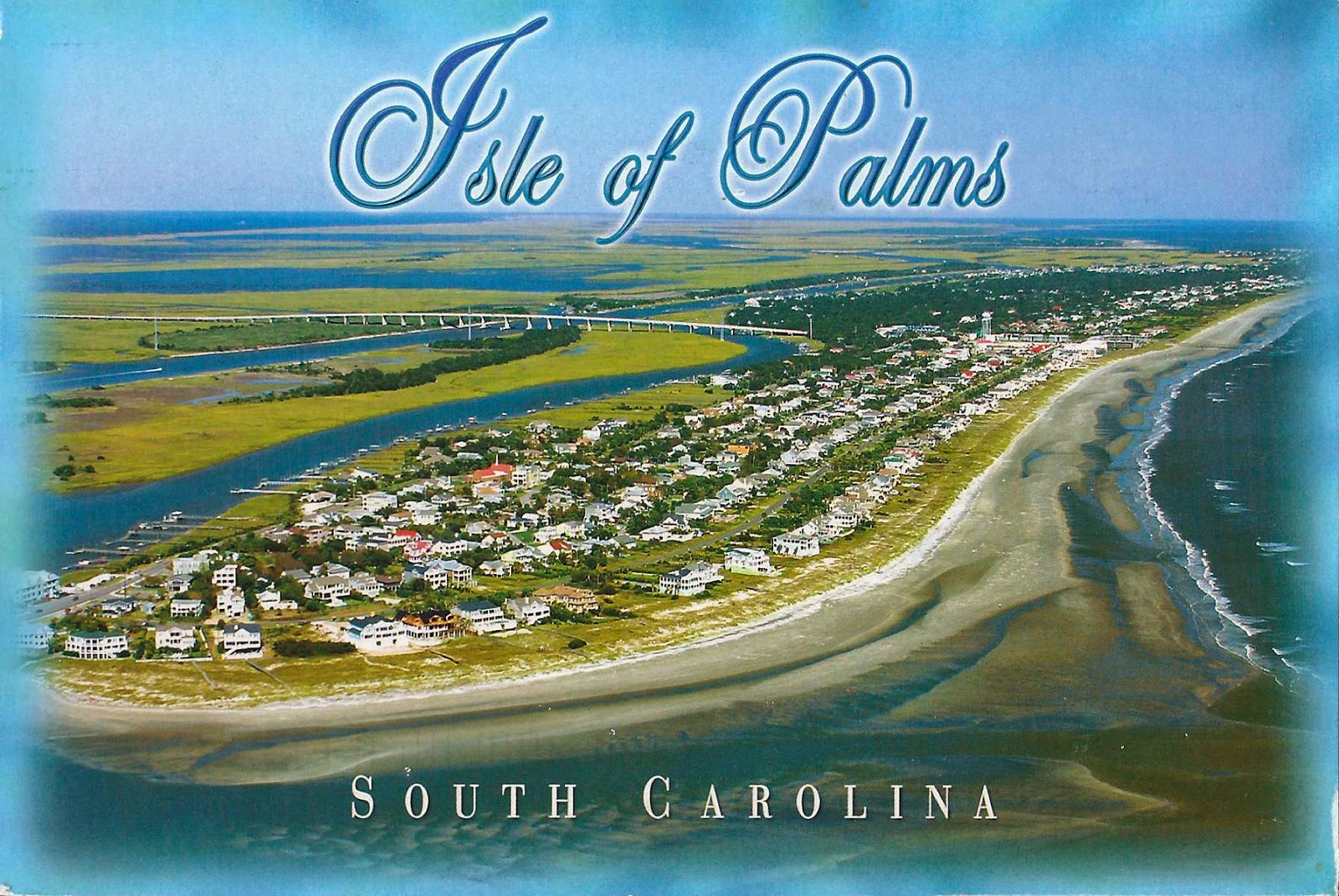
IOP pc

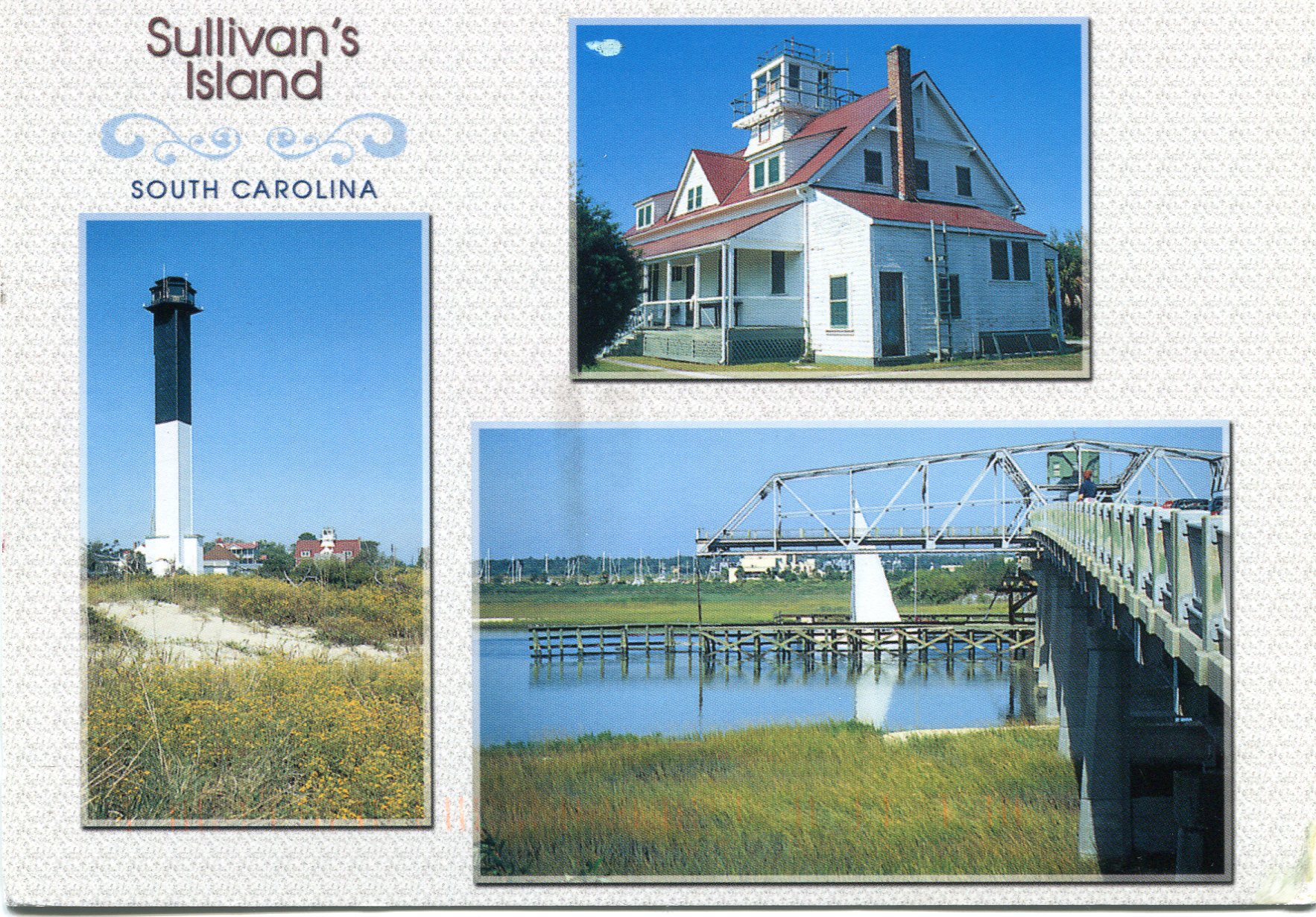
usa-south-carolina-sullivans-island

To attempt to find the answer to this ultimately useless question, I did some googling on Yahoo (mixed metaphors is where it’s at) and compared the demographics of the three island communities.[3]

2021 Population:

Folly Beach  1,035 (61.15% 1-year decline!)

Isle of Palms 4,318 (1.21% 1-year decline)

Sullivan’s Island 2,220 (.09% 1-year increase)

2021 Median Ages

Folly Beach 62 (18.3% 1 year increase)

Isle of Palms 51.7 (3.54% 1-year decline)

Sullivans Island 51.7 (strange that Sullivan’s and IOP’s median age is exactly the same)

Once again, Folly is the median.

2021 Poverty Rate

Folly Beach 16.2% (61.3% 1-year increase)

Isle of Palms 2.51% (2.43% 1-year decrease)

Sullivan’s Island 10.1%

2021 Median Household Income

Folly Beach

$76,250 (14.3% 1-year decline)

Isle of Palms

$134,917 (4.97% 1-year growth)

Sullivan’s Island

$229,118

Median 2021 Property Value

Folly Beach $632,700 (1.36% 1-year growth)

Isle of Palms $883,200 (8.33% 1-year growth)

Sullivan’s Island $2,000,001

Ethnicity

Folly Beach 100% (non-Hispanic) white

Isle of Palms  96.2% (non-Hispanic) white, Asian (non-Hispanic) 1.97% Other (Hispanic 0.556%), and White (Hispanic) 0.44%

Sullivan’s Island 100% (non-Hispanic) white

Average commute time

Folly Beach  24.6 minutes

Isle of Palms 27.9 minutes 

Sullivan’s Island 16.7 minutes

Conclusion

So let’s face it. That was a waste of time. If you’re going to come up with an answer, demographics aren’t going to help. You need to go maybe to history or —

Wait, Caroline just popped into the drafty garret to ask what I was up to, so I told her I was trying to determine via demographics why Folly was more peculiar, funkier, than the IOP and Sullivans.

“More barstools per capita,” she immediately said.

Damn!  Being so much smarter, why in the hell do women make so much less than men?

Yes, Caroline: Planet Follywood, Sunset Cay, the Washout, Jack of Cups, Drop-In, Loggerheads, the Crab Shack, Taco Boy, Coconut Joe’s, Lowlife, The Bounty Bar, Rita’s, the Tides, Chico Feo.

I’m sure I’m leaving somebody out – and except for one, none of them smack of commerciality.


[1] Wisely, Bill copyrighted the phrase.

[2] https://www.latimes.com/opinion/story/2019-10-20/abcarian-sunday-column

[3] Data for Folly and IOP from Data USA, Sullivans Island from various sources.