A music video in accompany the dub poem Nassau Street Song.
Follow on Twitter @ragwatercat
A music video in accompany the dub poem Nassau Street Song.
Follow on Twitter @ragwatercat
Essentially, British pop music falls between two poles of influence, the music hall tunes of the 19th and early 20th Centuries and the R&B co-opted by the Brit bands of the ’60’s (with the Beatles more or less representing the former and the Stones the latter).
Certainly, songs like “Honey Pie” from the Beatle’s White Album owe more to Harry Dacre’s “Daisy Bell” than they do to any Chuck Berry tune.
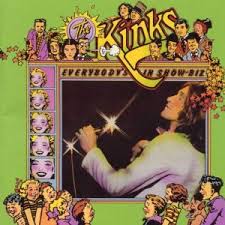
One British band who in its later years owed much to the music hall tradition is the Kinks. Although they began as perhaps the very first hard rockers in history with singles like “You Really Got Me” and “All Day and All of the Night,” by ’72 front man Ray Davies had abandoned three chord anthems and looked back to the golden ages of music hall and Hollywood for his inspiration.
The double album Everybody’s in Show Biz marks this transition. The first record consists of studio recordings that confront life on the road or hearken back to the nostalgia of Mickey Rooney and George Sanders, and the second features songs from a two-night Carnegie Hall concert. Most of the tunes from the concert come from the Kinks’s previous album Muswell Hillbillies, which deals with the frustrations of 20th Century life and presages Davies’ forthcoming nostalgic bent.. The tune “Skin and Bone” that I’ve illustrated through the short film below offers an example of this transition from boogie woogie to Vaudeville:
But at my back I always hear
Time’s wingèd chariot hurrying near
Marvell, “To His Coy Mistress
I have measured out my life with coffee spoons
Eliot, “Prufrock”
Of course, time seems to pass more rapidly as we age because of the forever diminishing frames-of-references that years represent.
For example, when I was five, a student at Miss Marion’s kindergarten, a year was a fifth of my life and seemed as expansive as a continent. The previous Christmas seemed like a far distant outpost several time zones removed, separated by a progression of slow transpiring days that unfurled and closed like lazy morning glories.
[check out the vines on the left as Cat Stevens rejoices]
Now, that I’m 61, a year seems like one revolution on a Tilt-a-Whirl that’s gone haywire in Max Sennett short – each successive whirl faster – last Christmas seeming a day or two ago and the next a day or two away.
But here’s the thing. For the past week it’s as if I exist in a Rod Sterling directed Twilight Zone adaptation of a Kafka short story.
Every time I reach for something, it’s the very last one available! It’s ubiquitous. Uncanny.
For example, the day before yesterday, I had to replace the toilet paper roll in the master bath and the very next day needed to replace the roll in what we euphemistically call “the powder room.” Coincidence – of course – but then last night as I unfurled the dental floss, the spool unwound and spit out the last remaining thread . This morning’s dry dog food scooping found the cup hitting the bottom, the food not completely done, but within three or four days of depletion.
And here’s the clincher: at school, I forgot to hit the staple function on the copier in the work room,[1] so had to staple my Romanticism tests by hand, and guess what, not only did the first stapler I used run out of staples, but the next one did as well!
To be honest, though, there was plenty of looseleaf paper to distribute to my students who are at this very moment in time explaining why this stanza of Wordsworth’s “Ode: Intimations of Immortality” conforms to the subject matter and poetic conventions of Romanticism:
What though the radiance which was once so bright
Be now for ever taken from my sight,
Though nothing can bring back the hour
Of splendour in the grass, of glory in the flower;
We will grieve not, rather find
Strength in what remains behind;
In the primal sympathy
Which having been must ever be;
In the soothing thoughts that spring
Out of human suffering;
In the faith that looks through death,
In years that bring the philosophic[2]
[1] By the way, in those halcyon days before email, the copy room called the Lounge, and perhaps the fact that we in the working world are so busy there’s no time for contemplation may also play a role in the seeming acceleration of time’s passage.
[2] Of course, when I was copying my rubric for grading my students’ responses the copier ran out of paper. I swear!
The ghost of Pieter Brueghel the Elder haunts Folly Beach’s Folly Gras celebration
As the last few hours of my solstice break leak away (an unpleasant analogy hovers just beneath the level of consciousness), I’m faced with the unthinkable. My favorite drinking spot, the bar where I grade my essays on Saturday and Sunday afternoons is closing tomorrow. Think Bret Harte’s “The Outcasts of Poker Flat,” Jack London’s “To Build a Fire,” Nevil Shute’s On the Beach. I feel hopeless, lost, and abandoned; set adrift on a leaky raft as my former cruise ship heaves it bow before the plunge.
What will become of my beloved bartenders? The regulars, those connoisseurs of craft beers? Those other regulars, lovable losers like me?
Oh, I know there’re other bars on Folly. That’s like telling Romeo, “Hey, Bub, there’s other chicks,” or Dante, “Florence ain’t the only city state in Italy.”
Watch it and weep!
a pretentious early attempt at filmmaking

 You Do Hoodoo