Unless you’re atypically morbid, like David Sedaris, who whiles away his time in airports “wondering which of the many people around me will die first, and of what,” chances are you’ve exiled the thought of your own mortality to the deepest, remotest outpost in the penal colony of your consciousness. And nothing screams mortality like a bald, cadaverous middle-aged woman sporting a pink baseball cap and a tee that reads “I Got Chemo Brain. What’s Your Excuse.” Encountering her on a sidewalk, you might nod a quick greeting, or if she were preoccupied, avert your eyes.
That is, unless you — or someone very close to you — have/has been diagnosed with cancer. In that case, this plucky woman is a cognoscente, a knower, a fellow sufferer, a sister, so you look her in the eye, smile your most winning smile, and say hello.
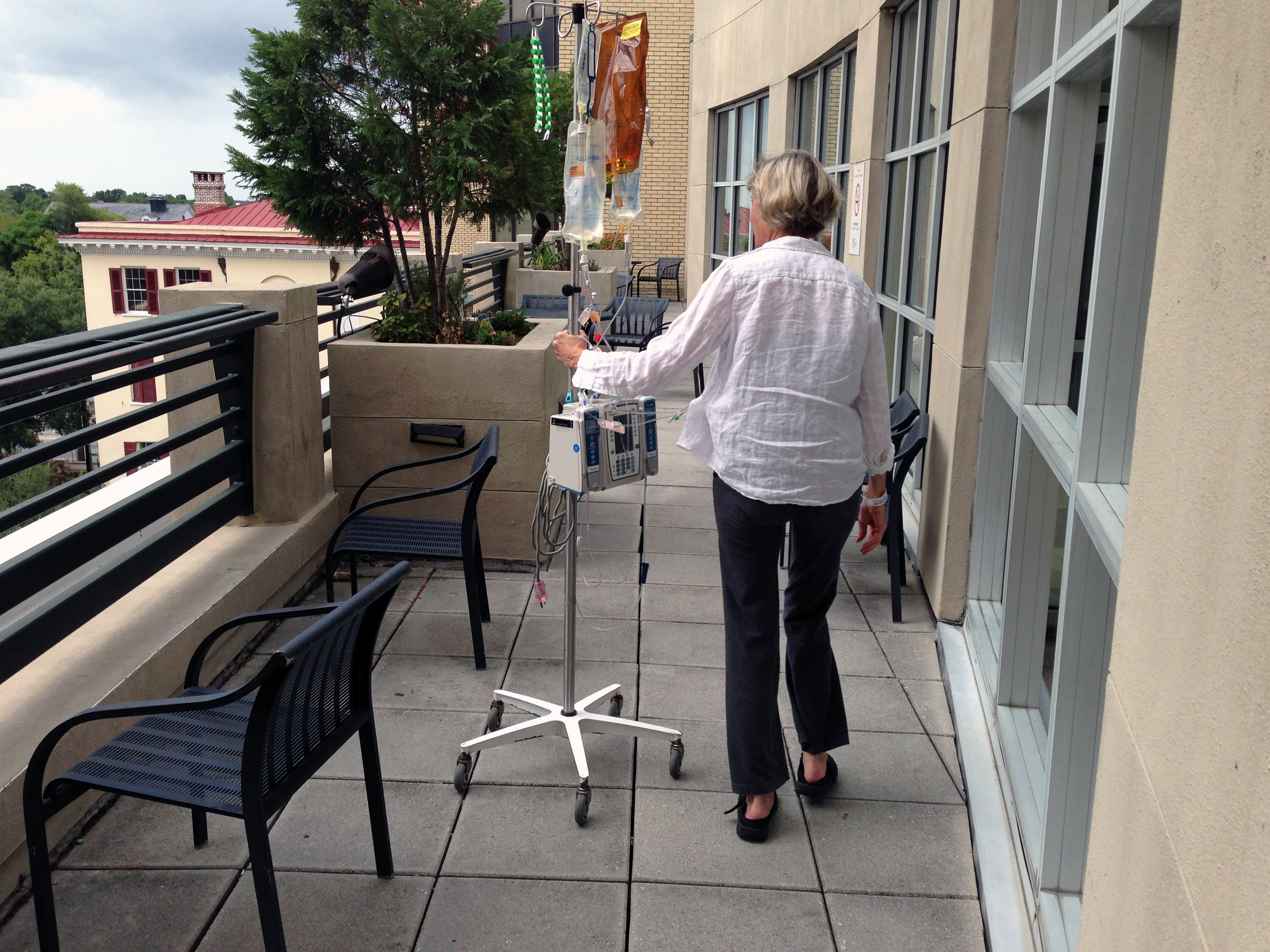
Since my wife Judy’s diagnosis of lymphoma, we’ve by necessity been hanging out with cancer patients — at Roper’s/St Francis’s West Ashley Cancer Center, on the fifth floor of the old downtown Roper, and at an adjacent building where nurses administer white-blood-cell-enhancing injections on Sunday mornings to folks undergoing chemo.
Our first visit takes place on a day so bleak weatherwise that I expect to see the words “Directed by Ingmar Bergman” projected on the bank of dark gray clouds squatting over the harbor. There’s a flash flood warning until eleven, and the rain is steady but not torrential at the moment.
We arrive, take the elevator to the fifth floor (what is it about cancer and fifth floors?) to find at least a dozen people waiting for their injections. What strikes me foremost is how cheerful these folks seem to be. At first, the office is so crowded that we stand out in the hall and have a conversation with a robust-seeming but patchily bald thirty-something who is (cliche #1) battling relapsed colon cancer, a disease first diagnosed when he was overseas on active duty. Obviously, he’s been dealt an unlucky genetic hand; his brother is also battling cancer, a lymphoma. He gives us the name of an author and book about some miraculous diet.
 As people exit, we make our way inside and have a seat. I’m across from a large man in his seventies wearing suspenders and holding a hand-carved cane in the shape of an egret in the big paw of his hand. This man’s head looks like a giant flesh-colored bowling ball, and he doesn’t have any eyebrows. As it turns out, he lives in the town of my birth, Summerville, and commissioned some local artisan to carve the cane for him. He says with a smile that his wife was supposed to come with him, but her head was under the covers when he left. “So I’m going to get some breakfast,” he says good-naturedly. “She can get her own breakfast.”
And then there is the smiling, petite, and ever so fragile-seeming older woman who looks as if she might weigh all of her eighty pounds. She’s wearing a baseball cap and speaks in a cheerful, clipped Northern cadence.
She knows things we as yet don’t know and serves as a wonderful role model. She’s come here alone with her (cliche #2) head held high, and seems perfectly happy.
Oh, these cliches! They’re impossible to avoid. When people ask, we say we’re optimistic but (cliche #3) taking it one day at a time, which, if you stop to think of it, is how we should live whether we’re suffering from cancer or just won the Powerball Jackpot. When I walk Saisy now, I take note of what I might have missed before, the smell of lighter fluid, the sight of pelicans in an unbalanced vee overhead, the sounds of squealing little girls dabbling in the waves.


 You Do Hoodoo