Matthew Arnold vs. Thomas Friedman

Whenever I participate in interviews for prospective administrators or humanities teacher candidates at my school, my first question goes something like this:

Matthew Arnold once wrote that education’s primary purpose was “getting to know [. . .] the best that has been thought and said in the world.” I’ve recently attended a couple of conferences devoted to the brave new world of “21st Century education.” The lecturers at these conferences argue we should be preparing students for global capitalism, making sure they can command computers, work together in groups, plan and implement projects, etc.[1]  A survey of British literature, for example, comes off as impractical in this context.  After all, understanding how WWI’s shattering of Western Civilization’s stained glass window relates to the fragmentary nature of Eliot’s “The Waste Land” isn’t going to have much practical value in negotiating an international real estate transaction.

What’s your take on this dichotomy?  Should we jettison the great books and literature survey courses in exchange for a more practical, hands-on approach to dealing with data?  Does understanding the sequence of the history of thought have any practical value?

Of course, it’s not an easy question, but that’s the point.  And, of course, an astute listener will detect my bias in framing the question.

The truth of the matter is that British literature surveys in high schools are hobbling towards extinction.  Only my school’s sophomore honors classes encounter the historical sequence that features, among other riches,  Romanticism’s rejection of Augustan rationality (cf. the 60’s vis-à-visthe 50’s); the non-honor classes explore the British canon thematically, e.g., Beowulf and Frankenstein headlining a unit on “monsters.”

Instead of a tapestry, they get a quilt.

The counterargument, which I concede has merit, is that students need to understand non-Western cultures in our rapidly shrinking world.  On the other hand, reading a Chinese poem in translation means forsaking sound, which is what poetry is all about.  I would argue that understanding how Keats employs caesura to slow down the lines of “An Ode to a Nightingale” to convey exhaustion might have more analytical merit that engaging with naked poetic ideas from afar stripped of the original interconnections of sound and sense that enhanced their meanings.

* * *

What has sparked this post is a happy coincidence that has occurred in the 9th grade genre course I teach.  This year in the 9th grade we replaced 1984 with The Picture of Dorian Gray as our second semester novel.  As my fortitudinous non-plan planning has had it, I find myself simultaneously teaching The Picture of Dorian Gray (1890) to freshmen and Heart of Darkness (1899), to sophomores.

Although I concede you could teach both in the monster unit — Gray versus Kurtz – students would be ignorant of the Victorian background that makes the contrasts of these two works and their characters so meaningful.  They would miss out the connection between this:

[Dorian] was seated at the piano, with his back to them, turning over the pages of Schumann’s “Forest Scenes.”

And this, Marlow in “Heart of Darkness” talking about his European colleagues in the Belgium Congo:

“The word ‘ivory’ rang in the air, was whispered, was sighed. You would think they were praying to it.”

“21st Century” educational question:  “Are Dorian/Lord Henry/Kurtz’s ‘Intended’ complicit in the slaughter of African elephants?”
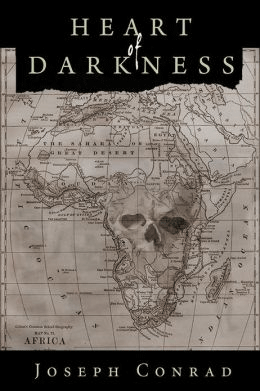
 

Dig this; here’s our first peek at Lord Henry, the villain of TPoDG:

From the corner of the divan of Persian saddle-bags on which he was lying, smoking, as was his custom, innumerable cigarettes, Lord henry Wotton could just catch the gleam of the honey-sweet and honey-coloured blossoms of a laburnum . . .  [my italics]

Here’s our first peek at Conrad’s alter ego:

Marlow sat cross-legged right aft, leaning against the mizzen-mast. He had sunken cheeks, a yellow complexion, a straight back, an ascetic aspect, and, with his arms dropped, the palms of hands outwards, resembled an idol.  [my italics]

Indulge me on last contrast, a contrast in how one feels about lying, which is of particular political import right now in the USA.

“Let’s go to the theater tonight,” said Lord Henry.  “There is sure to be something on, somewhere. I have promised to dine at White’s, but it is only with an old friend, so I can send him a wire to say I am ill, or that I’m prevented from coming in consequence of a subsequent engagement.”

Marlow, on the other hand:

You know I hate, detest, and can’t bear a lie, not because I am straighter than the rest of us, but simply because it appalls me. There is a taint of death, a flavour of mortality in lies – which is exactly what I hate and detest in the world – what I want to forget. It makes me miserable and sick, like biting something rotten would do.

I’ve been highlighting snippets from the other novel to both ninth and tenth grade classes.  I pretend that the two events, Marlow’s telling his horrific story of what he saw in Africa on the Nellie in the Thames and Lord Henry lounging on the divan in Mayfield, are taking place simultaneously.

And, of course, they were.

1010226_1431056643796011_1891552011_n1


[1]Not surprisingly, this information is provided via lecture, rather than having the attendees discover it in group work,
The Power of Glove

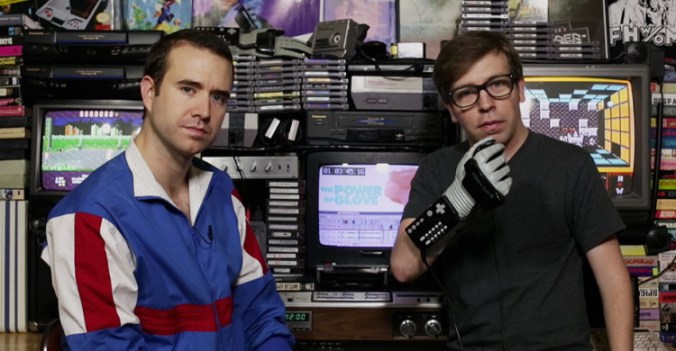
The filmmakers: Andrew Austin and Adam Ward (sporting the Power Glove)

Several years ago, my son Ned, then a graduate student, brought home to Folly Beach a friend, Andrew Austin, who was studying film-making at Wake Forest. A native of Lake Charles, Louisiana, Andrew is an interesting, quirky cat (as we old beatniks say).[1] For example, he always sports red socks (in honor of his grandfather), has mastered the art of rolling coins across his knuckles, and juggles so well you might guess he spent his childhood on the vaudeville circuit.

Here he is in 2011 performing in our living room to the dulcet sounds of fellow Louisianan Dr. John.


I caught up with Andrew last week when he crashed at my place in between film festivals where his first feature (co-created with Adam Ward) A The Power of Glove is making the rounds.

I got a chance to view the film, and if you ever get the chance, jump at it.

It’s a tribute to the documentary that I found it completely engaging even though it concerns the realm of video gaming, a pastime that interests me about as much as the private lives of minor league baseball umpires.

The movie chronicles the rise and fall and semi-resurrection of the Power Glove, a 1980s contraption that was supposed to revolutionize video gaming but ended up being a colossal critical and commercial failure. Nevertheless, the glove has managed to enthrall certain gamers and has over the years provided hackers with hardware that they have readapted to interface with whatever their obsession might be — electronic music or virtual reality, for example.

Take a peek at the trailer.

The scope of the research is beyond impressive. The Austin and Ward assembled a wide range of people associated with the glove — its inventors, marketing executives, engineers, aficionados, musicians, artists, and a “virtual reality evangelist – to name a few. From the coloring to the graphics to the soundtrack, the film has a real 80s feel.

I certainly hope whoever picks up its distribution will do the film justice.

Andrew and I-and-I at Chico Feo 


[1] Is there any such thing as a young beatnik, a twenty-year-old-bongo-playing-beret-wearing-goatee-sporting-Ginsberg-reciting hep-cat?

This Absurdity

Marius van Dokkum

What shall I do with this absurdity —

O heart, O troubled heart — this caricature,

Decrepit age that has been tied to me

As to a dog’s tail?

Yeats, “The Tower”


Although I’m old enough to qualify for Medicare A, I don’t think of myself as “a senior citizen.”   Nevertheless, manufacturers of walk-in tubs, wheel-equipped walkers, and adult-diapers have increasingly targeted me as a potential consumer.

It’s time I faced it: I am a senior citizen, a paltry thing, a tattered coat upon a stick, a demographic corpse-a-coming whose limbo-winning-contest days are way, way over. Now, catching a wave is a major accomplishment; riding my skateboard sends my heart rate into machine-gun blast parameters. Although I’d like to think my sons don’t “curse the gout, serpigo, and the rheum, /For ending [me] no sooner,” [1] it’s obvious we’re in the last ten minutes of the feature film of my life.

However, the “senior dating sites” haven’t written me off as semi-incapacitated yet. They’ve discovered I’m a widower and think I’d probably prefer to avoid a desolate, lonely, sciatica-ridden senescence sitting in my drafty garret filling in crossword puzzle books, compulsively checking my dwindling net worth, trying in vain to decipher the misshapen letters/symbols/numbers of passwords in my late wife’s address book that look as if they may have been scrawled by Woody Guthrie in the last stages of Huntington’s.

Just yesterday, SeniorMatch came on to me, in hopes whupping up some post-menopausal passion between me and a soon-to-be-discovered other, seductively pumping me with compliments, assuring me I’m “experienced” and that I “know what I like.”

We’ll have fun fun fun until the offspring take the car keys away.

Well, they’ve already gotten something wrong: I’m not experienced. Until this year, I hadn’t had a date since 1976, and on that one, she, my late wife, did the asking under the pretense I would be dining with her and her roommate, a fellow bartender. Before then, I was a serial monogamist. I think I’ve only asked someone I didn’t know well out twice.

And until this year, I didn’t realize that certain times a day held certain implications for singles meeting for a drink, that 4 pm meant something different from 7.

I do, however, know what I like: the sound of my own voice.


And what I don’t like: most people.

However, if I were to sign up, this would be my profile picture:


[1] Measure for Measure, 3.1

A Short, Rambling Treatise on Lying


815196-7

Andrzej Mazur, “The Liar

I grew up down the street from a pathological liar. He was a year or two younger, friends with my brother. To give you an example, one time he told me that outside his house he had thrown his baseball glove through his bedroom’s second story window, and the glove landed in his toy chest, which I guess is possible, but then he said he tossed a baseball into the air and swatted it with a bat and the ball arced through the same window and landed in the glove in the toy box.

In those days the word “bullshit” was not in my vocabulary – I was eight or nine — and in fact, I didn’t call him out on his lies because I didn’t want to embarrass him. However, his lying made me want to avoid him because not calling him out made me feel as if I were complicit, a liar by proxy. At that age, I didn’t contemplate what compelled him to construct such outrageous tales. Now it seems obvious that he found something lacking in himself and needed to compensate.

However, don’t we all sometimes “stretch the truth” to make our experiences seem, well, more notable?

Richard Wilbur assures us that

To claim, at a dead party, to have spotted a grackle,

When in fact you haven’t of late, can do no harm.

Your reputation for saying things of interest

Will not be marred, if you hasten to other topics,

Nor will the delicate web of human trust

Be ruptured by that airy fabrication.

However, he implies that embroidering reality shouldn’t be necessary, given the wonders surrounding us:

In the strict sense, of course,

We invent nothing, merely bearing witness

To what each morning brings again to light:

Gold crosses, cornices, astonishment

Of panes, the turbine-vent which natural law

Spins on the grill-end of the diner’s roof,

Then grass and grackles or, at the end of town

In sheen-swept pastureland, the horse’s neck

Clothed with its usual thunder, and the stones

Beginning now to tug their shadows in

And track the air with glitter. All these things

Are there before us; there before we look

Or fail to look.

But we do fail to look. And our memories can be faulty: there may or may not been tiny swastikas tattooed between each finger of the man I worked with in 1974, but details enhance verisimilitude, and I can see those jailhouse tats as I’m retelling the story. I could pass a polygraph I’m so sure he had a tiny little swastika between each finger.

* * *

In Heart of Darkness, Charlie Marlow confesses, “You know I hate, detest, and can’t bear a lie, not because I am straighter than the rest of us, but simply because it appalls me. There is a taint of death, a flavour of mortality in lies – which is exactly what I hate and detest in the world – what I want to forget. It makes me miserable and sick, like biting something rotten would do.”

Marlow does, however, end his narrative with a whooper-and-a-half when he tells Kurtz’s fiancée that his last words were her name.

Let’s have Brando playing Kurtz deliver his actual dying words.

As the Kurtz’s “Intended” collapses into tears, Marlow gets the hell out of that house with its grand piano and its ivory keys:

It seemed to me that the house would collapse before I could escape, that the heavens would fall upon my head. But nothing happened. The heavens do not fall for such a trifle. Would they have fallen, I wonder, if I had rendered Kurtz that justice which was his due? Hadn’t he said he wanted only justice? But I couldn’t. I could not tell her. It would have been too dark—too dark altogether….”

Of course, we forgive Marlow that lie. Not lying in that situation would be like Stephen Dedalus’ not praying for his mother when she asked on his deathbed.

In that case, to hell with integrity!

* * *

That leaves us with two more categories, the lie to try to get out of trouble (been there, done that) and the despicable lie, for example, impugning someone’s integrity for spite.

Our president is, of course, guilty of this type of lie mongering when he calls Comey “a liar” and “sleezeball,” words of projection I think. Trump’s a terrible role model for sure, what Marlow would call “a papier-mâché Mephistopheles,” hollow to the core.

Does this sound like someone we know:

He had no genius for organizing, for initiative, or for order even. [. . .] He had no learning, and no intelligence [. . .] He originated nothing, he could keep the routine going – that’s all [. . .] Perhaps there was nothing within him.

Like the boy with the magic baseball glove and ball, it seems obvious that Trump finds something lacking in himself and needs to compensate.

276_picture

EBENEZER SUNDER SINGH

Good Advice, Take It or Leave It

Hendrik Jacobus Schotten, Good Advice

Don’t be in a hurry. Who cares if you’re late? Well, a few might: your employer might, your date might. The judge at your preliminary hearing.

On the other hand, oblivion is fine with it.

Norman Rockwell

Learn how to hold a fork. Note the difference between how Nick and Nora Charles deftly handle silverware as opposed to how prisoners in Russian movies fist wooden spoons as they slurp their swill. You don’t want to be eating like that in a cafeteria. Or maybe you do. Maybe you’re antisocial. If so, at least in the privacy of your lonely kitchen, mind your manners.

Nick and Nora Charles in After the Thin Man.

Don’t leave your Bo Diddley Beach Party LP (recorded live at Myrtle Beach) unsheathed, naked on your dormitory floor. Crunch.[1]

If you’re going to purchase Costa sunglasses, be mindful. Don’t perch them on the top of your head on the roller coaster ride. Buy cheap shades instead. Only the most shallow of consumers, like me, pay attention to the quality of your eyewear.

***

Never wash your hands more than four times a day – and that seems excessive to me. Cultivate immunity. Make friends with Mr. and Mrs. Germ.

Pilate Washing his Hands 1663 by Mattia Preti

When you read, slow down. Pay attention to the sound of of words.

***

Try not to lie unless you’re in dutch deep. Say vague things like you can’t come after all because “something’s come up.” If there’s a follow up question or remark, like, “I hope everything’s all right,” say, “Well, not really, but I’ll be okay.”

***

Floss your teeth before you go to bed. Then brush them again, this time with Listerine. Those receding gums will make you look creepy, predatory, Nosferatu-ish.

Don’t engage in political arguments on social media. Don’t post what you eat on social media. Don’t smugly say not a bad seat when you’re sitting at ringside.


***

Avoid advice dispensing know-it-alls.


[1] Thornwell Tenement, University of South Carolina, 1972.


In All His Tuneful Turning

IMG_1938

View from my classroom window

Nature’s first green is gold,
Her hardest hue to hold.
Her early leaf’s a flower;
But only so an hour.
                                              Frost, “Nothing Gold Can Stay”


Is it merely my morbid imagination, or has this been a dreary spring weatherwise?

Today, for example, like yesterday and the day before, a leaden sky darkens the land, muting nature’s first green.  And, since nothing gold can stay, it also follows that neither can gray, that the leaden sky and dank, chilly air won’t stay around forever.  Obviously, weather is constantly moving from west to east as the earth spins, so we can look forward to bright days ahead, and dark days, sickness and health, until death slams the door and the picture making machine shuts off, which doesn’t faze me one iota.  As the poet sez, “I don’t remember any problems I had before I was born.”

I do remember, however, it was a bright sunny but below-freezing day when I repeated after the pastor those words “in sickness and in health” and that Judy’s, my bride’s, expression seemed beyond earnest as she stared me in the eye, looking beyond sincere, and her ardor sort of surprised me, and I felt sort of guilty, abstracted there at the altar, thinking not about the vows but about how she looked and wondering what my expression looked like. In other words, I was distracted, out of time.

judy-the-bride

The good news is that we got to enjoy thirty-nine-and-a-half earth revolutions before death did us part, and it’s almost been a year since then, eleventh-twelfths of a revolution, a quick year, eventful, often lonely but not always.

I’m sitting here at school between conferences with someone else’s advisees (their advisor’s on maternity leave), and it’s the last time I’ll ever do so (mine or all seniors, and I won’t be assigned any new ones). Even though I’m not at all adept at negotiating the byzantine grids of requirement, I am good at engaging parents in small talk, playing the Yeatsian role of sixty-year-old smiling public man (what he calls “a comfortable kind of old scarecrow”).  Nevertheless, I won’t miss having advisees next year, the way I might miss teaching “Among School Children.”  Will I even come to school on conference day or instead practice at being retired by riding my bike to the Lost Dog for a croissant?

I find myself less and less in a hurry nowadays, and when I eventually do retire, I hope to never be in a hurry ever again. Old age can have its compensations, educated offspring, paid mortgages, free time.

So c’mon, sun, break through; match my mood. I’m done with school for today. I get to hang out with Walker Percy for the rest of the early afternoon and then look forward to whatever.

Easter 2018

photo credit Caroline Traugott

I guess from now on, I’ll always associate spring with death, Mother’s Day especially, the day my sons’ mother passed, a word I don’t use in this context. It’s probably such a popular euphemism because it suggests travelling, passing through death’s dark door into another realm, the undiscovered country, Hamlet calls it.

Although I don’t believe in an afterlife, I’m not arrogant enough to think I could not be wrong about my disbelief. Once again, Hamlet, to his pal Horatio, after having conversed with the spirit of his father:

There are more things in heaven and earth, Horatio,

Than are dreamt of in your philosophy.[1]

As it turns out, my younger son Ned has recently conversed with his mother Judy, though in a dream. Aglow, Ned said, with golden light, she told him she was fine, and that things were more important where she was now, that she was busy.

At any rate, any rational person perceives the ubiquity of death — the fallen leaf, roadkill in the medium, swatted mosquito, ill-tended orchid — with a measure of dispassion.  The not-so-sad fact is the last thing that dying or grieving makes you is special.

Of course, we’re all destined to die – the blight that man was born for, Hopkins calls it in “Spring and Fall.”

Márgarét, áre you gríeving

Over Goldengrove unleaving?

Leáves like the things of man, you

With your fresh thoughts care for, can you?

Ah! ás the heart grows older

It will come to such sights colder

By and by, nor spare a sigh

Though worlds of wanwood leafmeal lie;

And yet you wíll weep and know why.

Now no matter, child, the name:

Sórrow’s spríngs áre the same.

Nor mouth had, no nor mind, expressed

What heart heard of, ghost guessed:

It ís the blight man was born for,

It is Margaret you mourn for.

On the other hand, more importantly, we’re born to live, and spring, of course, is all about resurrection. Look at Good Friday’s full moon at the top of this page, perched in a tree above the Pour House porch. How beautiful!

Now it’s waning, melting away, obliterating fewer stars as it progressively disappears, and, of course, our favorite star continues to do its thing.

And for all this, nature is never spent;

There lives the dearest freshness deep down things;

And though the last lights off the black West went

Oh, morning, at the brown brink eastward, springs —

Gerard Manley Hopkins, “God’s Grandeur”

Yesterday, Caroline and I picked up two six-day-old peeps as an Easter present for her daughter. Downstairs in Ned’s vacated room, growing seemingly in time-lapse fashion before our very eyes, downy little dinosaurs pecking away, stretching their tiny embryonic-looking wings, lucky to be alive.

To me, this seems enough: to be able to breathe, to taste, to fall in love again, to read Hopkins out loud backed by wind chimes as the melting moon makes her way towards the horizon to be reborn.

Happy Easter.


[1] Philosophy here could entail science.

My Linguistic Reign of Terror

photoshopped from left to right: Donald Trump, Jr., Eric Trump, Betsy Devos, Mitch McConnell,Paul Ryan, and Donald Trump

Most people my age have cleaned out the attic of their overblown aspirations, have gotten rid of the ridiculous notion that they’ll write the great American novel or sell an original screenplay that wins an Oscar (which, in my case, would include getting shitfaced at the Vanity Fair after party and going home with Myrna Loy).

Not me. I still dream of single-handedly overthrowing the US government, declaring myself a Sun God, and initiating a reign of terror to punish those who have offended my delicate sensibilities.

Don’t worry, I won’t bore you with detailed descriptions of the exquisite tortures I have concocted for the likes of Mitch McConnell (staring into a mirror), Paul Ryan (translating Atlas Shrugged into Finnish), or Donald Trump (taking away TV and Internet privileges until he has memorized word-for-word the 1855 edition of Song of Myself).

Once the heavy-duty guillotining was done and the nation had settled down to the thousand years of bliss I had promised, I would issue several proclamations concerning the use of language.

* * *

It would be unlawful to end a declarative sentence with an interrogative lilt. Like, no more, “I have never had a toe amputated?”

Incorrect pronoun cases would be allowed (e.g., me and Timmy went, between you and I); however, not making the distinction between less and fewer would be punishable by having to sing at one sitting “10,000 Bottles of Beer on the Wall.”[1]

Except for vacations to all-inclusive Jamaican resorts, there would be no more laying in the sun.

Tattooed proclamations could no longer be rendered in gothic script.

Adolescent boys would be required to dot i-s with hearts.

* * *

Oh, my God. Lord Acton is right about absolute power! Obviously, it’s past time for me to pack up this fantasy and put in on the side of the road to be transported to the dump of broken dreams.

Hey, I got plenty of more productive things to do with my time, like researching Medicare supplemental insurance policies/walk-in tubs.

Go ahead, brothers and sisters, say what you will. Dig on that First Amendment.

Do it!


[1] I was delighted yet dismayed to hear my grief counselor’s 9-year-old tell me that on a recent fieldtrip they sang “100 Bottles” (delighted) but beer had been replaced with milk (dismayed). Yet another example of political correctness run amok.

myrnaloyhair2Myrna Loy

Don’t Touch That Thesaurus, Sophomore!

collins

Here’s what happens when you put a thesaurus in the hands of a sophomore writing an essay on Pride and Prejudice:

As soon as he matriculates into the Bennet’s domicile, Mr. Collins’s lack of social opulence opaquely dissembles in elocutions of grandiosness that triturate on the tender spots of Mr. Bennet and his female offspring’s sense and sensibilities.  Mr. Collins’s unenlightenment of social indicators immobilizes his ability to apple polish his way into the family’s entwinements. A disproportionate kow-towing to the strictures of formality manufacture him into an integer of caricature.  Whether he’s dogmatizing from the pulpit or twaddling at a shindig, Mr. Collins is sure to faux pas his way into jocosity. 

[ sigh sough]