The Ever Losing Gamecock Blues


Take me to a taproom,

Pull me an IPA.

Ain’t no Pabst gonna do it,

The Gamecocks played today.


Most talented team ever,

All the sportswriters said,

But when the game clock expired,

My hopes were also dead.


So here we go again,

A dozen or so Saturdays shot.

Ought to cancel my ESPN

And buy me a pound of pot.


But Hope is a powerful drug,

And patterns easy to ignore.

So sure as hell next Saturday,

I’ll be cursing our failure to score.


So take me to a taproom,

Pull me an IPA,

Ain’t no Pabst gonna do it,

The Gamecocks played today.


Weekday Road Trip, Featuring Live: Steve Earle, Beto O’Rourke, and the Mighty Dukes

Steve Earle and the Dukes At Francis Marion U. Performing Arts Center Tuesday 27 August 2019

BBQ and Alt American Heroes

For the last couple of decades, on a weekday around 11:30, you’d likely find me at the cafeteria sneaking an early bite in hopes of avoiding the crush of famished adolescents who descend upon the regular lunch period.  But last Tuesday at 11:30, I was pulling into what my father-in-law Lee Tigner calls the omphalos of the barbeque world, Brown’s Bar-B-Que, right outside of Kingstree on North Hwy 52.

For our first anniversary, my wife Caroline bought us tickets[1]to a Steve Earle concert in Florence, South Carolina, a city on the move in an otherwise non-prosperous region of the Palmetto State.  On a whim, we decided to take the back roads and have lunch on the way.  The obvious choice was Brown’s.

If I should ever find myself on death row, I’m ordering Browns’ buffet for my last meal.[2]

Rice, roast beef stew, delicious tiny fried creek shrimp, fried catfish, mac and cheese, vinegary pepper barbeque (lean and clean), pork brusque, potato salad, coleslaw, desserts galore, including banana pudding, any condiment you could hope to have.[3]

Overstuffed but satisfied, we continued our journey racing graffiti-covered boxcars as they rumbled along parallel to us on 52.

As the outskirts of Florence became center city, we slowed down in anticipation of making a right turn when we saw on the sidewalk coming towards us this quirky bespectacled man sporting red knee-length shorts, a ZZ-Top-like beard, and long shoulder length hair.

Yes, it was the man himself, Steve Earle, American treasure, brilliant songwriter, and eclectic producer of a various strains of Americana music – blues, country, bluegrass, rockabilly, Celtic hybrids.  He’s also a published short story writer, novelist, and playwright. Probably, he was on his way to the Francis Marion Performing Arts Center, which was walking distance from our hotel and the Hyatt.  I’m embarrassed to say it, but it was sort of thrilling seeing him as a civilian, sporting what my pal Jake would call a dgaf [4]outfit.

Checking In and Out

The Hotel Florence is lovely and well staffed, and I don’t know why this happens, but when Caroline checked us in, they bumped us up to a two-bedroom suite with a full kitchen and two full baths, shades of our honeymoon when we were bumped up to the Presidential Suite at the Grove Park Inn.  In both cases it was too much, appreciated, but under-utilized.

Despite the swanky digs, we weren’t in the mood to lounge around in our rooms.  We needed a drink, so I googled “bars in Florence,” and the most interesting name that came up was “Downtown Southern Funk,” located eight minutes away in the warehouse of Seminar Brewery, Florence’s oldest.

While we were in that cavernous space, the Manager asked if we wanted a free ticket to the concert that night.  We told him we were set, but he insisted we take the ticket and try to give it away at the venue.  So we took the ticket, and as we were chatting with a bartender, I said,” Hey, man, you really ought to take the ticket and go.”  He insisted he couldn’t because with Beto being there in a couple of hours, they’d need all the bartenders they could muster.

“Beto O’Rourke?”

“Yeah, he’s giving a town hall meeting here at six.”

We ended up giving the ticket to another patron, whom we saw later at the show and who picked up our tab.

 To Go or Not to Go

Back at the hotel, we contemplated.  The town hall started at 6, the concert at 7:30, which would mean an Uber to and fro, but ultimately, we opted for the rough and tumble of American democracy instead of the serenity of the hotel bar.

We arrived at about a quarter to six, and the lack of security surprised me: no metal detectors, no riffling through handbags.  I’d call it a modest crowd, mostly white.  We grabbed a couple of beers and chatted with Beto’s South Carolina chair, a lovely, articulate woman in her late twenties.

After a brief introduction from a state representative, Beto took the microphone and delivered his stump speech, which focused on guns and immigration.   Of course, he hails from El Paso, site of recent carnage, and I was somewhat surprised when he said the word “shit.”  “We need to quit selling that shit,” he said, referring to assault weapons. Indeed, how absurd that it’s legal to buy weaponry not intended for hunting or self-defense but for rapidly killing human beings, whether they be elementary school children, patrons of movies or gay bars, or Walmart shoppers.

Some smug, ramrod-erect old man interrupted Beto, who goofed by handing him the microphone. [5]The man launched into a screed claiming it was cellphones, not guns, that were to blame for the spate of American bloodbaths. No, these massacres are a by-product of educational dereliction, a consequence, he claimed, of society’s and government’s rejection of Yahweh and His Only Begotten Son.  Aides attempted to get the mike from him and finally succeeded.  Once Beto was able to speak, looking directly into the man’s face, he calmly mentioned that European countries also had high cellphone usage and were much less religious than the USA but rarely were the the scenes of mass shootings.

Once questions began, a young man with a baseball cap flipped backwards claimed that Trump was not a racist among a shower of boos as Caroline and I sidled outside to catch our Uber and hit the concert.

Beto at Seminary Brewing Tuesday 27 August 2019


The Francis Marion Performing Arts Center

Florence, or FloTown as the hipsters call it, is enjoying urban renewal, and you could sense a genuine pride in several of the residents we talked to about the transformation. They said that before the Performing Arts Center, you wouldn’t want to be in this section of town at night.  One actually compared it to Detroit. Now, it’s very peaceful, laidback, verdant.

Anyway, the area is now quite nice, and I agree with brochure we were handed when we entered  the Performing Arts Center that “the unique facility offers patrons an unusual level of intimacy, paired with sophisticated acoustics.”

The Concert

Steve came out and introduced the first act, the Mastersons, a husband-and-wife team consisting of superb guitarist Chris and exquisite fiddler Eleanor Whitmore, masters of technique and vocal harmony.
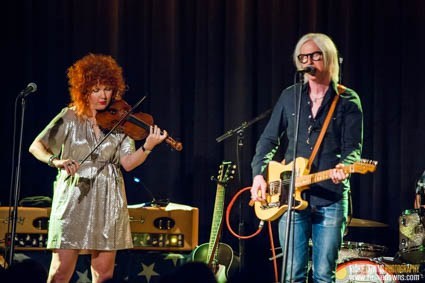
Alexandria, VA – July 18, 2017 – Steve Earle and The Dukes perform at The Birchmere. (Photo by Richie Downs)

They also accompanied Steve and the Dukes throughout the concert, which featured several covers of Guy Clark songs and a generous sampling of Steve’s greatest hits, which, as I have already said, cover the gamut of various Americana subgenres.

I can’t provide a complete set list but songs included Clark covers “Desperados Waiting for a Train,” “Dublin Blues,” and “LA Freeway.”

Among Earle’s hits, we heard “Guitar Town,”  “Galway Girl,”  “Fort Worth Blues,”  “Copperhead Road,” and many others, including a car medley featuring Springsteen’s “Racing in the Streets,”  “Sweet Little 66,” and “Pink Cadillac.”[6]

The Dukes sounded great, whether harmonizing a bluegrass number, plucking an Irish melody, or fuzzing dissonantly on one of his rockers.

A+

At the Francis Marion Performing Arts Center Tuesday 27 August 2019

The Dispensary

We walked home after the show, and instead of going back to the hotel, we hit the rooftop bar at the Dispensary.

It’s fairly dark up there and seating consists of sofa sets and coffee tables.  When we arrived, a couple of females nestled at a corner table, but that was it.  About a half an hour later, a college couple arrived, and the male gave his date a sort of a mini tour of the skyline before snuggling down on a sofa across the bar from us.

As we got up to leave, in stepped the Dukes: the above-mentioned Chris Masterson and Eleanor Whitmore, Ricky Ray Jackson, and Brad Pemberton (sans bassist Kelly Looney).  We told them how much we enjoyed the show, and Chris thanked us. I apologized for being intrusive, and he said, “Oh no, thanks for coming to the show.”

We hauled our glasses downstairs, the bartender thanked us, and that was that: a memorable post-retirement weekday, to say the least.

Selfie at the Dispensary Rooftop Bat Tuesday 27 August 2019


[1] Of course, the traditional gift for the first anniversary is paper.

[2]BTW, Mr. Earle has two dramatic monologue songs sung by death row denizens, “Bill Austin” and “Jonathan’s Song.”

[3] Or would it make more psychological sense to order a pack of saltines and a Carling Black Label beer?

[4] an acronym for “don’t give a fuck fig.”

[5]At these town halls, aides carry a separate microphone to field questions.

[6] Steve’s hero, Townes Van Zandt also covered “Racing in the Streets” on one of his live albums.
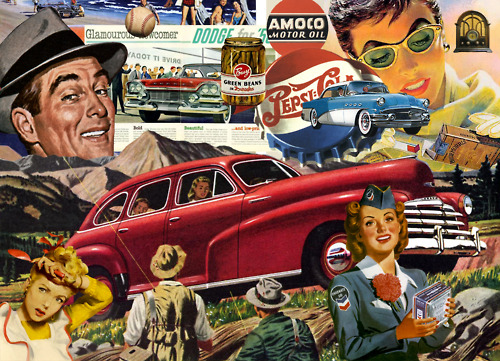
1950’s Trivia Quiz

In my last post, I wrote about teaching a history elective called America in the Sixties.  Unfortunately, I didn’t interweave the material into a harmonious tapestry; instead, I patched together a quilt – separate units on the 50’s, civil rights, Vietnam, the Great Society, Second Wave Feminism, Counterculture, and music.

I thought it might be fun to see how any trivia mavens out there might fare on the multiple-choice section of my final exam.  I’m fairly sure no one is interested in tackling the exam essay.[1]

So, here’s the first section on the 1950’s.  The answers will appear in the comments below.

1. Who warned the American People about the dangers of “the military-industrial complex?”

A. Truman  B. Eisenhower  C. Kennedy  D. Nixon

2. Which of the following statements is not true concerning the US economy in the 1950s?

A. GNP averaged 7.6%    B. high government spending  C. characterized by consumer society D. low taxes

3. Which of the following is not true about women in the 1950s?

A. median age of marriage rose
B. many women kept working
C. women could not legally obtain an abortion
D. women were seldom employed as business executives

4. What was the primary reason that the number of college students doubled in the 1950s?

A. booming economy   B. baby boom   C. GI Bill   D. more acceptable for women to attend

5. Who is the Senator who spearheaded the Red Scare persecution of American citizens considered “communist sympathizers?”

A. Joseph McCarthy   B. Roy Cohn  C. Barry Goldwater D. J Edgar Hoover

6. What was the surname of the married couple who were convicted of providing the Soviet Union with scientific atomic bomb making secrets?

A. Hiss  B. Cohn  C. Arnold   D. Rosenberg

7. Which of the following didn’t occur in the 1950s?

A. Montgomery Bus Boycott  B. integration of Little Rock Schools  C. Brown v. Board of Education  D. the March on Washington

8. Who was the leader of the Soviet Union for majority of the Fifties?

A. Lenin  B. Stalin  C. Khrushchev D. Brezhnev

9. Which of the following is not associated with Beats?

A. Allen Ginsberg  B. Timothy Leary  C. Jack Kerouac D. William Burroughs

10.  Which of the following wasn’t a musical force in the Fifties?

A.  Bo Diddley                                    B.  Buddy Holly

C. Chuck Berry                                  D.  James Baldwin


[1]The 60s obviously had its dark and bright sides, and not surprisingly, historians disagree about whether the overall impact was positive or negative. Here’s historian Arthur Marwick:

Mention of `the sixties’ rouses strong emotions even in those who were already old when the sixties began and those who were not even born when the sixties ended. For some it is a golden age, for others a time when the old secure framework of morality, authority, and discipline disintegrated. In the eyes of the far left, it is the era when revolution was at hand, only to be betrayed by the feebleness of the faithful and the trickery of the enemy; to the radical right, an era of subversion and moral turpitude. What happened between the late fifties and the early seventies has been subject to political polemic, nostalgic mythologizing, and downright misrepresentations.

In a thesis driven essay in which you cite specific events and individuals, evaluate the 60s as a decade. On the whole, do you consider it positive or negative. Why?

Matters you might consider include the social and economic order of the 1950s, the Communist threat, civil rights, assassinations, Viet Nam, Great Society legislation, social upheaval (counterculture, protests, riots), and women’s rights.


The Omission of Blue Cheer

In my last two years at Porter-Gaud, I taught a class called “America in the Sixties,” a history elective I felt unqualified to teach.  Sure I came of age in the Late Sixties and Early Seventies, yes, I was suspended from school for wearing a black armband on Moratorium Day[1], and, um, sure, I could offer firsthand insight of what it is like to ingest lysergic acid diethylamide. On the other hand, my knowledge of the Freedom Riders, the Gulf of Tonkin Resolution, and the Great Society agenda was on par with Mike Pence‘s knowledge of the poetry of Charles Bukowski.

The one topic we covered I felt confident about was music.  Thanks to the sophistication of the latest technology, I could embed short videos into Keynote slide shows that covered the roots of rock, Early Sixties music, Mo Town, Stax, the British invasion, and finally the San Francisco sound.

But even here I was somewhat derelict because in the San Francisco piece I failed to mention the seminal acid blues rock band Blue Cheer, whom some identify as the very first heavy metal band.[2]

My pal, the late Gordon Wilson, turned me on to Blue Cheer in ’69.  The band, which borrowed their name from a variety of LSD, had released a really arresting album, Vincebus Eruptum, the year before.   Its most successful single, a cover of Eddie Cochran’s “Summertime Blues,” actually peaked at #14 on Billboard, though I don’t remember ever hearing it on the radio. Also featured on the album was the blues standard “Rock Me, baby,” made famous earlier by Muddy Waters and BB King.

Eddie Cochran

So what you got was the blues all hepped up on goofballs.

Here’s a video.  Note the relentless drumming and wailing guitar.


Anyway, I think “Summertime Blues” holds up fairly well, though I doubt if many of my students in the Sixties course would have dug it.  When I first started teaching at PG in the mid-Eighties, students were obsessed by Sixties music.  In fact, I dubbed them “the re-generation.” However, nowadays hip hop and country have replaced rock as the most popular genres, and most of those students of mine last year would prefer to hear Beyoncé over Janis Joplin.


[1]15 October 1969

[2]Maybe, but isn’t the Kinks’ “You Really Got Me” at least a heavy metal song, even if you wouldn’t call the Kinks a “heavy metal band?”

Corky Cain, Washed Up Surfer, Sings of Dead End Hedonism


sick with desire

And fastened to a dying animal


My ash blonde hair has disappeared,

leaving a freckled scalp in its stead.

Two black bags bulge beneath my eyes,

All rheumy and rimmed with red.


They say sagacity is recompense.

(I’d settle for a dollop of common sense).

Hey, little lady, could you spare me a smile?

(Or at least a wink instead of a wince?)


No, when it comes to wisdom,

I’m an old lecher banging on a drum,

cruising the boulevards looking for love

in the suburban sprawl of Byzantium.


Playing the fool, the pantaloon,

howling for hours at the hollow moon,

waking in the morning with a broke down head,

knowing that never will be all too soon.


Old friend, Willy B, sing me a song

that will drown out the barbarous gong

of the death knell clanging in my brain

you, the king of love gone wrong.

Al Gored

Where will my typing fingers lead my mind this morning?  There are so many topics to explore, from the divine (is there an afterlife and what would it be like) to the absurd (evangelical Christians claiming a Professional Wrestling promoter who paid off a porn star to keep quiet about their tryst three months after the birth of his son was sent by God Almighty to save us all).

Or I could waste my and your time engaging in wishful thinking.  For example, how would the world be different if 19,000 Palm County Florida ballots had not been spoiled because of shoddy ballot design and Al Gore had been elected President in 2000?

Here are some possibilities:

Perhaps 9/11 would have been prevented.  Bush ignored intelligence warnings that Bin Laden was planning to attack the US. Perhaps Gore would have put the nation on Red Alert, but, of course, there’s no way of knowing for sure.

I am, however, supremely confident that Gore would not have waged war against Iraq – Afghanistan perhaps, but not Iraq — saving hundreds of thousands of lives and billions of dollars.

Imagine that money being directed towards infrastructure instead of military hardware.

Remember his much maligned idea of taking the Clinton surplus, placing it “in a lock box” for the upcoming rainy day (think monsoon, deluge) when our aging population overwhelms Social Security and Medicare funds?

John Roberts and Samuel Alito wouldn’t be on the Supreme Court.

The Great Recession avoided.

I could go on.

But what is it about Al Gore that makes him the target of such widespread animosity?   He seems to provoke a disproportionate amount of scorn from Late Empire citizens from all walks of life.  I remember all too well during the 2000 Campaign when the mainstream [insert nervous throat-clearing audio] liberal press pilloried him, as if coming off as a somewhat pompous, wooden media presence was more worthy of scorn than being a dysphasic Connecticut cowboy with a mutant Midas touch that turns everything he touches into shit, whether it be an oil-drilling company, a war of liberation, or the United States economy.[1]  So what if Gore served in Nam?  W served his country in the saloons of Texas.  So what if W is incapable of delivering an unscripted coherent paragraph? Al Gore claims that he invented the Internet. Ha ha ha ha ha.

You would think that in the ruinous aftermath of the Bush Debacle, people might cut poor Al some slack, realizing that a rather robotic public persona doesn’t mean that human being behind the automaton mask is necessarily a buffoon.  Having W as your lab partner might yield a couple of funny jokes you could tell later, but you’re much less likely to have a beaker blow up in your face if Al (or Hillary Clinton) were working at your side.

But people still love to hate Gore.  I remember a decade ago when the South Carolina Aquarium bestowed upon Gore its Legacy Award, providing him a pulpit to preach his sermon on looming environmental disaster.

At the time, disgruntled citizens inundated[2]our local paper with comments like these:


An award? An AWARD???  Instead, ARREST this sorry piece of trash for aiding and abetting the greatest scientific fraud in the history of mankind!

Ask any REAL scientist, physicist, etc. Gore’s theories are not supported by the scientific community.

Anyone curious about how Gore’s family made their money in Tennessee?

[. . .] the SC Aquarium is honoring the father of all hoaxes ALGORE. It is a joke. I sure am not going to visit or take my children to a place that supports fraud science.

We already have clean air, water and food or we would all be dead.

Critical thinking at its finest!

So what are we to make of the general public’s disdain of this well-meaning man?  I have noticed similar reactions to certain students when I worked as an educator.  For whatever reason, some unfortunates attract a disproportionate fusillade of slings and arrows for their seemingly petty peccadillos – their fashion faux pas, shyness, sexual orientation, intellectual curiosity, etc.

I suspect that this tendency for folk to gang up on the socially awkward lies in some deep-rooted evolutionary adaptation.  It’s nothing new.


[1]Our current President, who makes W sound Ciceronian when it comes to oratory, shares these sentiments.

[2]Have you picked up on the flood motif?

Ayn Rand’s Treasury of Children’s Verse

“The proper method of judging when or whether one should help another person is by reference to one’s own rational self-interest and one’s own hierarchy of values: the time, money or effort one gives or the risk one takes should be proportionate to the value of the person in relation to one’s own happiness.” — Ayn Rand


Good Riddance

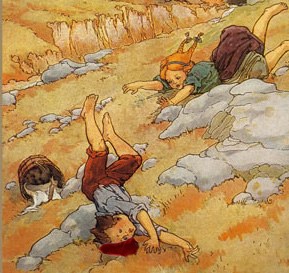
Jack and Jill went up a hill
to fetch a pail of water.
Jack fell down and broke his crown
And Jill came tumbling after.

And none of John Galt’s women
and none of John Galt’s men
lifted one little finger
to help either of them.

Pork

This little piggy went to market (as bacon)
This little piggy as ham;
This little piggy was injected with chemicals
And ended up as spam,
And this little piggy (see below)
went wee wee on the killing floor.

Pitch Black Night

Three blind mice
Three blind mice
See how they stumble
See how they starve.

All three were poisoned by the butcher’s wife
Who didn’t get the dosage of the poison quite right,
So now they spend their very last day
in pitch black night, pitch black night.

Yuk

Georgie Porgy pudding and pie
Hung with the girls and not the guys.
Puberty’s hitting him, however,
Precipitated a change in Georgie’s weather,
So Georgie ditched his girly toys
And hid in the closet with like-minded boys.

Mistress Ayn has this to say
To all of you who might be gay.
Breaking nature’s laws
Denotes “psychological flaws.”

She finds you personally “disgusting”
For your perverted lusting.
If you want to join her nation
Then you better switch your orientation.

Lullaby

Now I lay me down to sleep
in a universe dark and deep.
If I die before I wake,
Tough shit, them’s the breaks.

In High Praise of Deadwood


Yesterday in the cool air-conditioned confines of the Irish Pub St. James Gate, I told my beloved (who is more intelligent and literate than me I) that I considered the HBO series Deadwood to be a greater work of art than Toni Morrison’s Song of Solomon, a particularly insensitive comment on the week of the Nobel Laureate’s demise.  However, I didn’t make the claim to diss Song of Solomon or Ms Morrison, but rather to heap high praise on Deadwood, which I went on to compare to a magnificent Victorian novel in its construction (created in the flux-time of serialization), its breadth and depth, the complexity of its characters, etcetera, etcetera.

Robert Penn Warren mentored the series’ creator and writer, David Milch, and as far as 20th Century narratives go, Deadwood might owe more than a little something to All the King’s Men, but forgive me; I digress.[1]  These multi-seasonal television series I consider a really important advancement in the making of fiction. No longer must Middlemarch be freeze-dried into 90 minutes of cinematic action, hence the breadth and depth alluded to above. We can see the action and hear the characters and tailor the pace of the narrative to our individual attention spans, be they flea-like or godlike, as we do when reading a novel.

Many have (to point of cliché-dom) compared Deadwood to Shakespeare’s works, not only in the broad array of human types incarnated in individual flesh, but also in the language Milch employs.

Here’s Milch addressing the language of the series:

Many of them might have been illiterate, but they knew the King James Bible and Shakespeare, and that’s what shaped the way they thought and the way they expressed themselves.

Formal letters didn’t convey a great deal of how people spoke, but informal letters—say, a brother writing a brother about life in a mining camp, or period memoirs or diaries—do. Of course, much of the best stuff wasn’t written with the idea of publication. But you can get a fairly good idea of the evolution of the language and the derivation of most words and terms in the Library of Congress papers on oral history, and H. L. Mencken’s The American Language is very good on this too.


The dialogue, often iambic, can be stilted in its diction and syntax, but is infused with jazz-like riffs of alliterative vulgarity and profanity.[2]

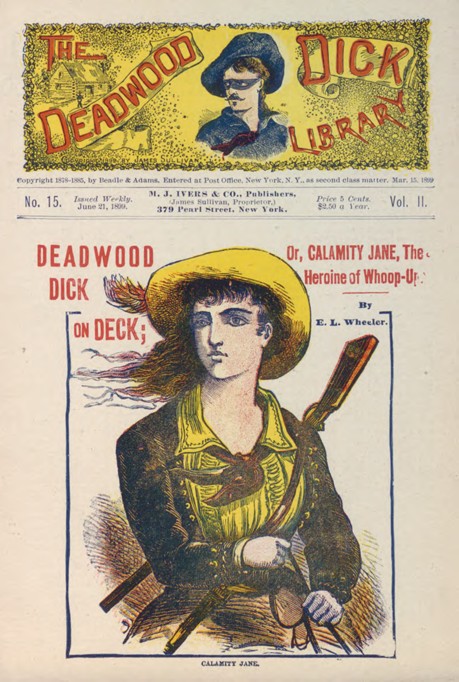
I’ll offer a couple of quick examples from Calamity Jane, who is mostly employed as a means of comic relief but who possesses, nevertheless, depth, because of her sensitivity and moral courage.

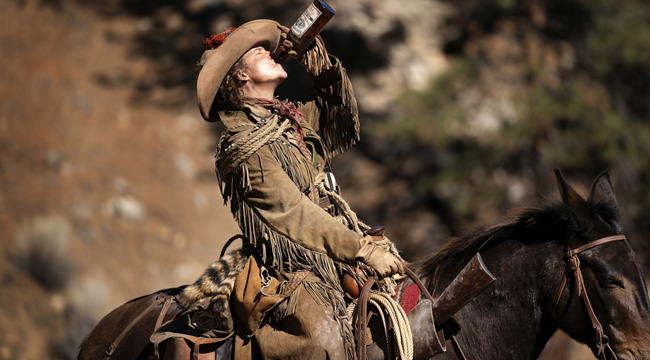
Robin Weigert as Calamity Jane

Here are a couple of examples of her use of language, both dealing with African American characters. When Jane tells Samuel Fields (who has dubbed himself the Little N-word General) that she’ll help him bury fellow African American Hostetler, he says, “That ain’t gonna raise your popularity with your fellow white people.” She replies, “Question I wake to in the morning and pass out with at night: ‘What’s my popularity with my fellow white people?’”

Later Aunt Lou, George Hearst’s cook, asks Jane if she could have a taste of the liquor Jane’s been chugging from a bottle.  Jane says, of course, but stops Lou from reaching for a cup as she hands her the bottle. “Do not employ a mug lest next we’d be donning white gloves.”

I could go on and on, but unlike a television series, a blog ain’t the medium for long-windedness, so I end with this admonition.  If you haven’t seen Deadwood, you need to check it out.  Despite its battlefield load of corpses, it’s life-affirming in the truest since of the word, the story, in Milch’s own words “of order rising from chaos.”)

Listen to the language here (there are vulgarities and racial epithets, be warned).


[1]I’ve never quite succeeded in squelching my bad habit of name-dropping.  I actually met Robert Penn Warren in a smallish group of English majors when he visited the University South Carolina circa 1974.  One of my teachers (a PhD candidate) had the courage to ask the first question:  “Mr. Warren, do you think a formal education would have ruined Earnest Hemingway?” Mr. Warren (screeching): How in the hell would I know!”

[2]There is a difference.  Vulgarity traffics in sex and excrement; profanity traffics in taking the Name of the Lord in vain.

Sweet Soul Music, a Brief History and Exegesis

Jean Mirre

One of my favorite one-hit wonders is Arthur Conley’s “Sweet Soul Music,” a sort of sonic collage of borrowed (polite word) sources paying homage to a few of the great soul singers of the Sixties.

The underlying source is Sam Cooke’s “Yeah Man,” released posthumously after Cooke’s bizarre murder (shot to death wearing nothing but a shoe and a sports jacket). [1]

I say collage, because Conley and his co-writer, the great Otis Redding, not only “borrow” from Mr. Cooke, but also co-opt the opening bars of the theme song from the movie The Magnificent Seven.

Here’s how “Yeah Man” commences:


Here’s the theme song from the movie:


And the beginning of Conley’s “Sweet Soul Music”:


Note initially the songs begin with the identical question, “Do you like good music.”  However, Conley substitutes Cooke’s “crazy about music” with “sweet soul music”  and sharpens Cooke’s “crazy about the dances” with “going to a go-go,” an allusion to the Smokey Robinson song of the same name. Specificity sharpens Cooke’s rather generic proclamations.

“Sweet Soul Music” is a tribute, a list of soul singers to be celebrated.

First Low Rawls.

Spotlight on Lou Rawls, y’all
Ah don’t he look tall, y’all
Singin’ loves a hurtin’ thing, y’all
Oh yeah, oh yeah

Then Sam and Dave

Spotlight on Sam and Dave, y’all
Ah don’t they look boss, y’all
Singin’ hold on I’m comin’
Oh yeah, oh yeah

Wicked Wilson Pickett is third

Spotlight on Wilson Pickett now
That wicked picket Pickett
Singin Mustang Sally
Oh yeah, oh yeah

Co-author Otis Redding is the penultimate singer cited

Spotlight on Otis Redding now
Singing fa fa fa fa fa fa fa fa
Fa fa fa fa fa fa fa fa
Oh yeah, oh yeah

Finally, the Godfather is crowned king

Spotlight on James Brown, y’all
He’s the king of them all, y’all
Oh yeah, oh yeah

Except Otis gets as encore allusion, the last singer’s name we hear in the song:  “Otis Redding’s got the feeling,”  Arthur grunts as the song fades away.

Check it out in its entirety:


[1]Hacienda Hotel, LA, 11 December 1964.  Check it out. Here’s one version: http://performingsongwriter.com/mysterious-death-sam-cooke/

Pulp Fiction Aficionado: the Genre of Once Upon a Time . . . in Hollywood

A few critics have panned Quentin Tarantino’s Once Upon a Time in  . . . Hollywood because it affectionately depicts a past that predates political correctness. For example, Richard Brody of The New Yorker notes that some have called the movie “Tarantino’s most personal film,” then adds, “and that may well be true—it’s far more revealing about Tarantino than about Hollywood itself, and his vision of the times in question turns out to be obscenely regressive.”

Never mind that Tarantino’s Jackie Brown features a working class African-American heroine as protagonist, Once Upon a Time, in Brody’s words, “reserves the glory moments of actorly allure, swagger, and charisma for male actors: when [character Sharon]Tate blithely admires herself, it’s for the role of the ‘klutz’ who falls on her ass for Dean Martin’s amusement and titillation.”

Brody ends his review with this observation: “Once Upon a Time . . . in Hollywood is about a world in which the characters, with Tarantino’s help, fabricate the sublime illusions that embody their virtues and redeem their failings—and then perform acts of real-life heroism to justify them again. Its star moments have a nearly sacred aura, in their revelation of the heroes that, he suggests, really do walk among us; his closed system of cinematic faith bears the blinkered fanaticism of a cult.”

C’mon, there ain’t nothing “real life” about Once Upon a Time, as the first four words of its title suggest.  It’s a comedy dressed up like a spaghetti western, often cartoonish. We have essentially two protagonists a la a buddy film, Rick Dalton, an actor, and his best friend, Clint Booth, his stunt double. When stunt double Rick repairs his pal Clint’s roof TV antenna, he foregoes a ladder, acrobatically propelling himself skyward, leaping from roof to roof like a ninja. It’s supposed to be funny, not realistic. Speaking of ninjas, Clint also out-martial-arts Bruce Lee with some spectacular kung fu fighting on a movie set. Unlikely to say the least. Oh yeah, Rick happens keeps a flamethrower at his hill top ranch house, which comes in very handy in the climactic scene. Think the Marx Brothers, not Joan Didion.

In other words, Tarantino’s goal is to entertain us, not to provide a commentary on the ‘60s.  So what if the protagonists don’t like hippies (and I was one sort of back then); most people didn’t.  Anyway, Tarantino doesn’t view the world through the annals history; he views it through what appeared on movie screens throughout the history of the cinema.

He’s not a social critic; he’s a pulp fiction aficionado.