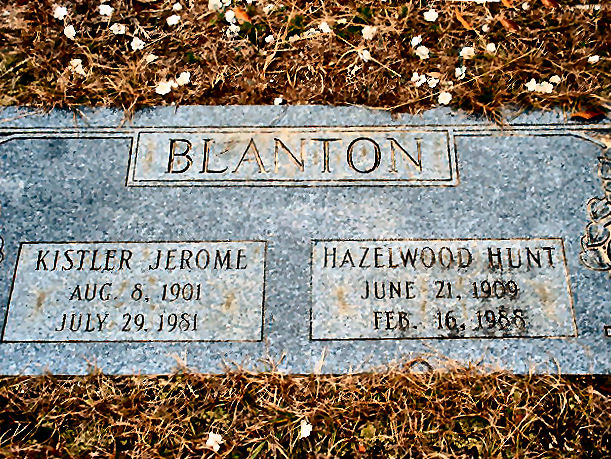
Because as a toddler I couldn’t pronounce Kistler,
my grandfather became known as Kiki –
as opposed to Grandpa, Peepaw, Pawpaw, or Pops.
Scots Irish, raw-boned, ruddy red, he stood five-foot-five, a bantam rooster of a man.
He owned and operated the Nation Station just outside of Summerville, and he’d pump your gas and check your oil and wipe your windshield, making sure you were good to go in those days of yore before self-service and debit cards.
When it was his time to go, at the hospital overnight we took turns sitting vigil so he wouldn’t have to die alone.
On one of my nights, he commenced, as he might say, to hallucinatin’, being chauffeured by long-dead second cousins once twice, but now, forever removed.
I tried to talk him down as if he were tripping, not knowing that it’s not uncommon for the dying to seek refuge in the ether.
Kiki didn’t believe in God, so at the funeral the rent-a-preacher didn’t know him, spoke in generalities, blandishments, insuring that Kiki would not come back alive.
No mention of the sun’s having baked his bald head and exposed neck into a permanent ripe tomato red.
No mention of the angry invectives That spewed like lava when he was angry “That goddamn psalm-singing son-of-a-bitch!”
No mention of the ukulele, the yodeling, his tenor voice,
No mention of the radio, Paul Harvey, the Atlanta Braves.
No mention of the half-pints of Old Crow hidden in his shoes in the closet so his wife, my grandmother,
In a Downton Abbey episode, the Dowager asks some lower order of humanity, and I’m paraphrasing, “This weekend you speak of – what is a weekend?”
Now that I have attic-stashed my academic robes, I can somewhat identify. Although my wife Caroline and stepdaughter Brooks are still bound by the chains of weekday responsibilities, I am not. There’s no place I must be on a Monday or Tuesday of Friday morning unless I have scheduled a doctor’s appointment or a meeting with my ace financial advisor Jumping Jack Flash Evans[1], or better yet, brunch with an out-of-town visitor.
Nevertheless, I still prefer weekends over weekdays because they’re more festive. No longer do I have the Sisyphean routine of essay assessment intruding upon a glorious Saturday, 65-degree, low humidity morning. I can walk with my [tautology warning] high-strung Chihuahua/rat terrier mix to the post office, taking either beach or river route, picking up her poop with aplomb, punishing ordinance-breaking layabouts[2] on the river route who have left their garbage receptacles on the street by plopping the biodegradable shit sack into their trash cans.
Grading Essays on a Saturday
I can do yard work or not or watch ESPN’s Game Day or not or crank out a blog post or not.
This is not to say that my life is stress free. Yesterday, for example, I obsessed over the upcoming Game 6 of the Braves vs. Dodgers, NCLS game. In the morning, I puttered around the house, clipping Elaeagnus, solving crosswords, and fretting about a Capital One card that had gone AWOL. Although the Braves were in the enviable position of being up 3-2 in the series, a decades long legacy of losing shadowed that rosy scenario. After all, they were up 3-1 last year and failed to win the series.
Although I hesitate to share with my readers (so far this year 17,000 visitors from 125 countries, including Mongolia), when I’m anxious about something, I tend to self-medicate. So, I cracked open a beer earlier than usual. Selfless Caroline was escorting Brooks and two of her friends to Fright Nite, a Halloween extravaganza 45-tedious-minutes away (we’re talking crossing at least five bridges and encountering hundreds of un-masked people standing in lines for hayrides), so given the early beer and etcetera, I decided to stay at home on the island and watch Clemson and Pitt collide on the gridiron.
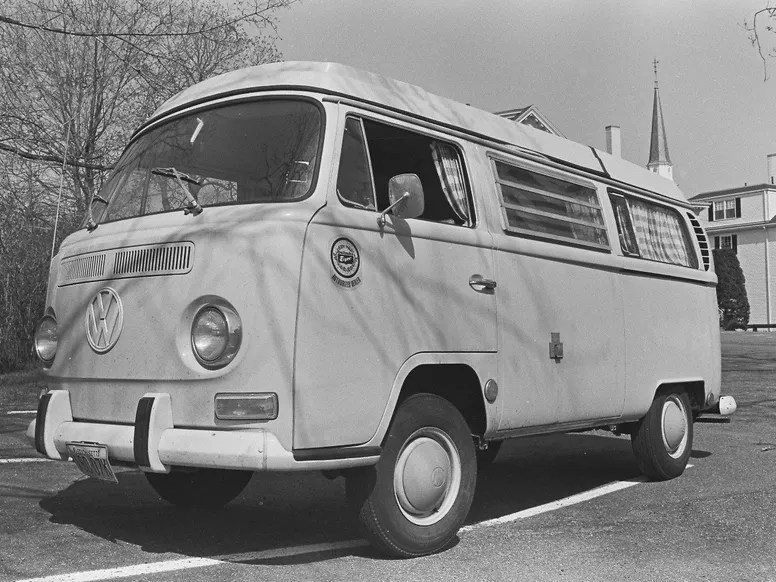
As I sat in front of computer waiting for kickoff, I received a text from my friend Nick Daily, who was enjoying a beverage at the Drop-In on Center Street. So, I hopped on Caroline’s bike and pedaled the six blocks, stashed the bike in an alleyway, and ambled on in to find Nick and his neighbor William at the bar. Nick has a bad jones for VWs and had driven a vintage (I think 70s) micro bus that wouldn’t start, so he and William were sitting around waiting for whatever was ailing the bus to heal itself. Disgruntled, William fretted over the fact that he had sneaked away while his wife was gone and his dogs needed to taken outside to relieve themselves.
Nick was confident that the bus would start, William less so. Nick left a couple of times to try to crank it, and although without success, he intimated that the engine had hiccuped, which was a good sign. William had had enough, however. He paid his bill and left, perhaps to hire an Uber. His farewell was, shall we say, brusque.
I suggested to Nick we split for Chico Feo, and he agreed. He’d decided to try to start the bus again, so we both clambered aboard. I’ve owned two such vehicles, and, let me tell you, they all smell exactly alike, a musty old upholstery aroma augmented by an olfactory trace of leaking oil.
I love that smell.
Lo and behold, as Nick turned the ignition, the engine coughed its way into life, and we drove the two blocks to Chico where a bachelor party was going strong with sleeveless toxic males chugging beer to the Dionysian chants of vociferous inebriates.[3]
Bachelor Party at Chico Feo by Wesley Moore
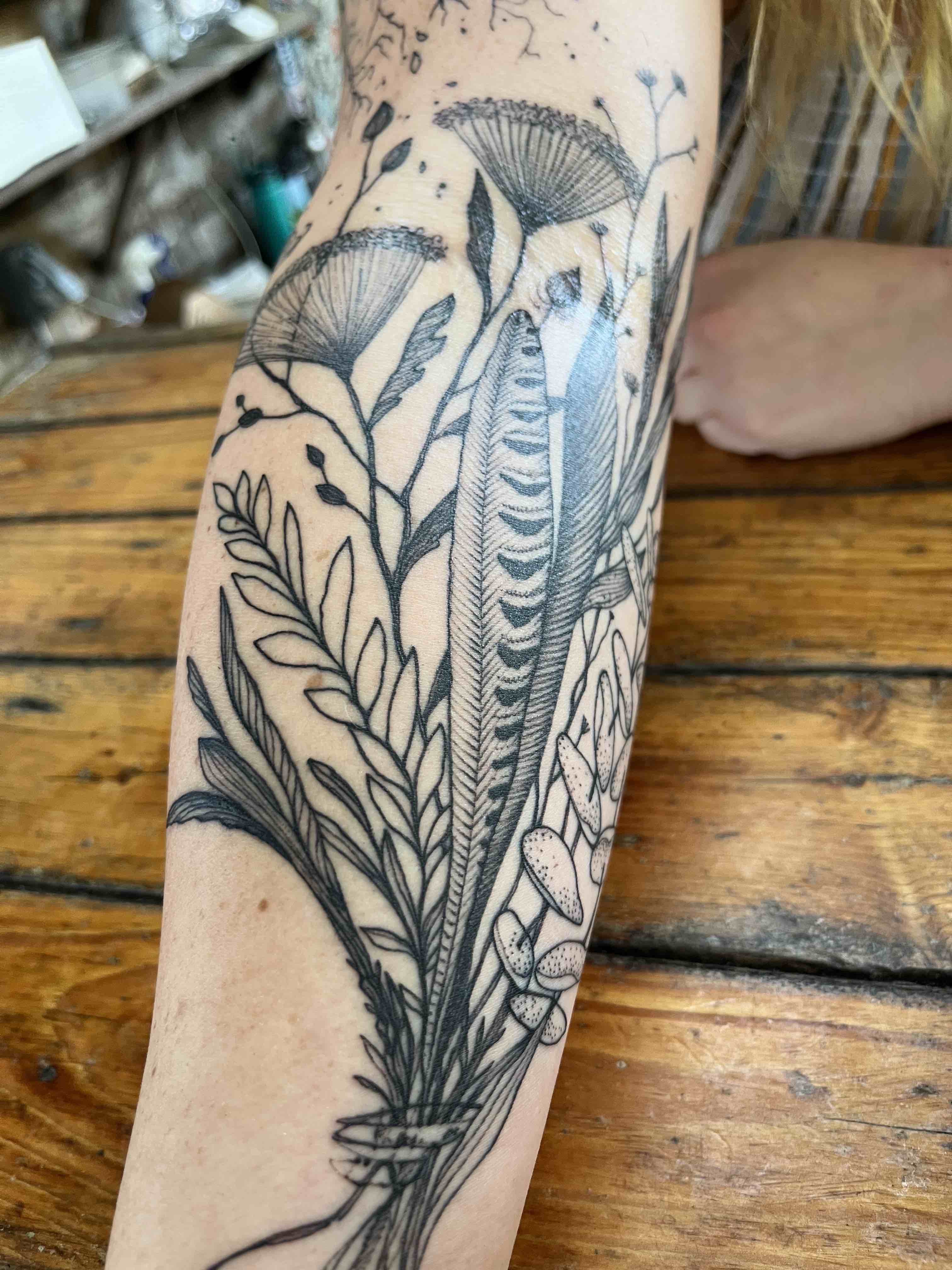
On the corner of the bar sat Jenny, a former colleague. Her husband Allan had just purchased a Harley, so they were in the best of moods. My pal Greg was a-foot, and bartender Katie had just gotten a new tattoo (pictured below). I checked my phone. Clemson, who had been ahead at the Drop-In were two touchdowns down (PRAISE HIS NAME!). Wait, what was this? My missing credit card hiding beneath another! (PRAISE HIS NAME!)
Eventually, Nick toted me home for an afternoon-cap, and former colleague and super cat Al Wilson showed up. All of this helped to distract from the upcoming game.
Eventually, they left, and Caroline and the Fright Nite crew arrived. It was game time.
I’ll give Paul Newberry of the Associated Press the last word and end with a photo of my son and grandson.
ATLANTA — Eddie Rosario capped a remarkable NL Championship Series with a three-run homer, sending the Atlanta Braves to the World Series for the first time since 1999 with a 4-2 victory over the defending champion Los Angeles Dodgers on Saturday night.
The Braves won the best-of-seven series four games to two, exorcising the demons of last year’s NLCS — when Atlanta squandered 2-0 and 3-1 leads against the Dodgers — and advancing to face the AL champion Astros.
Glory!
[1] I have been doing business with Mr. Evans since Jimmy Carter slept in the White House. I think the Dow was something like 780 when Judy B and I first met Jack at his Robinson Humphrey office.
[2] When I checked the etymology of layabout on the on-line Etymology Dictionary, I was tempted – but resisted – clicking the ad link to “Toenail Clippers for Seniors.” (I’m not making this up).
[3] Jenny, a talented maker of jewelry and superb bartender – a different Jenny from my former colleague – has dubbed bachelor party males as “bronadoes” and bachelorette party females as “ho-a-canes.” For whatever reason, Folly Beach has become a mecca for these prenuptial blowouts.
Jasper Johns’ half-sister, Owen Lee, and I were acquaintances, not quite friends, in the very late 70s or very early 80s. We both taught Developmental Studies English[1] at Trident Technical College in North Charleston, South Carolina. Between classes, we’d yuk it up and trade cynical witticisms like a couple of podunk Dorothy Parkers and HL Menckens.
One night after classes, she invited me to join her at the Garden and Gun, a gay bar that had recently opened to cater to the Spoleto crowd. Weeks earlier, she had dropped her famous semi-sibling’s name, but the sad truth is all I knew of Johns’ work were the targets and flags, and in keeping with my late-twenties ignorance, I was not overly impressed.[2]Anyway, Owen invited me to her place for a nightcap and showed me some original Johns works hanging in her apartment. After the drink, I headed home to Limehouse Street.
Fastforward thirty-five years. The week of my son Harrison’s marriage in DC, the Hirshhorn was staging an exhibition of Johns’ work, so we hopped the Metro to check it out. Now, I was duly impressed. Of course, we saw the iconic flags, targets, and maps, but also large arresting canvases with strings and flatware and shadows, works that I found emotionally moving.
However, it wasn’t until last week until I really came to appreciate Johns more fully after taking in his current exhibition (October 2021 through February 2022) at the Whitney. Thanks to my brand-new hearing aids paired with my iPhone, a website dedicated to the exhibition guided me through eleven gallery rooms. Chief curator Scott Rothkopf and others talked about the paintings and sculptures. John Cage read Jasper’s words excerpted from a documentary. He said early in his career he attempted to create impersonal works but that ultimately “was a losing battle.”[3] Nevertheless, he remains reticent about his art because he believes that the viewer must bring his or her own life experiences into the mix.
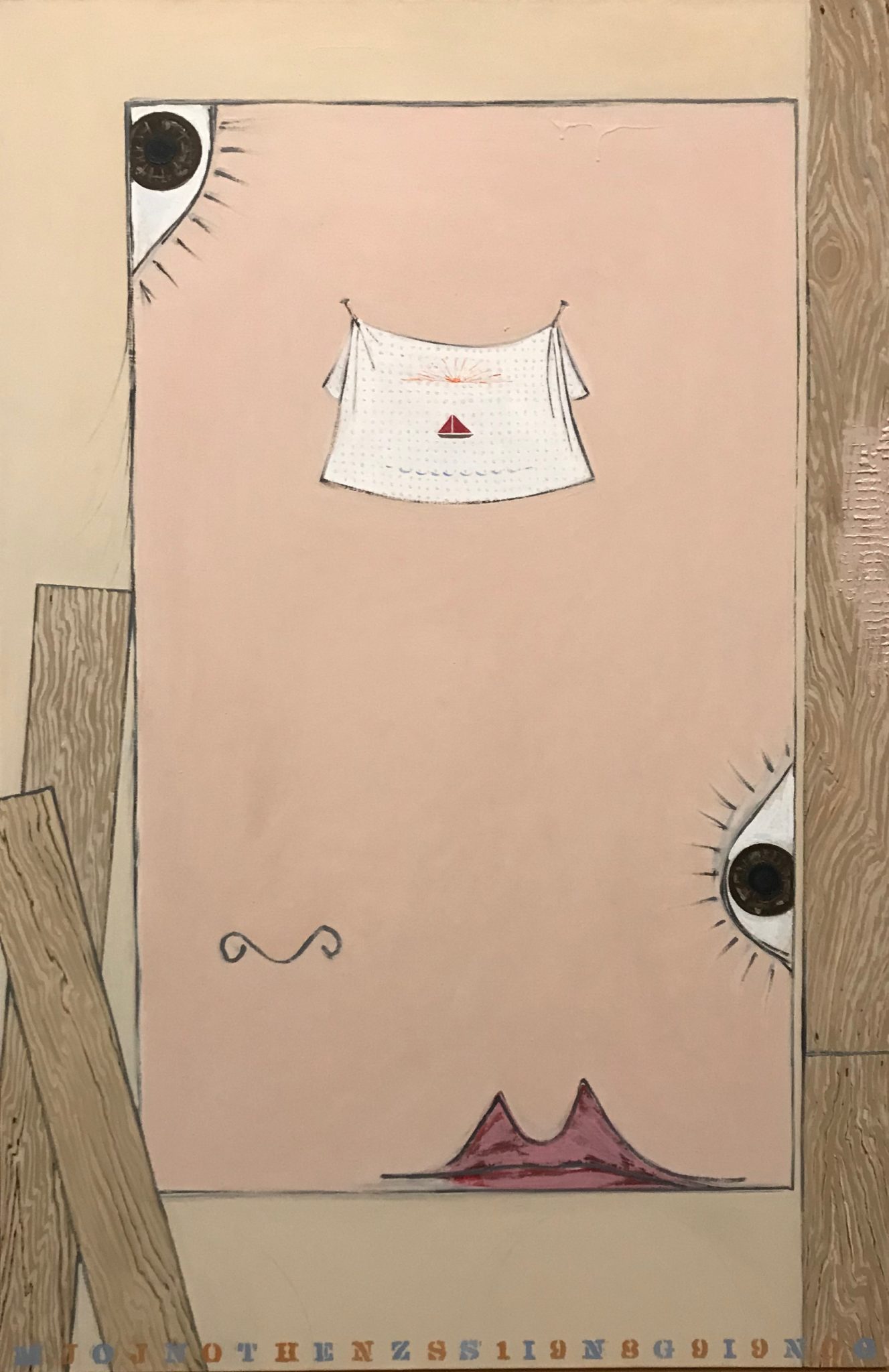
The thematic division entitled South Carolina particularly interested me. Johns, like Truman Capote, spent much of his childhood being shuttled off to various aunts and cousins. How disorienting it must be to be passed around without a permanent home. Here’s a painting based on his childhood called Montez Singing.
Montez was Johns’ step grandmother, and the song she sings is entitled “Red Sails.” The web-based tour guide notes the red ship and offers interpretations on the Picasso-like cubist body parts.
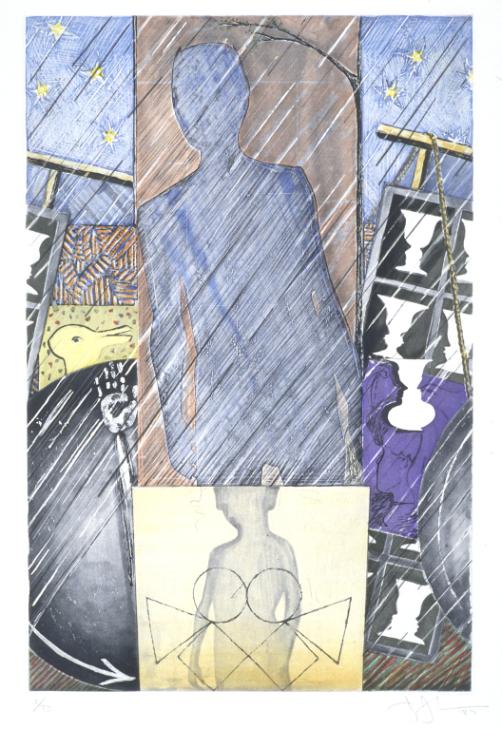
Another of my favorites is “Spring” where we encounter Johns’ shadow and the rigid arm that appears in many of his paintings. Also note the child’s shadow, below the adult’s shadow. How remarkable to produce such stunning objective correlatives to your vaporous memories.
The Seasons (Spring) 1987 Jasper Johns born 1930 Presented by the American Fund for the Tate Gallery, courtesy of Judy and Kenneth Dayton 2004 http://www.tate.org.uk/art/work/P12997
Owen Lee ended up moving away after a stint in Edisto.[4] Around the turn of the century, out of nowhere, I received a message on my voice mail on my landline. She had moved back in Charleston to a downtown apartment and suggested we get together, which never came about. I did see her one last time at our friend Ted Phillips’ funeral. We sat together in a back pew, and because she had walked to the service, I gave her a ride to her apartment when it was over. She poured me a scotch and reminisced about a period when she worked for Jasper and Andy Warhol. This apartment had originals as well, and I worried a bit because Owen repeated stories, lost her way in conversation a couple of times, and explained these lapses by claiming that she had received a blow to the head as a child.
She was still a lovely person, fascinating to listen to, despite having entered an early stage of dementia.
[1] Known as “remedial English” in a previous, less sensitive era.
[2] I wouldn’t go so far as call myself a philistine. For example, unlike the babysitter in Flannery O’Connor’s “The River,” I wouldn’t say, “I wouldn’t have paid for that,” [the babysitter] said, nodding at the painting, “I would have drew it myself.”
[3] Actually, it was John Cage reading Johns’ words.
[4] The voice on the guided tour pronounces it ed-DEES-toe
[1] Prosaic titles used to be a thing, and Yeats was a master. e.g.:
To A Poet, Who Would Have Me Praise Certain Bad Poets, Imitators of His and Mine
You say, as I have often given tongue In praise of what another’s said or sung, ‘Twere politic to do the like by these; But was there ever dog that praised his fleas?
2] To me, it sounds like the boot noise of doomed soldiers marching.
We have not reached conclusion, when I Stiffen in a rented house.
TS Eliot “Gerontion”
Ain’t Got You
I’m sixty-five, got cataracts, Hump-forming on my back, A candidate for a heart attack, But I ain’t got you . . .
Got nurses to the left of me, Nurses to the right of me, Nurses all around me, But I ain’t got you.
Got a wheelchair, a walk-in tub, Teeth ground down into little nubs, Got a membership to the Rotary Club And you lookin’ good in your hot pink scrubs!
Got a closet full of robes, And no matter where I go Got hair in my nose. But I ain’t got you.
But I ain’t got you. No, I ain’t got you.
If you enjoyed this post, more are on the way. Check out “Papa’s Got a Brand New Colostomy Bag” and “We’ll Have Fun, Fun, Fun Till Our Grown Children Take Our Car Keys Away”.
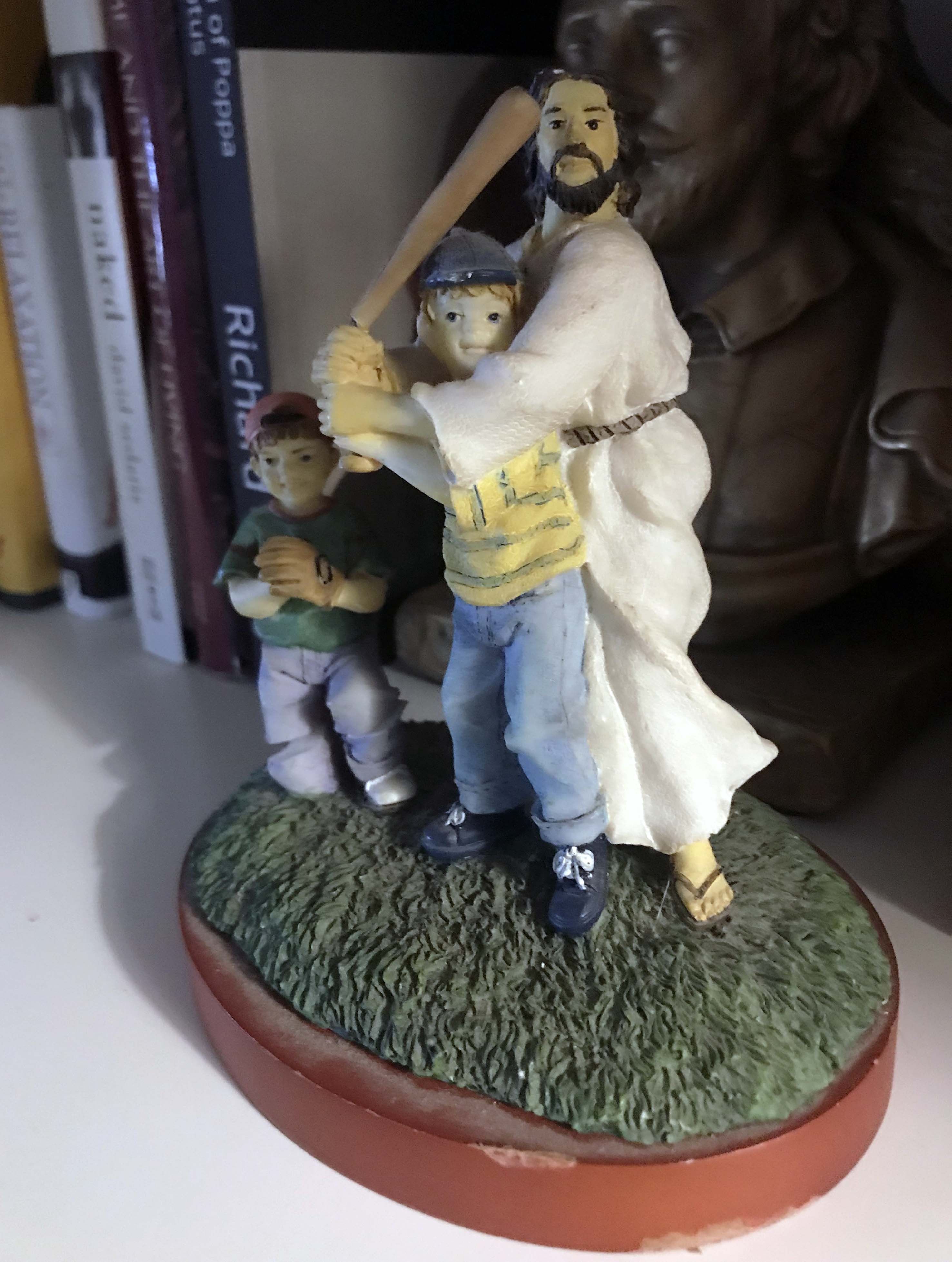
As a Jesus-revering lapsed Buddhist, I know I should detach myself from desire and step beyond the swirl of samsara.
I know, I know.
But, goddamn it, sometimes my ego’s tempted to unzip its amiable persona so Mr. Hyde/Incredible Hulk can bust out and snatch from the cuddling arms of certain Youth Ministers their teddybearjesuses! I long to confront, to bellow like a crazed evangelist on a street corner, “Grow up, you [minced oath alert] theologically stunted pathetic puerile protoplasmic pondspawn!”
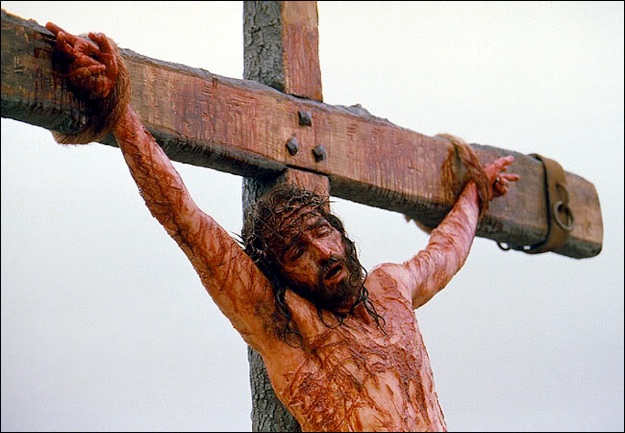
How could you not have picked up on this untidy detail: Jesus’s own father allowed him to be nailed alive to boards!
“Ye ha’ seen me heal the lame and blind, And wake the dead,” says he, “Ye shall see one thing to master all: ‘Tis how a brave man dies on the tree.”
Ezra Pound, “Ballad of the Goodly Fere”
Given the illustration above [hat tip to Mel Gibson] and the never ending reaches of eternity, why would you presume that the Trinity-That-Is-One desires what is most comfortable for you in this abbreviated vale of tears? Or that the most comfortable outcome – what you desire – is best for you spiritually. We’re so blessed [I hear people say] Sally got into Swanee. We’ve been so blessed [others say] our dishwasher didn’t need replacing after all. Christianity isn’t about copping fringe benefits for the faithful but about taking an unworldly long perspective on our short stay here and sacrificing our own comfort to make others more comfortable.
It’s a hell of a lot to ask.
From what I read, blessed are the poor, not comfortable smug upper middle class lower-case christians who love Jesus but hate Biden, who write generous checks to the Good Cheer Club but who want to see unemployment benefits cease. They’re the crowd of know-nothings huddled around Job.
Blake: Job rebuked by his friends
Hey, Youth Ministers, how about offering your pledges some muscular Christian theology that doesn’t whistle past the Darwinian graveyard but confronts the ever-growing chasm between Christian dogma and science?
In other words, bring in the Jesuits.
***
If you’re extolling faith over reason, you might as well be peddling snake oil.
Q. What’s one thing that Osama Bin Laden and George W Bush had in common?
A. An unwavering, absolute and certain faith (in two very different deities).
Based on what? Mother’s milk, that’s what.
If the raw unfiltered DNA that made up Osama had somehow been born to Barbara and Poppy, would he have fervently believed that there is one god and his name is Allah?
Or switcher-roo, picture W with in long white robes and a beard hanging to his sternum. Reared in Saudi Arabia, would he know in his marrow bone that Jesus is Lord?
Let’s face it: faith is culturally conditioned and therefore unreliable as far as narrow religious affiliations go.
As my dear erstwhile friend Ed Burrows once told me, if you can’t justify your beliefs through reason, then your beliefs are worthless.
Amen, Ed. We really should go out for a drink one of these days.
Many Americans, like those who rant against Critical Race Theory, don’t have much patience with malcontents like me who catalogue the various and sundry crimes in our nation’s blood-drenched history – the initial genocide, the horrorshow of slavery, our third world murder rates. To even acknowledge these negatives is to “apologize for America” – in the words of Senator Mitt Romney – who beneath those corporate jeans and collared shirts enjoys the freedom to wear magic Mormon “temple garments,” a tribute to the wisdom of our Founding Fathers and the bravery of those heroes who made the supreme sacrifice, etc. And who can argue with the undeniable truth that a country in which a descendent of a Black African (or a bishop in a marginalized religion like Mormonism) can rise to the highest offices of the land is truly exceptional?
temple garments
Our constitution – and this is exceptional – grants us the right to pursue happiness – whether that means spending a Saturday afternoon discharging elephant guns at a shooting range, watching Sergei Eisenstein’s, Бронено́сец «Потёмкин, or cross dressing and parading down 5th Avenue in celebration of the resurrection of our Lord.
Yet, happiness can be so elusive. Great success certainly doesn’t guarantee felicity as Tiger Woods or Amy Winehouse can/could testify. There is, I think, in the USA a misconception that having a constitutional right topursue happiness means that you’re entitled to happiness, and as my childhood hero Sportin’ Life put it so eloquently in Porgy and Bess. “It ain’t necessarily so.”
However, in Late Empire America, judging by the posts of my thousand-plus Facebook friends, trumpeting one’s happiness seems to be a borderline obsession.[1] Certainly, there must be battalions of social scientists studying the ratio of positive to negative posts as they attempt to determine the happiness quotient of Facebook subscribers. Certainly, among the unscientific sampling of my friends,[2] I’d say happy dominates a thousand to one.
Of course, the tendency to post positive rather than negative feelings makes sense. When one of my barmates at Chico Feo asks how I’m doing, I virtually never put into words the existential angst that shadows every waking minute of my Beckettian existence.
“Hi, Wes. How’s it going?
“Every word is like an unnecessary stain on silence and nothingness. No, I regret nothing, all I regret is having been born, dying is such a tiring business I always found. And when I die let me go to hell, that’s all I ask, and go on cursing there, and them look down and hear me, that might take some shine off their bliss.”
“Uh, OH-Kay. Have a good one.”
Anyway, nothing much makes sense anymore. The Trump people simultaneously long for authoritarianism while decrying the tyranny of mask mandates while the far left’s free speech intolerance is so extreme that even milquetoasty comedians like Jerry Seinfeld won’t play college campuses.
Like Kris Kristofferson once put it, “Freedom is just another word for nothing left to lose.
[1] On the other hand, this isn’t the case on Twitter, which teems with death announcements and the oft repeated phrase, “I’m broken,” following. Why is Facebook so positive and Twitter so negative?
[2] I.e., “friends, acquaintances, former students, cousins, virtual strangers [including at one time Jerry Lee Lewis himself (thanks, Killer, for the Asian bikini model link)], Lucinda Williams, etc.
But weigh this song with the great and their pride;
I made it out of a mouthful of air,
Their children’s children shall say they have lied.
WB Yeats “He Thinks of Those Who Have Spoken Evil of His Beloved”
A by-product of breathing, that mouthful of air, exhalation tracking up through the trachea, plucking the vocal c[h]ords: vowels, consonants, words, words, words. Say outloud the title of this post – the sounds of words. Dissonant, sharp, as unlovely as the scraping of a rake on gravel, echoing Juliet’s lament as Romeo vacates their marriage bed:
It is the lark that sings so out of tune, Straining harsh discords and unpleasing sharps.
Romeo and Juliet by Todd Peterson
Perhaps even more discordant is Gerard Manly Hopkins postlapsarian description of industrialization:
And all is seared with trade; bleared, smeared with toil;
And wears man’s smudge and shares man’s smell: the soil
Is bare now, nor can foot feel, being shod.
Industrial wasteland matte by Ryan Morgan
Who sez that poetry’s supposed to sound pretty?
Not Alexander Pope:
But when loud surges lash the sounding shore,
The hoarse, rough verse should like the torrent roar
Nor that barbaric yawper Walt Whitman:
Nor him in the poor house tubercled by rum and the bad disorder.
Nor Ol’ Ez in St. Elizabeth’s ranting:
the drift of lice, teething,
and above it the mouthing of orators,
the arse-belching of preachers.
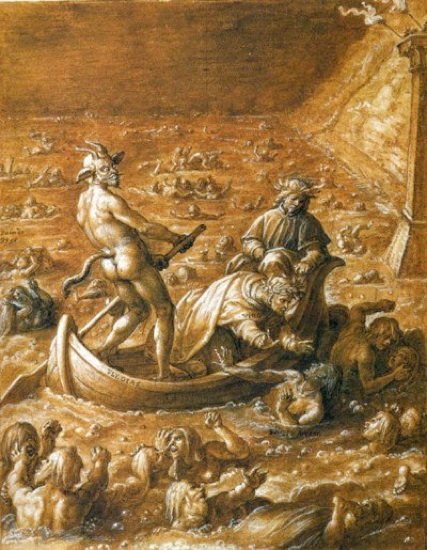
Inferno, Canto 8 by Giovanni Stradano
Thanks to its Anglo-Saxon roots, English is well-suited to screech. However, thanks to its French invaders, our language can also coo. And don’t forget the ess-cee (sc) words of the Vikings with their skalds singing of skulls and skies and scales.
English-speaking poets possess quite a synthesizer through which to sample sounds, orchestrating Anglo-Saxon, Norse, and French symphonically (Milton) or piping a simple Saxon tune in tetrameter (Anonymous).
Given global warmification/climatic alternation, the following worry may seem as trivial as the date of Alfred Tennyson’s death, but I wonder, given our beeping visual small screen secondhand exposure to actual sights and sounds, if off-the-cuff eloquence might become as rare as first edition Kafkas.
In my youth, among my compatriots, having a way with words held sway. I think of Jake the Snake Williams politely stringing together sentences to a Jehovah’s Witness in Richland Mall, and the fellow smiling, nodding his head, and saying, “Brother, you got you an excellent rap.” Or Furman Langley lamenting in a Lowcountry gumbo of gullah-echo the pain he be suffering from the “Hurry Curry Casserole Blues.”
The “like-like” syncopatations of youthful inarticulation and the ubiquitous interrogative lilt of a nation of valley girls’ declarative sentences gives me pause?
Because I suffered from rheumatic fever when I was five or so, and that malady is a nasty by-product of streptococcus, my mother overreacted whenever I had a scratchy throat. Whenever I wanted to get out of going to elementary school, all I had to do is feign a sore throat, and – presto! – there I was propped up on pillows reading The Tower Treasure or The Swiss Family Robinson. On those days I didn’t have to trudge single file to the cafeteria for a glop of canned spaghetti and mayonnaise deluged coleslaw. I’d be slurping a bowl of canned chicken noodle soup instead.
In high school whenever you missed school, the office called home to guard against truancy; however, both of my parents worked, there would be no one home to answer the phone, so I never got caught cutting school. Whenever I legitimately missed because of some ailment, my mother’s excuse always read: “Please excuse Rusty for yesterday’s absence as he was sick,” a rather awkward sentence to my ear, but a handy one, because the forged note I’d construct matched all the others, so no suspicions were raised. Anyway, I didn’t cut all that often, a couple times to go surfing at Folly and once to King Street in December with Becky Baldwin, Becky Moore, Gordon Wilson, and maybe Juli Simmons.
Not to put too fine a point on it, but I detested high school, so my ending up spending most life teaching at one is, as they say, somewhat ironic. However, as far as my teaching career goes, my attendance was stellar. I doubt if I missed more than twenty days in thirty-four years (not counting the last week of my wife Judy Birdsong’s life). Even though we got two personal days a year, I only took two in all, one to attend the third game of the 1991 World Series and another to see the Stones in 1996. The horrible truth of the matter is that missing school for a teacher isn’t worth it; it’s its own punishment.[1]
Given Porter-Gaud School’s rotating schedule, one year – it was 2010, in fact – my classes on Wednesdays ended at 10:30, but we were required to stay on campus for extra help, etc. I didn’t mind because I could get lots of grading done.
And, of course, if something came up, the administration would allow you to leave, if you informed them of your destination. That’s what happened on Wednesday 8 September 2010 when I had a flat tire. Although I usually patronized Hays Tires, I decided to go to Gerald’s Tires for the sake of frugality.
Based on their television ads, I had never liked Gerald’s. Back in the day when they went by Gerald’s Recaps, one of their ads featured an elderly black woman who said, “And they is very courtesy.” In 2010, the commercials teemed with strangely gleeful hourly employees who looked as if they might have stepped out of a Soviet propaganda film celebrating the dignity of labor. “Wheeeeee,” one says in a Mayberry drawl as he rolls a tire, “We’re having fun now.” The ads closed with a white church steeple pointing heavenward in a sky of pure blue. “It’s a great day at Gerald’s, especially on Sundays.”
With my last class over at 10:30 and nothing facing me but a department chair meeting at 3:15, I thought I’d hit Gerald’s about 1:00, grade a few journals, and return to school. When I arrived at the screeching Clemson orange of the building, there was nowhere to park. All of spaces pictured above were filled with vehicles having their tires tended to. The unshaded bench out front bore three sweating patrons. Not a good sign in that heat. On the street running perpendicular to the building, a battered line of automobiles stretched towards the horizon.
I parked illegally and entered the building. Inside, every folding chair held a patron, and a line of four patiently stood waiting their turn, an interview with the one representative who, though polite, looked as if his lean frame owed more to methamphetamines than to a rigorous workout regimen. Hoisted in the corner on a wooden platform, an early model television blared the cynical spin of a [redundancy alert] vacuous Fox newsblonde.
[sigh]
When I made it to the counter, the fellow (poorly peroxided black-rooted straw spilling from his baseball cap) informed me that it would be an hour-and-a-half. With nowhere to sit, I decided to hit the pavement. I told him I was parked illegally. “Park in the parking lot in the back,” he said. “Just ignore the Not for Gerald’s signs.” I did as I was told and brought back the key.
I decided to hoof in the heat the quarter mile to Steinmart’s to pick up a couple of dress shirts. This trek took me past a thrift shop, a bar, two consignment shops, a hair salon with a hand painted window, a couple of shuffling vagrants, a bank. Once I hit the acres of the heat-radiating parking lot, I passed a giant pet store that boasted “Unleashed Dogs Always Welcome Inside.”
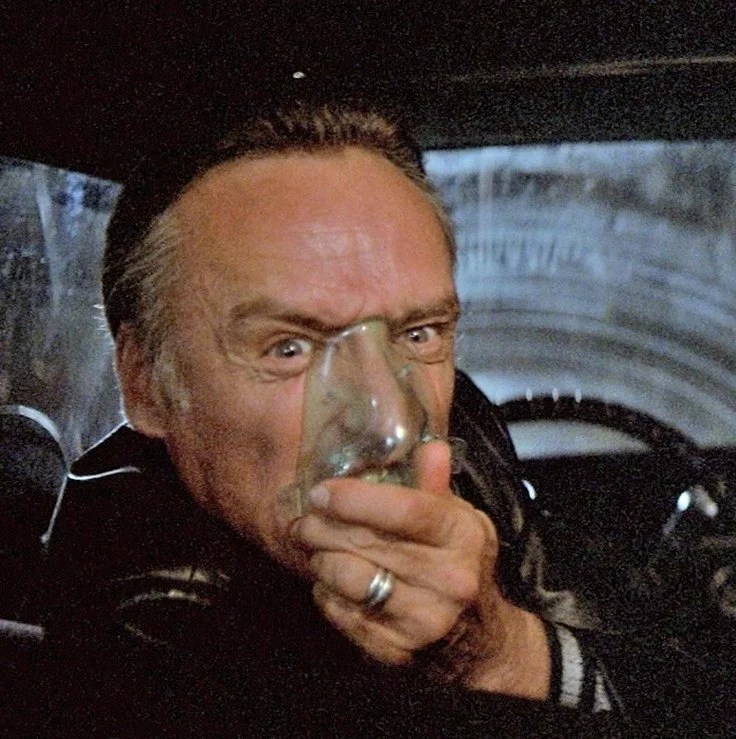
I wouldn’t have been surprised to look up and see David Lynch shouting through a megaphone in one of those airborne director’s chairs.
scene from David Lynch’s Blue Velvet
Ah, Steinmart’s AC hit me like a champagne-soaked towel. The contrast between the clientele of my twin shopping experiences was akin to stepping from the boxcars of Steinbeck into the glitzy interiors of Danielle Steele. Here among the racks of brand name (albeit discounted) clothes grazed carefully coiffed matrons and Izod-sporting businessmen. Although the store wasn’t busy, I did have to stand in line, but unfortunately not long enough; only forty minutes had elapsed by the time I returned to the Bright Orange Building.
Now, I found myself in Sartre-Full-Nausea mode.[2] Should I do what I wanted to do (slide into an obscure booth in Gene’s Haufbrau and knock down a couple while I graded journals) or what society/my superego wanted me to do (sit on an uncomfortable folding chair and listen to Fox News’ distortions among the blather of ill-informed fellow citizens?) Should I suffer Nausea by exhibiting bad faith and cave to society’s petty morality or be true to myself and risk the unlikely occurrence of the Headmaster or Board member discovering me in a seedy tavern during work hours?
Bravo Id! Superego be damned! The chances of the headmaster or a board member slumming it at Gene’s Haufbrau on a Wednesday afternoon were on par with Donald Trump getting a likeness of Noam Chomsky tattooed on his chest.
When I returned to Gerald’s, things had thinned out a bit. I took a seat next to a rotund woman in her late sixties/early seventies who had poorly dyed thin red hair and clutched her bag as if it held a dozen super Powerball winning lottery tickets. Another woman, a bit younger but with age-inappropriate Bonnie Raitt locks falling in Pentecostal splendor beneath her shoulders, sat down across from us.
The Fox anchors were all a-twitter because Hillary Clinton had announced our huge deficits made us weaker, as if that were hypocritical, as if she and Obama had single-handedly produced the sea of red they had inherited, as if Fox News hadn’t been screaming for the war with Iraq and the draconian tax cuts that had created the deficit in the first place. As luck would have it, the anchors broke away to cover Obama in Ohio delivering a speech on the economy.
“I don’t see where he’s done anything but increase our debt,” the rotund redhead said to the woman across from us.
As I held my tongue, dutifully circling misplaced modifiers and ticking active verbs, the redhead suddenly said, “I lost my youngest one last week.”
“Your youngest what?” the other said.
“My youngest child. My baby.”
“Oh, I’m terribly sorry,” the other said, but looking more curious than sad. “What happened?”
“She called me up and said she had an earache, and in an hour, she was gone.”
“Oh, my goodness. I’m so sorry. How old was she?”
“Thirty-eight.”
“Do they know what it was?”
“The results from the autopsy ain’t come back yet.”
A smiling mechanic opened the door. “Mrs. So-and-So, your car’s ready.”
The woman with the long hair stood up and leaned over to the red-headed one.
“What you say your name was?”
“Ferguson.”
“I’ll say a prayer for you tonight.”
(Yep, make sure to get the name right, I thought. God’s got a lot on his plate nowadays).
I looked over my shoulder to see my car parked out front. After ten more minutes, it was still there, so I went out to discover that my tire had been repaired. Going back in, I informed the cadaverous young man behind the counter.
“I’ll go get the paperwork,” he said.
In a few minutes, another smiling mechanic came in dangling my keys. “Mr. Moore, here you go. Have a nice day.”
“But I haven’t paid,” I said.
“It’s nothing,” he said, “Only a tire repair. Have a nice day.”
So, I drove back to school, hit the Department Chair meeting and have not the slightest inkling of what transpired there, don’t recall at all.
It’s the weirdness you remember, not the mundane, the days you cut, not the days you attend.
[1] “Nausea” is what Sartre termed that way too common situation when you forego whatever you really want to do.















 You Do Hoodoo