Given today’s GDP numbers for 2023 (2.5% growth) and for the 4th quarter (3.3% growth), not to mention all-time stock market highs, it’s no wonder Donald Trump is musing out loud how he wishes the economy would implode. After all, on October 22, 2020, he predicted the stock market would crash under Biden.
Nostradamus he ain’t.
In other news, Trump has instructed the Buddy Rich of Bible-thumping, i.e., House Speaker Mike Johnson, to torpedo the bi-partisan agreement on the border forged in the Senate because solving the problem would cost Republicans their number one talking screaming point.
Anyway, why should Republicans bother with governing when Hunter Biden’s laptop exists in the form of three-dimensional matter, when instead of passing legislation, they can bask in the klieg lights of Fox News studios?[1]
Yes, despite his having been convicted of rape by a jury of his peers, of having admitted to stealing top secret classified materials, of his sitting on his Depends-padded ass doing nothing during the Capitol insurrection, despite his bizarre, slurred word salads, his trouble distinguishing Nikki Haley from Nancy Pelosi, you have the fallen competitors lining up like so many ventriloquist dummies to endorse him despite his 90-odd criminal indictments.
Speaking of ventriloquist dummies, Tim Scott, please disappear. Your moon-faced head-bobbing grinning behind Trump during his bitter post New Hampshire victory speech in which he threatened to sic the Feds on the woman who appointed you senator was even more demeaning than your artless staged engagement photo op.
Psst, hey, y’all, Trump’s going to lose the general election. He needs to expand his base from his devoted non-college degreed MAGA cultists and the hundred or so avaricious billionaires who support him, or he’s going down yet again. Along with him abortion-banning Congressional Republicans. Among the sane and educated, Joe Biden is the lesser of decreptitudes.
A little anecdotal evidence: Yesterday afternoon, I chatted with two tourists from Beech Mountain, North Carolina, she a social worker, he a firefighter, she a liberal, he a conservative, and neither is voting for Donald Trump.
Pass the popcorn.
Here’s Trump”barring” potential Republican voters from “the MAGA camp.”
[1]C.f. South Carolina’s own Hester Prynne wannabe, Nancy Mace.
What a storehouse of sorrow must have existed in the soul of Miss Etta James, nee Jamesetta Hawkins, whose eventful life was fraught with childhood abuse, illicit drug use, and musical triumph. To quote Van Morrison’s “Summertime in England,” James was “high in the art of suffering” and could conjure her hurt Stanislavski-style as she belted out the blues, that history of sadness made manifest in the hurt of her voice, the expressions of her face.[1]
One of my favorite videos of all time is her duet with Dr. John in “I’d Rather Be a Blind Girl.” As I mentioned recently in a post on the Pouges, I’d treat my students to a music video whenever everyone in the class made a 100 on a pop or vocabulary quiz, which, of course, spurred them on to read or review vocabulary and afforded me the pleasure of expanding their cultural heritage, expanding the narrow range of what they considered cool.
What a pleasure to study their faces as they watched this video.
[1] As in Konstantin Stanislavsky’s acting system in which he sought to activate actors’ memories to express emotions rather than merely representing them.
This is the beginning of my current work in progress entitled Long Ago Last Summer. The first draft is completed, so now comes the painstaking work of refinement. What’s below are the first paragraphs of the 7100-word first chapter.
Chapter 1
Those Who Think, Those Who Feel
1
My father aspired at some point early in his life to become a tragic figure, but unfortunately, even at that, he failed. Born in the 1920s in the shabby outer edges of Reconstruction’s long shadow, he grew up in Charleston, South Carolina, in those days a rundown museum of a city with its weather-beaten mansions and black women calling out in Gullah, balancing baskets of vegetables or laundry on their heads. A talented storyteller, my father was a virtuoso on the heartstrings, recounting unfortunate events from his melancholy childhood, an exotic world of paregoric addicts, ancient cotton-haired slave-born coloreds[1], blind street musicians, and blue-blooded eccentrics. I can conjure his depiction of himself even now, a ragamuffin Depression boy in knickers and cap hawking newspapers on city street corners. It’s odd that I picture his old stories in black-and-white. Perhaps it’s because of the photographs or the old movies of that era. Memory is a curious thing. I guess you could say it’s a collection. The older we get the more we discard, up to a certain point. My father, however, was a curator with a very narrow thematic interest. And what he kept was very well preserved and artfully presented.
2
My father felt unloved by his father, a distant presence puffing a pipe, turning a page of The Saturday Evening Post. I remember meeting my grandfather only once or twice when my father was alive, and I never heard my father utter a kind word about “the old man.” In my post-mortem meetings with Grandfather Postell,he was what you might call lively but egocentric. He’d talk about his golf and his dead Airedales and about his photography but never expressed any curiosity about what was going on in my little life. He had been the youngest of five, the only boy, the son of an Upcountry state senator, and perhaps spoiled by the plump quartet of his elder sisters, my great aunts, formidable eccentrics in their own rights. I can very well imagine not being loved by this man, though, on the other hand, I can’t really imagine being abused by him.
His son, my father, absolutely worshipped his own mother, whose portrait hung, eerie and Oedipal, over my parents’ four-poster bed. She was beautiful and angelic and elegant and the brains behind the studio. Grandmother Postell’s death from T.B., three years before my birth, was right out of “Ligeia.” Yellowed photographs of her propped up on pillows in a ghostly white gown survive in black picture albums. As a little boy, I remember carefully turning the pages of those albums, gazing at my tall slender grandmother leaning against an antique car, my father half-her-size, standing beside her with his thick wavy hair combed straight back.
As a child, listening to my father’s version of his own childhood, my eyes would sometimes fill with tears as he would in his gruff way catalogue his sorrows. He made me feel lucky to be me, and I felt guilty because I took for granted the bright sunshine of Suburban Summerville, my middle-class neighbors, and the leisurely hours I had to loll away shooting marbles or riding my bike on lazy Saturday afternoons. Unlike his own father, my father had sacrificed everything for us by working at the dreary Naval Yard, a job well below the significant talents he possessed. My father saw himself as a marked man, doomed to a life of bad luck, and I guess you could say that in some ways he was.
Though, by Depression standards, at least economically, my father didn’t have it all that bad. He lived with his parents, who had been employed as portrait photographers but who had lost everything in the Crash. During the Thirties, they stayed with his mother’s parents who lived in the second story over a pharmacy they owned on the corner of Spring Street and Ashley Avenue. Anyone who owned a business that didn’t fold during the Great Depression shouldn’t complain too much about deprivation. With money so scare, being a child laborer[2], especially a paperboy, might be considered a blessing, but not to my father, who viewed himself as Oliver Twist, a figure to be pitied, and perhaps he deserved that pity. I wasn’t there to witness his life.
His stories, though, always accentuated the poverty. I’ll grant that living with eight other people in 1200-square feet isn’t enviable, but it’s not exactly The Grapes of Wrath either. After all, deprivation was pretty much the way-it-was in Charleston during the Depression, a city isolated and traumatized by the events of a war that still could claim a few living veterans shuffling down its sidewalks. Nevertheless, I don’t dispute that something must have been lacking in his childhood, and I suppose that the best guess for what was lacking is love. My own mother, in the unenviable position of following a dead saint, once surmised that what had ultimately been lacking in Daddy’s life was maternal love, not so much as paternal love, but Daddy would never have owned up to that. An insinuation like that would have thrown him into a rage, and he was the furniture-smashing type when he lost his temper.
When not working or getting expelled from a series of schools, my father roamed the streets of the Upper Peninsula. Here, he could put his seemingly endless store of anger to good use, saving a squirt from a cowardly bully or bloodying the nose an arrogant Northerner who had indiscreetly commented on the corporeal charms of some perceived paragon of Southern ladyhood. In the stories my father told us, he was always the cavalier, the heroic fellow, always smaller than the oppressors he pummeled, always a figure of sympathy. Boxing was the only sport he cared anything about. I can remember his yelling at the television on Friday nights, barking advice to Sugar Ray Robinson or Archie Moore, “Keep that left up, keep that left up.”
Of course, to be a tragic hero you’re supposed to be somewhat bigger than life and somehow bring your calamity down upon yourself, perhaps because you suffer from a fatal flaw, like too much ambition or too much pride, or in my father’s case, too much a flair for the dramatic. Nevertheless, his story, which is also my story, doesn’t quite make the grade as far as tragedy is concerned. I personally see our lives as a dark comedy, more Beckett than Tennessee Williams. You may have heard the saying, “Life is a comedy to those who think, but a tragedy to those who feel.” Like everything else, it all depends upon your perspective.
Ah, New Year’s Day, when we eat collards and black-eyed peas and look forward to changing ourselves for the better, vowing to practice mindfulness so that the all too ephemeral array of everyday wonders doesn’t flash by unheeded.
Alas, however, our resolutions, more often than not, succumb to the deadly weight of habit as we, distracted by the morning news, fail to appreciate the taste of our buttery toast.
Although I’m not a fan of HD Thoreau (too smug, too self-righteous, too puritanical), he does have somewhat of a point here:
“And I am sure that I never read any memorable news in a newspaper. If we read of one man robbed, or murdered, or killed by accident, or one house burned, or one vessel wrecked, or one steamboat blown up, or one cow run over on the Western Railroad, or one mad dog killed, or one lot of grasshoppers in the winter, – we need never read of another. One is enough. If you are acquainted with the principle, what do you care for a myriad of instances and applications?”
New Year’s Resolution #1: Don’t read the paper or doom scroll while eating.[1]
On the other hand, you do want to be somewhat cognizant of what’s going on in the world, to base whom you’re voting for on something more concrete than “it’s time for a change” or “the price of avocados has gone through the roof.” Democracy depends on an informed citizenry and all that jazz.
I recall a Mad Magazine parody of the Fifties sitcom Ozzie and Harriet where Harriet, not wanting to upset husband Ozzie, had cut out unpleasant news stories from the paper, which resulted in his booking the family’s vacation in the civil war torn Dominican Republic, the contemporary equivalent booking a tour of the Gaza Strip.
New Year’s Resolution #2: Don’t book vacations in war zones.[2]
Hey, wait, here’s s resolution I hope we all can embrace without caveats.
New Year’s Resolution #3: Strive to be kind.
Hey, y’all, Happy New Year! Thanks for reading.
My son Ned’s Nuremberg rendition of his mother Judy Birdsong’s New Year’s Soup (Bon Choy substituted for collards, which you can’t get in Germany.
[1] Caveat #1: Yeah, but I’m not eating toast, I’m eating some generic cereal, so I’d rather read about the latest baseball transactions than contemplate the taste of cardboard.
[2] Caveat #2. Yeah, but the bluesman Robert Lighthouse recently toured The Ukraine and found it to be one of the most rewarding experiences of his life. (You can read my interview with Robert HERE.)
Well, young and old and in-between, another winter solstice had swirled us into darkness, which means it’s time for my annual attempt to rack up a few more hits by shining a light on what I consider the highlights of a year of blogging.
So let’s get going.
January
In light of the Murdaugh mess, I became more aware of just how disloyal our computers can be, whether they’re ratting us out as we’re careening 80 miles an hour heading down a dirt road to Mama’s looking to cop an alibi or merely chatting it up in a bar and having our words transported to blood-sucking capitalists, which happened to me in The Saint James Infirmary iPhone Blues
Also, I at the start of the new year, I went all self-defacing with some un-wistful memories of motor incoordination. I went all Spasmadaco.
Here Comes the Night features a Van Morrison music clip, which in itself is worth a click.
July
July was fun. I wrote a nostalgic piece claiming not to be nostalgic called A Nostalgic Dismissal.
And I hitched a train up to DC, got to see my son, daughter-in-law, grandson, and fellow grandparent. Alas, though, I suffered misadventures after making some bad choices on the train trip home. There’s no fool like an old fool. You can ride along in Choo Choo Ding a Ling Ling.
August
Kirkus reviewed my novel: Kirkus Review of Today, Oh Boy.
And the delightful Montgomery Boat Brawl balmed my wizened heart.
As she’s wont to do, Nancy Mace made an ass out of herself by thinking being slightly snubbed is the equivalent of standing on a scaffold and being humiliated by an entire town and then being further sexually shamed by having your status as adulteress emblazoned on your breast for the rest of your life.
Richard Ford photoshopped into Chico Feo from a photo taken by Wesley Moore III at the Circular Congregational Church in Charleston, SC.
Frank Bascombe and I go way back to 1986, the year my second son Ned was born. Frank and I first met when I read Richard Ford’s third novel The Sportswriter, a book I absolutely dug, essentially because I loved Frank’s voice, which he himself describes as “a frank, vaguely rural voice more or less like a used car salesman: a no-frills voice that hopes to uncover simple truth by a straight-on application of the facts.”
Frank has narrated four subsequent novels: Independence Day, which won the Pulitzer, The Lay of the Land, Let Me Be Frank with You, and Be Mine, which was published earlier this year.
Reading the first three of the Bascombe novels was like hanging out with my eloquent best friend Jake Williams, someone who can clearly perceive and then articulate how the messed-up moving parts of the human condition combine (or clash) to create, more often than not, heartache. Frank, like Jake, is stubbornly and stoically determined to remain semi-cheerful through most of its travails. Neither is a whiner; they’ve read their Aurelius.
By most people’s standards. Frank’s life has been fraught with disappointment. His first son Ralph died of Reye Syndrome at nine, he’s been divorced twice, traded in a promising literary career for sports writing, then abandoned journalism for selling real estate. His son Paul, a troubled individual throughout his childhood, adolescence, and middle age, dies at the end of Be Mine at 47, the victim of ALS.
Yet, unlike my experience reading the first four of the Bascombe novels, I was not sad to see the story end, not sad to be separated from the companionship that Frank afforded me, because in his old age Frank has become somewhat of a mansplainer. He’s too much of a know-it-all, too ready to diminish his fellow humans by pigeon-holing them into stereotypes. Here’s his description of one of the well-meaning greeters at the Mayo Clinic where Paul is receiving treatment:
He’s pushing a wheelchair and wearing a blue Mayo parka and a big, coffee-breath, come-on-in grin, as if he knows not only my car but everything about us. These fellows are mostly 60-ish, jowly-jovial Rotarian types with hamburger laughs, ex-military or retirees out of the sheet metal trade, who’d otherwise be home with the wife watching TV.
Here’s his take on his Mrs. Harald, who runs with her husband a motel near Sioux Falls, South Dakota:
Mrs. H seems like the best ole raw-boned gal you want to have be your cousin. But I’m willing to bet, after a couple of Crown Royals, she’ll be laying the cordwood to immigrants, ethnics, socialists, elites, one-worlders, the UN, Kofi Annan and whatnot – anyone else who fails to believe property rights outweigh human ones.
To me, on the other hand, she seems like a well-meaning Southern transplant who sympathizes with Frank and Paul and who benignly ignores Paul’s foul mouth.
Anyway, I’m not saying that the novel is not well-plotted, rich in characterization, or worthy of Ford’s magnificent body of work. I’m only saying that Frank and I have drifted apart, a phenomenon that has happened often to him with others throughout the novels. Chances are Frank and I won’t be meeting again, not because I wouldn’t read a subsequent Bascombe novel, but because I doubt if they’ll be another. Frank seems to suffering the onset of memory issues.
Here is the end of Be Mine.
I hear my name called. “Where are you, Frank? I’m coming. I have something you’re going to like. Something very different and new.” I turn to see who it is. The empty time I’ve missed has gone quietly closed from both sides. “Okay,” I say, “I’m ready for something different.” I smile, eager to know who is speaking to me.
Of course, I wish Frank only the best. He’s ultimately a good guy, and the pleasure of having known him far outweigh my current niggling complaints.
Although it occurred 71 years ago tomorrow, I remember my birth as clearly as if it had happened yesterday.[1]
I recall grooving in the womb, the temperature a comfortable 98.6, the background music the soothing backbeat of my mother’s twenty-one-year-old heart of gold, womb service delivered umbilically in the amniotic Eden of pre-Natal bliss.
But, alas, on the fourteenth of December, an earthquake, a rupture, unwanted spasms, an excruciating expulsion through an opening not nearly large enough to accommodate the partially deflated soccer ball of my head, which, as it turned out, was covered with Hemoglobins.
Hour after hour of torture. Then I feel the ice cold clamp of forceps on my head, depressing and denting it, as Dr. Snyder yanks me out of the vice of a constricted passageway into the freezing but blinding bright light of Dorchester County Hospital’s delivery room.
To add insult to injury, he grabs me by the ankles and slaps the tiny target of my ass as I let out a hellish, ear-shattering scream.
Welcome to the third planet from the sun, little one.
I was not a pretty sight. Both parents agreed that I was the ugliest baby they’d ever seen. They’d sometimes tell the story to dinner guests in my presence. The punch line was that Daddy had to ride back to Clemson right after the not-so-blessed event, and some lady on the Greyhound asked him why he looked so distraught, and he replied, “Because my wife has just given birth to a seven pound, four ounce monkey.”
After the laughter subsided, my mother would add, “But a week later he was the most beautiful baby you’d ever seen. When I would stroll him around Colonial Lake, strangers would stop and marvel at his beauty.”
Yeah, right. No wonder I’m so messed up.
[1] Of course, at my age, remembering what happened yesterday clearly is not a given.
This week, i.e. 7 November 2023 – 2 December 2023, certainly has been an eventful one when it comes to obituaries, politics, and the rule of law.
I’ll start with the last item first.
In the insurrection realm of the Trump inditements, Roy Cohn’s protege isn’t even bothering to claim innocence anymore but arguing that he shouldn’t go to trial until he finishes his second term as president in 2029, when he’ll be even older and more morbidly obese. His crackerjack legal team argues that trying him for treason during his campaign for president amounts to election interference.[1] Of course, if he wins again and again mouths the oath of office to protect the Constitution, he won’t have to worry about the term ever ending as he’ll follow in the footsteps of his good buddy Kim Jong Un and declare himself President-for-Life, perhaps bestowing succession to his sons North Korean style, which means that one day we’ll have a President who also holds the title of Bar(r)on.
By the way, when’s the last time you’ve seen a photo of Barron Trump? He’s essentially invisible, drifting ghostlike through the rococo rooms of the Mar-a-Lago family compound pioneering a brand new literary genre, Glitter Gothic.
I’ll continue to reverse order with George Santos, the Inspector Clouseau of con men, who funneled campaign contributions into his own coffers, and dig this, stole contributors’ identities racking up thousands of dollars on their credit cards.
Here’s a pithy summary from the NYT:
The [Congressional] report detailed “substantial evidence” of the congressman funneling campaign funds to cover personal expenses, including at luxury retailers, on cosmetic procedures and on travel.
Examples include: $4,127 at Hermès; “smaller purchases” at OnlyFans, a website that hosts adult content, and makeup store Sephora; $6,000 at Ferragamo; nearly $3,000 on Botox; and $3,332 for an Airbnb, when Santos was “off at [the] Hampton’s [sic] for the weekend.”
Yesterday, in a rare example of bipartisanship, the House expelled him. Certainly, he must suffer from some form of mania, some Murdaugh-like disorder that prevents him from perceiving future consequences of wholesale criminality.
At any rate, I’m going to sort of miss him.
Last, but not least, death.
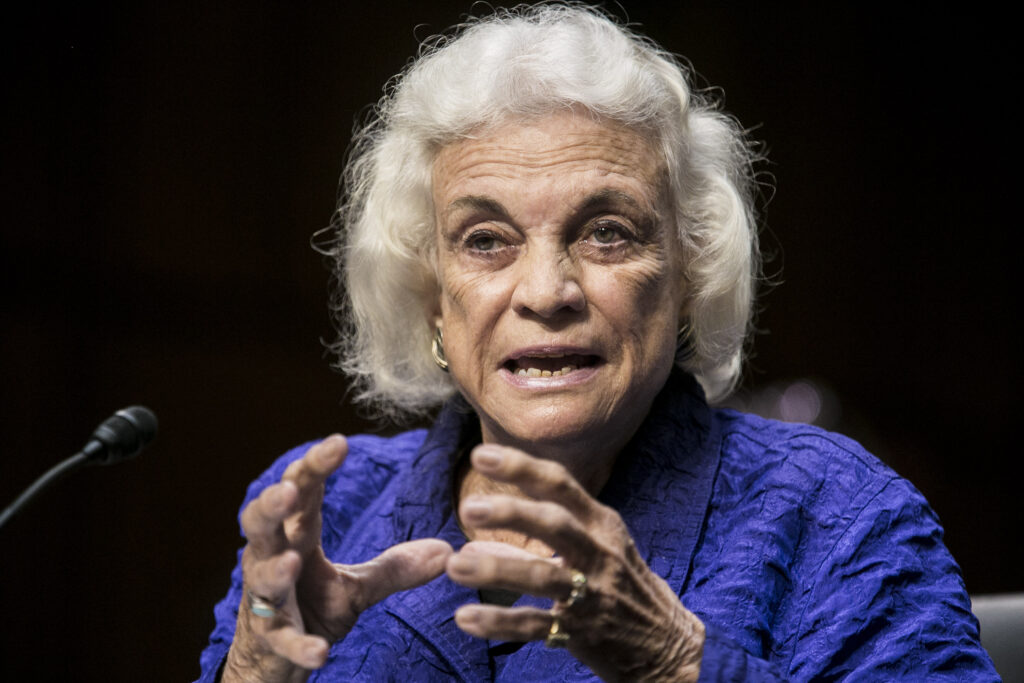
Sandra Day O’Connor died, which was news to me because I was shocked to discover she wasn’t dead already.
(Photo by T.J. Kirkpatrick/Getty Images)
Also, Shane MacGowan, founder and front man of the Celtic punk band The Pogues finally, as they say, bit the dust. Ever heard the phrase, “live fast, die young, and leave a beautiful corpse?”
Hey, Shane certainly satisfied the first piece of that triad of terrible advice. According to one obituary I read, “He was repeatedly injured in falls and struck by moving vehicles.” My son Ned remembers “chatting with some Irish people who had seen him perform in a wheelchair and vomit on himself onstage.”
When I was teaching, I told my classes whenever they all made a hundred on a reading or vocabulary quiz, we’d have a “Fethibal,” that I’d turn them on to some cool video.
By far, the most popular one was the Pogues’ cover of “Dirty Old Town,” which inverts the tropes of Romanticism where lovers woo one another beneath factory walls.
Here’s a link. Enjoy! And Happy December! Click the link “Watch on YouTube!”
[1] Have you heard that Irony has committed suicide? You can read about it HERE.
A speech given in honor of Vaughan Murzursky’s retirement from Porter-Gaud School
Over the years, I’ve had the honor to deliver several of these sending-off speeches for some masterful teachers – the late Tom Evatt, Erica Lesesne, Sue Chanson, Ed Burrows, Natalie Herford. But never have I faced such a daunting task as to encapsulate in under four minutes the five-FEET, two inches of gut-crunching, man-eating terror that is Paula Vaughan Mazursky.
“The Czarina.”
Where to begin?
How about Barnwell, South Carolina, Vaughan’s hometown?
Besides Vaughan, Barnwell has produced more than its share of notable South Carolinians, including, in the political realm, Edgar Brown and Solomon Blatt. However, undisputedly, Barnwell’s most famous native son is James Brown, the Godfather of Soul, the hardest working man in showbiz, or perhaps, nowadays, the hardest working penitent in Purgatory.
Of course, the Godfather was 13 years older than Vaughan, and Barnwell’s schools were segregated in their day, but what an exciting concept to think of them as contemporaries, the Godfather and the Czarina, in an integrated high school, perhaps as chemistry lab partners – if I may quote the Godfather – [holler] – what an explosive combination that would have been!
For, like James Brown, Vaughan Mazursky has Soul, soul with a capital S, which may be the most remarkable trait of this very remarkable, unforgettable woman. I don’t mean to diminish Vaughan’s stellar intelligence – anyone who has had the privilege of being her friend can attest to her quickness and her formidable knowledge of geography, history, art, and politics – but it is her passion that sets her apart from all the rest of us who have taught and teach here; it is her passion that has made her the teacher that former students first ask about when we bump into them years later, the teacher whom they never ever forget.
Add to her intelligence, her passion, and her learnedness – spontaneity – a joie de vivre that might spur her to jump upon a coffee table in the old teacher’s lounge to belt out Marvin Gay’s “A Stubborn Kind of Fellow” or to scream the Georgian word for freedom right in front of a Soviet tank in occupied Tbilisi or to raise both arms in triumphant joy at an Obama rally at the Cistern, an image that appeared internationally in various media (though as a subject of a National Enquirer article, Vaughan is no stranger to the limelight). Absolutely, Vaughan lives her life to the fullest.
Damn the cruise missiles, full speed ahead!
She was a demanding teacher, which endeared her to wise parents, not so much to materialists. Whenever I hear of that proverbial subliterate high school student from No-wheres-ville, USA who points to the Indian Ocean when asked to locate Alaska on a globe, I think of my two sons pouring over maps of godforsaken sub-Saharan countries, labeling rivers and mountain ranges, or strutting around the house doing the Wagga-do-do dance (which, by the way, Vaughan, I have spelled in this speech W-a-g-g-a-d-o-d-o).
O, my brothers and sisters, I have faced the fearsome wrath of MaZoo. In ’89 before I accompanied her and 21 students on a 28-day trip to the Soviet Union, a trek that took us from Leningrad to Moscow to Siberia back through Tashkent, Alma-Ata, Samarkand, and Tbilisi, I had to prove my worthiness by taking geographical tests along with the students on every so-called Republic we passed through. I, too, had to memorize the names of transliterated towns, rivers, lakes, and mountains and spell the transliterations correctly. Let’s say on the first couple of quizzes I didn’t meet the Czarina’s high expectations, but soon learned that she was serious. She wasn’t going to take along to a foreign land anyone not competently aware of the history and topography of his destination.
The good ol’ Evil Empire has been in history’s dustbin for two decades, so many of you may not know that Vaughan taught a senior course in Soviet history back in the day, a course that attracted the very brightest of our students, the de facto AP history course for seniors back when there wasn’t an AP history course for seniors.
It is, I think, the mark of a great teacher that she can effectively teach a wide range of grades. Here, the Czarina reigned supreme – She taught 8th graders geography, current affairs – and had them watch heart-throb ABC news anchor Peter Jennings every Monday thru Thursday – all the while below the radar teaching them organizational and study skills. Meanwhile, in the Upper School, she was having students grapple with the forces that led to the Russian Revolution, the complexities of the emerging Soviet State, the nuts and bolts of economics.
[Sigh] There’s so much more to say – I should talk about her trailblazing as one of the first female teachers in this school – I should talk about the devotion that the very best graduates we’ve produced hold for her, people like George Kent, Paul O’Brien, Blakely Blackford, and Alex Werrell, but I’m nearing the end of page two, which is my self-imposed limit.
* * *
In closing, as I stand here recalling the history of a great history teacher, I would like to mention a name from the past, Berkeley Grimball, who hired Vaughan and me and a handful of others here but without whom none of the rest of you would be here, because this institution would not exist.
By the early Sixties, Porter-Military had been reduced to a school for troublesome boys, and the Gaud School, though excellent in academics, subsisted in dingy, threadbare rooms, in a sort of Dickensian shabbiness.
It was Berkeley Grimball who had the vision to unite the spirituality of Dr. Porter and the academic rigor of Mr. Gaud to create this hyphenated school, and when the three schools merged in 1965 – at the height of Civil Rights Unrest – Porter-Gaud offered enrollment to anyone who qualified, white, black, or yellow, Muslim, Jew, atheist, or Hindu – a liberality of which we all can all be proud, a liberality that Vaughan Mazursky has always proudly embraced.
As we old folks disappear, we are fairly soon mostly forgotten. That is the way of the world.
However, Vaughan, you, for sure, have attained legendary status and your legacy will be remembered and cherished for decades as you remain a part of those students’ lives you have enriched – as you have enriched those of us who have taught with you – and I hope you’ll continue to enrich us, your friends, at parties and taverns and non-violent demonstrations.
Mike Johnson, the hastily installed new Speaker of the House of Representatives, is a religious fanatic who makes my late Bircher literalist cousin Zilla look like a forward thinker.
For example, here’s his take on same-sex marriages:
“Homosexual relationships are inherently unnatural and, the studies clearly show, are ultimately harmful and costly for everyone. Society cannot give its stamp of approval to such a dangerous lifestyle. If we change marriage for this tiny, modern minority, we will have to do it for every deviant group. Polygamists, polyamorists, pedophiles, and others will be next in line to claim equal protection. They already are. There will be no legal basis to deny a bisexual the right to marry a partner of each sex, or a person to marry his pet.”
Oh, I’m sure at the moment Mike’s on a prestige high, puffed up with pride, swamping Jesus’s switchboard with an overload of hallelujahs, enjoying all the attention, but this too shall pass because he’s destined to fail at his new job – understaffed, inexperienced, more or less chosen, not for intellect nor competence but because he possesses a winning Republican combination of rightwing fanaticism softened by a pleasant demeanor.
Affable Mike Johnson believes that the Bible is literally true. He’s on record claiming that the earth is a mere 6,000 years old, which is pretty remarkable for anyone in the 21st Century but especially remarkable for someone so powerful, someone a mere two deaths away from possessing the nuclear codes.
I suspect that the 18 Republican representatives who serve in districts carried by Biden and who voted for Johnson may come to rue their decision come November 2024.
Hey Mike, as St. Teresa of Avila once said, “More tears have been shed over answered prayers than unanswered prayers.”





















 You Do Hoodoo