“History repeats itself, first as tragedy, then as farce.”
Karl Marx
Let me begin this scholarly screed by introducing you to some of the lovelies who frequent the Felliniesque get-togethers at Mar-a-Lago.
I mean, we’re in John Waters territory here, in the land of farce, grotesque exaggeration, caricature.
From John Water’s “Female Trouble”
Speaking of which, Thursday a week ago (18 July 2024) on the stage of the Republican National Convention, Hulk Hogan endorsed Donald Trump, “the quadrice-indicted twice-impeached once-convicted popular-vote-losing adderall-huffing insurrection-leading ear-diapering testimony-ducking judge-threatening lawyer-ignoring witness-tampering day-one-dictatoring disabled-veteran-dishonoring inheritance-squandering rube-fleecing clown-makeup-smearing language-mangling serial-sexual-predating draft-dodging casino-bankrupting butler-bullying daughter-perving hush-money-paying real-estate-scamming bone-spur-faking ketchup-hurling justice-obstructing classified-war-plan-thieving golf-cheating weather-map-defacing horse-paste-promoting paper-towel-flinging race-baiting tax-evading evidence-destroying charity-defrauding money-laundering diaper-filling 88-count 78-year-old fluorescent tangerine felony factory.”[1]
At the end of his speech, Hogan ripped off his shirt to reveal a tee emblazoned with
TRUMP
VANCE
MAKE AMERICA GREAT AGAIN!
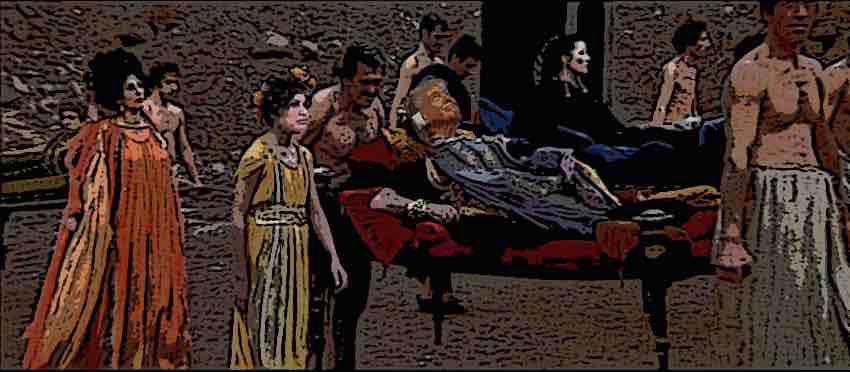
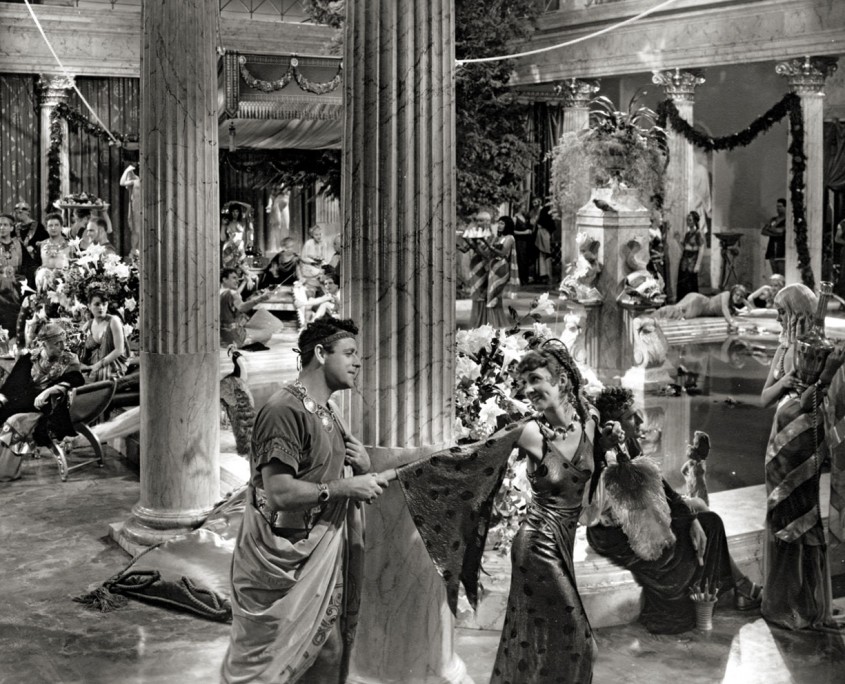
Not surprisingly, the literature of Nero’s Rome provides us with an ancient parallel to our current farcical state of affairs. Check out in your ample spare time The Satyricon by Petronius the Arbiter.[2] Here’s a still from Fellini’s cinematic treatment of Petronius’s classic, from the chapter known as “Trimalchio’s Dinner.”[3]
In his famous statement, “history repeats itself, first as tragedy, then as farce,” Marx was riffing on the Hegelian idea that history repeats patterns but in different ways, e.g., the French Revolution leading to Napoleon I (tragedy) and then to rise and fall of Napoleon III (farce).
Or, to draw a North American Parallel, the American Revolution is followed by the Civil War (tragedy) and then by the MAGA revolution (farce).
However, the thing is that when melodrama is exaggerated it becomes comic a la Reefer Madness, but when farce is overly exaggerated, it can become terrifying in a creepy clown sort of way.
I mean, imagine being trapped in an elevator with Don, Jr.’s fiancé Kimberly Guilfoyle! Imagine the future White House wedding.
I try not to take things for granted. For example, yesterday Caroline and I sludged on foot through heavy humidity to Planet Follywood for breakfast, and as my sunglasses fogged up like a time-lapsed cataract, I thought to myself how nice it is not to have to assess essays.
Of course, we’re smack dab in the middle of the summer, so I wouldn’t have any essays to grade anyway, but still, if I weren’t retired, I’d be lamenting that it’s really not the middle of the summer, given contemporary school schedules. The post Labor Day onset of school has gone the way of the hand-cranked eggbeater, a relic of the predigital era. I recently overheard someone say that school this year starts on August 7th, which is way too early — way, way too early.
Of course, the very beginning of school does have its charms, like meeting new colleagues and students, and the welcome-back faculty and staff cocktail party is fun, but the next thing you know, you’re slogging through over-annotated summer reading books and their accompanying journals. More than any other project, including research papers, I hated assessing those annotated novels and journals, fussing over inelegant quotation integration, encouraging students to break quotes into small units and imbed them into analytical prose.
For example,
Not: “Moore juxtapositions descriptions of impoverished Camilla Creel and Jill Birdsong during Activity Period. Camilla has no friends. ‘As usual Camilla Creel doesn’t move from her seat when the bell rings for Activity Period. The rest of the girls in her home economics class can’t wait to put away the dress patterns they’re cutting out and stow those scissors so they can rush out into the teeming halls where boys cut fool and girls gossip.’ Compare this with ‘Jill Birdsong has made her way to the Junior Civitan meeting in Miss McGee’s room.'”
[vigorous yawn]
But Instead: Moore adds another set of foils to underscore differences among the characters, in this case Camilla Creel and Jill Birdsong. At Activity Period, friendless Camilla ‘doesn’t move from seat when the bell rings,’ unlike Jill Birdsong, who is making ‘her way to the Junior Civitan meeting in Miss McGee’s room’ to interact with her peers in choosing a charitable project for an African American nursing home. Ironically, Camilla is so impoverished that her family lives in an abandoned school bus, but to the rest of the school, she’s essentially invisible.”[1]
[lesser yawn]
So, my mid-summer Island life isn’t darkened by dreading upcoming responsibilities. Now I can complain about the heat and tourists walking five abreast on Hudson Street instead of interminable faculty meetings and the annual blood borne pathogen tutorial and accompanying test.
[cue Alice Cooper]: “School’s out forever.” The back-to-school sales no longer produce sighs.
[1] from Today, Oh Boy, (121-3). BTW, I realize it’s obnoxious to market my novel like this. But buy it, dammit. Here’s a LINK.
I don’t remember the last time I cranked down a backseat window and stuck my head out into the wind shoosh of a moving vehicle down a suburban street back in the day before seatbelts, shouting some silly something like “E=MC2” to startled pedestrians just because I felt like it, so it’s been a while since I hollered out of a car window, misbehaving in public.
Private misbehavior I’ve also been guilty of, like calling bullshit on some shared Biblical absurdity at a cocktail party in Atlanta or Charleston, embarrassing my spouse, when I should have dismissed the chemical spritz of the believer and not call attention to myself. I’m guilty of lesser sins as well like being the last to leave the party, absentmindedly belching after a meal, checking my phone mid-conversation.
But there’s no fun in any of that, no fun in the sudden oath, the blows and fall of anger, but I do confess I still (in my acetic heart) appreciate the jiu jitsu of a bitchy bon mot done up in Oscar Wilde style, knocking a snoot down a peg or two or three. So I’m laying off misbehaving, y’all, heeding the call, but not exactly minding my own beeswax it seems.
How about with invasion: muskets versus bows and arrows? Wind-borne lamentations. Later, clinking chains, songs of woeful repetition. The worst kind of karma, evil spreading out in concentric circles, dispersing like an oil spill, sullying every man, woman, and child.
This degradation is Faulkner’s great theme: the darkness of terrible wrongs blighting the Southern landscape, passing from generation to generation, destroying both the rich and the poor, Joe Christmas and Quentin Compson.
These shadows—genocide, slavery, the War—incubate the monsters of Southern Gothic literature: incestuous aristocrats, necrophiliac halfwits, sadistic Alabama sheriffs—not to mention the supernatural, hoodoo and haints.
When I was eleven or twelve, I asked our housekeeper Alice who was part Cherokee and part African if she believed in ghosts, and she told me that she had seen her father standing in her backyard the night after his death. We were sitting in my mother’s 1960 Ford Fairlane in the parking lot of the Piggly Wiggly in Summerville, South Carolina. I could see wonder and dread on Alice’s face when she told me about that visitation. She was tall, slender, graceful, light- skinned with high cheekbones, but always wore a somewhat sad expression. I have no idea how old she was.
The dog was howling, she said. The dog had seen her papa’s ghost as well.
The supernatural is one strain of Southern Gothicism; however, the suicide hanging in the attic, the alcoholic great aunt who gave birth to the idiot child buried in the backyard is another. These more mundane instances of Southern Gothicism are even more terrifying because they’re not merely figments of superstitious imaginations, but flesh-and-blood monstrosities. William Faulkner’s Miss Emily Grierson and Flannery O’Connor’s Misfit did not materialize out of thin air; their prototypes, walking and talking lost causes, traveled the streets of Oxford and Milledgeville.
***
Over the course of her long life, Shirley Gibson, a Charleston institution, has amassed an enormous number of friends from every social strata, from countesses to street musicians. Also, she has mentored dozens of young people including the artist Shephard Fairy and the novelists Katie Crouch and Grady Hendrix. Having taught art at Porter-Gaud School for four decades, her house on Trumbo Street features an array of colorful ceramics she has crafted in an Italian style. A somber portrait of her great grandmother hangs in the downstairs parlor, but the house, despite its age, projects a youthful vibe. Associating with young people keeps you young, they say, and Shirley remains young at eighty-something.
Some of Shirley’s people come from Mississippi, the birthplace of the blues and the former stomping grounds of William Faulkner himself, whose novels take place in the imaginary county of Yoknapatawpha, modeled on Lafayette County and its county seat Oxford, Faulkner’s hometown. He spent the majority of his life populating Yoknapatawpha with characters who span the entire history of Mississippi, starting with native inhabitants of the early 19th Century, through the antebellum period, the War itself, and its awful aftermath — characters like Chief Issetibbeha, the planter Thomas Sutpen, Bayard Sartoris, Sam Fathers, Ike McCaslin, Joe Christmas, Benji Compson, Flem Snopes, Dilsey Gibson . . .
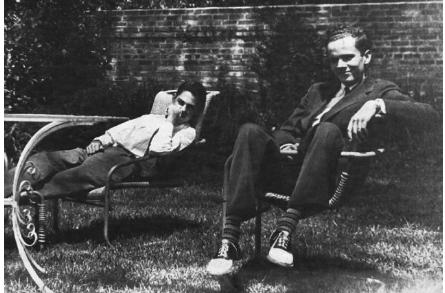
Mississippi is also where the novelist Walker Percy and his brothers LeRoy and Phinizy moved after they were orphaned in the 1930s. Their adopted town Greenville calls itself “the heart and soul of the Delta,” and it was there that Walker Percy became lifelong friends with Shelby Foote, the novelist and chronicler of the Civil War. As young men, they embarked on a pilgrimage to Oxford to meet Faulkner. Although Foote and Faulkner engaged in a spirited conversation, Percy was so awestruck that he was unable to utter more than a couple of words.
Shelby Foote and Walker Percy
A few years ago at one of Shirley Gibson’s dinner parties, I sat at the dining room table next to Walker Percy’s niece Melissa. Although Melissa didn’t delve into her family’s “ancient history,” her great grandfather, John Walker Percy, committed suicide in 1917 when Uncle Walker was one, and Walker’s father, LeRoy Hope Percy, took his own life when Walker was thirteen. After her husband’s death, Walker’s mother, Martha Susan Phinizy, moved to Athens, Georgia, with her three sons to live with her mother.
At the dinner table on Trumbo Street, Melissa told the story of her grandmother’s death, how she drove her car off a county bridge into a creek with Melissa’s father in the front seat. Her father Phin, only nine years old at the time (six years younger than his brother Walker), somehow managed to extricate himself from the sinking automobile, but his mother would or could not escape. Uncle Walker, she told us, regarded the death as a suicide.
After crawling his way up the bank, her father Phin waited on the side of a desolate Georgia dirt road in the middle of nowhere, his mother by now a corpse in the submerged car. He sat there alone for twenty minutes. Melissa said that the next car that came by was Uncle Walker’s. They, along with brother LeRoy, were now the orphans of suicides, fortunate to find a good home with their first cousin once removed, William Alexander Percy, a bachelor lawyer and a poet, but the orphans of suicides, nevertheless. At the time of this telling, her father was still alive—though not alive—in a nursing home, one of the living dead. In the Percys’ case, Southern Gothicism was not merely a literary genre, but a way of life.
Long Ago Last Summer, a collection, short fiction, poetry, and essays, forms a sort of a mosaic of my life. It’s a guided tour, if you will, of the haunted houses and cobwebbed attics of my youth. You will encounter a collection of characters: village idiots, spinster aunts, hard core alcoholics, and at least one mass murderer, Pee Wee Gaskins, who picked me up hitchhiking in 1971. Each piece can stand alone, so you can skip around. However, if you read the chapters in chronological order, you will grow up and grow old with me, as it were. For example, the first two stories in the collection, “Those Who Think, Those Who Feel” and “Airwaves,” are highly fictionalized accounts of portions of my parents’ lives. The last entries deal with my wife Judy’s death and my finding new late life love.
Although coming of age in the South in the post-World-War-II era could be very unpleasant—not to mention dangerous—it wasn’t all bleakness and mayhem. We had more than our share of laughs, and despite the ignorance and bigotry and anger manifest throughout our history, including the present with the MAGA movement, I’m nevertheless proud to claim the South as my homeland.
After all, if it weren’t for Blacks and Scotch Irish rustics, American culture would be dull indeed.
For whatever reason, this summer I’ve started missing teaching. I have an acquaintance, a very intelligent and accomplished young woman who is trilingual, spent a couple of years in Africa with the Peace Corps but who now suffers from what I’ll call low-grade ennui, her post jungle job not as satisfying as it seemed on paper. I see her occasionally at Chico Feo, and I ask her how her ennui is going, I’ve also been reciting snippets of poems dealing with profound boredom, riffing on Baudelaire, Yeats, Eliot, Roethke, Berryman, and Bukowski.
For example, J. Alfred Prufrock is no stranger to tedium.
For I have known them all already, known them all:
Have known the evenings, mornings, afternoons,
I have measured out my life with coffee spoons.
She enjoys these snippets, leans in so she can hear Prufrock above piped-in music.
Contemporary culture is so impoverished. TikTok, Insta, Facebook, et. al offer quick fixes to sate the need for constant stimulation, but they’re about as nourishing as cardboard. It’s not only fun but also life enhancing turning young people on to what Matthew Arnold called “the best that has been thought and said.” As a teacher, I especially enjoyed explaining how the elements of cultures reinforce each other and how the best art incorporates contemporary science and history into its mix: Planck and Einstein + WW1 + Freud = Modernism.
And no rock
If there were rock
And also water
And water
A spring
A pool among the rock
If there were the sound of water only
Not the cicada
And dry grass singing
But sound of water over a rock
Where the hermit-thrush sings in the pine trees
Drip drop drip drop drop drop drop
But there is no water
So yeah, I miss that (but not meetings, emails, EpiPens, essay grading, overwrought parents, dress code violations, and all that life-negating rigmarole.
***
What brought this nostalgia to mind was watching last night a video of Elvis Costello in 1978 performing “Watching the Detectives” in Kohn, Germany. We had a tradition that if every student in my class scored a 100 on a reading or vocabulary quiz, we’d have what I called a “Festival” and turn them on to some really wonderful music videos like Etta James and Dr. John performing “”I’d Rather Be a Blind Girl” or the Pogues doing “Dirty Old Town.” I considered it not a waste of time but an enrichment of their lives.[1]
“Watching the Detectives” is an homage to film noir, and the lyrics mimic a screenplay:
And the music that supports these lyrics percolates ska-like. It’s such a good song, and I wish I could share it with someone and explain it to them[2] why it’s relevant.
[1] Also, it was a huge incentive to read the assignments.
[2] Yeah, I know, I know, “them” should be a singular pronoun.
Thursday night, our friend David Boatwright met Caroline and me at the Terrace Theater to check out the Ethan Hawke Flannery O’Connor biopic Wildcat.[1] It’s gotten mixed reviews—hovers around 5 on the Rotten Tomato ten point scale— but I wonder if to fully appreciate the film you need to be familiar with O’Connor’s work. Throughout the action, Hawke and fellow screenwriter Shelby Gaines intersperse fiction from O’Connor’s canon into the story of her adulthood, but if you’re unfamiliar with her stories — e.g., “Parker’s Back” or “Revelation”— you very well may find the film quilt-like, a series of narratives stitched together that don’t create a comprehensive or unified overview. Brandon Yu, who reviewed the movie for New York Times, complains, “Half-sketched and sometimes hard to follow, the stories glimpsed here ultimately fail to produce a fully legible or consistently engaging arc of what must be a roiling inner world.” However, if you’ve read the stories, this is not the case. You see how they came to be via her daily interactions with others and understand how the stories embody her Catholic vision.
I don’t think the Hawkes (Ethan’s daughter Maya plays O’Connor and his wife Rachel is credited as a producer) necessarily set out to produce a fully integrated masterpiece like Citizen Kane but rather made the movie as an homage to Flannery, an artist of the highest caliber who simultaneously can make you laugh out loud and feel pathos. Maya Hawke discovered O’Connor in high school, used O’Connor’s Prayer Journal for her audition monologue at Julliard, and essentially became obsessed with the writer.
I can empathize. I’ve learned a lot from Flannery O’Connor about writing fiction. Not only that, but her stories are so fun to teach, are so well crafted with each element of the plot — name selection, physical description, characterization, symbolism, and tone—linked to a common central theme: in a Catholic universe underserving people can be granted grace, even in the seemingly godforsaken Southern Gothic world of rural Georgia.
Take the story “A Good Man Is Hard to Find,” for example, which dramatizes a family vacation where a mother, father, two bratty children, an infant, and a grandmother are murdered by an escaped convict called the Misfit. Yet I’d classify the story as a comedy, both in the literary sense and also in the Medieval sense of “The Divine Comedy” where a soul moves from darkness to light. The grandmother in the story is a self-centered pain-in-the-ass who essentially causes the wreck that allows the Misfit to murder the family and steal their car. However, at the very end of the story, grace descends upon the old woman when she sees how miserable the Misfit is and tries to comfort him:
[The Misfit’s] voice seemed about to crack and the grandmother’s head cleared for an instant. She saw the man’s face twisted close to her own as if he were going to cry and she murmured, “Why you’re one of my babies. You’re one of my own children!” She reached out and touched him on the shoulder. The Misfit sprang back as if a snake had bitten him and shot her three times through the chest. Then he put his gun down on the ground and took off his glasses and began to clean them.
Hiram and Bobby Lee returned from the woods and stood over the ditch, looking down at the grandmother who half sat and half lay in a puddle of blood with her legs crossed under her like a child’s and her face smiling up at the cloudless sky.
illustration by Jeffrey Smith
Note that her “legs are crossed,” an obvious Christian symbol, “under her like a child,” which suggests innocence regained, and that she is “smiling up at a cloudless sky.” In O’Connor’s Catholic universe, this amounts to a happy ending for the Grandmother’s death comes at a moment of redemption. This message is no doubt alien to most contemporary US citizens; however, as the movie makes abundantly clear, she wasn’t writing for the materialistic middle class.
“Either one is serious about salvation or one is not,” O’Connor writes in Mystery and Manners. “And it is well to realize that the maximum amount of seriousness admits the maximum amount of comedy. Only if we are secure in our beliefs can we see the comical side of the universe.”
For me a movie is a successful if I think about it a lot after seeing it. In the wee hours this morning, as I wandered the barren moors of my insomnia, I thought about how the subdued colors of the film in general and threadbare genteel shabbiness of her home in specific underscore the profound melancholy of Flannery O’Connor’s life. She had studied at the famed Iowa Writer’s Workshop, hung out with Robert Lowell and Katherine Anne Porter, but after developing lupus was exiled from a literacy life in the North to a suffocatingly provincial existence on a farm in Milledgeville, Georgia, There she worked in pain and physical decline until her death at 39, all the while being totally unappreciated by her homefolk who found her fiction to be inaccessible and life-negating.
My only gripe is that the Hawkes’ depiction of O’Connor lacks the dry humor that she demonstrated in her letters. Maya Hawkes’ acting is superb, but she portrays O’Connor as sort of a rigid, humorless young woman on the spectrum whereas in reality O’Connor was fun to be with. I once had dinner with the late Ashley Brown, a professor at the University of South Carolina, who was close friends with Flannery and who appears often in her collected letters. I asked him if she were as severe a Catholic as the stories suggested, and he said, “Oh, no, not at all. She was delightful, very witty, fun to be with.” Then he whipped out photo albums featuring pictures he had taken of her with her peacocks. She was often beaming in those photos.
Nevertheless, by external standards, her life was bleak, and the film’s underscoring of that fact has made me appreciate her achievement even more. To see her alchemizing on screen the characters from her daily life into the immortals of her stories is very satisfying indeed. I also appreciate the way she didn’t outline her stories but had them unspool spontaneously from her subconscious, which is the way I also write fiction.
I’ll leave you with this delightful seduction scene from “Good Country People” where in a hayloft Manly Pointer, a door-to-door Bible salesman, demands that one-legged hot-to-trot nihilist Hulga Joy Hopewell say the words “I love you” to satisfy a mechanical formula he insists must be followed as a prerequisite for sex:
The boy’s look was irritated but dogged. “I don’t care,” he said. “I don’t care a thing about what all you done. I just want to know if you love me or don’tcher?” and he caught her to him and wildly planted her face with kisses until she said, “Yes, yes.”
“Okay then,” he said, letting her go. “Prove it.”
She smiled, looking dreamily out on the shifty landscape. She had seduced him without even making up her mind to try. “How?” she asked, feeling that he should be delayed a little.
He leaned over and put his lips to her ear. “Show me where your wooden leg joins on,” he whispered.
I often say that my novel Today, Oh Boy has the most unerotic sex scene in all of American literature, but now, rereading the above, I take it back.
[1] Although better known in Charleston a muralist and a painter, David is also a filmmaker, and sitting next to a filmmaker made me pay closer attention to technique, which is a good thing.
Hey, I got a beef with whoever writes the narratives of the PBS series Nature. It really bugs me when the narrator – and it happens all the time – says stuff like the panther chameleon’s eyes have been engineered by nature to rotate independently as they stalk their prey.
Note to the science writers at Nature: check out Charles Darwin’s The Origin of the Species. Natural Selection ≠ Engineering. Natural Selection is a horrifically random process that includes genetic mutations, asteroids colliding with the Earth, etc. Your use of the word engineering suggests the decrepit teleological intelligent-design argument (as if having an asteroid smack into the planet is an efficient way for an engineer to facilitate the rise of mammals).
I’ll give Robert Frost the last word on this topic:
Design
I found a dimpled spider, fat and white, On a white heal-all, holding up a moth Like a white piece of rigid satin cloth — Assorted characters of death and blight Mixed ready to begin the morning right, Like the ingredients of a witches’ broth — A snow-drop spider, a flower like a froth, And dead wings carried like a paper kite.
What had that flower to do with being white, The wayside blue and innocent heal-all? What brought the kindred spider to that height, Then steered the white moth thither in the night? What but design of darkness to appall?– If design govern in a thing so small.
Now, that’s what I call engineering: a Petrarchan sonnet that through pattern debunks the argument from design!
Hey, what’s all this negativity, mon? It’s Bloomsday, for Joyce’s sake and Father’s Day to boot, not to mention Sherry Browne’s birthday.
Let’s not squander this day bellyaching. Why not in honor of the Master spend your day wandering the streets of Folly, breakfasting on Guinness and kidney, writing love letters using a nom de plume, hitting a funeral, lunching in a pub on cucumber sandwiches, visiting a library and then another pub, releasing some tensions at the beach, getting into an altercation with a one-eyed anti-semite, dropping in on a maternity ward and then a brothel, bringing home a troubled young man, peeing together in your garden as you bid him adieu, then crawling into bed with your wife who has fond memories of you in your youth.
O and the sea the sea crimson sometimes like fire and the glorious sunsets and the figtrees in the Alameda gardens yes and all the queer little streets and pink and blue and yellow houses and the rosegardens and the jessamine and geraniums and cactuses and Gibraltar as a girl where I was a Flower of the mountain yes when I put the rose in my hair like the Andalusian girls used or shall I wear a red yes and how he kissed me under the Moorish wall and I thought well as well him as another and then I asked him with my eyes to ask again yes and then he asked me would I yes to say yes my mountain flower and first I put my arms around him yes and drew him down to me so he could feel my breasts all perfume yes and his heart was going like mad and yes I said yes I will Yes.
A year or so ago, Buxton Books invited me to recite a favorite poem for their on-line series, “The Power of Poetry” as part of the promotion for my novel Today, Oh Boy. However, I don’t think the clip was ever posted, so in honor of Yeats’ 159th birthday, I’m posting it here. The text of poem itself is below the video.
We sat together at one summer’s end, That beautiful mild woman, your close friend, And you and I, and talked of poetry. I said, ‘A line will take us hours maybe; Yet if it does not seem a moment’s thought, Our stitching and unstitching has been naught. Better go down upon your marrow-bones And scrub a kitchen pavement, or break stones Like an old pauper, in all kinds of weather; For to articulate sweet sounds together Is to work harder than all these, and yet Be thought an idler by the noisy set Of bankers, schoolmasters, and clergymen The martyrs call the world.’ And thereupon That beautiful mild woman for whose sake There’s many a one shall find out all heartache On finding that her voice is sweet and low Replied, ‘To be born woman is to know— Although they do not talk of it at school— That we must labour to be beautiful.’ I said, ‘It’s certain there is no fine thing Since Adam’s fall but needs much labouring. There have been lovers who thought love should be So much compounded of high courtesy That they would sigh and quote with learned looks Precedents out of beautiful old books; Yet now it seems an idle trade enough.’
We sat grown quiet at the name of love; We saw the last embers of daylight die, And in the trembling blue-green of the sky A moon, worn as if it had been a shell Washed by time’s waters as they rose and fell About the stars and broke in days and years.
I had a thought for no one’s but your ears: That you were beautiful, and that I strove To love you in the old high way of love; That it had all seemed happy, and yet we’d grown As weary-hearted as that hollow moon.
Of course, I’m not amazed that Donald Trump is thoroughly corrupt (from the split ends of that plasticine confection he considers hair, to the soulless soles of his feet), nor am I amazed that millions of lost souls worship him as a Jim-Jones-like demigod, consumed as they are with envy and anger, the two least enjoyable of the deadly sins. What does amaze me is how the leaders of the Republican party, people who should know better – like Speaker of the House Mike Johnson, for example – kill off their better angels to keep in the not-so-good graces of this totally despicable Mammon-worshiping, porn-star bonking, delusional, self-pitying piece of shit.
Yesterday, seemingly seconds after Trump’s conviction, Speaker Johnson was assailing the verdict, Mitch McConnell claiming that the charges should never have been brought against him, and Elise Stefanik prevaricating that Biden’s corrupt Justice Department (who, by the way, is prosecuting Biden’s son) is to blame for the unjust prosecution of a presidential candidate for falsifying business records to conceal a payoff to a porn star he had sex with during the first month of his third son’s life.
I’ll concede that the so-called hush money trial is the least nefarious of Trump’s several indictments, not nearly as bad as illegally hoarding nuclear secrets in his bathroom, nor as bad as attempting to cajole Georgia’s secretary of state into stealing enough votes to overturn a legal election, and certainly not as bad as encouraging an insurrection in an attempt to disrupt the transition of power.
However, a jury of Trump’s peers, fellow New Yorkers – one of whom gets her news from Fox – convicted him after carefully weighing the evidence.
Yet, there’s no guarantee, given the inequities of the Electoral College, that Trump won’t be reelected, that he will once again raise his right hand and swear to uphold the Constitution so he can begin organizing his mass deportations, constructing detention camps, and putting into action his campaign of Putin-like retribution.










 You Do Hoodoo