This year’s Spoleto Festival features a potentially budget-busting array of popular musical choices. To wit, Mavis Staples, Patti Smith, Jeff Tweedy, Lucinda Williams, MJ Lenderman, Band of Horses, and Yo La Tengo.
For the sake of solvency, I’ve limited myself to two performances, Patti Smith and Lucinda Williams.
First up was Patti Smith, who appeared Wednesday at the Cistern, a splendid outdoor venue located on the College of Charleston’s campus.
I love Patti Smith. Her injecting high art references into three chord rock inspired me back when I was a wastrel grad student in 1975, a mere half century ago. The album was Horses, its cover photo shot by Robert Mapplethorpe, her housemate. What I love about that record is its expansive allusiveness, its juxtaposing via a sonic collage high and low art, Rimbaud and Boney Maroney, bats with baby faces doing the Watusi like Bela Lugosi. But, most of all, what I love is that it rocks.[1]
In my old age, I purchase expensive concert tickets that put us way up front. For Patti, my wife Caroline and I sat on the third row. I was under the false impression that Patti might perform the songs of Horses in order, but she only sang one song from the album, “Redondo Beach,” a lilting reggae number whose light-hearted melody belies the lyrics’ first person account of a gay lover’s suicide.
Why try to explain when you can listen to a snippet yourself.
Anyway, the concert was laidback, with Patti filling up deadtime with friendly anecdotes while her band tuned and retuned their instruments in Kingston-Jamaica-grade humidity.
Caroline was blown away, and so was I, though I really would have loved it if she had included “Gloria,” a mash-up of the Van Morrison/Them classic and some badass self-assertion:
I walk in a room, you know I look so proud I move in this here atmosphere where anything’s allowed Then I go to this here party and I just get bored Until I look out the window, see a sweet young thing Humping on a parking meter, leaning on the parking meter
Oh, she looks so good, oh, she looks so fine And I’ve got this crazy feeling that I’m going to, ah-ah, make her mine.
G-L-O-R-I-A!!!
photo credit I-and-I
So tonight, we’re headed back to the Cistern to see Lucinda, which for me will be the third time. She’s had a stroke, which she says affects her guitar playing, but I bet it hasn’t diminished that beautiful distinctive Southern vowel-rich hoarse voice of hers.
I certainly hope not.
[1] You can read a tribute to Patti by clicking HERE.
Like the recurring characters in Cheers, I show up most afternoons at what the quaint call “a local watering hole.” Chico Feo, my bar of choice, is one part Cannery Row, one part Key West tourist mecca, one part – as far as the cooks and bartenders go – extended family.
I enjoy watching people interact, hearing the latest gossip, and, if the opportunity arises, engaging tourists with meaningful conversations. After all, I suspect my obituary will mention that among other things I was a fiction writer, and as I often inform total strangers, I’m constantly gathering “data” about this and that, which I might use in creating a character. It’s a way to justify my personal questions about their lives. To me, constructing characters that readers care about is the most gratifying aspect of fiction-writing.
Unfortunately, today I happened to sit next to a borderline asshole. He was in his late 20s sporting muscles, tattoos, and the ubiquitous baseball cap worn backyards. On the plus side, he might end up in one of my stories and receive the karmic comeuppance he deserves.
Solle, perhaps the most effective bartender I’ve encountered in a drinking career that spans over a half a century, asked me how my book promo TV interview went, and the aforementioned borderline asshole said, “I saw it!”
I informed the borderline asshole that his having seen it was impossible in the current space/time continuum because the interview hadn’t aired yet. Then he said, “I saw you at the studio.” It occurred to me that he might be a camera person, so I asked him if he worked for FOX 24, and he said, laughing, “No, I’m just fucking with you.”
I was not amused.
He and his friend started talking about how great it must be to live on Folly, and I agreed it was, that I was very fortunate. They live in West Ashley, and I said that was a convenient place to live because it’s near everything – the airport, downtown Charleston, Folly itself.
A few minutes later, the borderline asshole asked me what the book was about, so I clicked off some sound bites from the interview. “It’s a memoir,” I said, “but it’s as much about the South as it is about me – antebellum plantations, shotgun shacks, Pentecostal churches, juke joints. It’s a collection of short stories, essays, and poems, each of which can stand alone and be enjoyed separately, but if you read it cover to cover you get a history of the South from segregation through the civil rights movement and the cultural revolution of the 60s.”
“Wow, you must be a racist,” he said.
“What!!!??? Why do you say that?”
“If you’re not a racist, then why aren’t you?”
“Why not, because I grew up with Black people. I like most of them I’ve met.”
“I’m a racist,” he said.
No doubt I was scowling, because he immediately said, “Ha, ha, I’m not really a racist. I’m just fucking with you.”
Dark clouds were scudding overhead, so I decided it was time to walk home, which takes me past a melancholy memorial marking the spot where someone named Phillip died in a traffic accident. For some reason – maybe because before I left the bartender Katarina clasped her hands in mock prayer asking the skies not to rain – my inner poetic jukebox cued a line from one of Shakespeare’s sonnets: “And trouble deaf heaven with my bootless cries” and then a line from A Midsummer’s Night’s Dream followed: “Chanting faint hymns to a cold fruitless moon.” And finally, a line from a Grass Roots song that I don’t even like: “Sha la la la la la live for today.”
I took a right on Erie, and as coincidence would have it, I encountered an interracial couple pushing a baby stroller. They were taking up the entire right hand lane, so I suggested they walk on the left so they could see the traffic coming. The red-haired woman and her husband smiled. She said, “Thanks, but we’re staying right here” and disappeared into the yard of a rental.
So much for my mansplaining.
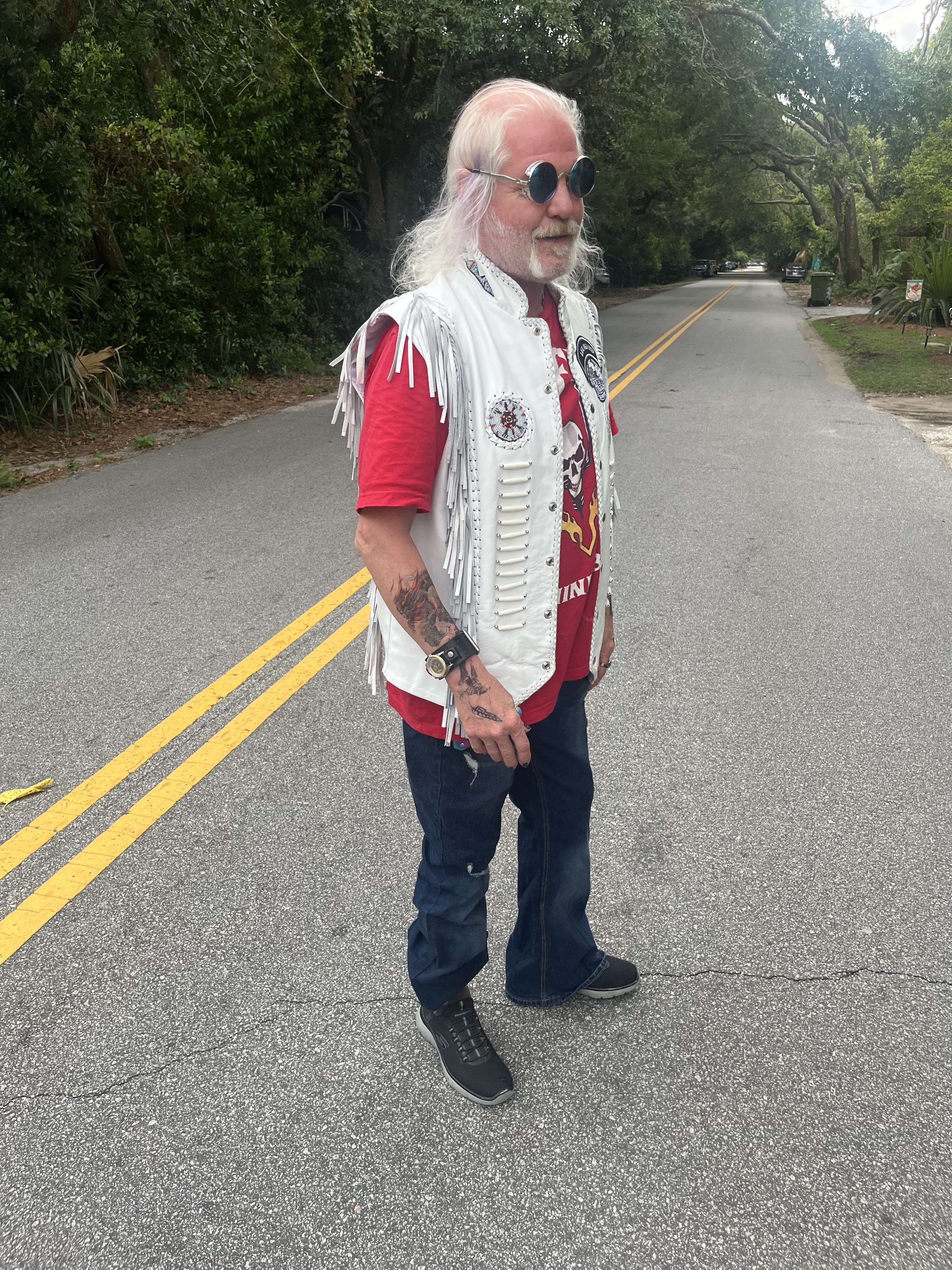
I decided to cross over to Hudson using a tree embowered beach access path and spotted through the tree tunnel a couple weaving past on skateboards. Once I hit 5th Street, I bumped into my neighbor Lance. I asked him about his outfit, a white fringed patch-bedecked vest over a red tee shirt emblazoned with a skull, and he explained the various patches and emblems.
As I said good-bye, he said, “I love you, man,” which was a nice way to end my excursion.
Vaudeville Meets William Faulkner Meets The Hallmark Channel
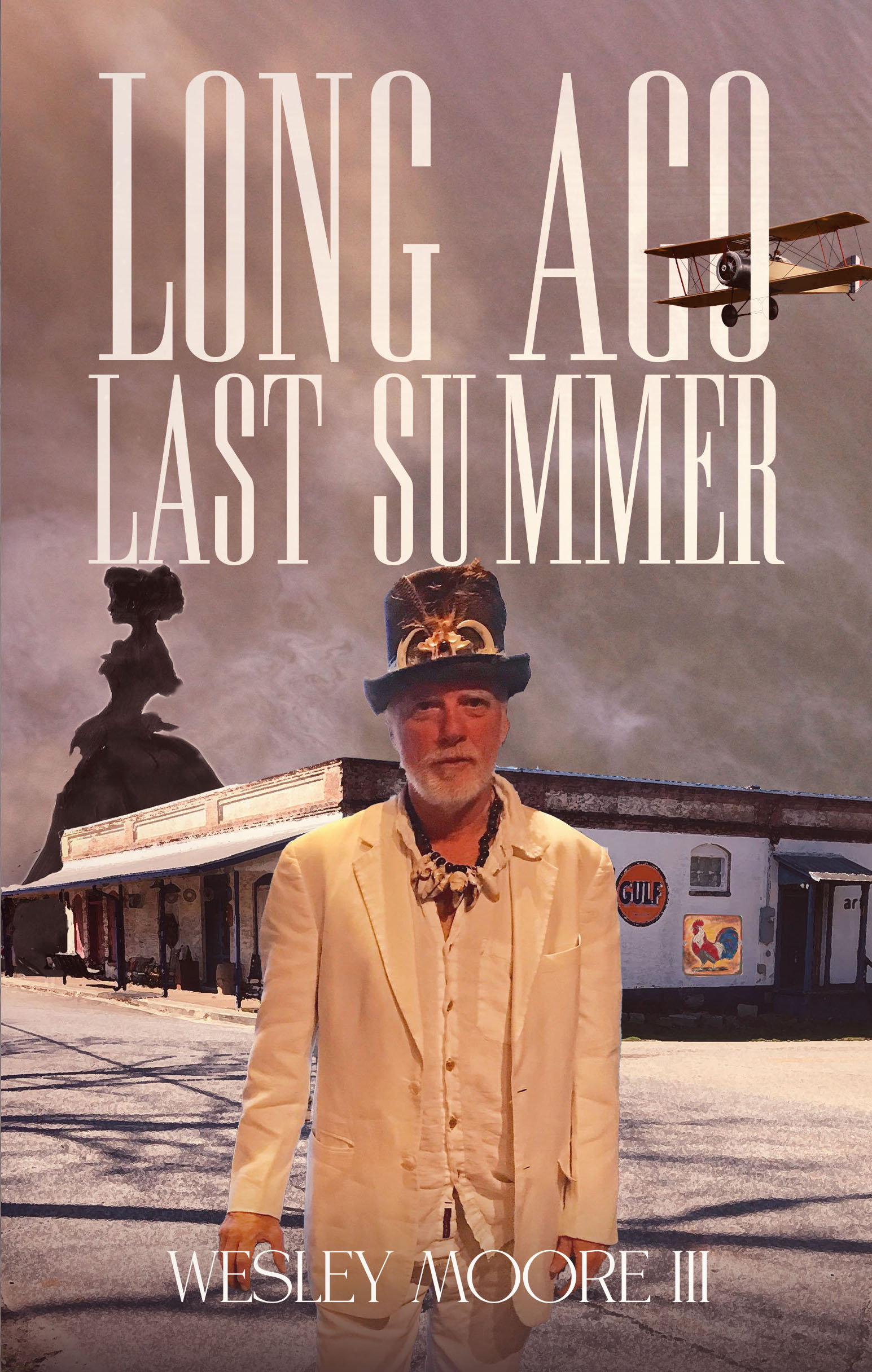
On Friday, I had my first interview involving my new book Long Ago Last Summer. Lorne Chambers, who owns the Folly Current and has an MFA in writing from the College of Charleston, met me at Chico Feo where we chatted about creative writing in general and Long Ago in particular over a couple of beers.
Occasionally, I didn’t know how to respond to Lorne’s excellent questions because Long Ago is such a strange book that it can’t be easily categorized. When you’re trying to sell something, it’s helpful to have a clear, simple message like it’s “a coming-of-age novel” or a “dystopian sci-fi epic” or “a romantic comedy.” With Long Ago Last Summer it’s more like Vaudeville meets William Faulkner meets The Hallmark Channel.
In essence, it’s a memoir, which is embarrassing enough because of the egocentricity inherent in thinking my life is so noteworthy that it warrants being shared with others. And in many ways, my life has been unadventurous. I enjoyed a long lasting, loving marriage for 38 years, a stable teaching career for 34 years, reared two successful sons, owned a succession of dogs, remarried as a widower and gained a remarkable stepdaughter. I’m well-travelled, I guess, but that’s not unusual in this day and age. To adapt a cliche: my adulthood has not been much to write home about as far as excitement goes.
On the other hand, I grew up in the segregated South, a very dark, fascinating place, a fallen civilization forever picking its scabs but then licking those newly opened wounds. The little Lowcountry town of Summerville where I grew up had two (what I’m going to uncharitably call) village idiots, among other eccentrics, like the old crone Miss Capers, religious fanatics galore, creepy good humor men, and more alcoholics per capita than most places this side of the Betty Ford Center.
Much of the book deals with an awakening consciousness that develops in a Southern Gothic setting, or, as the back cover puts it, Long Ago Last Summer “embodies the profound paradoxes of Southern culture against a landscape dotted with antebellum plantations, shotgun shacks, suburban subdivisions, Pentecostal churches, and juke joints.”
However, Long Ago is not a typical memoir in that it’s fragmentary, a collage of sorts, a mosaic, a smorgasbord or gumbo that runs the gamut from lighthearted vignettes to bleak accounts of terrible wrongdoing. If I were going to wax hyper-pretentious, I’d call it neo-Modernistic because like Eliot’s “The Waste Land,” it pieces together fragments to create a narrative held together by recurring themes. In this case, Sothern Gothicism, alienation, insomnia, and the vagaries of memory and reality.
Short fiction, verse, essays, and parodies that can stand alone out of their context occur chronologically to trace my life from its beginnings in 1952 to the present. Long Ago is, as stated in the preface, “a guided tour of the haunted houses and cobwebbed attics of my youth” followed by my college experience, my meeting and falling in love with Judy Birdsong, her illness and death, and my finding new love after her departure. In fact, included in the collection is a villanelle written by my wife Caroline that deals with Judy’s lingering presence in our marriage. In some cases, fiction is juxtaposed with non-fiction so that it’s not necessarily clear which is which.
In other words, Long Ago Last Summer is really weird, like its subject matter.
I’m appearing next week on Fox News 24’s midday show to attempt to explain all of this to viewers who may or may not have heard of TS Eliot and/or Modernism or vaudeville for that matter.
Also, weather permitting, I’m reading brief samples Monday, May 26 around 7:20 at George Fox’s open mic Soap Box at Chico Feo.
On 14 December 1952, a rare snowy day in Summerville, South Carolina, Dr. Howard Snyder, aided and abbeted by forceps, yanked me from my mother’s womb into a world of relative woe. The procedure flattened my head, which resulted in cephalohematoma, a condition in which blood pools under a newborn’s scalp. My father had to leave that afternoon to return to Clemson via a Greyhound bus. When the lady sitting next to him asked why he looked so sad, he replied, “My wife just gave birth to a seven pound, eight ounce monkey.”
As a child and teenager, I heard this anecdote on more than one occasion, which would elicit a cackle from my mother, who in so many words agreed that indeed I was a hideous newborn. However, she was quick to assure me that in a couple of weeks I was so beautiful that when she pushed my stroller around Colonial Lake, strangers stopped her to admire my beauty.
I took solace in my mom’s stroller story as a child, not realizing that praising a baby’s looks is a common practice of adults when they run across almost any infant. On Facebook, I often encounter the red puffy yet wrinkled faces of newborns who are deemed “beautiful” or “adorable” by scores of friends of the parents.
Meanwhile, elsewhere, Ethel and Julius Rosenberg sat in a courtroom being grilled by Roy Cohn, Donald Trump’s mentor. My first full year, 1953, marked the feverous height of the Red Scare, back when the Russians were our enemies rather than our friends (or at least our President’s friend).[1] This collective commiephobia spread, appropriately enough, during an epidemic of polio.
Trump and Cohn
In 1953, R&B had not made it to the mainstream, and rock-n-roll was in utero. Every artist but one in Billboard’s top 30 singles of 1953 is white, mostly male crooners and female sopranos. Overly orchestrated instrumentals were also popular. The number one hit that year is “The Song from the Moulin Rouge” by Percy Faith and His Orchestra, a song so saccharine sounding that your ears might develop diabetes if you listen to more than twice.
I’ve never heard of loads of these hitmakers like Pee Wee Hunt, Frank Chacksfield, Richard Hayman, Joni James. By far, the coolest song in that top 30 is from the one Black performer, South Carolina’s own Eartha Kitt, singing and purring “C’est si Bon” en francais. She later was cast as Cat Woman in the Batman TV series.
On the other hand, I have not only heard of but seen all of the top movies of ‘53, except for The Naked Spur. I’ve seen From Here to Eternity and Gentlemen Prefer Blondes at least twice, I’ve also watched Roman Holiday and Stalag 17. Disney’s Peter Pan was one of my favorite movies in childhood, especially because the leader of the Lost Boys was, like me, a red head.
Nevertheless, despite the general awfulness of 1953, being born around then ended up being a propitious time to begin life’s journey. My parents, who had grown up during the Great Depression, wanted my siblings and me to have a better life than they suffered yet didn’t monitor our every move, allowing us to roam freely, unencumbered with water bottles or walkie talkies, the ’60’s equivalent cell phones.
And by our adolescence in the mid ’60s, the music got ridiculously good, though we feared getting drafted and going to Nam, but by then the war was winding down and a draft lottery was in force. Compared today, college tuitions were dirt cheap. I could earn enough money in the summers to cover tuition.
However, I must say, for me at least, it’s a melancholy situation in my twilight years to witness the spectacle of lawlessness and corruption foisted on the Republic by Roy Cohn’s mentee, who obviously, as far as Machiavellianism is concerned, was an A+ student.
C’est la vie, as Eartha might sing.
I’ll leave you with the number 1 hit of 1953.
[1] Fun facts to know as share: Roy Cohn, who in addition to being one of the prosecutors at the Rosenberg trial, also served as chief counsel for Joseph McCarthy’s witch hunts, a term Donald Trump appropriated during his first term to describe investigations targeting him for such acts of malfeasance like storing stolen classified documents in bathrooms and paying hush money to porn stars.
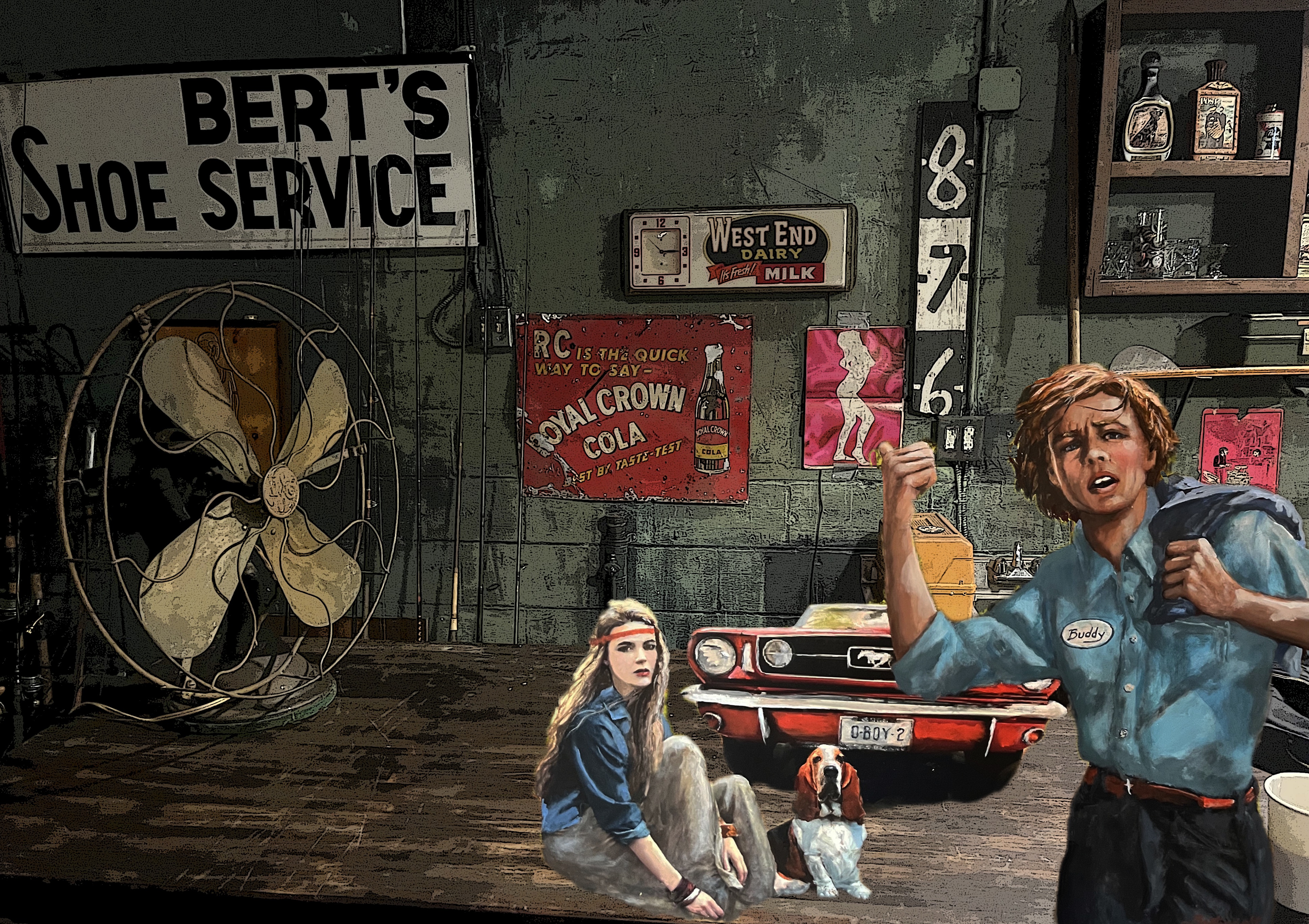
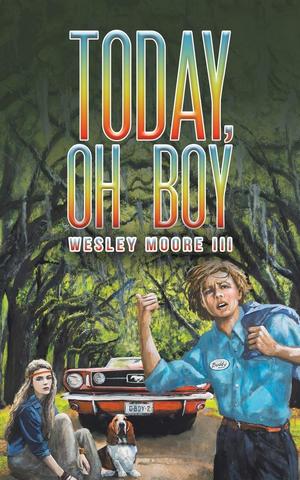
When my friend David Boatwright, who produced the cover of Today, Oh Boy, approached me about adapting the poolroom chapter from the novel into a fifteen-minute film, I jumped at the chance. David whipped out a script, which I approved, then later made some significant changes.
Near the end of the novel, which is set in 1970, Rusty Boykin, an ADD-riddled hippie-wanna-be from Summerville, South Carolina, and Ollie Wyborn, a straightlaced, straight-A transplant from St. Paul, Minnesota, join forces in thwarting an attack from a pair of rednecks whose favorite pastime is, to use the Lowcountry lingo of the day, “cutting ass,” i.e., beating up people they don’t cotton to.
David’s major change in the second draft of the script was fusing Rusty and Ollie into one character, which I again approved, given I had complete confidence in his intelligence and talent, and because as a practical matter, there’s virtually no room for character development in a fifteen-minute movie. Another significant change, which added gravitas to the film, David created a new character, a Viet Nam vet who relates a harrowing account of wartime mayhem to the bartender, played my former student, David Mandell.
So anyway, David Boatwright and his producer Paul Brown raised the needed money and assembled a crew of costume designers, cinematographers, assistant directors, sound people, make-up artists, art directors, property managers, actors, a stunt coordinator, a basset hound, etc. and shot the film in four days.
The exterior shots, which included fisticuffs and car chase, were filmed on bucolic Wadmalaw Island and the interior shots at the defunct West Ashley restaurant Bearcat, which has been transformed into a ’70s era bait and tackle shop/bar complete with pinball machines and a functioning jukebox on loan from my friend Thom Piragnoli.
I asked David if I could have a cameo, and he said, of course, so yesterday I spent twelve amazing hours on the set being part of an incredibly complicated matrix of moving parts.
When I arrived at seven, an actor was seated having his hair tended to. One of the make-up women said she would do my hair next, and I explained, “But I have no hair,” removing my hat, and she said, “Great!,” meaning, I take it, less work for her. After I introduced myself, another woman said, “Oh, these young actors can’t wait to meet you. They’re walking around with the book.”
Indeed, they were incredibly appreciative. Each one sincerely thanked me for writing the novel. Two actors, twins brothers playing rednecks, asked me why their characters were so angry. When the actor Logan, who played the Viet Nam vet, thanked me for, in his words, “creating all of this,” I told him that, in fact, David had created his character and dialogue. He said yes, but I had created the world around him. To my mind, his performance and speech are the climax of the film.
I abstractly knew that it would be cool to see characters I had created “come to life,” but had underestimated how gratifying it ended up being. It was especially moving to see Jill Birdsong, modeled on the high school version of my late wife Judy Birdsong, performing her role, and I especially enjoyed the actor Patrick Basquill, who brought the bully Bobbey Ray Bosheen to life. The creepiness he brought to the role reminded me of William Dafoe’s portrayal of Bobby Peru in David Lynch’s Wild at Heart.
Also, it was really weird to hear the name “Rusty,” my childhood nickname, called out throughout the day. Sometimes, I thought they were referring to me. And Thomas, the actor who plays Rusty, looks a lot like I did in high school, except he has blue eyes, high cheek bones, brown hair, and isn’t riddled with freckles and acne.
In other words, he’s skinny.
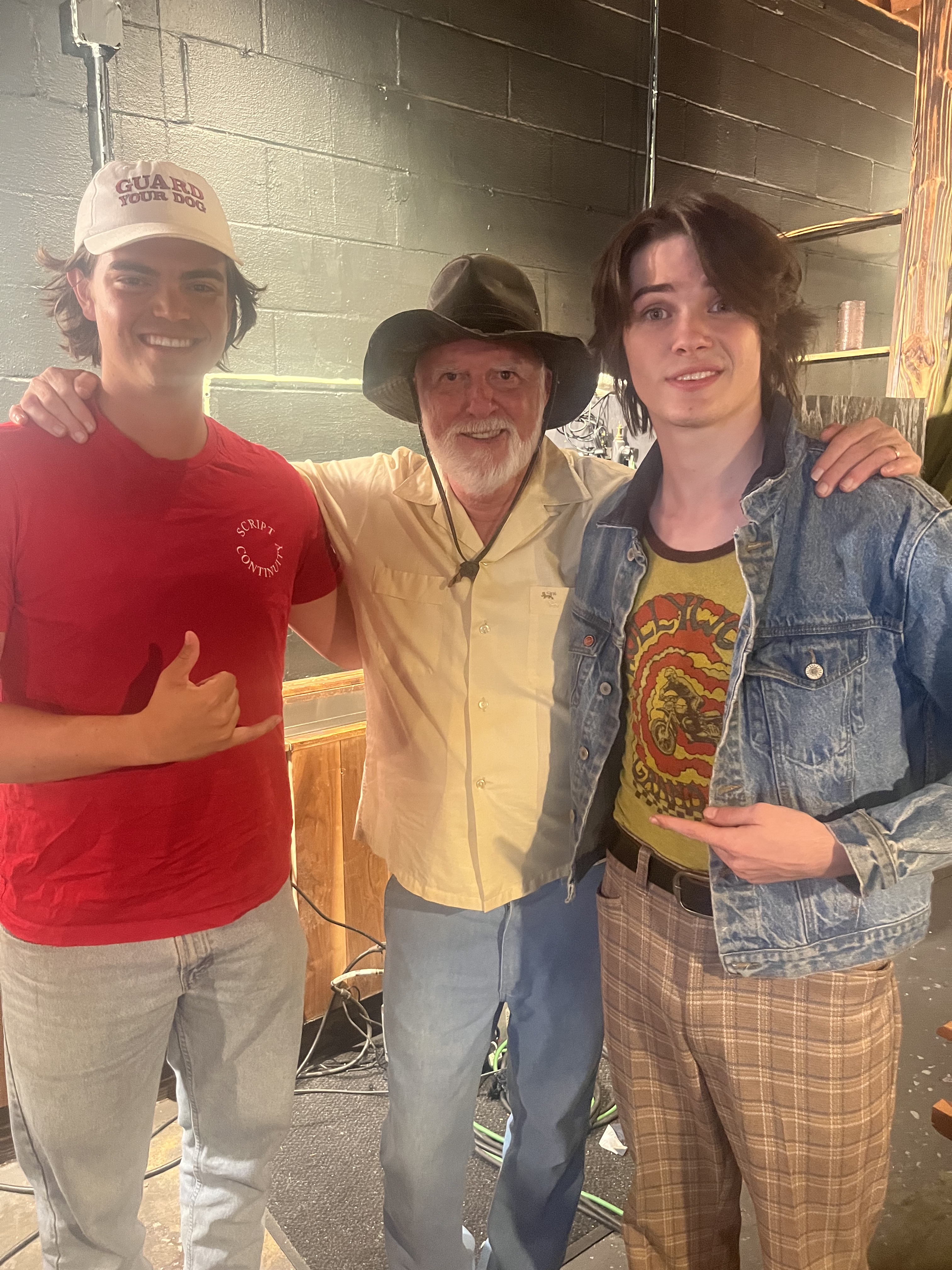
from left to right, Thomas Beck, Rusty Moore, and “Rusty Boykin”
It was such a wonderful day, the best ever in my life as a writer, and I can’t wait to see the finished product, entitled Summerville 1970, which will make the festival circuit and premiere sometime in the fall at the Terrace Theater on James Island.
Before I end this way too egotistical account, I want to acknowledge my wife Caroline Tigner Moore, without whom the manuscript of Today, Oh Boy would have been found in a drawer after my demise, rather than becoming a published novel.
Caroline has encouraged me throughout but also has bravely said, “Un-uh, that doesn’t work, why don’t you do this instead.” She’s tactfully guided me through the interviews and the whole befuddling process of my post-teaching career, including offering encouragement in my avocation of creating “fake paintings.”
After my beloved Judy Birdsong died, I imagined the lonely life of a wounded epicurean, but Caroline has enriched my life in ways I could not have imagined, especially in establishing a loving family that includes my wunderkind stepdaughter Brooks, who is as kind as she is brilliant, and a trio of pets, KitKat, the demi-mutt, and our blue-eyed ragdoll cats, Juno and Jasmine.
Love to them and to you!
PS. Here’s a link to the Kirkus review of Today, Oh Boy that includes an interview and links to purchase it via Amazon and Barnes and Noble, or better yet, get it from your local independent book store, which in Charleston is Buxton Books.
At the request of an actor who’s interested in pitching my novel Today, Oh Boy to producers he’s worked with, I’ve written an adaptation of the novel for the screen.[1] It’s not an official screenplay per se, but a roadmap for the actor to determine what scenes he will use to produce a short “teaser” reel consisting of would-be shots from the would-be movie. I have no idea how this is done. Via AI I suspect. Anyway, with the final proofs from the novel to the right of my iMac’s screen and a blank Word document on the left, I began writing and cutting and pasting.
The good news is that originally, using present tense and employing crisp visual imagery, I consciously composed Today, Oh Boy to read like a movie progressing. For example, here’s the opening of the novel.
A mango-hued, pockmarked bulletin board hangs on a classroom wall of pale lime green concrete blocks, the bulletin board pencil-stabbed and compass point-gouged. Among the graffiti are the names of the star-crossed lovers: Sandy + Tripp. Tragic Tripp, whose body was found last week tangled in blackberry bushes along the banks of the Ashley River, his skull smashed after falling off Bacons Bridge.
S-A-N-D-Y + T-R-I-P-P.
Rusty Boykin, a skinny, freckled redhead sitting on the bulletin board row in Mrs. Laban’s homeroom, traces his index finger in the depression of Sandy’s name. He supposes it’s Tripp’s work – the letters inartistic, juvenile. Sandy hasn’t been to school since Tripp’s death, four class days ago, and now it’s Monday, and she’s still not here. She should be sitting right in front of Rusty, her honey-colored hair hanging like a curtain to her waist.
How to adapt this for the screen? One way, you could have Rusty tracing his finger in Sandy’s name and then suddenly cut to Tripp falling off the bridge, or you could begin with Tripp’s accident. What I did was to begin with Tripp’s last meeting with Sandy, a conversation through her open bedroom window, his leaving in a rage, jumping into his GTO, pealing off, and ultimately driving his car off the road at Bacons Bridge into the Ashley River.
Actually, Tripp’s death is what Hitchcock called a McGuffin, a misleading device that’s irrelevant to the overall narrative. After all, Today, Oh Boy is a comedy. Its title comes from the Beatles’ song “A Day in the Life.”
I read the news today oh boy
About a lucky man who made the grade
And though the news was rather sad
Well I just had to laugh
So, by having Tripp drive off the bridge rather than falling off the bridge, what I gain in cinematic excitement, I lose in the comic pairing of his first and last names. As it turns out, Tripp was a bully, a high school version of Trump. At one point in the book, Alex Jensen, a junior at Summerville high, says to a friend Will, “Your last name is Trotter, you name your son Tripp, and he falls off a bridge to his death. What a surprise.”
In addition, the novel employs a great deal of what critics call “indirect discourse,” a device that allows a narrator to report what someone is thinking without using his exact words. For example, in the above excerpt, the sentence, “She should be sitting right in front of Rusty, her honey-colored hair hanging like a curtain to her waist” is rendered second-hand through Rusty’s consciousness. In a screenplay, you have to “show” rather than tell “tell,” which can lead to really awkward exposition, like you find in bad fiction like “The Most Dangerous Game”:
You’ve good eyes,” said Whitney, with a laugh,” and I’ve seen you pick off a moose moving in the brown fall bush at four hundred yards, but even you can’t see four miles or so through a moonless Caribbean night.”
That I couldn’t use direct narration or indirect discourse meant I had to omit some characters, like Camilla Creel, the impoverished girl who lives in an abandoned school bus with her mother and sister, and Weeza Waring, Will’s mother, who added several comic touches throughout the narrative.
So, overall, the script is much tidier than the novel, much more streamlined, yet not as rich in my attempt to capture the zeitgeist of Summerville, South Carolina in 1970, during integration, the beginning of the counterculture, and during an influx of Northerners moving to what at the time was a staid, conservative community.
Then again, I’m sure a professional screenwriter could do a much better job.
[1] By the way, it’s on sale at Amazon for a mere $10.
Although spring offers rebirth, for example, dollar weeds resurrecting, azaleas ablaze, etc., it also has its downsides.
Nature’s first green is gold,
Her hardest hue to hold.
Her early leaf’s a flower;
But only so an hour.
Then leaf subsides to leaf.
So Eden sank to grief,
So dawn goes down to day.
Nothing gold can stay.
Robert Frost “Nothing Gold Can Stay”
OMG! My life is slipping through my fingers! Nothing good ever lasts for long!
April is the cruelest month, breeding
Lilacs out of the dead land, mixing
Memory and desire, stirring
Dull roots with spring rain.
Thomas Sterns Eliot “The Waste Land”
Same ol’ same ol’, death and resurrection, death and resurrection, death and resurrection . . .
Here on Folly Beach, springtime attracts sybarites of all stripes, like those 25 cent beer nights in the 1900s, those days of yore.
Today at Lowlife, on my side of the bar, a crew of northern males in their early sixties sported expensive haircuts, retro bowling-like shirts, and satiric lanyards celebrating impending inebriation. Maybe it was a college alum get-together. Who knows? I asked one of them what was up, but he was not forthcoming.
Meanwhile, inside the restaurant, across the bar from where I sat, a bushel of bachelorettes were doing something similar in the team party department, dressing alike, engaging in one last bacchanalia before the sacred vows.
Elsewhere (all over the world, in fact) more serious folks were amassing to protest the hare-brained economic and geopolitical executive orders of a leader who always wins golf tournaments held on courses he owns.
Here’s the White House’s official announcement: “The President won his second round matchup of the Senior Club Championship today in Jupiter, FL, and advances to the Championship Round tomorrow,”
To quote Bob Dylan,
I couldn’t help but feel ashamed
to live in a land
where justice is just a game.
But here’s the good news (and the bad news). Trump and his cabinet are too slapdash careless to topple our democracy. Their idiotic unprovoked trade war is sure to produce a blue tsunami in the midterms next year.
Pity the poor Nancy Maces who’ll have to choose between getting primaried a year from now or continuing to vote for destruction.
Trump’s insanity will lead to failure. People will pretend they didn’t vote for him.
So don’t despair. Nothing orange can stay. Spring leads to summer, summer autumn, fall winter.
Around and around we go, and where we end up is in the rat’s alley where the dead men lost their bones. so I say, to quote the late great Warren Zevon, “Enjoy every sandwich.”
Let me say right off that I’m an avid admirer of WC Fields, who, in fact, is the inspiration for Colonel Duckenfield, the amiable but drunken calculus teacher in my novel Today, Oh Boy.[1]
Here he is in action:
Colonel Dukenfield has charged his minions with two in-class problems using the squeeze principle, so he has excused himself, ostensibly to use the restroom. A huge veined bulbous nose dominates his round, puffy, flushed face, though there’s still a gleam in his squinty blue eyes, especially when he’s talking to a pretty lady. His knees, though, are killing him, along with his corn-riddled toes stuffed into a pair of scuffed wingtips, the only dress shoes he owns. Once he reaches the faculty men’s room, he closes the door and takes out the pewter flask that bears his name and the name of his plane, the Flying Fortress, etched handsomely in ornate, old-fashioned cursive. He sloshes the Jameson’s whiskey around before taking a long, hard draw. Carefully, he screws the cap back on and places the flask in the right pocket of his blazer.
I mean, what’s not to love?
So I don’t intend any disrespect to Field’s surviving progeny (his great granddaughter’s wedding picture appeared in the Santa Cruz Sentinel in 2018) when I suggest that Lindsey Graham could be plausibly cast as an older Fields in a biopic once his political career is over, which may be sooner rather than later, given that he could get primaried on the one hand, and the country is on the road to economic and geopolitical ruin under our unhinged Dear Leader on the other.
What a great pairing of buffoons, Fields’ cinematic persona with Graham’s real life personality!
I know you might be thinking that Graham’s a little long in the tooth at 69 to embark on a new career; however, look at me at 72, getting ready to make a cameo in an upcoming short feature based on a chapter from Today, Oh Boy.[2]
So, Lindsey, see, it’s never too late to segue into something new. Look, man, you’re addicted to the limelight, and look, even if there’s not a Fields biopic on the horizon, maybe some enterprising filmmaker will buy the rights to Today, Oh Boy, and you can end up playing the Colonel himself.
As my wife Caroline says, “We can hope. We can dream.”
I subscribe to an internet entity called “Poem of the Day,” which provides me each a.m. with a dollop of verse to go along with a cup of whatever ground coffee is on sale at Harris Teeter on the previous Senior Citizen Discount Thursday.
will crawl out of the drain and try to kill you like some 80s horror flick.[1]
I like the poem, its witty catalogue of unpleasant analogies. Bad poems are like “a black widow creeping/from the mound of linens still warm from our bodies.” They “steal your breath/ when you wake parched, hungover, emptied,” etc.
What really caught my attention, being a fake artist and all, were these lines describing another, much more successful fake artist:
Once, in Zurich, we were served rabbit paella at a party celebrating an exhibition of an artist from Venice Beach who used to be homeless but drinks $25 Erewhon smoothies and paints hundreds maybe thousands of happy faces with his feet. His canvasses go for $25,000. Toe paintings are better or at least significantly more profitable than failed poems.
This really hit home because the day before yesterday I got a text from a number I didn’t recognize with this message:
“Found some ‘fake’ art at goodwill today. I’m going to buy it as an investment.”
I responded, “Who in his right mind would give a masterpiece like that away?”
But to be honest, I did know. It was the fellow who won it at Chico Feo’s annual Canine Halloween Costume Contest. Harlan, the organizer, asked if I would donate a print, and I thought it was one of the better prizes, but as luck would have it, the winner is an actual artist who upon receiving it asked me if I’d seen any of his works.
I hadn’t.
But I’ll also admit it would take a certain, rare art lover with a funkadelic sensibility maximus to want to hang the print above the mantle.
Anyway, the poet nails it when she whines about the unprofitability of writing poems vis-à-vis creating pictural art. In fact, believe it or not, despite receiving a rave review from Kirkus Reviews and having appeared on a local television show and several national podcasts, my novel Today, Oh Boyhas provided me with less income than my fake paintings.[2]
Already this month, I’ve received two commissions and sold another print, not including the secondhand Good Will purchase.
Anyway, I’d say that creating these canvases is more fun that writing fiction and certainly more fun that going over the “corrected proofs” of a manuscript that soon will be bound and sold in bookstores and online, which I have been doing of late.
I don’t have a pub date yet for Long Ago Last Summer, but I’m guessing late spring or early summer.
PS. Speaking of commissions, Caroline and I have commissioned the unfake funkadelic artist Thom Piragnoli to create a sign for our driveway to alert visitors where our hidden house hides.
You can check out Thom’s art at Chico Feo. The one above is called Galaxy Gals. Check out this LINK for more on Thom.
[1] Rather than cutting and pasting the entire poem, I’ll provide a link because non-poetry lovers, i.e., 99.97% of people, would abandon this post for the greener pastures of a TikTok video. Here’s the LINK. You can read along while Jessica Abughattas reads it in a rather pleasant regionless accent.
[2] To be honest, this was not the case in 2023, the year Today, Oh Boy was published.














 You Do Hoodoo