George Fox, impresario extraordinare, has made Mondays on Folly Beach a day not to dread but one to look forward to. His open mic Singer/Songwriter Soapbox, which features original works, is attracting nationally known artists such Sierra Hull, Joel Timmons, Sally George, and the poet Chuck Sullivan, who published in Esquire Magazine in the Seventies when Gordon Lish ruled that literary roost and introduced readers to the likes of Raymond Carver, Cynthia Ozick, T. Coraghessan Boyle, and Richard Ford.
Here’s a clip of Chuck reading his poem “Juggler on the Radio” at the Soapbox on 8 November 2022.
Yesterday afternoon, after dropping Caroline and Brooks off at the airport, I returned to my pet-ridden but otherwise empty house, and like a good canine stepdad, took KitKat to the dog park where she spazzed out with her patented chihuahua/Jack Russell berserko barking – high-pitched, frantic – perhaps off putting to the other dog owners. However, being dog lovers, they smiled at her, leaned over, and scratched her tiny head, understanding that dogs, like virtually all animals, are territorial.
Folly Dog Park
Unlike KitKat, the humans at the dog park are friendly, non-territorial. We know each other as acquaintances, and welcome newcomers into “our community.”
After I returned KitKat to the house, I decided to do a very not unusual thing, i.e., to ride my bike to Chico Feo for two or three (or as it turned out, in this case, four) low-alcohol Founders All-Day IPAs.[1]
When I arrived, the bar was pleasantly uncrowded. I conversed with my pals Mike and Francesca, bantered with the Irishman Jack, checked out Cory’s multifunctional Swiss-like army knife thingamajig, and talked Dharma with Megan, a poet, my Buddhist friend who through mediation is engaged in the very difficult process of dismantling her ego. She’s shedding intoxicants – not only alcohol and drugs, but social media, the World Wide Web itself, preparing to leave Folly to travel the world.
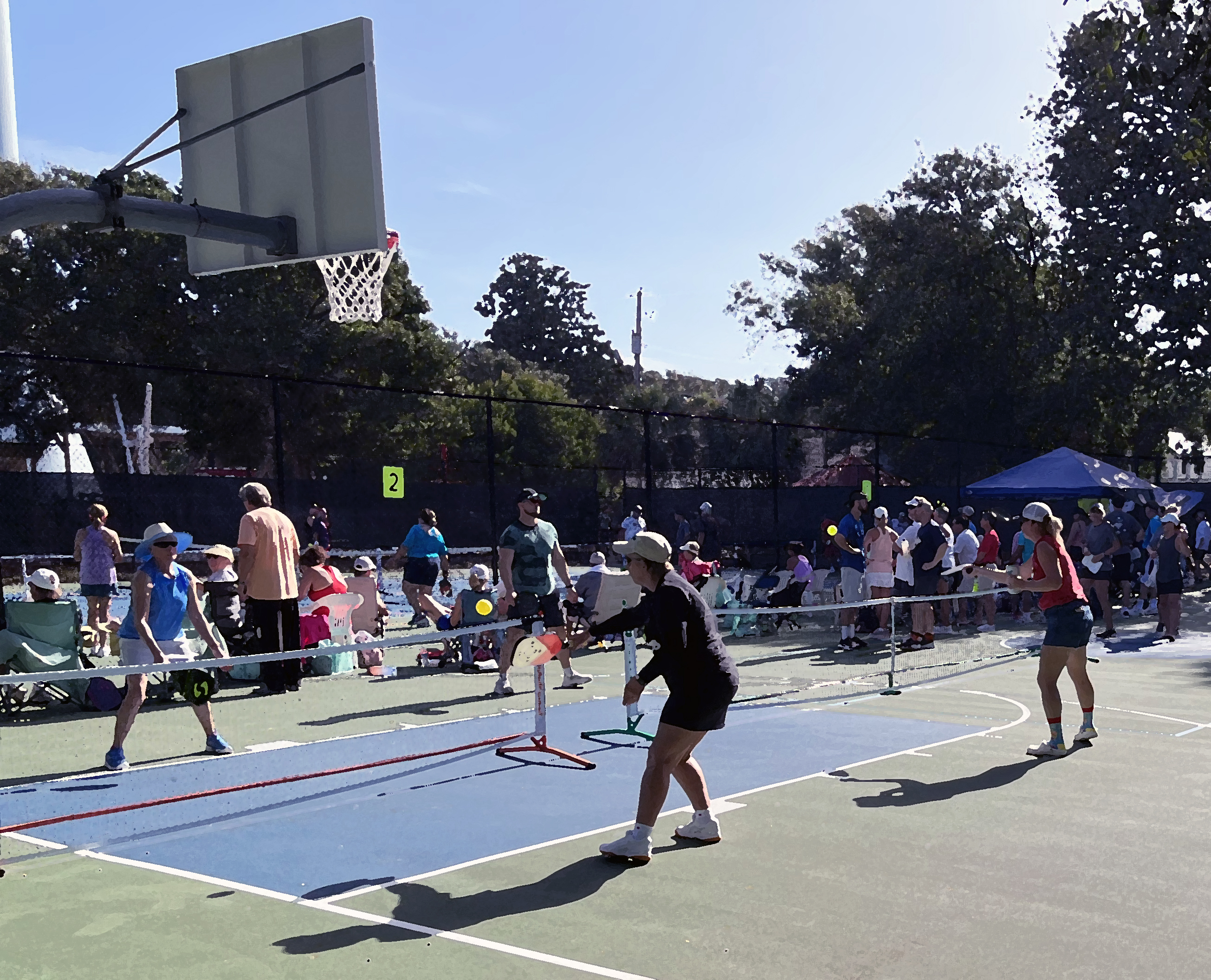
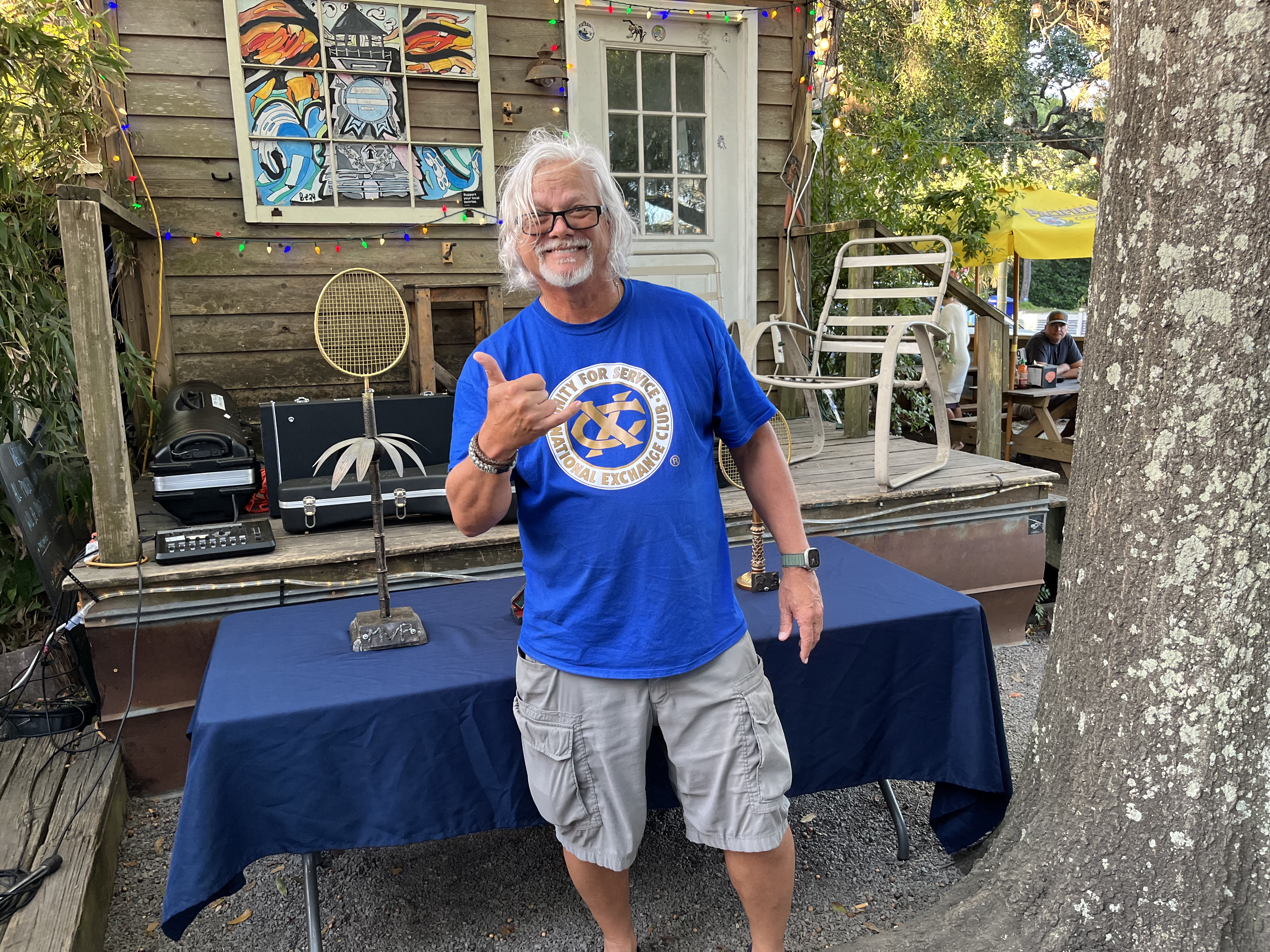
A band was setting up, and someone asked Solly, the greatest of bartenders, who was playing, and he said they were associated with the charity pickleball tournament being held this weekend at the Folly Beach tennis courts.[2] Then, a bit later I spotted my pal Billy Grooms, the City Councilman, hauling a handsome trophy to be awarded to whoever[3] wins the tournament. It appeared that Chico was helping to promote the event.
Billy Grooms
Billy, a hip-looking fifty-something, seemed to be spearheading the tournament, and as a former manager of FM radio stations in the Columbia area, he’s an expert promoter. He sat next to me at the bar and rhapsodized about the salutatory effects of playing pickleball. As more and more tournament people filled the area in front of the bar, I joked that they had elevated the median age of Chico Feo by a decade or so, that I was feeling downright young, though that was hyperbole. Most of the patrons looked to be in their fifties of early sixties.
Billy likened the pickleball community to the movie Cocoon in which old hedonists fly off into outer space to recapture their youthfulness. Billy mentioned that the close quarters of the courts create a sort of intimacy as doubles partners face off at each other at close range. He extolled the camaraderie that pickleball creates, mentioning that opponents often engage in G-rated trash talking.
In other words, pickleball is a helluva lot of fun, not to mention great exercise.
Megan had spotted some young women across the bar dressed up as old folks, sporting white wigs and unhip attire, and wondered if they were mocking the pickleballers.
Although I was wearing a fedora, not a pith helmet, I immediately assumed my amateur anthropologist persona and went over to ask them what was up. “Noooo,” they chimed in unison in their pleasant upstate twangs, “we love pickleball.”
As it turned out, they were bachelorette party participants. One of the women, a short twenty-something in a white wig, assisted by another costumed woman on a stool, performed a magic trick for me with boxes and colors, and I dutifully played along. “Yes, green was the color I had chosen!”
All in all, it was quite a night at Chico with a much more wholesome crowd, some of whom seemed to have stepped directly out of a family friendly sitcom from the Sixties, Hugh Beaumont and Barbara Billingsley types. When one country club Republican-looking fellow shook my hand and said what a pleasure it had been chatting with me, I accidentally blurted, “Yeah, mon,” which perhaps confused him and made me feel slightly guilty.
Meanwhile, in front of the band stand, young couples danced with their toddlers. I warned Solly that now these wholesome folks had discovered Chico, they’d overtake the joint, displacing lovable territorial losers like I-and-I.
He shook his head like that ain’t ever going to happen.
Addendum: The next night I ran into the bachelorettes who had been in costume, and after reading this post, they wanted the world to know that they’re not twentysomethings but thirtysomethings. Whatever, they were a blast to hang out with. Safe travels, ladies.
photo credit Mikey
[1] Note to writers: the phrase “low alcohol Founders All-Day IPAs” is technically redundant because “low-alcohol” is implied in the adjective “all-day.” However, it sounds too cool not to say – low-alcohol Founders All-Day IPAs. I say ear music should trump over-rigid grammatical purity.
[2] Note, they’re called “tennis” not “pickleball” courts. Last week the NYTs ran a lengthy articleabout pickleball’s bourgeoning popularity and how traditional tennis players resent having their courts overtaken by practitioners of what they consider a bastardized version of their beloved sport. In fact, Megan, the Buddhist, falls into the traditional tennis category.
[3] In the a-foolish-consistency-is-the-hobgoblin-of-little-minds mode, I consider using the pronoun “whom” as a subject an almost unforgivable grammatical lapse.
Is there anything worse than contrarians mansplaining conspiracy theories?[1]
What really gripes me is not so much the ridiculousness of their arguments but the smug all-knowing tone these crackpots employ as they confidently explain, for example, that the US government is injecting tracking devices into its citizens via the COVID vaccine or that Princess Di and JFK, Jr. are alive and well shacking up in Bolivia.
Whenever I fall victim to such an occasion, I immediately call bullshit, and if that doesn’t work – if my interlocutor insists on droning on – I end the conversation by stating that I’m seventy, the clock’s ticking, I’m incapable of being convinced, and I’d much rather spend this precious moment doom-scrolling or watching the shadows of the trees sway on the fence of this beer garden rather than learning about how Kennedy and Diana survived their crashes and ended up in La Paz.
I’ll admit this scenario rarely happens, maybe once a year[2]; more frequently, I fall victim to someone mansplaining something I’m all too familiar with, e.g., the plays of William Shakespeare or the principles of Mahayana Buddhism.
Once again, it’s the all-knowing tone I find more offputting than the presumption that I’m ignorant.
In this situation, I might interrupt and say something like, “Yeah, I dig. By the way, who’s your favorite minor comic character? Mine’s Thersites from Troilus and Cressida,” or “‘By the way, have you ever contemplated the affinities of quantum mechanics and Buddhism? You know, ‘form is emptiness, emptiness is form.'”
Sometimes these ploys don’t work because mansplainers are terrible listeners. It’s as if they’re reading internal teleprompters or something. They feel compelled to educate you, or perhaps to highlight their own learning.
Anyway, here’s a handy little chart courtesy of Kim Goodwin and the BBC.
[1] Okay, I mean besides pedophiles, serial killers, Amway representatives . . .
[2] A negative byproduct of hanging out in bars. I can’t recall ever being accosted by a conspiracy theorist at a dinner party.
In the wee hours this morning, I suffered through one of my post-retirement nightmares, a reprise of I’ve Never Been to Class and the Final Exam Is Tomorrow. However, in this morning’s remake, I’ve transitioned from slack-ass student to unconscientious teacher.
In the dream, I’ve returned to class after a holiday with no lesson plans, no homework assignments, with nothing but empty words, my in-class bantering the equivalent of padding an essay with strings of superfluous phrases that take up space but denote next to nothing.
I hate dreams like this!
Well, I’ve decided rather than squandering thousands of dollars in therapy paying for advice from a virtual stranger who probably hasn’t read Ulysses – not to mention Jung and Freud – I’ll prepare lesson plans for phantom dream classes in the hope that I can short circuit my old-fashioned neurosis by being prepared.
Although I only taught history for four semesters in the last two years of my career, I really enjoyed whupping up assignments for the one-foot-out-of-the-door seniors who signed up for that elective, America in the Sixties.[1]
So, my first vaporous assignment is for a history class.
[Confession: Yes, MAGAs, you’re correct: many teachers (but not all) strive to indoctrinate students, which the following assignment certainly attempts to do].[2]
Assignment: Undoubtedly, in the last fifty years, the two most popular Presidents within the Republican Party were Ronald Reagan and Donald Trump.
Although they shared certain characteristics (species, gender, race, celebrity, divorces, party affiliation, fetishization of the Second Amendment), they also differed in several significant ways (in geopolitical attitudes vis a vis Russia, in their views of free trade vs tariffs, in their demeanors, in their adherence to Constitutional traditions).
In a well-developed essay devoid of superfluous phrases that take up space but denote next to nothing, compare Ronald Reagan and Donald Trump, exploring both similarities and differences. Make sure to address three of the above areas of difference.
In your conclusion, speculate on societal dynamics that explain such a radical shift in Republican ideological viewpoints. Aspects to consider: Fox News, declines in literacy, the prevalence of social media, socio-economic disparities . . .
It’s trickier for an English class because in my nightmare, it’s inevitably my British Lit survey that I’ve not prepared for, which begins with the Anglo-Saxon epic Beowulf and ends with Seamus Heaney.
It’s spring and we haven’t gotten past Chaucer!!!
I’m doomed! There’s no way to prepare. Cue Lady Macbeth’s scream in the Trevor Nunn BBC production.
[1] I suspect that course might be the root of my incompetent teacher nightmares because I felt as if I were shortchanging the students given my lack of knowledge, my ignorance of Chicago style research methodology, and my dearth of experience in organizing and implementing a history course.
[2] E.g., when I taught Old Testament in the 7th grade, I ended the unit by having students write a “character sketch ” of Yahweh. Almost every essay was negative: Yahweh was insecure, a “jealous God,” a belligerent Asshole who drowned innocent puppy dogs and kitty cats because His own Creation sucked. Not to mention, that his chosen one to regenerate the earth, ark-builder Noah, got shit-faced post-deluge and passed out naked in his tent, which freaked out his sons. Couldn’t Yahweh have found a Jimmy Carter equivalent instead? Isn’t he supposed to be omniscient?
Be thankful (if you’re not reading this from Russia)[1] that the cosmic crap throw of innumerable permutations of space/time has landed you in a nation that doesn’t ambush males lounging in neighborhood saloons, drag their startled selves to recruitment centers, and in less than a week, transport their untrained asses to the killing fields of the front lines as cannon fodder in an idiotic war instigated by a short-of-stature Napoleon wanna-be.[2]
Russian conscripts saying goodbye
It would be nice if my fellow Americans (especially elected Republican representatives and senators) would take the long view and recognize so-called strong men (i.e., authoritarian rulers) short circuit collaboration, gum up the machine of government with ego, and therefore create dysfunctional nations, because, just saying, not only are two heads better than one, but a few hundred heads are even better than two.[3]
It’s not as if the Trump administration functioned as a well-oiled drama free machine, as if the Donald possesses a vision that extends beyond his next iPhone notification. Oh sure, if Trump were president, he would have magically insulated the U.S. from the universal phenomenon of global inflation. [Cue the Lovin’ Spoonful]: Do you believe in magic? Do you believe in the heresy of evangelicals; do you believe the rantings of a damaged girdle-sporting narcissist who wears more make-up than Mae West in her Myra Breckinridge days?
Trump without make-up
Alas, power trumps decency. Lindsey Graham and Tim Scott and the rest of them will keep their cowardly lips sealed. Look what happened to Liz Cheney. There is – no offense Jesus – short term profit in the forfeiture of one’s soul.
Double alas, propaganda can be effective, especially when targeting the under-educated,[4] so I’m expecting that even despite the January 6 Committee’s powerful case that Donald Trump and his minions attempted to sabotage via coup the peaceful transfer of power in the United States of America, that Donald Trump (aided and abetted by state legislatures) will be elected as POTUS in 2024.
We, to quote one of my TTC students from 1978, “done gone cruzy.”
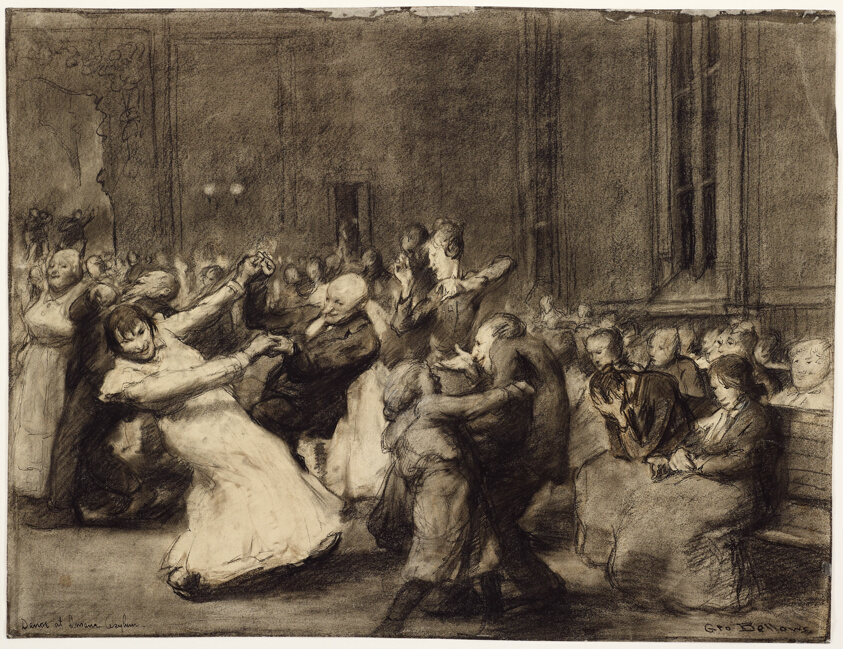
George Bellows: Dancing at the Insane Asylum
[1] So far this year, the blog has 24 hits from Russia, so it’s possible.
[2] Diagram that goddamn sentence grammar technicians.
Before I begin this paean on the exquisite pop/rock masterpiece “China Girl,” I thought I’d mention that some consider Bowie’s 1983 hit racist because he portrays a diminutive Asian female in stereotypical ways, and, [throat clearing], the sexualization of Asian females has been a Western European/North American thing for centuries.[1]
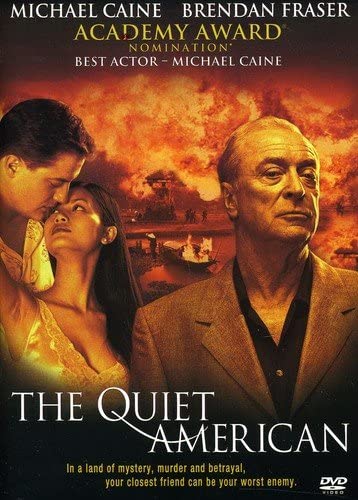
Take Graham Greene’s The Quiet American, for example, in which the narrator Fowler and his antagonist Pyle clash over the possession of Phoung, a Vietnamese husband-hunter who doesn’t even rate a name in Good Reads’ summary. There she’s merely “Fowler’s beautiful Vietnamese mistress.”
Anyway, Bowie considered “China Girl” a “very simple, very direct statement against racism.”
Anyway, whether it’s racist or antiracist[2], the song itself, its dynamic progression from the bubbly pop of the first verse through the escalation of the narrator’s increasing angst, is masterful as it gradually morphs from a Jackson-5-like pop tune into an echo chamber of Weimer Republic decadence. Throughout, Bowie’s phrasing is pliant as he adjusts his voice to the narrator’s successive moods as he transitions from the sunshine of verse one to “visions of Swastikas” in verse four.
The song begins with a riff that Jonathan Kim (the author of the linked article) describes as a “little plunky Asian-style riff” that “is the musical equivalent of someone saying “Ching chong ching.”
On the other hand, it’s catchy, cheerful sounding and segues into the first verse where the narrator’s calm baritone contemplates his Chinese lover.
I couldn’t escape this feeling with my China girl I feel a wreck without my little China girl I hear her heart beating, loud as thunder Saw these stars crashing
In the second verse, the mood darkens slightly, but Bowie’s voice remains relatively upbeat.
I’m a mess without my little China girl Wake up in the morning, where’s my little China girl? I hear her heart is beating, loud as thunder I saw these stars crashing down
After the chorus, in the third, stanza, a sense of anxiety shadows the vocal as the tempo increases. Also, Bowie renders a sort of rock-a-billy hiccup with the line “I could pretend that nothing really meant too much.” A hiccuppy muffled semi-sob sort of.
I’m feeling tragic like I’m Marlon Brando When I look at my China girl And I could pretend that nothing really meant too much When I look at my China girl
What follows is an instrumental interlude in which the thumping of bass and drums replaces the tinkle-tinkle lightness of the verse two verses, which then leads to what I called above “a Weimer decadence.”
I stumble into town Just like a sacred cow Visions of swastikas in my head Plans for everyone It’s in the white of my eyes
My little China girl You shouldn’t mess with me I’ll ruin everything you are You know I’ll give you television I’ll give you eyes of blue I’ll give you a man who wants to rule the world
The narrator sees himself as a negative influence, as a potential dictator perhaps, a man with some sort of dark mission, but when he gets into one of these moods, his Chinese lover soothes him, tells him to “shut his mouth.”
And when I get excited My little China girl says “Oh, baby, just you shut your mouth” She says, “Ssh” She says “Ssh” She says She says
A 25-second guitar solo replaces “ssh” as the direct object, and then the verse is repeated two more times before we come full circle and return from the realm of rock to bubbling pop as the playful Chinese riff returns, the bass stepping aside, out of the way.
Supposedly, Bowie adapted an earlier Iggy Pop version, and gives him co-writing a credit.
Obviously, I really admire the song, think it transcends the typical arc of a pop song yet remains, as they used to say on Bandstand, “danceable.”
[1] I struggled with what noun to use to describe the chronic Western sexualization of Asian females. I tried “predilection” and then “propensity” and finally “tradition” before opting for “thing,” the weakest of words that can describe anything from belly button lint to the resurrection of Jesus. Sometimes, though, you have to choose sound over sense.
[2] After all, as my bosom buddy Hamlet sez: “There’s nothing neither good nor bad but thinking makes it so.”
This is the first day of autumn weather wise, the turning of yet another page in the annals of my accumulated seasons, dating all the way back to 1952 when I was born just two weeks shy of the winter solecist.
Autumn was my mother’s favorite season, my late wife Judy’s favorite season, and my beloved Caroline’s favorite season. However, I always associated autumn with the beginning of school, which for me was always a sad occasion.[1] Despite the scorching heat, the subcontinental humidity, I always hated for to summer end.
Back when I attended elementary school, male teachers were as rare as white non-segregationists.[2] Rummaging through the cob-webbed bric-a-brac filled attic of my ever-dimming memory, I’m trying to come up with my first male teacher’s name.
A line of white-haired ghosts files past – Miss Marion, Mrs. Wiggins, Mrs. Jordon, Mrs. Montz, Mrs. Stall, Miss McCue, Mrs. Altman. Nope, no males in elementary school; even the principal Mrs. Muckenfuss was female.
In junior high, we had male PE teachers and a male principal whom I once saw knock two students’ heads together Three Stooges style, an act that today would no doubt land him before a judge.
Ah, those were the days. It was from him I received my first paddling, three sharp thwacks upon the tiny target my thirteen-year-old butt. I had Coach Blanton for PE, one of my mother’s good friends from high school, but I can’t think of a junior high academic male teacher.
As it turns out, I can’t remember all my teachers’ names, in fact, only a handful. There was Miss Shirley, a seventh grade Spanish teacher. I think I remember Mrs. Euler taught science, Mrs. Morgan English, Mrs. Meyers Algebra, and Mrs. Waltrip seventh grade math. I can’t for the life of me remember who taught me history, my favorite subject back then. And, oh yeah, Reid Charpia was another male PE teacher I had.
Okay, let’s try high school. One of my homeroom teachers was male, but I didn’t have him in class.
Eureka! It’s finally come to me finally. Captain House was my first male teacher, a WWII navy veteran, a colorful character who led this cheer at pep rallies:
Give ’em the ax,
Give ’em the ax,
Give ’em the ax.
Which side?
Which side?
Which side?
The cutting side!
The cutting side!
The cutting side.
Indeed, Captain House was the inspiration for a cheer I tried to install in Porter-Gaud’s collection of cheers, one I adapted from Alston High School, the African American high school in the “separate-but-equal” days.
I reckoned the primitive guttural chant would be a more effective motivator than the sing-songy cheers Porter-Gaud employed.
Victory, Victory, is our cry:
V-I-C-T-O-R-Y.
Will we win it?
You doggone right.
Porter-Gaud, Porter-Gaud, fight, fight, fight!
The irony is that I-and-I, a hater of school, ended up a teacher, did 34 years, as the ex-cons say. But now that’s over, I can fully embrace the pleasures of autumn, the crisp air, the turning of the leaves, college football, the MLB playoffs, etc. as I shuffle off towards my eventual exit.
The Wild Swans at Coole
The trees are in their autumn beauty,
The woodland paths are dry,
Under the October twilight the water
Mirrors a still sky;
Upon the brimming water among the stones
Are nine-and-fifty swans.
*
The nineteenth autumn has come upon me
Since I first made my count;
I saw, before I had well finished,
All suddenly mount
And scatter wheeling in great broken rings
Upon their clamorous wings.
*
I have looked upon those brilliant creatures,
And now my heart is sore.
All’s changed since I, hearing at twilight,
The first time on this shore,
The bell-beat of their wings above my head,
Trod with a lighter tread.
*
Unwearied still, lover by lover,
They paddle in the cold
Companionable streams or climb the air;
Their hearts have not grown old;
Passion or conquest, wander where they will,
Attend upon them still.
*
But now they drift on the still water,
Mysterious, beautiful;
Among what rushes will they build,
By what lake’s edge or pool
Delight men’s eyes when I awake some day
To find they have flown away?
WB Yeats
[1] I did enjoy buying back-to-school supplies, book bags and spiral notebooks. I can almost still smell the army surplus backpacks that Mama bought. However, all too soon those notebooks would be filled with my chicken scratch scrawl and the backpack with cheese cracker crumbs.
Who needs actual supernatural ghosts when we all have harrowing memories haunting us?
Take combat veterans for example. Like poor Wilfred Owen who lived just long enough to write this before getting killed in WWI.
Bent double, like old beggars under sacks, Knock-kneed, coughing like hags, we cursed through sludge, Till on the haunting flares we turned our backs, And towards our distant rest began to trudge. Men marched asleep. Many had lost their boots, But limped on, blood-shod. All went lame; all blind; Drunk with fatigue; deaf even to the hoots Of gas-shells dropping softly behind.
Gas! GAS! Quick, boys!—An ecstasy of fumbling Fitting the clumsy helmets just in time, But someone still was yelling out and stumbling And flound’ring like a man in fire or lime.— Dim through the misty panes and thick green light, As under a green sea, I saw him drowning.
In all my dreams before my helpless sight, He plunges at me, guttering, choking, drowning.
If in some smothering dreams, you too could pace Behind the wagon that we flung him in, And watch the white eyes writhing in his face, His hanging face, like a devil’s sick of sin; If you could hear, at every jolt, the blood Come gargling from the froth-corrupted lungs, Obscene as cancer, bitter as the cud Of vile, incurable sores on innocent tongues,— My friend, you would not tell with such high zest To children ardent for some desperate glory, The old Lie: Dulce et decorum est Pro patria mori.
Even if you were lucky enough to escape the trenches of that war, the beach heads of the second, the jungles of Viet Nam, and the deserts of the Middle East, you still have no doubt a host of melancholy memories that can arise in the wee hours like ectoplasmic phantoms.
Sundays too my father got up early and put his clothes on in the blueblack cold, then with cracked hands that ached from labor in the weekday weather made banked fires blaze. No one ever thanked him.
I’d wake and hear the cold splintering, breaking. When the rooms were warm, he’d call, and slowly I would rise and dress, fearing the chronic angers of that house,
Speaking indifferently to him, who had driven out the cold and polished my good shoes as well. What did I know, what did I know of love’s austere and lonely offices?
Robert Hayden
Lady Macbeth says, “What’s done is done,” but that’s not true as long as the subcranial electric impulses that are our memories decide to break out of their tombs and rattle their chains.
No worst, there is none. Pitched past pitch of grief,
More pangs will, schooled at forepangs, wilder wring.
Comforter, where, where is your comforting?
Mary, mother of us, where is your relief?
My cries heave, herds-long; huddle in a main, a chief
Woe, world-sorrow; an an age old anvil wince and sing –
Then lull, then leave off. Fury had shrieked ‘No ling-
ering! Let me be fell: force I must be brief.'”
O, the mind, mind has mountains, cliffs of fall
Frightful, sheer, no-man-fathomed. Hold them cheap
May who ne’er hung there. Nor does long our small
Durance deal with that steep or deep. Here creep,
Wretch, under a comfort serves in a whirlwind: all
One of the premier artists at Chico-Feo’s Singer/Songwriter open mic Mondays, Pernell McDaniel performs a wide range of originals. Whether he is singing about his beloved grandfather, star-crossed interracial couples, or the abundant goods available at Bert’s Market, his melodies and lyrics seamlessly meld into well-crafted crowd pleasers.
Here he is performing “The Ballad of Chris and Willy” on 19 September 2022.
The lyrics appear beneath the video.
Enjoy!
THE BALLAD OF CHRIS AND WILLY
On the other side of the tracks On the shady side of town Two young bucks worked a corner spot Sharing their love around Pimpin’ riffs and rhymes And layin’ down beats and tracks
Chris and Willy made their way Climbin’ each others backs Scrapin’ and scratchin’ A nd tryin’ to get ahead Where street cred and the dollar bill Was all the pride they had
And then the big time struck Like a lightning bolt And they got swept away in the fray Not knowin’ that their crooked paths Would cross again one day
Chorus
Yeah, Chris and Willy had a lifelong feud Kinda like they never had Nothin’ much better to do. But, Chris and Willy Never had a real fight Until a bald headed woman Came between ’em At the Oscar’s one night
Willy married a time or two And wound up with a chick named Jada. She was a swinger with alopecia. She was low hanging fruit for a hater.
Chris got rich on SNL And later on the silver screen. His money was green. But, he was an A-list star ‘Cause his jokes were all so mean. Then one night at the Oscar’s Willy had a nomination. And Chris was MC-ing center stage And tryin’ to be an aggravation. In a single lapse of judgement Chris joked about Jada’s scalp. And Willy stormed the stage And slapped the taste Out of Chris’s mouth! Tears filled Willy’s eyes As he reached his front row seat While Chris was tryin’ to keep his cool And checkin’ for loose teeth. Jada scanned the crowd Then beamed at Willy in adoration. But Willy couldn’t let it go Without one last indignation. In a voice that thundered Like the cannon fire When Sherman raped the South He said “Don’t let my wife’s name Come outa your fuckin’ mouth!”
Yeah, Chris and Willy had a lifelong feud Kinda like they never had Nothin’ much better to do. But, Chris and Willy Never had a real fight Until a bald headed woman Came between ’em At the Oscar’s one night

















 You Do Hoodoo