Pee Wee’s Here, Pee Wee’s There, Pee Wee’s Everywhere, Pee Wee’s Dead, But Be Aware

Probably my favorite and most oft-repeated personal anecdote is my half-hour ride to Folly Beach chauffeured by none other than that legendary folk hero and serial killing cut-up Donald “Pee Wee Gaskins,” nee Donald Parrot, AKA Junior Parrot.[1]

In fact, the Kirkus review of my memoir Long Ago Last Summer highlights the Pee Wee incident:

One of the standout pieces involves the author hitchhiking to Folly Beach as a teenager—he and his brother survived an encounter with someone who was likely the serial killer Donald “Pee Wee” Gaskins. Even though the hitchhiking story is only four pages long, it fits a lot of frightening intrigue into a short space; the reader not only learns who Gaskins was, but gets to see the monster in action, doing things like casually burning a boy with a cigarette. [2]

Of course, during that harrowing hitch-hiking experience, Pee Wee didn’t formally introduce himself or the beer-swilling, cigarette smoking ten-year-olds accompanying him, but twenty years later when I read his autobiography Final Truth, I put two-and-two together when he mentioned that he’d take nephews on beach excursions to Folly.

By the way, the memoir also boasts an original poem entitled “Pee Wee Gaskins Stopping at a Lake House on a Summer Evening.”  Because of its macabre content and abject vulgarity, I dare not post it here in its entirety, but I will share its first stanza:

Whose corpse this is I ought to know

Cause I’m the one what killed it so.

I hope no one comes by here

To watch me in the lake it throw.

So you can imagine how delighted I was last week to receive unsolicited through the mail a pre-publication copy of Dick Harpootlian’s upcoming book Dig Me a Grave: The Inside Story of the Serial Killer Who Seduced the South.

I’ve not quite finished it, but when I do, I’ll post a review here. For now, I’ll just say it’s a real page turner written in noirish prose as Harpootlian, who prosecuted Pee Wee, weaves the narrative of Pee Wee’s life with his own.  Exposure to cold blooded killers transforms Harpootlian from an underground newspaper publisher[3] into a prosecutor of murderers and from an anti-capital punishment advocate into a diehard (forgive the pun) proponent.

And as luck would have it, just last night I was privileged to hear my pal David Boatwright and his band Minimum Wage perform David’s song “Pee Wee Gaskins” at art reception at Redux Contemporary Art Center where Buff Ross is showing some of David’s murals that have lost their original homes in Charleston’s real estate shuffles.

The murals are so great.  My favorite is a street scene in which Fredick Douglas is operating a Trolly Car that runs from White Point to the Neck.

Cool ass art is displayed throughout the building, which is located at 1054 King Street.

It’s not every day you see an ad for a James Brown inflatable sex machine sex toy.

Anyway, here’s a snippet of Minimum Wage performing “Pee Wee”Gaskins.”  The iPhone video doesn’t do it justice.


[1] He’s also the namesake of an Indonesian punk rock band. 

[2] It’s floundering at number 1,125,593 on the Amazon Best Sellers list, so why don’t you do a senior citizen on a fixed income a favor and order yourself one.

[3] The Osceola, which I read as an undergrad at USC

I Read the Obituaries Today, Oh Boy

At my age, with 2.7 billion heartbeats (and counting) above my belt and 26,598 days (and counting) marked off my calendar, I’m not surprised when I learn that one of my highschool classmates has departed for “that undiscovered country from whose bourne no traveler returns.”[1]

A couple of weeks ago, for example, news that my junior-and-high school acquaintance Roanld Pinkney had died appeared on Facebook.  Ronald was one of the pioneering Blacks who integrated Summerville schools years before wholesale integration. No telling what indignities he suffered in silence. I’ve likened these pioneering Blacks to Jackie Robinson, intelligent, thick skinned stoics courageous enough to subject themselves to abuse for progress’s sake. Ronald was a genuinely good guy, and I toyed with the idea of attending his funeral, but didn’t, of course, because I’m selfish.

However, this Wednesday when I turned to the obituary pages of the Post and Courier and saw the name Adam Martin Reiley Jacobs VII, I was taken aback. Although Adam and I lost touch after he was drafted and I left for college, he was one of my best friends in my last two years of high school. I often stayed at Adam’s house, or we’d hang for days at Jerry Locklair’s beach house across from the Washout. 

The thing is, even though I hadn’t seen Adam since his Uncle Sammy’s funeral a quarter century ago, I’ve been hanging out with him over the past few years because he’s the inspiration for the character Will Waring in my novel Today, Oh Boy. Perhaps that’s why I’m taking his death so hard.

Right now I’m in the process of writing a sequel to the novel set in 1972 when characters from Today, Oh Boy return to Summerville for Christmas after their first semester of college.[2] Will has just been drafted, has received orders to report to Fort Jackson in early January.  

Last Wednesday, the morning I learned of Adam’s death, I had just finished writing a scene where Rusty’s visits Will at his place. For Christmas, Rusty gifts Will his beloved blue jean jacket with the rolling paper icon Mr. Zig Zag silkscreened on the back. [3]  Will had openly coveted the jacket.

“Damn, Rusty, you scared me!”

“Sorry, man. I knocked, but those headphones make you as deaf as Helen Keller.”

Will stiffly rises from the sofa, and they shake hands.

“I guess you’ve heard the news,” he says.

“God, yes. I’m so sorry, man.  Whatcha gonna to do?”

“Bite the bullet.  I thought for a second about going to Canada, but I’m just gonna bite the bullet and hope like hell I don’t end up in Nam.”

Will looks – what’s the word? – haggard – though 20-year-olds aren’t supposed to look haggard.  In their friendship triad, it was always Will who preached chill to AJ and Rusty, chastising them for what he dubbed their “reel-to-reel anxiety.”

Rusty extends his arm that holds the present. “Merry Christmas!”

“Man, looks like whoever wrapped this was on smack.”

“Guilty but not guilty,” Rusty says.

Will removes the paper and sees that it’s the Zig Zag jacket. He pauses, holds it out at arm’s length to admire the silk-screening.

“Wow, man, thanks, but I can’t accept this. Though really appreciate the gesture.”

“But I want you to have it.”

“When I wear it, people behind me will mistake me for you.”

“So you’re planning on dying your hair red?”

“You mean like a dick on a dog?”

They both laugh.  

After Today, Oh Boy was accepted for publication, I worried that Adam might read it and get pissed off I had partially based Will’s character on him.  I worried that Adam might not appreciate the scene where he and AJ share a joint or how I portrayed his mother, a source of comic relief, though she’s really not his mother (and I find her sympathetic). 

There’s a bit of solace in that no one in the novel comes off worse than Rusty, the character based loosely on me. Wesley Moore III probably has the strongest case for a lawsuit. But the thing is, even though Rusty and I had red hair and both our parents smoked like fiends, he’s not really me. He’s much stupider than I was, but also much nicer.  When an interviewer once asked my pal Josephine Humphreys if any of the characters in her novels were based on her, she said, “No, but I sometimes let them wear my sweaters.”  I can relate.

When I posted news of Adam’s passing on Facebook, I was surprised by how people seemed to be moved by his death even though their constant refrain was “I haven’t seen him in 50 years.”

Here’s my brother David’s response, “This has affected me more than I would have thought.” Mutual friend Susan Wallace Hoppe, though she hadn’t seen Adam since the 1970s, wrote, “This death has really hit hard.”

Why? Why are we so moved by his death when he’s been absent from our lives for a half century? 

I believe it’s because Young Adam was handsome, charismatic, kind, modest and came to be a sort of icon in the early days of Summerville’s rather tepid counterculture.  He was an artist, a drummer, a rebel, a sympathetic friend.  In our minds, he’s the avatar of our youth, so to speak, a sort of immortal. But, of course, he wasn’t immortal. If dashing Adam is dead, we can’t be far behind. 

I was expressing all of these sentiments to my wife Caroline, and she said she thought that Adam would be grateful to be in the novel because he’ll come to life whenever someone reads the book.  

I don’t know if Adam would have liked Will, but I’d like to think so. I created him to be likable like Will. He’s, in a way, the most humane character in Today, Oh Boy. 

In fact, at least in the novel, I’d rather be Will than Rusty.

Anyway, goodnight, sweet prince.


[1] From Hamlet’s 3d soliloquy.

[2] Those of you who have read the novel will be happy to learn that Ollie Wyborn’s dream of attending the Air Force Academy has come to pass. 

[3] The jacket actually belonged to Tim Miskell, and Adam, who was an artist, had done the silkscreen.

A Hit from Elvis Costello’s Radio Soul! Tour

photo credit Wesley Moore

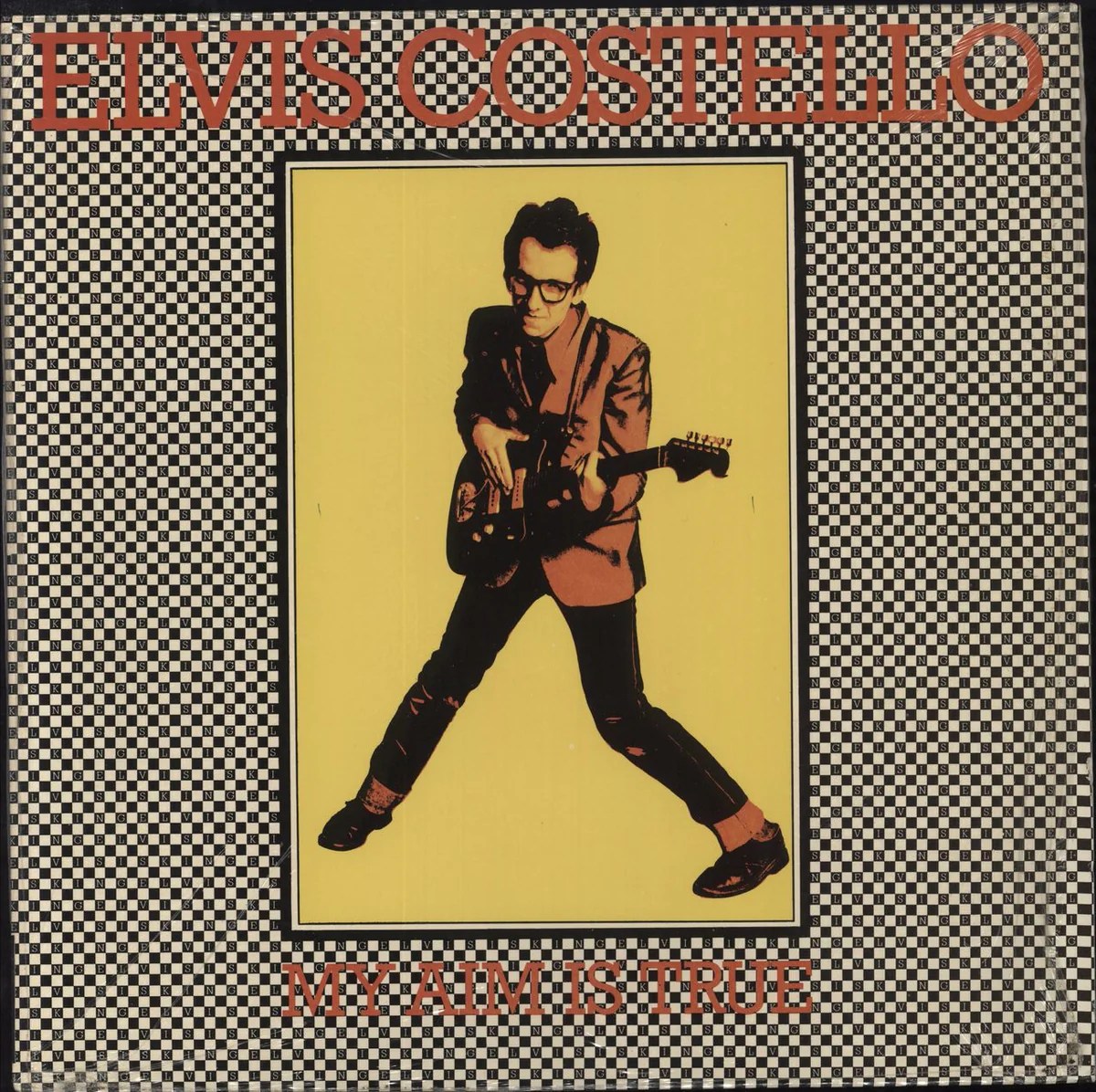
In the mid-to-late ’70’s when disco hip-bumped rock-n-roll off the dance floor, I was not a happy bugaloo-er.  My musical sensibilities are more in tune with “Wild Thing” than “Stayin’ Alive.”  so when my pal Jake Williams turned me on to Elvis Costello’s first album My Aim Is True circa 1978 I was delighted. 

Jake handed me the record cover. “What do you make of this?”

The cat on the cover looked like a cross between Buddy Holly (from the neck up) and a ’50’s Elvis Presley (from the neck down).  

“Let’s listen,” I said, and Jake slipped the vinyl from its sheath, dropped the needle, and pow.

My favorite track on that album is “Watching the Detectives,” a rock noir whose lyrics sometimes sound like a screenplay.

Long shot at that jumping sign
Invisible shivers running down my spine

Cut to baby taking off her clothes
Close-up of the sign that says, “We never close”

Lyrics with sophisticated word play embedded in catchy tunes – that’s Elvis Costello.

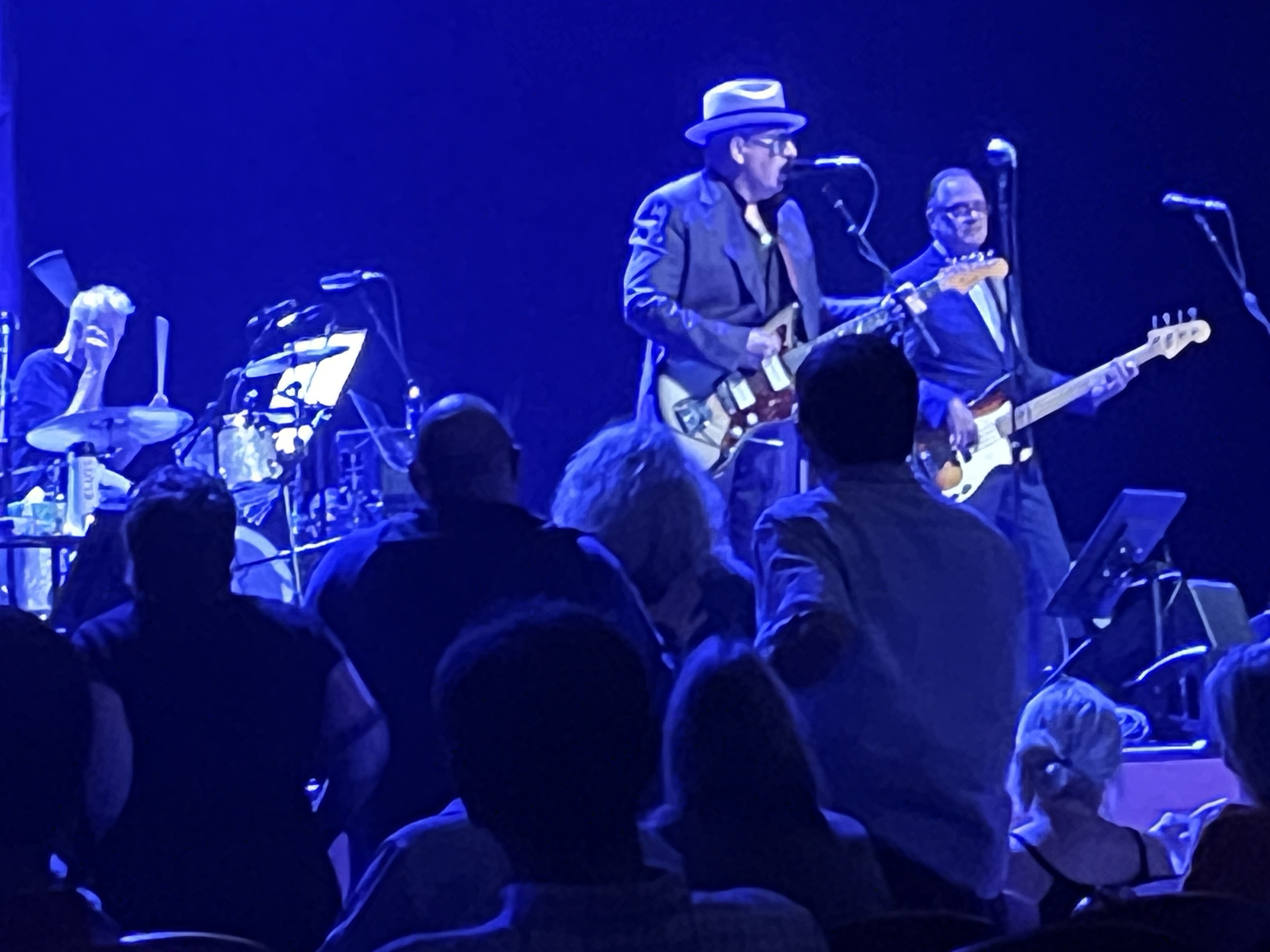
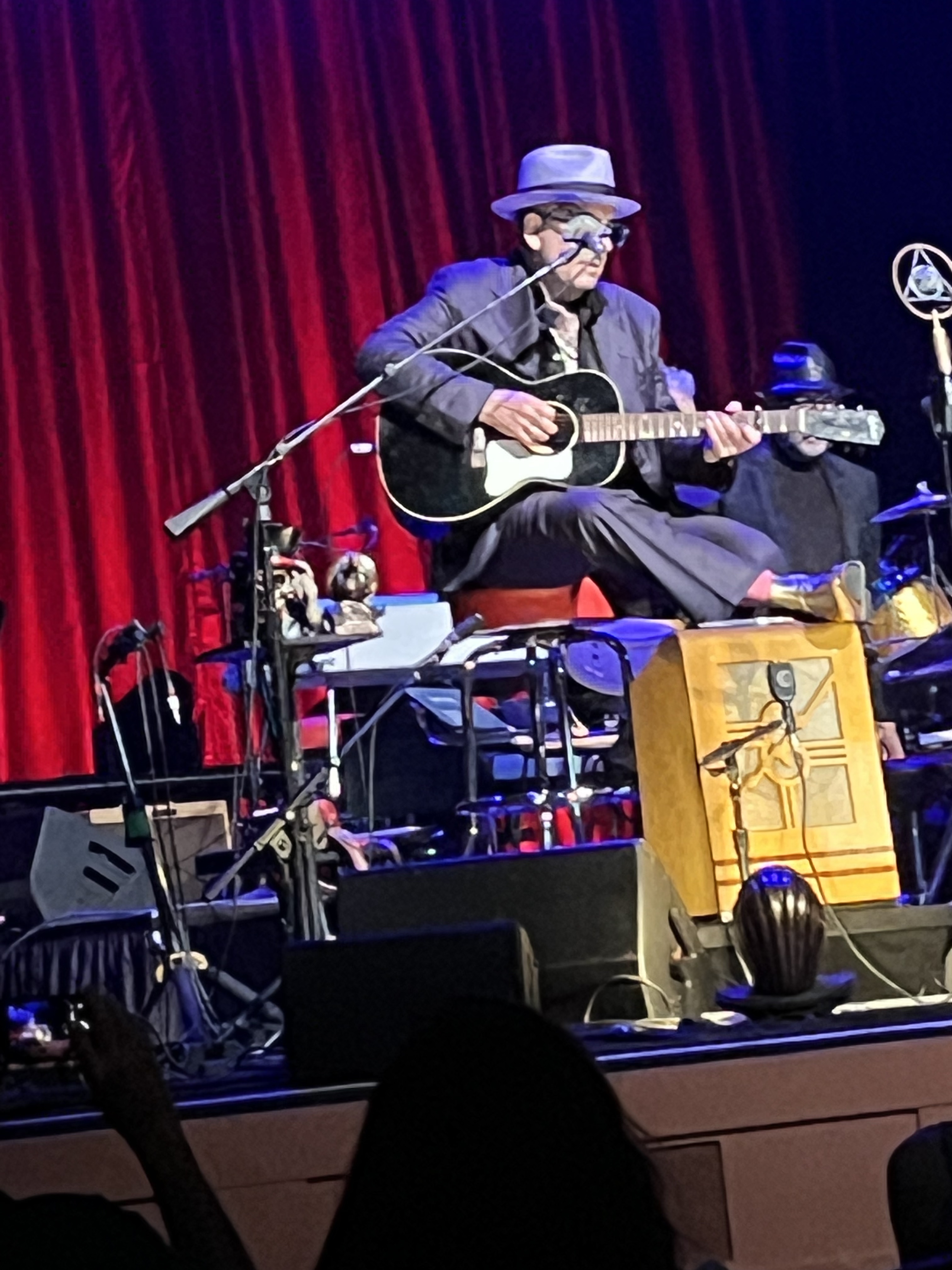
Nearly fifty years later, I got to hear him perform “Watching the Detectives” last night at the Gaillard in Charleston as part of a two-and-a-half hour concert featuring Charlie Sexton on guitar. The tour’s called “Elvis Costello and the Imposters – Radio Soul!: The Early Songs of Elvis Costello.” It’s only a three-week tour, so I don’t know how Charleston was lucky enough to get in the mix, but I ain’t complaining.

It occurred to me before the show that a Costello concert entailing even a carefully curated sample of his career might seem scattershot. After all, Elvis has explored an assload of genres throughout his half-century of stardom: new wave rock, country, (Almost Blue), New Orleans soul (with Allen Toussaint), pop standards (with Burt Bacharach), and collaborations with the Roots and the Brodsky Quartet. 

So I was grateful that last night he stuck to the old stuff – “Mystery Dance,” “Welcome to the Working Week,” “Every Day I Write the Book,” “Accidents Will Happen,” “No Dancing,” “Alison,” Radio, Radio,” “Pump it Up,” and “What’s So Funny ‘Bout) Peace, Love, and Understanding,” among others.

photo credit Wesley Moore

The band sounded great, especially Sexton’s searing guitar solos, and Elvis’s voice was strong and supple.  He was friendly and upbeat, roamed around the stage to various outposts, bantering as he got into position.

My only complaint is that occasionally I didn’t recognize a few songs right away (see also: Dylan), but my piss poor hearing might be to blame.  Also, I would love to have heard him do “Oliver’s Army,” but as Elvis’s fellow English rocker has pointed out, “you can’t always get what you want.”