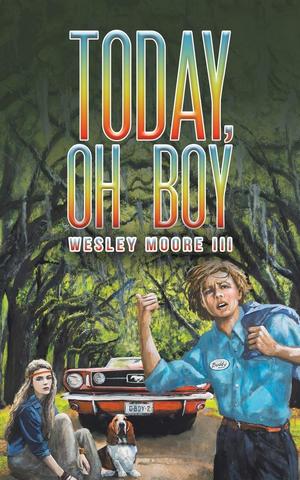
At the request of an actor who’s interested in pitching my novel Today, Oh Boy to producers he’s worked with, I’ve written an adaptation of the novel for the screen.[1] It’s not an official screenplay per se, but a roadmap for the actor to determine what scenes he will use to produce a short “teaser” reel consisting of would-be shots from the would-be movie. I have no idea how this is done. Via AI I suspect. Anyway, with the final proofs from the novel to the right of my iMac’s screen and a blank Word document on the left, I began writing and cutting and pasting.
The good news is that originally, using present tense and employing crisp visual imagery, I consciously composed Today, Oh Boy to read like a movie progressing. For example, here’s the opening of the novel.
A mango-hued, pockmarked bulletin board hangs on a classroom wall of pale lime green concrete blocks, the bulletin board pencil-stabbed and compass point-gouged. Among the graffiti are the names of the star-crossed lovers: Sandy + Tripp. Tragic Tripp, whose body was found last week tangled in blackberry bushes along the banks of the Ashley River, his skull smashed after falling off Bacons Bridge.
S-A-N-D-Y + T-R-I-P-P.
Rusty Boykin, a skinny, freckled redhead sitting on the bulletin board row in Mrs. Laban’s homeroom, traces his index finger in the depression of Sandy’s name. He supposes it’s Tripp’s work – the letters inartistic, juvenile. Sandy hasn’t been to school since Tripp’s death, four class days ago, and now it’s Monday, and she’s still not here. She should be sitting right in front of Rusty, her honey-colored hair hanging like a curtain to her waist.
How to adapt this for the screen? One way, you could have Rusty tracing his finger in Sandy’s name and then suddenly cut to Tripp falling off the bridge, or you could begin with Tripp’s accident. What I did was to begin with Tripp’s last meeting with Sandy, a conversation through her open bedroom window, his leaving in a rage, jumping into his GTO, pealing off, and ultimately driving his car off the road at Bacons Bridge into the Ashley River.
Actually, Tripp’s death is what Hitchcock called a McGuffin, a misleading device that’s irrelevant to the overall narrative. After all, Today, Oh Boy is a comedy. Its title comes from the Beatles’ song “A Day in the Life.”
I read the news today oh boy
About a lucky man who made the grade
And though the news was rather sad
Well I just had to laugh
So, by having Tripp drive off the bridge rather than falling off the bridge, what I gain in cinematic excitement, I lose in the comic pairing of his first and last names. As it turns out, Tripp was a bully, a high school version of Trump. At one point in the book, Alex Jensen, a junior at Summerville high, says to a friend Will, “Your last name is Trotter, you name your son Tripp, and he falls off a bridge to his death. What a surprise.”
In addition, the novel employs a great deal of what critics call “indirect discourse,” a device that allows a narrator to report what someone is thinking without using his exact words. For example, in the above excerpt, the sentence, “She should be sitting right in front of Rusty, her honey-colored hair hanging like a curtain to her waist” is rendered second-hand through Rusty’s consciousness. In a screenplay, you have to “show” rather than tell “tell,” which can lead to really awkward exposition, like you find in bad fiction like “The Most Dangerous Game”:
You’ve good eyes,” said Whitney, with a laugh,” and I’ve seen you pick off a moose moving in the brown fall bush at four hundred yards, but even you can’t see four miles or so through a moonless Caribbean night.”
That I couldn’t use direct narration or indirect discourse meant I had to omit some characters, like Camilla Creel, the impoverished girl who lives in an abandoned school bus with her mother and sister, and Weeza Waring, Will’s mother, who added several comic touches throughout the narrative.
So, overall, the script is much tidier than the novel, much more streamlined, yet not as rich in my attempt to capture the zeitgeist of Summerville, South Carolina in 1970, during integration, the beginning of the counterculture, and during an influx of Northerners moving to what at the time was a staid, conservative community.
Then again, I’m sure a professional screenwriter could do a much better job.
[1] By the way, it’s on sale at Amazon for a mere $10.
Although spring offers rebirth, for example, dollar weeds resurrecting, azaleas ablaze, etc., it also has its downsides.
Nature’s first green is gold,
Her hardest hue to hold.
Her early leaf’s a flower;
But only so an hour.
Then leaf subsides to leaf.
So Eden sank to grief,
So dawn goes down to day.
Nothing gold can stay.
Robert Frost “Nothing Gold Can Stay”
OMG! My life is slipping through my fingers! Nothing good ever lasts for long!
April is the cruelest month, breeding
Lilacs out of the dead land, mixing
Memory and desire, stirring
Dull roots with spring rain.
Thomas Sterns Eliot “The Waste Land”
Same ol’ same ol’, death and resurrection, death and resurrection, death and resurrection . . .
Here on Folly Beach, springtime attracts sybarites of all stripes, like those 25 cent beer nights in the 1900s, those days of yore.
Today at Lowlife, on my side of the bar, a crew of northern males in their early sixties sported expensive haircuts, retro bowling-like shirts, and satiric lanyards celebrating impending inebriation. Maybe it was a college alum get-together. Who knows? I asked one of them what was up, but he was not forthcoming.
Meanwhile, inside the restaurant, across the bar from where I sat, a bushel of bachelorettes were doing something similar in the team party department, dressing alike, engaging in one last bacchanalia before the sacred vows.
Elsewhere (all over the world, in fact) more serious folks were amassing to protest the hare-brained economic and geopolitical executive orders of a leader who always wins golf tournaments held on courses he owns.
Here’s the White House’s official announcement: “The President won his second round matchup of the Senior Club Championship today in Jupiter, FL, and advances to the Championship Round tomorrow,”
To quote Bob Dylan,
I couldn’t help but feel ashamed
to live in a land
where justice is just a game.
But here’s the good news (and the bad news). Trump and his cabinet are too slapdash careless to topple our democracy. Their idiotic unprovoked trade war is sure to produce a blue tsunami in the midterms next year.
Pity the poor Nancy Maces who’ll have to choose between getting primaried a year from now or continuing to vote for destruction.
Trump’s insanity will lead to failure. People will pretend they didn’t vote for him.
So don’t despair. Nothing orange can stay. Spring leads to summer, summer autumn, fall winter.
Around and around we go, and where we end up is in the rat’s alley where the dead men lost their bones. so I say, to quote the late great Warren Zevon, “Enjoy every sandwich.”


 You Do Hoodoo