Let me say right off that I’m an avid admirer of WC Fields, who, in fact, is the inspiration for Colonel Duckenfield, the amiable but drunken calculus teacher in my novel Today, Oh Boy.[1]
Here he is in action:
Colonel Dukenfield has charged his minions with two in-class problems using the squeeze principle, so he has excused himself, ostensibly to use the restroom. A huge veined bulbous nose dominates his round, puffy, flushed face, though there’s still a gleam in his squinty blue eyes, especially when he’s talking to a pretty lady. His knees, though, are killing him, along with his corn-riddled toes stuffed into a pair of scuffed wingtips, the only dress shoes he owns. Once he reaches the faculty men’s room, he closes the door and takes out the pewter flask that bears his name and the name of his plane, the Flying Fortress, etched handsomely in ornate, old-fashioned cursive. He sloshes the Jameson’s whiskey around before taking a long, hard draw. Carefully, he screws the cap back on and places the flask in the right pocket of his blazer.
I mean, what’s not to love?
So I don’t intend any disrespect to Field’s surviving progeny (his great granddaughter’s wedding picture appeared in the Santa Cruz Sentinel in 2018) when I suggest that Lindsey Graham could be plausibly cast as an older Fields in a biopic once his political career is over, which may be sooner rather than later, given that he could get primaried on the one hand, and the country is on the road to economic and geopolitical ruin under our unhinged Dear Leader on the other.
What a great pairing of buffoons, Fields’ cinematic persona with Graham’s real life personality!
I know you might be thinking that Graham’s a little long in the tooth at 69 to embark on a new career; however, look at me at 72, getting ready to make a cameo in an upcoming short feature based on a chapter from Today, Oh Boy.[2]
So, Lindsey, see, it’s never too late to segue into something new. Look, man, you’re addicted to the limelight, and look, even if there’s not a Fields biopic on the horizon, maybe some enterprising filmmaker will buy the rights to Today, Oh Boy, and you can end up playing the Colonel himself.
As my wife Caroline says, “We can hope. We can dream.”
I subscribe to an internet entity called “Poem of the Day,” which provides me each a.m. with a dollop of verse to go along with a cup of whatever ground coffee is on sale at Harris Teeter on the previous Senior Citizen Discount Thursday.
will crawl out of the drain and try to kill you like some 80s horror flick.[1]
I like the poem, its witty catalogue of unpleasant analogies. Bad poems are like “a black widow creeping/from the mound of linens still warm from our bodies.” They “steal your breath/ when you wake parched, hungover, emptied,” etc.
What really caught my attention, being a fake artist and all, were these lines describing another, much more successful fake artist:
Once, in Zurich, we were served rabbit paella at a party celebrating an exhibition of an artist from Venice Beach who used to be homeless but drinks $25 Erewhon smoothies and paints hundreds maybe thousands of happy faces with his feet. His canvasses go for $25,000. Toe paintings are better or at least significantly more profitable than failed poems.
This really hit home because the day before yesterday I got a text from a number I didn’t recognize with this message:
“Found some ‘fake’ art at goodwill today. I’m going to buy it as an investment.”
I responded, “Who in his right mind would give a masterpiece like that away?”
But to be honest, I did know. It was the fellow who won it at Chico Feo’s annual Canine Halloween Costume Contest. Harlan, the organizer, asked if I would donate a print, and I thought it was one of the better prizes, but as luck would have it, the winner is an actual artist who upon receiving it asked me if I’d seen any of his works.
I hadn’t.
But I’ll also admit it would take a certain, rare art lover with a funkadelic sensibility maximus to want to hang the print above the mantle.
Anyway, the poet nails it when she whines about the unprofitability of writing poems vis-à-vis creating pictural art. In fact, believe it or not, despite receiving a rave review from Kirkus Reviews and having appeared on a local television show and several national podcasts, my novel Today, Oh Boyhas provided me with less income than my fake paintings.[2]
Already this month, I’ve received two commissions and sold another print, not including the secondhand Good Will purchase.
Anyway, I’d say that creating these canvases is more fun that writing fiction and certainly more fun that going over the “corrected proofs” of a manuscript that soon will be bound and sold in bookstores and online, which I have been doing of late.
I don’t have a pub date yet for Long Ago Last Summer, but I’m guessing late spring or early summer.
PS. Speaking of commissions, Caroline and I have commissioned the unfake funkadelic artist Thom Piragnoli to create a sign for our driveway to alert visitors where our hidden house hides.
You can check out Thom’s art at Chico Feo. The one above is called Galaxy Gals. Check out this LINK for more on Thom.
[1] Rather than cutting and pasting the entire poem, I’ll provide a link because non-poetry lovers, i.e., 99.97% of people, would abandon this post for the greener pastures of a TikTok video. Here’s the LINK. You can read along while Jessica Abughattas reads it in a rather pleasant regionless accent.
[2] To be honest, this was not the case in 2023, the year Today, Oh Boy was published.
It’s way past time for true-believing, well-educated evangelists to hit the missionary road and scare the unholy shit out of these deluded MAGA worshipers who have rejected the love-thy- enemy theology of their would-be savior and instead have embraced the hate and revenge ideology of the false prophets Elon Trump and Donald Musk.
For what is a MAGA profited, if he shall gain the owning of the libs, but lose his own soul?
Here, let me have a go at it:
Oh my children, you know not the jeopardy into which you’ve placed your immortal souls. Why have you turned your back on the teachings of the Prince of Peace who bade you “love thy neighbor as thyself” but instead you worship a “man of lawlessness ” a “son of perdition?” (2 Thessalonians 2:3).
Pasteth the following descriptions into a search engine:
“male global leader”
“a deceiver who uses signs and wonders to mislead people”
“seeks to establish a global power structure”
“speaks arrogant words and blasphemies”
“an earthly tyrant and trickster”
Oh, I have saved you the trouble. These descriptions will leadeth you to the 13th Chapter of the Book of Revelation, which describes the Antichrist.
O, my brothers and sisters, repent before it’s too late. Oh, how you will lament upon the Judgement Day when your undying soul will be cast into the flaming cauldron of everlasting perdition, an eternity of suffering because you chose hate instead of love.
But, hold on, it’s not too late. Reread the Gospels, casteth away your Maga merch for God’s sake and your own!
“Its only boundary was the horizon, the sill of the sky, separating what the eye could see from what the mind might imagine.” ― Barry Lopez, Horizon
At the moment, thanks to my pal Bill Thompson, I’m reading Horizon, Buddha-like Barry Lopez’s fascinating memoir, a meditation on nature, human cultures, capitalism’s role in the secularization of society, language’s function in altering the world we perceive, the poisoning of the planet, among a host of other fascinating topics.
Lopez is difficult to characterize. For example, he was an explorer, having travelled to over 80 countries. His National Book Award winning work Arctic Dreams details five years he spent in the Canadian Arctic as a biologist. Lopez possessed, among many other virtues, a profound patience that allowed him the peace of mind to observe over hours, days, and weeks phenomena like light changing in the passage of time from dawn to dusk over the surface of the Pacific Ocean. Though married twice, he seems monkish in his seeking solitude, and indeed, after his Catholic education, he flirted with the idea of becoming a Trappist monk. Instead, he became a novelist, a painter, a landscape photographer, and philosopher. These hours of observation and solitude engender philosophical observation:
During certain periods of uninterrupted vigilance at the edge of the sea, I’ve also had the sense that there is some other way to understand the ethical erosion that engenders our disaffections with modern life—the tendency of ruling bodies, for example, to be lenient with entrenched corruption; the embrace of extrajudicial murder as a legitimate tool of state; the entitlement attitudes of those in power; the compulsion of religious fanatics to urge other humans to embrace the fanatics’ heaven. The pervasiveness of these ethical breaches encourages despair and engenders a kind of social entropy; and their widespread occurrence suggests that these problems are intractable.
Lopez is particularly interested in how commercial enterprises like logging transform forests from diverse ecosystems to tree farms. Clearcutting disrupts the natural order as invasive species displace native plants and animals, so rather than the terrain boasting a variety of different trees, the denuded landscape is replanted with one type of commercially profitable tree, e.g. Douglas firs or loblolly pines. A clearcut,” he writes, “is not the outward sign of a healthy economy but of an indifference to life.”
In a similar light, he laments Colonialism’s obliteration of native people’s cultures, the loss of native languages, and drives home the point that advanced technology does not make a culture superior to a less technically advanced culture, especially if the happiness of a culture’s people is a gauge of success:
The seductive power of this system of exploitation—tearing things out of the earth, sneering at the least objection, as though it were hopelessly unenlightened, characterizing other people as vermin in the struggle for market share, navigating without an ethical compass—traps people in a thousand exploited settlements in denial, in regret, in loneliness. If you empathize with the Jaburrara over their losses, you must sympathize with every person caught up in the undertow of this nightmare, this delusion that a for-profit life is the only reasonable calling for a modern individual.
Sounds a bit like the current ruling US regime.
On the other hand, the contrarian in me wonders how Lopez could afford to circumnavigate the planet, exploring exotic locales like Australia’s Outback and Afghan villages. Where did the money come from to bankroll these expeditions?
Capitalistic enterprise, I suspect.
Modern living is incredibly complicated, which, to be fair, he acknowledges, but whether you agree with him politically or not, Lopez provides, not only food for thought, but a feast for contemplation.
Reading this book has in a sense made me more alive in jarring me from my inwardness to seek out wonder outside the Self while seeking is still possible.
I’ll give him the last word:
Exposure to an unusually spectacular place in conducive circumstance, the thinking goes, can release one from the prison of one’s own ego and initiate a renewed awareness of the wondrous, salutary, and informing nature of the Other, the thing outside of the self.
Although I often whine about my chronic insomnia, in reality, it’s not a big deal because I’m retired. Rarely do I have to be at a certain place at a designated time, so I can nap whenever I want, sometimes snatching a snooze as early as ten a.m., so it’s not like stumble about zombie-like all day, sleep deprived.
In fact, it doesn’t make much evolutionary sense to be unconscious eight straight hours. I’ve read that our spear-toting pre-agrarian savannah-dwelling ancestors didn’t necessarily sleep through the predatory night, and during the Middle Ages, people engaged in a routine called “two sleeps,” turning in around nine or ten, slumbering for two or three hours, then awakening around one for what was known as “the watch,” a period in which they’d tend to tasks, socialize, and/or procreate.[1] Around two or three they’d again hit the literal hay (or if wealthy, a feather-stuffed mattress) and sleep until dawn or a bit later.
However, I don’t want to give the impression that now that I no longer have to battle Folly Road traffic in the a.m. that I dawdle away the day doing crosswords, binging Netflix, or wasting time on the internet. This week, in fact, I’ve been especially busy going through the second proofs of my next book, engaging in a political protest, and most vexing of all, jumping through the electronic hoops of TurboTax. Being retired makes performing these acts much more convenient.
Excuse me; I need to vent. Correcting the proofs on Long Ago Last Summer was much more difficult than it had been with my first book, Today, Oh Boy. This time around, rather than having a human being perform the copy editing phase, the publisher shoved the manuscript’s 62, 327 words through the woodchipper of AI.
The bookis a compilation of short fiction, poetry, and personal essays that features a medley of Southern voices. Each piece can stand alone; however, collectively, they form a sort of mosaic with one of the major patterns being Southern Gothic, that literary subgenre that features “incestuous aristocrats, necrophiliac halfwits, sadistic Alabama sheriffs [. . .] the suicide hanging in the attic, the alcoholic great aunt who gave birth to the idiot child buried in the backyard.”[2]
You know, the human byproducts of the post-Reconstruction South, the folks I grew up with.
Alas, AI wasn’t up to the task of dealing with the book’s cacophony of styles and voices. Not only did it remove double negatives from the foul mouth of serial killer Donald “Pee Wee” Gaskins (who picked me up hitchhiking in 1970) and replace them with grammatically correct utterances, but it also altered direct quotes from the poetry of Emily Dickinson. Anyway, on Monday I completed the weeklong task of correcting the corrections. If I were teaching full time, I would not have had the leisure to pick through the rumble and piece back together my original tiles.
Nor could I have attended Tuesday’s anti-Trump demonstration at Hampton Park without having to take a personal day. I had planned on Tuesday to do our taxes, but it ended up being one of those rare days when I had to be somewhere at a specific time. The protest occurred on the very day of Trump’s state of the union address in which he stupidly misconstrued the words “transgender” and “transgenic.”
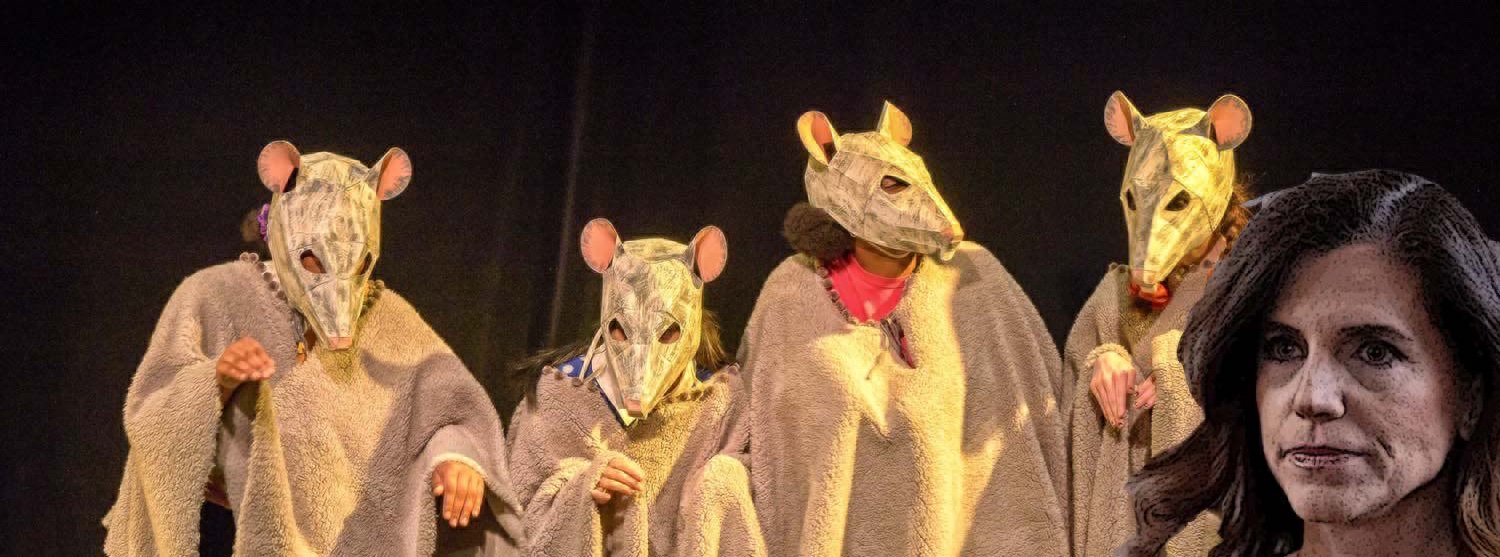
Trump: Eight million dollars for making mice transgender. This is real.
Jeff Tiedrich: No, no, no, no. Nobody is spending government money to make mice transgender. You low-wattage dolt. The word is transgenic.
Let’s say you’re a cancer researcher, and you implant some human genetic material into mice, in order to better study how cells mutate. boom! — you’ve just created transgenic mice.
Nobody is doing sex-change operations on mice and setting them loose in Nancy Mace’s bathroom.
But I digress. I hadn’t engaged in a public protest since the fall of 1971, and I it looked like many of the protestors in attendance were alive and kicking during the Viet Nam era, which makes sense, given they are past retirement age and free to go wherever they choose midday on a Tuesday in March. I used to tell my students that if the governor told my generation that we couldn’t drink until we were 21, there would have been 300,000 of us on the lawn of the Governor’s mansion every day of the week.
The protest, though somewhat limited in its attendance[3] and no doubt in swaying public opinion or sending shivers up the spines of Republican representatives, did provide an outlet for our outrage at Trump’s destroying our democracy and cruelly wreaking havoc upon the lives of so many of our citizens, not to mention his abandoning of Ukraine and the rest of our European allies.
It was somewhat comforting to rub elbows with like minded people whose intelligence and commitment was apparent in the signs that they carried.
photo credit Joan Perry
photo credit Caroline Tigner Moore
photo credit Linda Bell
Okay, don’t worry about this 5-paragraph essay set up. I’m not going to give you a blow by blow account of my doing taxes, which thanks to my late wife’s assets is complicated by K-I limited partnerships, etc. Nevertheless, I do them myself because nowadays accountants essentially have you enter your financial information into their computer software instead of TurboTax. It ends up being the same amount of work. Using an accountant might save us some money, but what the hay.
Ah, with my daily labors completed, here I sit sipping a Westbrook IPA at Lowlife Bar on a Wednesday afternoon scribbling this down in a composition notebook, happy to have completed the taxes and survived the tornados that never showed up on a day when Charleston County schools were called off.
Cheers! Thanks for reading until the end.
PS. Uh-oh! I just saw on LinkedIn that I appeared in 12 searches, two of which were the State Department and USAID. Yipes.
photo credit Joan Perry
[1] Since families usually slept in communal beds, having sex could be problematic.
[2] from the preface of Long Ago Last Summer, 38-9.






 You Do Hoodoo