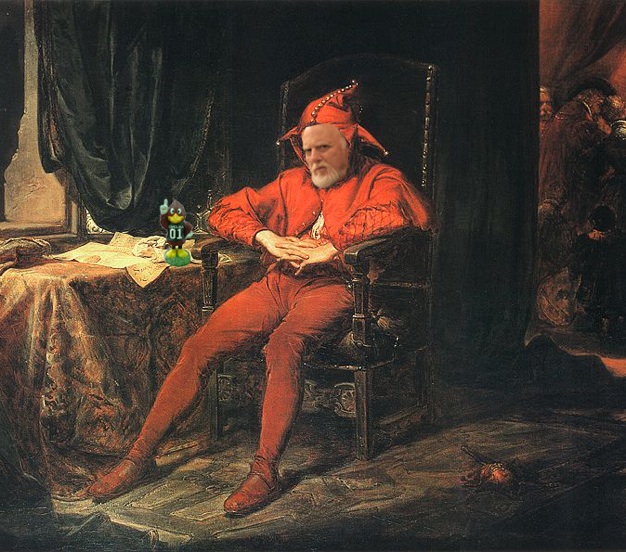
Swashbuckling Pundit Wesley Moore’s Prediction for the 2024 Presidential Election

Look, if you’ve ever been sucked into one of those social media video medical advertisements where some physician or chemist claims to have discovered a ridiculously easy way to detox the superfund-grade contamination of your liver without dieting or exercising or giving up your Jim Beam, you know you’re going to have to endure twenty plus minutes of tease before the secret is revealed that for $59.99 for can purchase a magical elixir, the great great great grandchild of 19th Century snake oil, and presto, no more liver problems.

But I’m not going to put you through that. I’m going to explain right away why Kamala Harris is going to win the presidency, maybe by a comfortable margin, and I wouldn’t be risking my stellar reputation as internet sage the weekend before the election if I were not positive.[1]

Let’s start unscientifically by plumbing the rich grotto of my intuition, a storehouse of data and sensations forming what the vulgar call “a gut feeling,” or what I’d prefer to call “an intestinal foreshadowing.”[2]

Okay, let’s get this show on the road.

Although I don’t believe that yard signs and crowd sizes are accurate predictors of election outcomes, this cycle seems somewhat different. At her rallies, Kamala’s audiences hang on her every word as she catalogues a future marked by communal problem solving whereas the less populous crowds at the Trump rallies tend to leave early during Trump’s interminable dystopian descriptions of mongrel hordes laying waste to municipalities or children exiting their school buses an entirely different gender than when they boarded in the morning. Any sane person who doesn’t reside inside the un-fun house of QAnon conspiracy theories knows that Trump is lying and/or delusional. Not a good look for someone entrusted with nuclear codes.

He offers no specific plans, but all the world’s and the nation’s ills will be solved, like the magic liver elixir, by his magical presence.

Slathered with orange make-up and topped with clownish platinum hair, like a cartoon character in the same clothes, he shambles around the nation in a haze that very well could be drug-induced.  I mean who falls asleep during his own felony trial? At any rate, his campaign has devolved into a Roman circus where he cosplays fast food minimum wage earners or sanitary workers. Yesterday, the garbage truck driving in circles with Trump staring out the window seems an apt metaphor for the campaign’s final stages. It’s almost as if his staff wants him to lose.

Segueing into a more data-driven arguments, early voting seems very promising for Kamala.  Although Republicans have been voting early, unlike in 2020, the voters have tended to be elderly high propensity voters, and Jen O’Malley Dillion, Kalama’s campaign chair, says, “We feel really good about what we’re seeing out there.” Even in Nevada where early voting rural Republicans have established a red fire wall, Dillion says in the last two days in Clark County, a Democratic stronghold, “we’ve had higher turnout from young voters than we have at any other point in this cycle.” She adds, “We are seeing Republicans voting early, but these are Republicans that are going to vote no matter what. So what they’re doing is that they’re changing their mode of voting. They were going to vote on Election Day, now they’re voting early.” She also claims that in other states low propensity voters are voting Democratic early. Polls also show that undecided voters are more open to voting for Kamala, not to mention than more women than men are voting with reproductive rights being one of the major issues.

Then there’s the discrepancy in the ground games. The Democratics boast a well-trained, well-staffed group of dedicated, enthusiastic doorknockers, postcard writers, phone-callers and texters whereas the Republicans are relying on paid workers, mercenaries you might say, to attempt to get the undecided to vote.

In short, the Republicans are, like their Dear Leader, disorganized (cf. Trump’s stashing classified documents in his bathroom). In the last days of the campaign you have Mike Johnson promising to end Obamacare if Trump wins, you have Elon Musk predicting Trump’s slashing spending will create temporary economic hardship, and Nikki Haley trashing the campaign. I suspect that Kamala will win at least 10% of Republican voters and a majority of independents. After all, Dick Cheney and Karl Rove are voting for Kamala. 

Lastly, the Democrats have several pathways to 270 electoral college votes, even if they were to lose Pennsylvania, which seems unlikely with a half-a-million pissed off Puerto Ricans living there.

Last, but certainly not least, the last three heart-breaking presidential loses in 2000, 2004, and 2016 featured wooden candidates incapable of warming the hearts of non-partisans. Obviously, Kamala is charismatic, out-Obama-ing Obama in my opinion.

Now that’s it. Excuse me while I check out some new promising dietary supplements. Cheers!


[1] Caveat: I’m not as positive that fawning Republican state legislatures and/or Speaker Mike Johnson will allow the certification of a Harris victory.

[2] Please note, I have now removed my tongue from my cheek. 
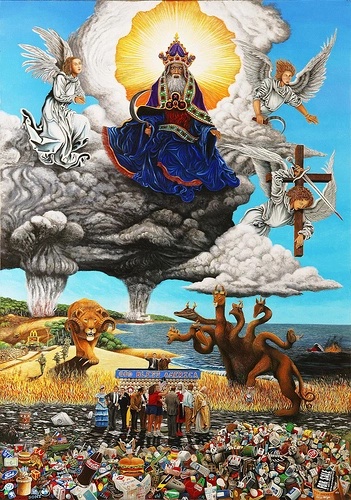
Wesley’s Weave: Dark Musings on Election Eve

Apocalypse by Adrian Kenyon

Donald Trump has dubbed his rambling speeches “the weave,” claiming that if you connect the dots of his zigzags, a unified picture appears. So I thought I’d give it a try myself.

Here goes.

The other night, after suffering through a self-righteous, ill-informed screed from a Facebook follower, I found myself listening to Bob Dylan’s masterful protest song “Hurricane,” a cinematic narrative recounting the arrest and trial of Rubin Hurricane Carter, a boxer wrongly convicted of a triple homicide in 1966 in Patterson, New Jersey.

Meanwhile, far away in another part of town
Rubin Carter and a couple of friends are drivin’ around
Number one contender for the middleweight crown
Had no idea what kinda shit was about to go down

When a cop pulled him over to the side of the road
Just like the time before and the time before that
In Paterson that’s just the way things go
If you’re black you might as well not show up on the street
‘Less you want to draw the heat

Near the end of the song Dylan sings,

How can the life of such a man
Be in the palm of some fool’s hand?
To see him obviously framed
Couldn’t help but make me feel ashamed to live in a land

Where justice is a game

Now all the criminals in their coats and their ties
Are free to drink martinis and watch the sun rise
While Rubin sits like Buddha in a ten-foot cell
An innocent man in a living hell

As I was listening, the long gone idealism of the 60s came to mind. Dylan himself — and Joan Baez –performed at the March on Washington, sharing the stage with Martin Luther King. They heard firsthand the “I Have a Dream Speech.”  They’re both still alive sixty-one years later.

In 1963, the American people considered communism the greatest threat to the nation’s sovereignty, and the Soviet Union was our greatest enemy whose spy agency the KGB eventually became the employer and training ground for Vladimir Putin, whom Donald Trump so idolizes, along with Kim Jong Un, the North Korean dictator. 

According to Trump, outside forces like Russia and North Korea aren’t the greatest threat to American sovereignty; no, it’s “the enemy within,” American citizens, news organizations, and celebrities tarred with the paradoxical disapprobation “woke.”  It’s Joe McCarthy redux, and McCarthy’s corrupt lawyer Roy Cohn was Donald Trump’s mentor.

Trump and his followers bring to mind WB Yeats’s lines from “The Second Coming”:

The best lack all conviction, while the worst

Are full of passionate intensity.

Fueled by the fifth deadly sin wrath, these resentful white supremist faux Christian cultists seem to prefer a dictatorship of oligarchs to the teachings of their would-be Savoir who famously preached

Blessed are the meek, for they shall inherit the earth.

Blessed are the merciful, for they shall obtain mercy.

Meanwhile,  

The blood-dimmed tide is loosed, and everywhere

The ceremony of innocence is drowned.

Connect these dots and what do you get?

[a] rough beast, its hour come round at last,

Slouch[ing] towards Bethlehem to be born.

James, Huck, and James McBride: A Review of Percival Everett’s “James”

After reading Dwight Garner’s laudatory review of Percival Everett’s James, I was eager to check it out, especially since I’m a huge fan of Huckleberry Finn

Here’s a snippet of Garner’s paean:

Percival Everett’s majestic new novel, James, goes several steps further. Everett flips the perspective on the events in Huckleberry Finn. He gives us the story as a coolly electric first-person narrative in the voice of Jim, the novel’s enslaved runaway. The pair’s adventures on the raft as it twisted down the Mississippi River were largely, from Huck’s perspective, larks. From Jim’s — excuse me, James’s — point of view, nearly every second is deadly serious. We recall that Jim told Huck, in Twain’s novel, that he was quite done with “adventures.”

Garner goes on to say, “This s Everett’s most thrilling novel, but also his most soulful.”

Alas, when reading James, I was never able to suspend my disbelief, to lose myself in the flow of action and forget that the narrative I was reading was a fictive construction. In his retelling of Huckleberry Finn from the perspective of Jim, Everett creates the conceit that the antebellum argot of slaves, the “Else’n they takes you to the post and whips ya[s]” is a linguistic ruse to appease the white population by making them feel superior. The narrator James (aka Jim) speaks (and thinks) in English so standard that he uses “one” instead of “you.”  In short, for me the novel is a contrivance; it’s created in a way that seems artificial and unrealistic.

Everett’s relating the events from James’ perspective in easy-to-decipher prose makes a lot of practical sense; however, the regionless diction of the retelling of Jim and Huck’s escape robs Jim of a breathing individual’s voice –– he could be from 21st Century Dayton, Ohio –– there are no quirks in his phraseology, no flashes of individuality, few regional linguistic markers, which divorces him from time and place and therefore relegates him into the status of a character in a novel rather than a person whom we believe is real. 

That said, Everett does an outstanding job of effectively depicting the horrors of slavery, the never-ending degradation, the perennial fear of having your family disbanded, the horrors of being horsewhipped, the constant verbal abuse. And the novel, especially after James hooks up with a minstrel show, becomes a real page turner, a sort of thriller with cliffhanging chapter endings as he and Huck manage a series of hairbreadth escapes a la The Perils of Pauline. Everett also creates a rich array of colorful characters that you care enough to keep reading, though you might grow a bit weary of the episodic nature of the plot bequeathed by Clemons. 

I couldn’t help unfavorably comparing James to James McBride’s The Good Lord Bird, which is also narrated by a slave, Little Onion, who is “liberated” by the historical abolitionist John Brown.  

Here’s Little Onion describing his liberator:

The old face, crinkled and dented with canals running every which way, pushed and shoved up against itself for a while, till a big old smile busted out from beneath ’em all, and his grey eyes fairly glowed. It was the first time I ever saw him smile free. A true smile. It was like looking at the face of God. And I knowed then, for the first time, that him being the person to lead the colored to freedom weren’t no lunacy. It was something he knowed true inside him. I saw it clear for the first time. I knowed then, too, that he knowed what I was – from the very first.

This is a person talking, not the idea of a person talking, which creates a depth of character that James lacks.

Compare McBride’s description with this: 

I was afraid of the men, but I was considerably more afraid of the dogs I’d heard coming our way. I could only imagine that they were after me, and so I was left confused by the presence of these two white men in our boat. Adding to the absurdity was the fact that they were opposite in nearly every way. The older man was very tall and gaunt, while the younger was nearly as short as Huck and fat. The younger had a head full of dark hair. The older was completely bald.

That’s not what I would call “cooly electric first person narrative.” In fact, when I taught composition, I would not allow my students to use the phrase “was the fact that.”

But, hey, look, as I’ve said elsewhere and often, writing a novel is a very difficult undertaking, and James is well worth reading, even though it falls short of my censorious standards for the high praise it has received.  It’s an audacious effort to reconfigure the novel that Hemingway credited with being the root of “all American literature.”  Also, the idea of seeing Huck’s world from Jim’s perspective is existentially cool, underscoring Hamlet’s observation that “There is nothing either good or bad but thinking makes it so.” 

I’d give it a B+ overall.