“Vacant shuttles/Weave the wind.” – TS Eliot, “Gerontion”
One of the many positive aspects of retirement is that I am no longer bound by industrialization’s time clock. If I awaken at three a.m.– what Gerard Manley Hopkins called “the fell of dark, not day” – instead of trying to grunt myself back to sleep, I tiptoe out of the bedroom, fire up the ol’ iMac and play Spelling Bee, a word game on the NYT crossword page. To attain the designation of “Genius” takes me anywhere from five to forty minutes. Generally, I fall asleep again around four or so and reawaken around six. I sometimes take two naps a day, one in the morning and one in the afternoon.
A man of leisure at last.
In my previous life as an English teacher, I would spend those awakened hours brooding about my working life and/or what TS Eliot called “the immense panorama of futility and anarchy that is contemporary history.”
By the way, that most quotable of quotes comes from Eliot’s essay “Ulysses, Order, and Myth.” Here’s another far less quotable snippet from that same essay: “Mr. Aldington treated Mr. Joyce as a prophet of chaos; and wailed at the flood of Dadaism which his prescient eye saw bursting forth at the tap of the magician’s rod.”
You win some; you lose some.
Speaking of losing, I just received this very minute this message via What’s App:
Hi, I’m Ivana. Nice to meet you.
I am looking for the other half of my life, someone who can accompany me throughout my life.
I am 36 years old and single. I like polite men. If you are very similar to me, please leave me a WhatsApp message now. I believe we can be each other’s life partners.
We can share each other’s lives and understand each other better.
WTF, as the young people say.
Then last Friday, at Chico Feo, Harlan, the bartender, told me that a young woman, an investigative reporter, wanted to interview me. I said, “Uh, okay,” so she, an attractive, twenty-something, sat on the stool next to me and asked if I were a writer. I had assumed she had known that, so I said yes, and she asked what I had written, so I told her about Today, Oh Boy,” a novel set in Summerville, South Carolina, which coincidentally is where she’s from. To cut to the chase, she’s doing an in depth investigation on the serial killer Richard Valenti, who murdered two teenaged girls on Folly Beach in 1973. I have a close friend who was also kidnapped by Valenti but who escaped along with two of her friends, which led to his arrest.
She asked if I minded being recorded, and I said no, so she pinned a mic on my lapel and started asking questions. She was impressively articulate, explained her interest in the case, and while we were talking, my wife Caroline arrived, so I invited her to join the conversation because Caroline is much smarter than I am. The reporter is also friends with one of the teens who escaped and is hesitant to ask her about it because “she might not want to reopen that door,” as she put it. Caroline jumped in and talked about how the patriarchy deals with women who have been sexually assaulted. By the way, this was two days after Trump’s 83 million dollar fine.
So anyway, I got 99 problems but worrying about grading essays ain’t one of them.
Given today’s GDP numbers for 2023 (2.5% growth) and for the 4th quarter (3.3% growth), not to mention all-time stock market highs, it’s no wonder Donald Trump is musing out loud how he wishes the economy would implode. After all, on October 22, 2020, he predicted the stock market would crash under Biden.
Nostradamus he ain’t.
In other news, Trump has instructed the Buddy Rich of Bible-thumping, i.e., House Speaker Mike Johnson, to torpedo the bi-partisan agreement on the border forged in the Senate because solving the problem would cost Republicans their number one talking screaming point.
Anyway, why should Republicans bother with governing when Hunter Biden’s laptop exists in the form of three-dimensional matter, when instead of passing legislation, they can bask in the klieg lights of Fox News studios?[1]
Yes, despite his having been convicted of rape by a jury of his peers, of having admitted to stealing top secret classified materials, of his sitting on his Depends-padded ass doing nothing during the Capitol insurrection, despite his bizarre, slurred word salads, his trouble distinguishing Nikki Haley from Nancy Pelosi, you have the fallen competitors lining up like so many ventriloquist dummies to endorse him despite his 90-odd criminal indictments.
Speaking of ventriloquist dummies, Tim Scott, please disappear. Your moon-faced head-bobbing grinning behind Trump during his bitter post New Hampshire victory speech in which he threatened to sic the Feds on the woman who appointed you senator was even more demeaning than your artless staged engagement photo op.
Psst, hey, y’all, Trump’s going to lose the general election. He needs to expand his base from his devoted non-college degreed MAGA cultists and the hundred or so avaricious billionaires who support him, or he’s going down yet again. Along with him abortion-banning Congressional Republicans. Among the sane and educated, Joe Biden is the lesser of decreptitudes.
A little anecdotal evidence: Yesterday afternoon, I chatted with two tourists from Beech Mountain, North Carolina, she a social worker, he a firefighter, she a liberal, he a conservative, and neither is voting for Donald Trump.
Pass the popcorn.
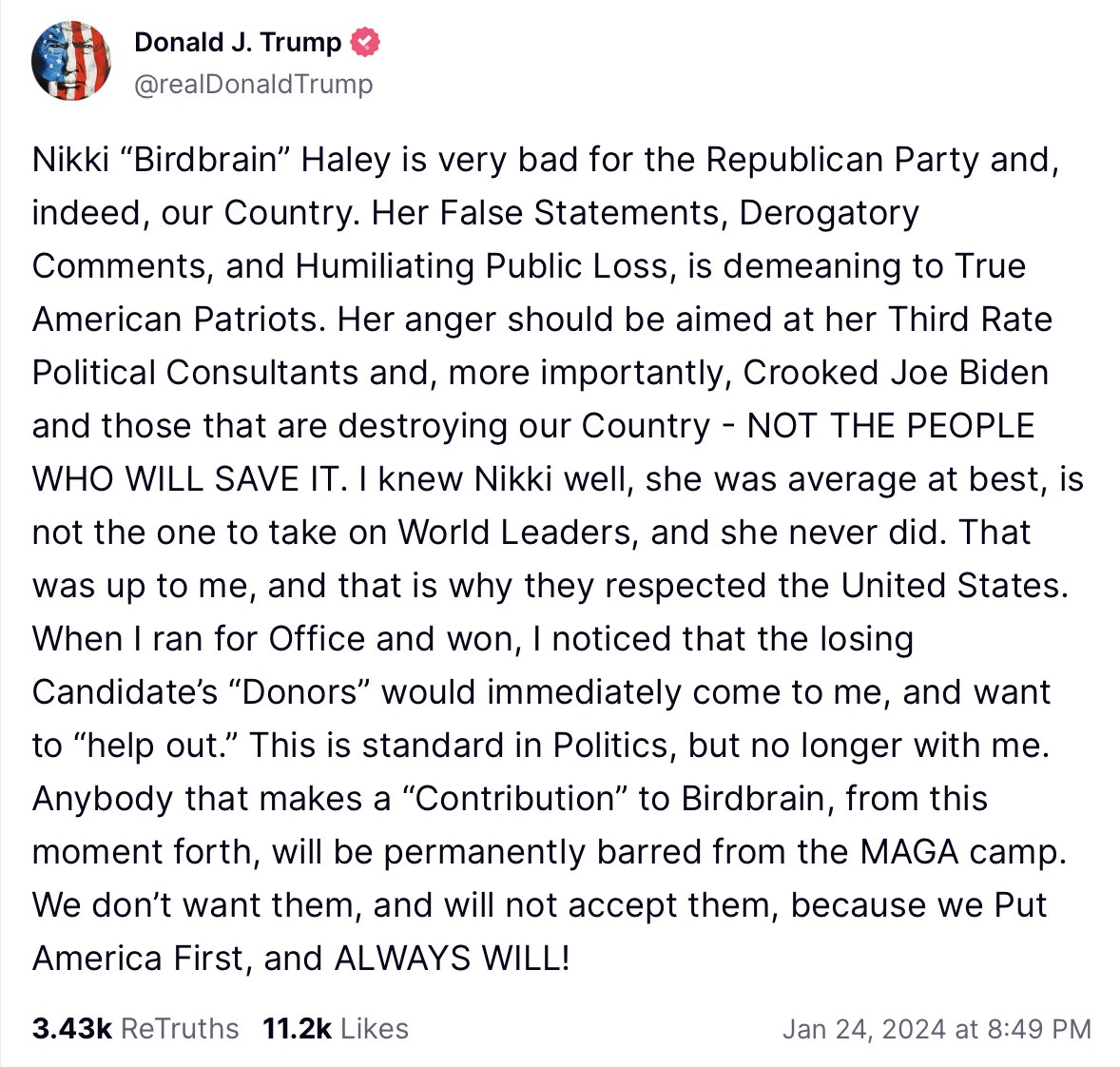
Here’s Trump”barring” potential Republican voters from “the MAGA camp.”
[1]C.f. South Carolina’s own Hester Prynne wannabe, Nancy Mace.
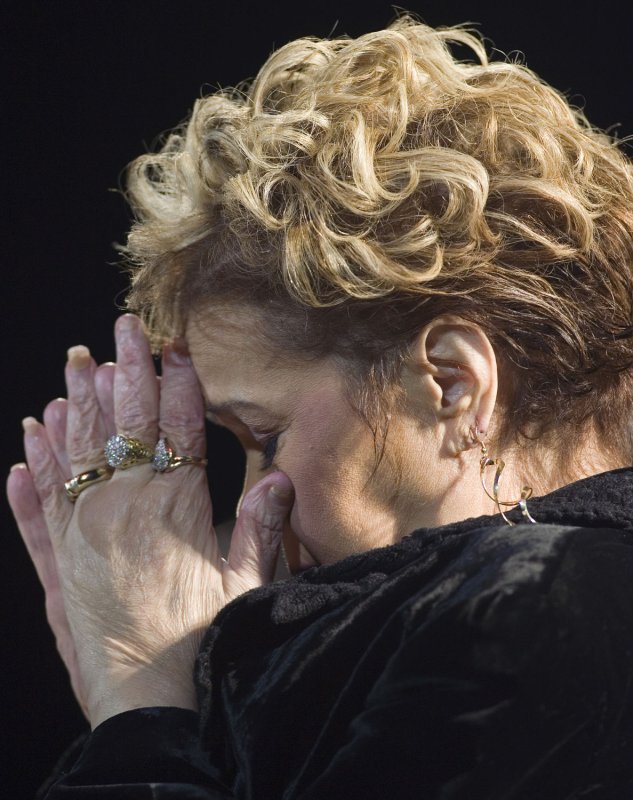
What a storehouse of sorrow must have existed in the soul of Miss Etta James, nee Jamesetta Hawkins, whose eventful life was fraught with childhood abuse, illicit drug use, and musical triumph. To quote Van Morrison’s “Summertime in England,” James was “high in the art of suffering” and could conjure her hurt Stanislavski-style as she belted out the blues, that history of sadness made manifest in the hurt of her voice, the expressions of her face.[1]
One of my favorite videos of all time is her duet with Dr. John in “I’d Rather Be a Blind Girl.” As I mentioned recently in a post on the Pouges, I’d treat my students to a music video whenever everyone in the class made a 100 on a pop or vocabulary quiz, which, of course, spurred them on to read or review vocabulary and afforded me the pleasure of expanding their cultural heritage, expanding the narrow range of what they considered cool.
What a pleasure to study their faces as they watched this video.
[1] As in Konstantin Stanislavsky’s acting system in which he sought to activate actors’ memories to express emotions rather than merely representing them.
This is the beginning of my current work in progress entitled Long Ago Last Summer. The first draft is completed, so now comes the painstaking work of refinement. What’s below are the first paragraphs of the 7100-word first chapter.
Chapter 1
Those Who Think, Those Who Feel
1
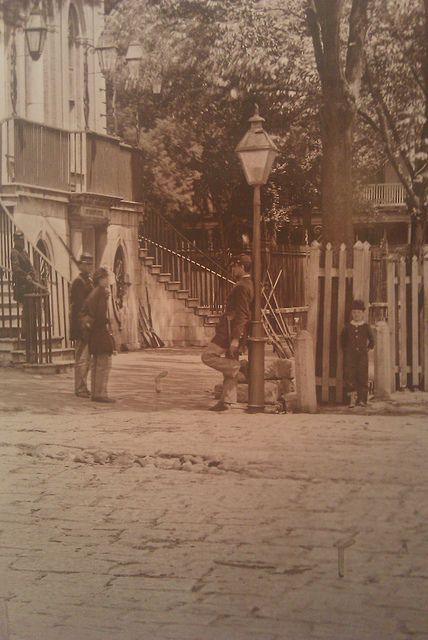
My father aspired at some point early in his life to become a tragic figure, but unfortunately, even at that, he failed. Born in the 1920s in the shabby outer edges of Reconstruction’s long shadow, he grew up in Charleston, South Carolina, in those days a rundown museum of a city with its weather-beaten mansions and black women calling out in Gullah, balancing baskets of vegetables or laundry on their heads. A talented storyteller, my father was a virtuoso on the heartstrings, recounting unfortunate events from his melancholy childhood, an exotic world of paregoric addicts, ancient cotton-haired slave-born coloreds[1], blind street musicians, and blue-blooded eccentrics. I can conjure his depiction of himself even now, a ragamuffin Depression boy in knickers and cap hawking newspapers on city street corners. It’s odd that I picture his old stories in black-and-white. Perhaps it’s because of the photographs or the old movies of that era. Memory is a curious thing. I guess you could say it’s a collection. The older we get the more we discard, up to a certain point. My father, however, was a curator with a very narrow thematic interest. And what he kept was very well preserved and artfully presented.
2
My father felt unloved by his father, a distant presence puffing a pipe, turning a page of The Saturday Evening Post. I remember meeting my grandfather only once or twice when my father was alive, and I never heard my father utter a kind word about “the old man.” In my post-mortem meetings with Grandfather Postell,he was what you might call lively but egocentric. He’d talk about his golf and his dead Airedales and about his photography but never expressed any curiosity about what was going on in my little life. He had been the youngest of five, the only boy, the son of an Upcountry state senator, and perhaps spoiled by the plump quartet of his elder sisters, my great aunts, formidable eccentrics in their own rights. I can very well imagine not being loved by this man, though, on the other hand, I can’t really imagine being abused by him.
His son, my father, absolutely worshipped his own mother, whose portrait hung, eerie and Oedipal, over my parents’ four-poster bed. She was beautiful and angelic and elegant and the brains behind the studio. Grandmother Postell’s death from T.B., three years before my birth, was right out of “Ligeia.” Yellowed photographs of her propped up on pillows in a ghostly white gown survive in black picture albums. As a little boy, I remember carefully turning the pages of those albums, gazing at my tall slender grandmother leaning against an antique car, my father half-her-size, standing beside her with his thick wavy hair combed straight back.
As a child, listening to my father’s version of his own childhood, my eyes would sometimes fill with tears as he would in his gruff way catalogue his sorrows. He made me feel lucky to be me, and I felt guilty because I took for granted the bright sunshine of Suburban Summerville, my middle-class neighbors, and the leisurely hours I had to loll away shooting marbles or riding my bike on lazy Saturday afternoons. Unlike his own father, my father had sacrificed everything for us by working at the dreary Naval Yard, a job well below the significant talents he possessed. My father saw himself as a marked man, doomed to a life of bad luck, and I guess you could say that in some ways he was.
Though, by Depression standards, at least economically, my father didn’t have it all that bad. He lived with his parents, who had been employed as portrait photographers but who had lost everything in the Crash. During the Thirties, they stayed with his mother’s parents who lived in the second story over a pharmacy they owned on the corner of Spring Street and Ashley Avenue. Anyone who owned a business that didn’t fold during the Great Depression shouldn’t complain too much about deprivation. With money so scare, being a child laborer[2], especially a paperboy, might be considered a blessing, but not to my father, who viewed himself as Oliver Twist, a figure to be pitied, and perhaps he deserved that pity. I wasn’t there to witness his life.
His stories, though, always accentuated the poverty. I’ll grant that living with eight other people in 1200-square feet isn’t enviable, but it’s not exactly The Grapes of Wrath either. After all, deprivation was pretty much the way-it-was in Charleston during the Depression, a city isolated and traumatized by the events of a war that still could claim a few living veterans shuffling down its sidewalks. Nevertheless, I don’t dispute that something must have been lacking in his childhood, and I suppose that the best guess for what was lacking is love. My own mother, in the unenviable position of following a dead saint, once surmised that what had ultimately been lacking in Daddy’s life was maternal love, not so much as paternal love, but Daddy would never have owned up to that. An insinuation like that would have thrown him into a rage, and he was the furniture-smashing type when he lost his temper.
When not working or getting expelled from a series of schools, my father roamed the streets of the Upper Peninsula. Here, he could put his seemingly endless store of anger to good use, saving a squirt from a cowardly bully or bloodying the nose an arrogant Northerner who had indiscreetly commented on the corporeal charms of some perceived paragon of Southern ladyhood. In the stories my father told us, he was always the cavalier, the heroic fellow, always smaller than the oppressors he pummeled, always a figure of sympathy. Boxing was the only sport he cared anything about. I can remember his yelling at the television on Friday nights, barking advice to Sugar Ray Robinson or Archie Moore, “Keep that left up, keep that left up.”
Of course, to be a tragic hero you’re supposed to be somewhat bigger than life and somehow bring your calamity down upon yourself, perhaps because you suffer from a fatal flaw, like too much ambition or too much pride, or in my father’s case, too much a flair for the dramatic. Nevertheless, his story, which is also my story, doesn’t quite make the grade as far as tragedy is concerned. I personally see our lives as a dark comedy, more Beckett than Tennessee Williams. You may have heard the saying, “Life is a comedy to those who think, but a tragedy to those who feel.” Like everything else, it all depends upon your perspective.
Ah, New Year’s Day, when we eat collards and black-eyed peas and look forward to changing ourselves for the better, vowing to practice mindfulness so that the all too ephemeral array of everyday wonders doesn’t flash by unheeded.
Alas, however, our resolutions, more often than not, succumb to the deadly weight of habit as we, distracted by the morning news, fail to appreciate the taste of our buttery toast.
Although I’m not a fan of HD Thoreau (too smug, too self-righteous, too puritanical), he does have somewhat of a point here:
“And I am sure that I never read any memorable news in a newspaper. If we read of one man robbed, or murdered, or killed by accident, or one house burned, or one vessel wrecked, or one steamboat blown up, or one cow run over on the Western Railroad, or one mad dog killed, or one lot of grasshoppers in the winter, – we need never read of another. One is enough. If you are acquainted with the principle, what do you care for a myriad of instances and applications?”
New Year’s Resolution #1: Don’t read the paper or doom scroll while eating.[1]
On the other hand, you do want to be somewhat cognizant of what’s going on in the world, to base whom you’re voting for on something more concrete than “it’s time for a change” or “the price of avocados has gone through the roof.” Democracy depends on an informed citizenry and all that jazz.
I recall a Mad Magazine parody of the Fifties sitcom Ozzie and Harriet where Harriet, not wanting to upset husband Ozzie, had cut out unpleasant news stories from the paper, which resulted in his booking the family’s vacation in the civil war torn Dominican Republic, the contemporary equivalent booking a tour of the Gaza Strip.
New Year’s Resolution #2: Don’t book vacations in war zones.[2]
Hey, wait, here’s s resolution I hope we all can embrace without caveats.
New Year’s Resolution #3: Strive to be kind.
Hey, y’all, Happy New Year! Thanks for reading.
My son Ned’s Nuremberg rendition of his mother Judy Birdsong’s New Year’s Soup (Bon Choy substituted for collards, which you can’t get in Germany.
[1] Caveat #1: Yeah, but I’m not eating toast, I’m eating some generic cereal, so I’d rather read about the latest baseball transactions than contemplate the taste of cardboard.
[2] Caveat #2. Yeah, but the bluesman Robert Lighthouse recently toured The Ukraine and found it to be one of the most rewarding experiences of his life. (You can read my interview with Robert HERE.)



 You Do Hoodoo