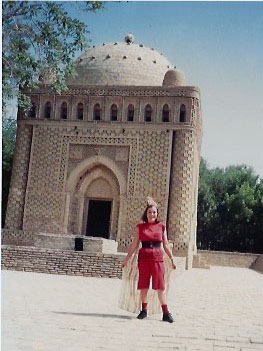
A speech given in honor of Vaughan Murzursky’s retirement from Porter-Gaud School
Over the years, I’ve had the honor to deliver several of these sending-off speeches for some masterful teachers – the late Tom Evatt, Erica Lesesne, Sue Chanson, Ed Burrows, Natalie Herford. But never have I faced such a daunting task as to encapsulate in under four minutes the five-FEET, two inches of gut-crunching, man-eating terror that is Paula Vaughan Mazursky.
“The Czarina.”
Where to begin?
How about Barnwell, South Carolina, Vaughan’s hometown?
Besides Vaughan, Barnwell has produced more than its share of notable South Carolinians, including, in the political realm, Edgar Brown and Solomon Blatt. However, undisputedly, Barnwell’s most famous native son is James Brown, the Godfather of Soul, the hardest working man in showbiz, or perhaps, nowadays, the hardest working penitent in Purgatory.
Of course, the Godfather was 13 years older than Vaughan, and Barnwell’s schools were segregated in their day, but what an exciting concept to think of them as contemporaries, the Godfather and the Czarina, in an integrated high school, perhaps as chemistry lab partners – if I may quote the Godfather – [holler] – what an explosive combination that would have been!
For, like James Brown, Vaughan Mazursky has Soul, soul with a capital S, which may be the most remarkable trait of this very remarkable, unforgettable woman. I don’t mean to diminish Vaughan’s stellar intelligence – anyone who has had the privilege of being her friend can attest to her quickness and her formidable knowledge of geography, history, art, and politics – but it is her passion that sets her apart from all the rest of us who have taught and teach here; it is her passion that has made her the teacher that former students first ask about when we bump into them years later, the teacher whom they never ever forget.
Add to her intelligence, her passion, and her learnedness – spontaneity – a joie de vivre that might spur her to jump upon a coffee table in the old teacher’s lounge to belt out Marvin Gay’s “A Stubborn Kind of Fellow” or to scream the Georgian word for freedom right in front of a Soviet tank in occupied Tbilisi or to raise both arms in triumphant joy at an Obama rally at the Cistern, an image that appeared internationally in various media (though as a subject of a National Enquirer article, Vaughan is no stranger to the limelight). Absolutely, Vaughan lives her life to the fullest.
Damn the cruise missiles, full speed ahead!
She was a demanding teacher, which endeared her to wise parents, not so much to materialists. Whenever I hear of that proverbial subliterate high school student from No-wheres-ville, USA who points to the Indian Ocean when asked to locate Alaska on a globe, I think of my two sons pouring over maps of godforsaken sub-Saharan countries, labeling rivers and mountain ranges, or strutting around the house doing the Wagga-do-do dance (which, by the way, Vaughan, I have spelled in this speech W-a-g-g-a-d-o-d-o).
O, my brothers and sisters, I have faced the fearsome wrath of MaZoo. In ’89 before I accompanied her and 21 students on a 28-day trip to the Soviet Union, a trek that took us from Leningrad to Moscow to Siberia back through Tashkent, Alma-Ata, Samarkand, and Tbilisi, I had to prove my worthiness by taking geographical tests along with the students on every so-called Republic we passed through. I, too, had to memorize the names of transliterated towns, rivers, lakes, and mountains and spell the transliterations correctly. Let’s say on the first couple of quizzes I didn’t meet the Czarina’s high expectations, but soon learned that she was serious. She wasn’t going to take along to a foreign land anyone not competently aware of the history and topography of his destination.
The good ol’ Evil Empire has been in history’s dustbin for two decades, so many of you may not know that Vaughan taught a senior course in Soviet history back in the day, a course that attracted the very brightest of our students, the de facto AP history course for seniors back when there wasn’t an AP history course for seniors.
It is, I think, the mark of a great teacher that she can effectively teach a wide range of grades. Here, the Czarina reigned supreme – She taught 8th graders geography, current affairs – and had them watch heart-throb ABC news anchor Peter Jennings every Monday thru Thursday – all the while below the radar teaching them organizational and study skills. Meanwhile, in the Upper School, she was having students grapple with the forces that led to the Russian Revolution, the complexities of the emerging Soviet State, the nuts and bolts of economics.
[Sigh] There’s so much more to say – I should talk about her trailblazing as one of the first female teachers in this school – I should talk about the devotion that the very best graduates we’ve produced hold for her, people like George Kent, Paul O’Brien, Blakely Blackford, and Alex Werrell, but I’m nearing the end of page two, which is my self-imposed limit.
* * *
In closing, as I stand here recalling the history of a great history teacher, I would like to mention a name from the past, Berkeley Grimball, who hired Vaughan and me and a handful of others here but without whom none of the rest of you would be here, because this institution would not exist.
By the early Sixties, Porter-Military had been reduced to a school for troublesome boys, and the Gaud School, though excellent in academics, subsisted in dingy, threadbare rooms, in a sort of Dickensian shabbiness.
It was Berkeley Grimball who had the vision to unite the spirituality of Dr. Porter and the academic rigor of Mr. Gaud to create this hyphenated school, and when the three schools merged in 1965 – at the height of Civil Rights Unrest – Porter-Gaud offered enrollment to anyone who qualified, white, black, or yellow, Muslim, Jew, atheist, or Hindu – a liberality of which we all can all be proud, a liberality that Vaughan Mazursky has always proudly embraced.
As we old folks disappear, we are fairly soon mostly forgotten. That is the way of the world.
However, Vaughan, you, for sure, have attained legendary status and your legacy will be remembered and cherished for decades as you remain a part of those students’ lives you have enriched – as you have enriched those of us who have taught with you – and I hope you’ll continue to enrich us, your friends, at parties and taverns and non-violent demonstrations.
Let me tell you, Vaughan, you are revered.
 You Do Hoodoo